The interstellar object 3I/ATLAS is alien technology being hidden by space agencies
By Colin PetersonJuly 12, 2026
Where the evidence lands →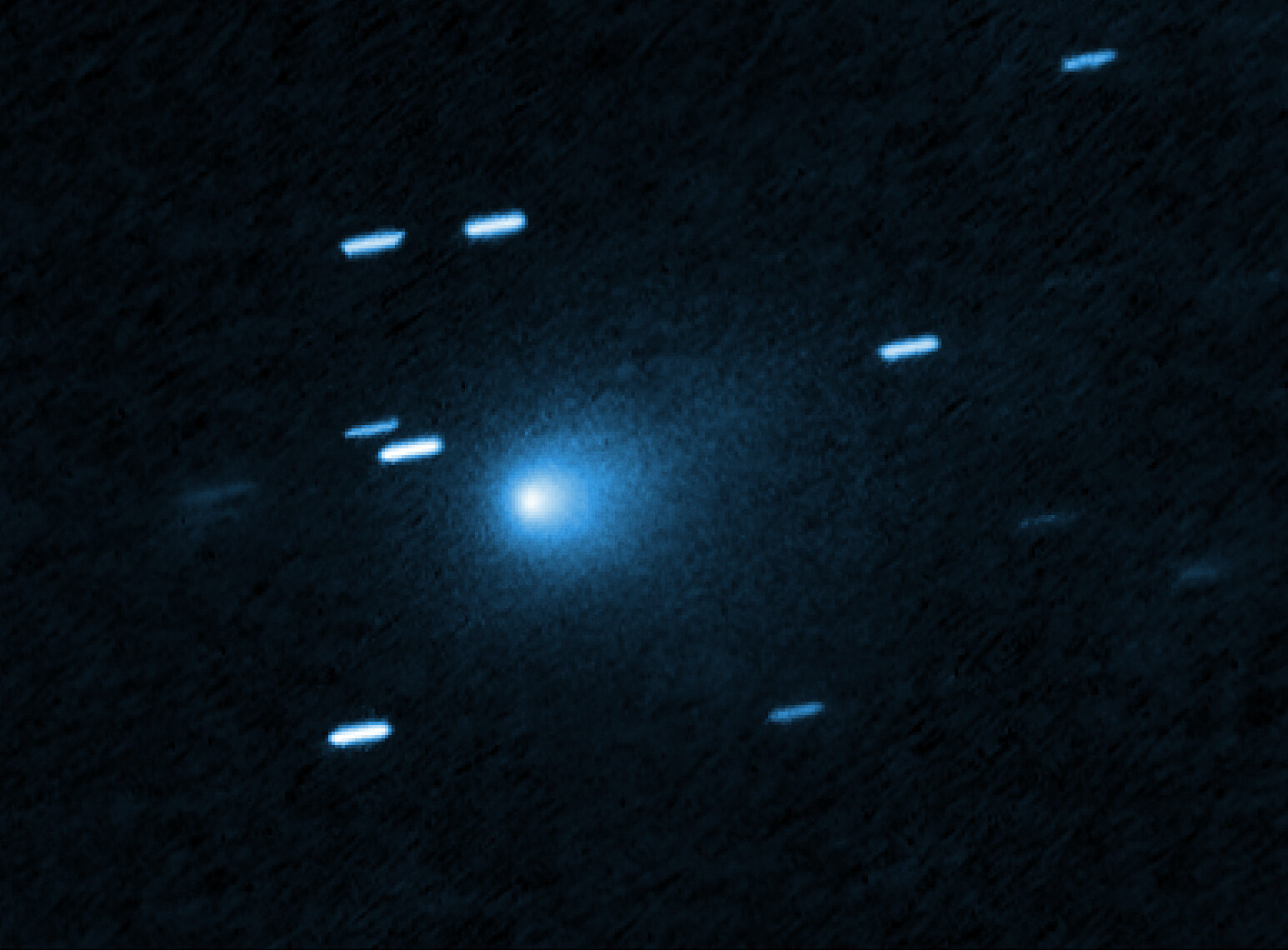
That 3I/ATLAS, the interstellar object discovered on 1 July 2025, is not a natural comet but an artificial craft or probe of extraterrestrial origin, and that its orbital geometry and behavior are technosignatures rather than the results of ordinary physics; and, in the theory's stronger online form, that NASA, ESA and other agencies have observed evidence of its artificial nature and are concealing it from the public.
3I/ATLAS is a real, confirmed interstellar object, and the overwhelming evidence is that it is a natural comet: it has a dust coma, it outgasses, and radio searches found no signal. The claim that it is alien technology is a minority hypothesis, framed by its main proponent as a long shot worth testing rather than a finding, and nothing observed so far supports it.
Believed by: a vocal online minority; raised as a low-probability, testable hypothesis by Harvard astrophysicist Avi Loeb
A study published in Nature on 22 June 2026 (Cordiner et al., NASA Goddard), using the James Webb Space Telescope, reported that 3I/ATLAS is releasing methane at roughly 11 times the level of any Solar System comet previously measured, which scientists interpret as ordinary thermal outgassing from an ancient object that likely formed billions of years before the Sun. The chemistry is a natural-comet result, but social-media posts seized on the findings to revive Avi Loeb-style claims that the object is an 'alien mothership,' a framing the outgassing data does not support. source →
The full story
The third visitor from somewhere else
On 1 July 2025, a survey telescope in the Chilean Andes flagged a fast-moving point of light. The instrument belonged to ATLAS, the NASA-funded Asteroid Terrestrial-impact Last Alert System, a network built to catch rocks that might hit Earth. Within a day, analysts at the International Astronomical Union's Minor Planet Center had done the geometry and reached a rare conclusion: this object was not orbiting the Sun at all. It was passing through, on a path bent too sharply and moving too fast, roughly 58 kilometres per second, to be held by the Sun's gravity. Traced backward, its track led out of the Solar System entirely.
The Minor Planet Center gave it the designation 3I/ATLAS, the “3I” marking it as the third confirmed interstellar object ever found, and the alternate cometary name C/2025 N1. It followed 1I/ʻOumuamua, the strange, tailless sliver that passed in 2017, and 2I/Borisov, an unmistakable comet seen in 2019. Archival images pulled from other ATLAS telescopes and from Caltech's Zwicky Transient Facility soon extended its observed track back to mid-June, sharpening the orbit and confirming beyond reasonable doubt that humanity was watching a piece of another star system fall through its own.
None of that is fringe. It is the settled, published, agreed-upon core of the story, and it is genuinely remarkable on its own terms. The disagreement is about one further step: what, exactly, the object is.
The case for looking twice
The most prominent voice asking whether 3I/ATLAS might be more than a comet is Avi Loeb, a Harvard astrophysicist and former chair of the university's astronomy department. In July 2025 he and two colleagues, Adam Hibberd and Adam Crowl, posted a preprint with a deliberately provocative title: Is the Interstellar Object 3I/ATLAS Alien Technology? It is worth stating clearly what that paper does and does not say, because the honest version of the argument is more careful than its viral summaries.
Loeb's case rests on a set of orbital coincidences. The object's path lies unusually close to the plane in which the planets orbit, it travels retrograde (against the planets' direction), and it happens to pass relatively close to Venus, Mars and Jupiter on its way through. Taken together, Loeb argues, these features are improbable enough to be worth flagging, and the responsible scientific move is to state in advance what observations would distinguish a natural body from an engineered one: an anomalous non-gravitational acceleration not explained by outgassing, say, or a shape or brightness pattern no comet should have.
This is, at its best, a defense of scientific humility rather than a claim of contact. Loeb has made the same argument about 1I/ʻOumuamua for years: that dismissing the artificial hypothesis without testing it is a failure of curiosity, not a triumph of rigor. In the 3I/ATLAS preprint itself, he and his co-authors are explicit that the most likely explanation is a natural comet, and he has repeated in interviews that he considers the artificial scenario a long shot. The value, on this telling, is not the answer but the discipline of asking, and of pointing real instruments at the object while it is briefly within reach.
The responsible version of the question is not “this is a spacecraft,” but “here is what we would see if it were, so let us look before it leaves and we lose the chance forever.”
What the telescopes actually saw
The trouble for the artificial hypothesis is that, as the observations came in, 3I/ATLAS kept behaving like a comet. Within weeks of discovery, telescopes recorded a coma, the diffuse cloud of dust and gas that forms when a comet's ices warm and vaporize, and later a tail. On 21 July 2025, the Hubble Space Telescope imaged a teardrop of dust streaming off the solid nucleus. Whatever else it was, this object was actively shedding material into space, which is precisely what natural comets do and what a manufactured hull has no reason to.
The decisive look came from the James Webb Space Telescope. In August 2025, its near-infrared spectrograph dissected the light from the coma and read off its chemistry: a composition unusually rich in carbon dioxide, together with water, carbon monoxide and carbonyl sulfide. The team estimated the nucleus was venting on the order of a hundred kilograms of CO2 every second. That mixture is chemically distinctive, a clue to where in some distant planetary system the object formed, but it is the spectrum of ancient ice, not of an engine or an alloy. Any tiny deviation between the object's predicted and observed path, the kind of thing Loeb had flagged as a test, is exactly the gentle push that outgassing gives every active comet.
The contrast with 1I/ʻOumuamua is instructive. That earlier visitor showed no visible coma and an acceleration that was hard to explain, which is what left room for genuine argument. 3I/ATLAS removed that room by wearing its cometary nature openly. When Breakthrough Listen pointed the Green Bank Telescope at it across a wide swath of radio frequencies during its close approach, listening for the narrowband transmissions a technology might leak, it found nothing: no credible narrowband technosignature. The object was scrutinized in visible light, infrared, radio and even X-rays, and at every wavelength it looked like nature.
As for the orbital coincidences: astronomers point out that a body drawn at random from the galaxy's vast population of stars and debris will, given enough measured quantities, show some alignment or close pass that looks striking in isolation. Flag enough features after the fact and improbability is easy to manufacture. The near-ecliptic, retrograde path is well within what natural interstellar objects can do; it is a reason to measure carefully, not a signature of intent.
A comet, not a spacecraft
Split the claim in two and the verdict comes into focus. That 3I/ATLAS is a real interstellar object, the third ever confirmed, on an unbound hyperbolic path, showing a coma and outgassing, reaching perihelion just inside the orbit of Mars in late October 2025 and passing Earth at a safe distance in December: all of that is documented and settled. It is a genuine, once-in-a- generation object of study.
That it is alien technology, or that its artificial nature is being concealed, is a different matter. The artificial hypothesis is not a fabrication; in its careful form it is a testable proposition that a serious scientist put forward with the odds stated plainly against it. But every test run so far has come back cometary: the spectra, the coma, the tail, the silent radio search. The cover-up version, meanwhile, is contradicted by the steady public flow of data from multiple independent agencies in multiple countries.
The fair summary is the one the scientists themselves offer. It is worth asking whether an interstellar visitor is more than it appears, because we cannot rule such a thing out in advance and the object will soon be gone. Having asked, and looked, and measured, the answer for 3I/ATLAS is that it appears to be a comet from another star: strange, ancient, chemically distinctive, and entirely natural, as far as anyone can yet tell.
What's still unexplained
- Why 3I/ATLAS is chemically unusual, with a coma so rich in carbon dioxide relative to water, is a real scientific question. The likeliest answers involve where and how it formed around its parent star and how long it drifted through interstellar space, possibly for billions of years, but the specifics are still being worked out and are a legitimate subject of ongoing study, not evidence of engineering.
- How large the nucleus actually is remains uncertain, because the surrounding coma makes the solid body hard to measure directly. Early estimates ranged widely, and a firmer size matters for questions about how much material the object is shedding; it does not, by itself, decide anything about origin.
- Whether the small non-gravitational changes in its path are fully accounted for by ordinary cometary outgassing, as expected, or leave any residual that needs explaining is the kind of detail astronomers will refine as more observations are reduced. On the evidence so far, outgassing suffices, but the final orbital analysis is the sort of thing that gets published after the object has receded.
- Whether any future interstellar object will ever show a feature that genuinely resists natural explanation is unresolved in principle. The honest scientific position, including Loeb's stated one, is that technosignatures are worth checking for precisely because we cannot rule them out in advance; that openness is not the same as evidence that 3I/ATLAS is one.
Point by point
The claim: 3I/ATLAS is a genuine, first-of-its-kind interstellar object, not something ordinary being sensationalized.
What the record shows: True, and this part is not in dispute. Its orbit is measurably hyperbolic and unbound; traced backward, it plainly comes from outside the Solar System and will leave and never return. It is the third such object confirmed, after 1I/ʻOumuamua (2017) and 2I/Borisov (2019). That it is real and interstellar is exactly why serious observatories, from Hubble and Webb to Mars orbiters, trained instruments on it. The rarity is real; the leap is from 'rare natural object' to 'built by someone.'
The claim: Its trajectory and timing are too neatly arranged to be a coincidence, which points to intelligent design.
What the record shows: This is the heart of Loeb's technosignature argument: the orbit lies close to the plane of the planets, is retrograde, and brings the object relatively close to Venus, Mars and Jupiter. Presented as a testable oddity, that is fair. But astronomers note these features are unremarkable for a body drawn from the galaxy's general population of stars and debris, and that with enough measured quantities (inclination, timing, closest approaches) some alignment can always be found after the fact. The coincidences are the reason to look closer, not evidence of a builder.
The claim: The object behaves in ways a natural comet cannot, so its activity must be technological.
What the record shows: The observed behavior is, in fact, strongly cometary. Hubble and ground-based telescopes recorded a dust coma and tail; the James Webb Space Telescope's spectra showed a coma rich in carbon dioxide with water, carbon monoxide and carbonyl sulfide, and estimated the nucleus was shedding on the order of a hundred kilograms of CO2 per second. Any slight non-gravitational nudge to its path is what outgassing does to comets routinely. Unlike 1I/ʻOumuamua, which showed no visible coma and fueled its own debate, 3I/ATLAS looks like a comet because it is doing the things comets do.
The claim: Agencies are hiding what they really know about 3I/ATLAS.
What the record shows: The record shows close to the opposite. NASA published a dedicated page and orbit data, the Minor Planet Center issued its circular within a day, ESA posted observations from Hubble, Webb, XMM-Newton and its Mars orbiters, and Breakthrough Listen publicly released a null result from its radio search. The images, spectra and orbital elements are openly available. A genuine cover-up would not look like a stream of press releases, preprints and downloadable data from multiple independent agencies and countries.
Timeline
- 2025-07-01A 0.5-metre telescope of the NASA-funded ATLAS (Asteroid Terrestrial-impact Last Alert System) survey at Río Hurtado, Chile, reports a fast-moving object, initially catalogued A11pl3Z, to the Minor Planet Center.
- 2025-07-02The IAU Minor Planet Center announces the object as interstellar in electronic circular MPEC 2025-N12, giving it the designation 3I/ATLAS (and the cometary name C/2025 N1). It is the third confirmed interstellar object, after 1I/ʻOumuamua in 2017 and 2I/Borisov in 2019.
- 2025-07Archival 'pre-discovery' images from other ATLAS telescopes and Caltech's Zwicky Transient Facility push the object's observed track back to 14 June 2025, tightening the orbit. The trajectory is strongly hyperbolic, with an eccentricity near 6.1 and an inbound speed of roughly 58 kilometres per second, far too fast to be bound to the Sun.
- 2025-07Telescopes detect clear cometary activity: a coma of dust and gas around a solid nucleus, and later a tail. On 21 July the Hubble Space Telescope images a teardrop-shaped cloud of dust streaming off the nucleus.
- 2025-07Avi Loeb and colleagues Adam Hibberd and Adam Crowl post an arXiv preprint, 'Is the Interstellar Object 3I/ATLAS Alien Technology?', arguing that certain orbital coincidences are worth examining as possible technosignatures while stating that the most likely explanation remains a natural comet.
- 2025-08The James Webb Space Telescope observes 3I/ATLAS with its near-infrared spectrograph, finding a coma unusually rich in carbon dioxide alongside water, carbon monoxide and other gases: a chemically distinctive but recognizably cometary makeup.
- 2025-10-303I/ATLAS reaches perihelion, its closest point to the Sun, at about 1.36 astronomical units, just inside the orbit of Mars. It never comes near Earth and poses no threat.
- 2025-12The object makes its closest approach to Earth on 19 December, a safe 1.8 astronomical units away, and continues outbound. Breakthrough Listen reports that a radio search with the Green Bank Telescope found no narrowband technosignatures.
From the case file
The actual records: declassified, released, or leaked. We link straight to each document in its official archive, so you never have to take our word for it. Read the originals yourself.
MPEC 2025-N12: 3I/ATLAS = C/2025 N1 (ATLAS)
The official electronic circular in which the Minor Planet Center announces the object as interstellar and assigns the designation 3I/ATLAS, the third confirmed interstellar object. The primary record establishing what the object is.
Read the document: IAU Minor Planet Center →Comet 3I/ATLAS
NASA's public information page on 3I/ATLAS, with orbital data, imagery and the agency's plain statement that it is a natural interstellar comet reaching perihelion just inside the orbit of Mars, posing no threat to Earth.
Read the document: NASA Science →Discovery and Preliminary Characterization of a Third Interstellar Object: 3I/ATLAS
The discovery and characterization preprint documenting the hyperbolic orbit and early cometary activity: the scientific record for the object's natural, cometary nature.
Read the document: arXiv →Is the Interstellar Object 3I/ATLAS Alien Technology?
The preprint that lays out the artificial-origin hypothesis as a testable exercise. Included as the primary basis of the claim; note that the paper itself states a natural comet is the most likely explanation.
Read the document: arXiv →ESA observations of interstellar Comet 3I/ATLAS
ESA's public account of its observations of 3I/ATLAS across space telescopes and Mars orbiters: openly published data that undercuts the claim of a concealed, agency-level cover-up.
Read the document: European Space Agency →Other case files that cite the same sources
3I/ATLAS is a real, confirmed interstellar object, and the overwhelming evidence is that it is a natural comet: it has a dust coma, it outgasses, and radio searches found no signal. The claim that it is alien technology is a minority hypothesis, framed by its main proponent as a long shot worth testing rather than a finding, and nothing observed so far supports it.
Reviewed by Colin Peterson · Last reviewed July 18, 2026 · How we rate
Common questions
Is 3I/ATLAS true?
3I/ATLAS is a real, confirmed interstellar object, and the overwhelming evidence is that it is a natural comet: it has a dust coma, it outgasses, and radio searches found no signal. The claim that it is alien technology is a minority hypothesis, framed by its main proponent as a long shot worth testing rather than a finding, and nothing observed so far supports it.
What is 3I/ATLAS?
In July 2025 astronomers confirmed the third known visitor from beyond our Solar System, an object on an unbound path that will never return. Most of the field sees an ordinary, if ancient, comet. A smaller current of speculation, amplified online and given intellectual cover by one prominent Harvard astrophysicist, asks whether it might…
What does the evidence show?
True, and this part is not in dispute. Its orbit is measurably hyperbolic and unbound; traced backward, it plainly comes from outside the Solar System and will leave and never return. It is the third such object confirmed, after 1I/ʻOumuamua (2017) and 2I/Borisov (2019). That it is real and interstellar is exactly why serious observatori…
Why do people believe it?
It is genuinely, verifiably extraordinary: a real object from another star system, moving through our own for a matter of months and never to return. That true rarity primes people to expect an extraordinary explanation, and 'alien craft' is the most extraordinary one available.
What is still unresolved?
Why 3I/ATLAS is chemically unusual, with a coma so rich in carbon dioxide relative to water, is a real scientific question. The likeliest answers involve where and how it formed around its parent star and how long it drifted through interstellar space, possibly for billions of years, but the specifics are still being worked out and are a…
Sources
- 1.Comet 3I/ATLAS, NASA Science (2025)
- 2.NASA Discovers Interstellar Comet Moving Through Solar System, NASA Science (Planetary Defense blog) (2025)
- 3.MPEC 2025-N12: 3I/ATLAS = C/2025 N1 (ATLAS), IAU Minor Planet Center (2025)
- 4.Discovery and Preliminary Characterization of a Third Interstellar Object: 3I/ATLAS, D. Seligman et al., arXiv preprint 2507.02757 (2025)
- 5.Is the Interstellar Object 3I/ATLAS Alien Technology?, A. Loeb, A. Hibberd & A. Crowl, arXiv preprint 2507.12213 (2025)
- 6.ESA observations of interstellar Comet 3I/ATLAS, European Space Agency (2025)
- 7.Comet 3I/ATLAS: frequently asked questions, European Space Agency (2025)
- 8.Breakthrough Listen observations of interstellar object 3I/ATLAS, SETI Institute (2026)
- 9.Temporal evolution of the third interstellar comet 3I/ATLAS: Spin, color, spectra, and dust activity, Astronomy & Astrophysics (2025)
- 10.3I/ATLAS, Wikipedia
Embed this case file on your site
Paste this snippet to show this case file as a small card, with a link back to the full write-up. Free to use.
<iframe src="https://theconspiratory.com/embed/3i-atlas" title="The Conspiratory verdict" width="520" height="190" style="border:0;max-width:100%" loading="lazy"></iframe>Help us investigate
This is a living case file. If you spot an error or know evidence we missed, tell us, and weigh in on where you land.
Where do you land?
Cast your read on this one.
Comments
Add your take. Comments are read and approved by a human before they appear, so keep it on topic and civil. Please do not accuse named, living people of crimes.