The FBI blamed the 2001 anthrax attacks on the wrong man, and the true origin is being obscured
By Colin PetersonJuly 12, 2026
Where the evidence lands →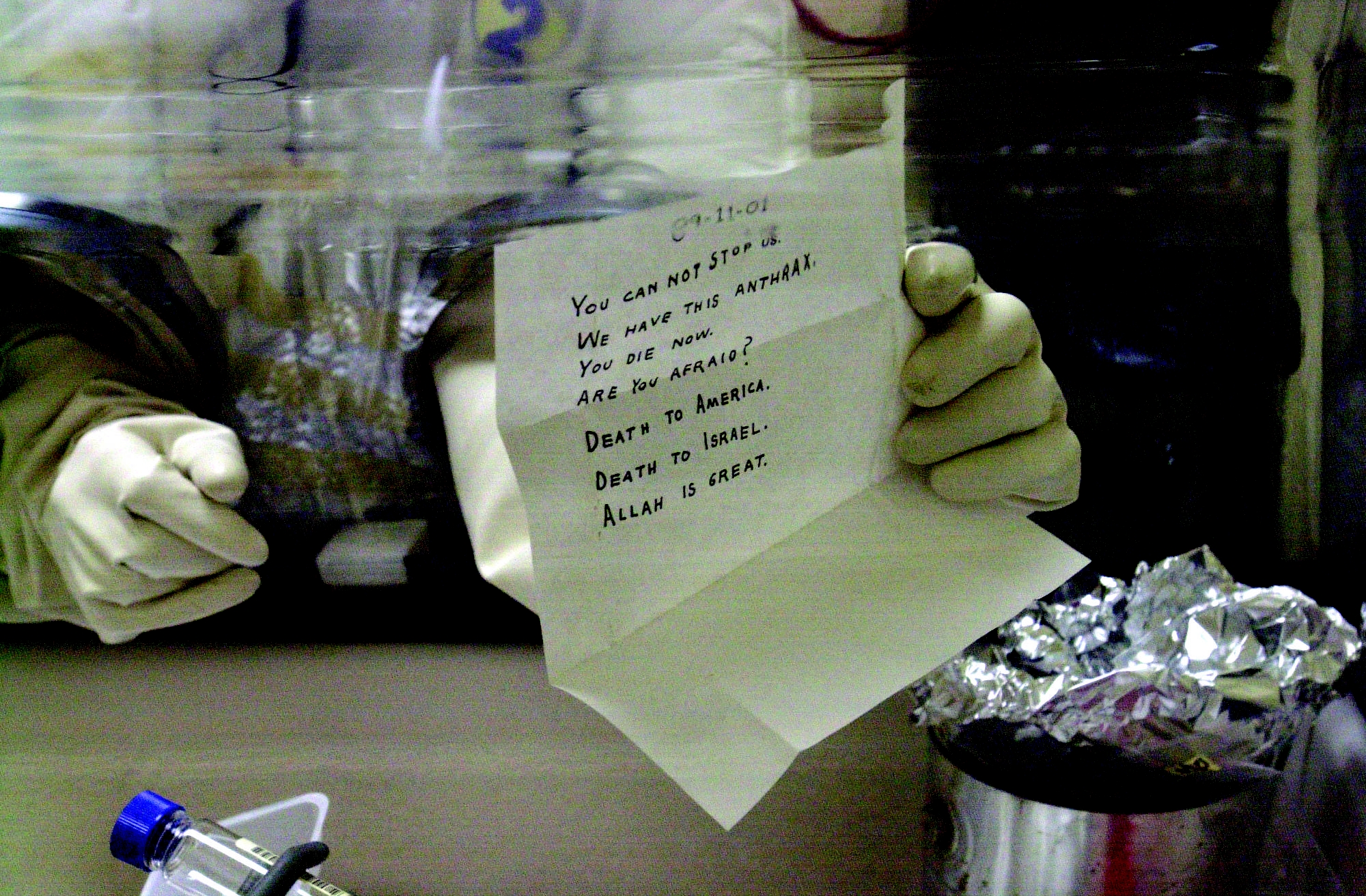
That the FBI's Amerithrax investigation reached the wrong conclusion, or an unproven one, when it named Dr. Bruce Ivins as the lone author of the 2001 anthrax letters, and that the genetic and circumstantial case against him is too weak to be certain, so the real origin of the attack material may lie elsewhere and is being obscured.
The letters and the five deaths are real, and the FBI concluded that Army biodefense researcher Dr. Bruce Ivins was the sole perpetrator. But Ivins died in 2008 before he was ever charged or tried, and the 2011 National Academy of Sciences review found that the scientific evidence did not definitively link the attack spores to his flask, leaving the sole-perpetrator conclusion genuinely contested.
Believed by: There is no reliable polling on this belief, but the doubt is unusually mainstream. A joint 2011 investigation by PBS Frontline, ProPublica and McClatchy, members of Congress, a National Academy of Sciences panel, and a number of Ivins's own former colleagues at Fort Detrick have all publicly questioned whether the FBI proved its case.
The full story
The letters, and the dead
The facts of the attack itself are not in dispute, and they are grim. Beginning in mid-September 2001, in the raw weeks after the September 11 attacks, letters filled with powdered Bacillus anthracis, the bacterium that causes anthrax, passed through the US mail. The first wave, postmarked in Trenton, New Jersey on 18 September, went to newsrooms, including NBC anchor Tom Brokaw and the New York Post, and to a tabloid publisher in Florida. A second wave, postmarked 9 October, was addressed to two US senators, Tom Daschle and Patrick Leahy, and carried a far more refined and dangerous powder.
Five people died. Robert Stevens, a photo editor in Florida, was the first, on 5 October 2001, the first US death from inhalation anthrax in a generation. Two Washington postal workers, Thomas Morris Jr. and Joseph Curseen, died after spores leaked from the letters passing through their sorting facility. So did Kathy Nguyen, a New York hospital worker, and Ottilie Lundgren, a 94-year-old woman in Connecticut, neither of whom has ever been convincingly linked to a specific letter. Seventeen more people were infected and survived. The powder was identified as the Ames strain, a laboratory strain of anthrax used in American biodefense research, which pointed the investigation, from early on, inward toward the government's own facilities.
What followed was the largest and most complex investigation in FBI history, code-named Amerithrax. It ran for the better part of a decade. It produced two very different suspects, one settlement, one death, and a formal conclusion that a great many serious people still do not accept.
The case that was never tested
Start with what should trouble even a cautious reader: the accused was never charged, and he was already dead when he was named. Dr. Bruce Ivins, a biodefense microbiologist at the Army's USAMRIID laboratory at Fort Detrick, died on 29 July 2008 of an apparent overdose, days after learning charges were coming. A week later, prosecutors held a press conference to announce that he had been the sole perpetrator all along. There was no arrest, no indictment tested in court, no cross-examination, and no defense. The strongest safeguard against a mistaken accusation, a trial, never took place.
Then there is the science, which the FBI itself submitted for outside review. In 2008 the Bureau asked the National Academy of Sciencesto examine the technical case, presumably expecting validation. What it got, in the Academy's February 2011report, was a careful refusal to go as far as the FBI had. The reviewers accepted that the anthrax was the Ames strain and that four genetic mutations found in the letters also appeared in Ivins's flask, known as RMR-1029. But they concluded that this established an association, not proof of origin: the evidence, they wrote, “did not definitively demonstrate” that the mailed spores were grown from that flask, and it was “not possible to reach a definitive conclusion about the origins” of the material from the science alone.
The FBI asked the National Academy of Sciences to certify its science, and the Academy declined to say the evidence pointed conclusively at Ivins's flask.
The flask was not a private object, either. RMR-1029 and its genetic markers had been shared with other institutions, and by the FBI's own account something like a hundred people had some form of access to the material or its descendants. The genetics could narrow the field to that shared lineage; they could not, the Academy found, pick one man out of it. A later Government Accountability Officereview in 2014 added that the validation and statistical methods behind the genetic tests “could be improved,” and that the FBI had lacked a consistent framework across the contractors who developed them.
And the technical objections did not stop at genetics. The powder in the Senate letters was strikingly pure and fine, and independent scientists have long argued that producing it in that quantity and quality, without leaving a trace, would have been very hard for one researcher working alone with the equipment Ivins had. That is a claim the official account never fully put to rest.
What the FBI actually assembled
The doubts are real, but so is the case the FBI built, and honesty requires laying it out rather than waving it away. The Bureau did not pick Ivins at random. Its 2010 Investigative Summary assembled a dense circumstantial narrative, and taken together it is not trivial.
The spine of it was the flask. Years of genetic work traced the distinctive mutations in the attack powder to RMR-1029, a specific preparation of Ames-strain anthrax that Ivins had created and controlled at USAMRIID. From there the investigators layered on behavior: Ivins had logged an unusual pattern of late-night, solo hours in the high-containment lab in the weeks immediately before each mailing, hours that departed sharply from his normal routine and that he could not, in the FBI's view, adequately explain. When first asked for a sample of his anthrax for the genetic database, he submitted material that the Bureau said did not properly represent his flask, which prosecutors read as an attempt to throw them off; his defenders read it as a paperwork failure, and later releases showed the picture was messier than first presented.
The FBI also pointed to Ivins's documented and serious mental-health struggles, including threatening statements and a history that a panel of forensic psychiatrists, reviewing his sealed records after his death, concluded was consistent with someone capable of the act. Prosecutors noted his professional stake in anthrax vaccine work at a moment when that program was faltering, offering a possible motive, and his connections to the geography of the mailings. None of these facts, on its own, was conclusive. The FBI's argument was that the accumulation, the flask, the hours, the sample, the psychology, the motive, pointed to one man.
It is worth stating plainly what this evidence is and is not. It is a serious, multi-strand circumstantial case that persuaded the career investigators who built it. It is not a courtroom verdict, and it was not certified as conclusive by the outside scientists the FBI itself invited to check it. Both of those things are true at once, and the disciplined reading holds them together rather than collapsing into either the Bureau's certainty or a flat rejection of it.
Why the doubt took hold and stayed
The reason this case did not close in the public mind when the FBI closed the file is that the investigation had already, visibly, been wrong once. Before Ivins there was Steven Hatfill, another former Army scientist, whom the Attorney General called a “person of interest” on television in 2002. Hatfill was never charged with anything. He was trailed by agents in the open, named again and again in the press, and had his life dismantled on suspicion. And he was innocent. The government exonerated him and, in 2008, paid roughly $5.8 millionto settle his lawsuit over the leaks about him. Anyone who watched that happen had a rational basis to distrust the Bureau's next confident announcement, and the next suspect could not benefit from the presumption the first one had been denied.
The subject matter did the rest. Anthrax grown in a US military laboratory, mailed to senators and anchors in the traumatized weeks after 9/11, touches every nerve at once: bioterror, the government's own weapons work, the intelligence failures of that autumn, and the sense that powerful institutions do not tell the whole truth about their own programs. A lone, troubled scientist is a psychologically thin ending for a story that large. A hidden origin, by contrast, matches the scale of the fear.
What kept the doubt respectable, rather than fringe, was that credentialed people shared it out loud. Microbiologists who had worked beside Ivins said publicly they did not believe he had done it. A sustained 2011 investigation by PBS Frontline, ProPublica, and McClatchy, working through the released files, found gaps and contradictions in the government's account, and reported that even some of the FBI's own scientific consultants wondered whether the real perpetrator was still at large. When the dissent comes from inside the field and from mainstream newsrooms, it does not read as paranoia. It reads as an open question.
A lone scientist, unproven to a jury
The careful verdict has to hold two things without letting go of either. The FBI conducted an enormous investigation and concluded, on a substantial circumstantial record, that Bruce Ivins acted alone. And that conclusion has never been proven to the standard a criminal case demands, was not certified as scientifically conclusive by the National Academy of Sciences, and was reached about a man who died before he could answer it. That is why this file rates the claim disputed, not debunked and not confirmed.
What is documented is not in question: the letters, the five deaths, the seventeen infections, the Ames strain, the shared flask RMR-1029, the FBI's formal sole-perpetrator finding, and the Academy's later refusal to call the science definitive. What is genuinely unresolved is whether the FBI reached the right answer, or a provable one. This file makes no finding that Ivins was innocent and none that he was guilty; he was never charged, tried, or convicted, and it would be wrong to write as if he had been.
One point of fact, though, is not disputed at all, and it anchors everything else. The investigation publicly targeted Steven Hatfill, and Steven Hatfill was innocent, cleared and compensated by the government that had pursued him. That established error is the reason a reasonable person can decline to simply trust the Bureau's second conclusion, and it is the reason the honest label here is an open dispute rather than a closed case.
What's still unexplained
- How many people could actually have drawn on flask RMR-1029 and its genetic markers? The FBI narrowed a pool that reportedly included roughly a hundred people with some access, but the National Academy of Sciences found the science could not by itself single out Ivins from everyone who could reach the shared material, and the full boundaries of that pool have never been publicly resolved.
- How was the powder in the Senate letters actually produced, and where? The refined quality of that material, and the question of whether it lay within the practical reach of one researcher using USAMRIID equipment without detection, was left unresolved by the Academy's review and is still argued among specialists.
- Did the earlier, wrongful focus on Steven Hatfill distort the investigation? Years of certainty about the wrong man, followed by a pivot to Ivins, raises the unanswered question of how much investigative momentum and public messaging shaped the final conclusion rather than following cleanly from the evidence.
- Would the case have survived a trial? Because Ivins died before charges, no court ever tested the circumstantial chain, cross-examined the FBI's scientists, or heard a defense, so whether the sole-perpetrator conclusion would have persuaded a jury remains, permanently, a matter of speculation.
Point by point
The claim: The FBI's science definitively tied the anthrax in the letters to the specific flask in Ivins's lab, so the origin is settled.
What the record shows: This is the load-bearing claim, and it is the one the National Academy of Sciences would not endorse. The Academy's 2011 review agreed the powder was the Ames strain and that four genetic mutations, or 'morphs', found in the letters were also present in Ivins's flask RMR-1029, which established a genuine association. But it concluded that the data 'did not definitively demonstrate' that the spores were grown from that flask, and that 'it is not possible to reach a definitive conclusion about the origins' of the anthrax from the science alone. RMR-1029 was not unique to Ivins: material from it, and the morphs it carried, had been shared with other laboratories and could be accessed by a large number of people, which the science could not narrow down.
The claim: Ivins was proven guilty of the attacks.
What the record shows: He was not, in the legal sense, and this file will not say otherwise. Ivins was never charged, never tried, and never convicted; he died before prosecutors filed a case, so no jury ever weighed the evidence and no defense was ever mounted. What exists is the FBI's investigative conclusion that he was the sole perpetrator, built on circumstantial elements: his access to RMR-1029, unusual late-night hours alone in his lab in the weeks before the mailings, an allegedly misleading anthrax sample he submitted, and a documented history of mental-health difficulties. That conclusion is the FBI's, and it has been contested by the National Academy of Sciences, by some of the government's own scientific consultants, and by colleagues at Fort Detrick.
The claim: Even setting Ivins aside, the FBI has a demonstrated record in this very case of publicly targeting an innocent man.
What the record shows: This is documented and it matters. Before Ivins, the investigation focused for years on Dr. Steven Hatfill, whom the Attorney General publicly labeled a 'person of interest' in 2002. Hatfill was never charged with anything. He was placed under overt surveillance, named relentlessly in the press, and ultimately cleared and formally exonerated. In 2008 the government paid him roughly $5.8 million (a $2.825 million cash payment plus an annuity) to settle his Privacy Act suit over leaks about him, though it admitted no liability. That the same investigation had earlier been so confident about a man it later exonerated is, fairly, a reason to scrutinize its later confidence rather than take it on faith.
The claim: The letter powder was too refined and sophisticated for one scientist to have made alone, pointing to a state-level program rather than a lone Army researcher.
What the record shows: This is genuinely disputed rather than settled either way. The Senate letters contained an unusually pure, finely milled powder, and early reports of a silicon signature fueled speculation that it had been deliberately 'weaponized', which would imply resources beyond one man at a bench. The FBI's later analysis, supported by outside laboratories, concluded the silicon was naturally incorporated during growth and not an added coating, and that the material was within the reach of a skilled insider. But independent scientists have continued to argue that producing that quantity and quality of spores would have been difficult to do undetected with the equipment Ivins had, and the National Academy panel noted the FBI did not fully resolve how the powder was made. Neither a lone-actor nor an outside-origin account is scientifically closed.
Timeline
- 2001-09-18The first wave of letters is postmarked in Trenton, New Jersey and mailed to news organizations, including NBC News anchor Tom Brokaw and the New York Post, and to American Media Inc. in Florida. The powder inside is later identified as the Ames strain of Bacillus anthracis.
- 2001-10-05Robert Stevens, a photo editor at American Media in Boca Raton, dies of inhalation anthrax, the first such death in the United States in a quarter century. Over the following weeks four more people die: two Washington postal workers, Thomas Morris Jr. and Joseph Curseen; a New York City hospital worker, Kathy Nguyen; and Ottilie Lundgren, a 94-year-old woman in Connecticut. Seventeen others are infected and survive.
- 2001-10-09A second wave, postmarked the same day, is sent to US Senators Tom Daschle and Patrick Leahy. These letters carry a more refined, highly concentrated powder and force the closure of Senate office buildings and mail facilities.
- 2002-08Attorney General John Ashcroft publicly calls former Army researcher Steven Hatfill a “person of interest.” Hatfill, never charged, is placed under open surveillance and named repeatedly in the press. He maintains his innocence and is eventually cleared entirely.
- 2008-06-27The Justice Department agrees to pay Hatfill roughly $5.8 million to settle his lawsuit alleging that officials leaked information about him in violation of the Privacy Act. The government later formally exonerates him of any involvement in the attacks.
- 2008-07-29Dr. Bruce Ivins, a microbiologist at the US Army Medical Research Institute of Infectious Diseases (USAMRIID) at Fort Detrick, dies of an apparent overdose of acetaminophen, days after learning that prosecutors were preparing to charge him. He is never charged, tried, or convicted.
- 2008-08-06At a press conference, Justice Department and FBI officials name Ivins as the sole perpetrator, resting the case in large part on a flask of anthrax in his lab, designated RMR-1029, that they say was the genetic parent of the attack spores.
- 2010-02-19The Justice Department, FBI, and US Postal Inspection Service formally close the Amerithrax investigation and release a 92-page Investigative Summary laying out the circumstantial case that Ivins acted alone.
- 2011-02The National Academy of Sciences, asked by the FBI itself to review the science, concludes that the genetic evidence established an association with Ivins's flask but did not definitively prove the attack spores came from it, and that a firm origin could not be established from the available scientific evidence alone.
From the case file
The actual records: declassified, released, or leaked. We link straight to each document in its official archive, so you never have to take our word for it. Read the originals yourself.
Amerithrax Investigative Summary
The 92-page document with which the Justice Department formally closed the case, laying out the circumstantial argument that Bruce Ivins acted alone: his access to flask RMR-1029, his late-night lab hours, and the sample the FBI said he submitted to mislead investigators.
Read the document: U.S. Department of Justice →Review of the Scientific Approaches Used During the FBI's Investigation of the 2001 Anthrax Letters
The independent review the FBI itself requested. It confirmed the Ames strain and the genetic association with RMR-1029 but concluded the evidence did not definitively demonstrate that the attack spores came from Ivins's flask, and that a firm origin could not be established from the science alone.
Read the document: National Academies →Anthrax: Agency Approaches to Validation and Statistical Analyses Could Be Improved (GAO-15-80)
A congressional watchdog review finding that the genetic tests underpinning the case were generally validated but that the FBI lacked a comprehensive framework, and that the contractors did not develop adequate statistical confidence for interpreting the results.
Read the document: U.S. Government Accountability Office →Amerithrax (FBI Records: The Vault)
The FBI's own document release from the investigation, running to thousands of pages of interview reports, lab records, and internal files: the raw material from which journalists and outside scientists reconstructed, and questioned, the case against Ivins.
Read the document: FBI Vault →Transcript of Amerithrax Investigation Press Conference
The transcript of the press conference at which officials first publicly named Ivins as the sole perpetrator, a week after his death and with no charge ever filed: the moment the FBI's conclusion became public without a courtroom to test it.
Read the document: U.S. Department of Justice →Other case files that cite the same sources
The letters and the five deaths are real, and the FBI concluded that Army biodefense researcher Dr. Bruce Ivins was the sole perpetrator. But Ivins died in 2008 before he was ever charged or tried, and the 2011 National Academy of Sciences review found that the scientific evidence did not definitively link the attack spores to his flask, leaving the sole-perpetrator conclusion genuinely contested.
Reviewed by Colin Peterson · Last reviewed July 12, 2026 · How we rate
Common questions
Is Anthrax attacks true?
The letters and the five deaths are real, and the FBI concluded that Army biodefense researcher Dr. Bruce Ivins was the sole perpetrator. But Ivins died in 2008 before he was ever charged or tried, and the 2011 National Academy of Sciences review found that the scientific evidence did not definitively link the attack spores to his flask, leaving the sole-perpetrator conclusion genuinely contested.
What is Anthrax attacks?
In the weeks after 9/11, letters filled with powdered anthrax moved through the US mail, killing five people and sickening seventeen more. After the longest and most expensive investigation in its history, the FBI concluded that a single Army scientist, Dr. Bruce Ivins, had done it alone. He died of an apparent overdose in 2008, before h…
What does the evidence show?
This is the load-bearing claim, and it is the one the National Academy of Sciences would not endorse. The Academy's 2011 review agreed the powder was the Ames strain and that four genetic mutations, or 'morphs', found in the letters were also present in Ivins's flask RMR-1029, which established a genuine association. But it concluded tha…
Why do people believe it?
The central conclusion was never tested in court. Ivins died before any charge was filed, so the strongest single check on a criminal accusation, an adversarial trial, never happened. A conclusion announced at a press conference, with the accused already dead, invites the doubt that a verdict would have absorbed.
What is still unresolved?
How many people could actually have drawn on flask RMR-1029 and its genetic markers? The FBI narrowed a pool that reportedly included roughly a hundred people with some access, but the National Academy of Sciences found the science could not by itself single out Ivins from everyone who could reach the shared material, and the full bounda…
Sources
- 1.Amerithrax Investigative Summary, U.S. Department of Justice (2010)
- 2.Transcript of Amerithrax Investigation Press Conference (August 6, 2008), U.S. Department of Justice (2008)
- 3.Justice Department and FBI Announce Formal Conclusion of Investigation into 2001 Anthrax Attacks, U.S. Department of Justice (2010)
- 4.Review of the Scientific Approaches Used During the FBI's Investigation of the 2001 Anthrax Letters, National Research Council / National Academy of Sciences (2011)
- 5.Anthrax: Agency Approaches to Validation and Statistical Analyses Could Be Improved (GAO-15-80), U.S. Government Accountability Office (2014)
- 6.Amerithrax or Anthrax Investigation, Federal Bureau of Investigation (2010)
- 7.Anthrax suspect settles law suit (Steven Hatfill $5.8 million settlement), Al Jazeera (2008)
- 8.New Evidence Adds Doubt to FBI's Case Against Anthrax Suspect, ProPublica / PBS Frontline / McClatchy (2011)
- 9.The Anthrax Files, PBS Frontline (2011)
Embed this case file on your site
Paste this snippet to show this case file as a small card, with a link back to the full write-up. Free to use.
<iframe src="https://theconspiratory.com/embed/amerithrax" title="The Conspiratory verdict" width="520" height="190" style="border:0;max-width:100%" loading="lazy"></iframe>Help us investigate
This is a living case file. If you spot an error or know evidence we missed, tell us, and weigh in on where you land.
Where do you land?
Cast your read on this one.
Comments
Add your take. Comments are read and approved by a human before they appear, so keep it on topic and civil. Please do not accuse named, living people of crimes.