Encrypted papers reveal a fortune in buried treasure in Virginia
By Colin PetersonJuly 8, 2026
Where the evidence lands →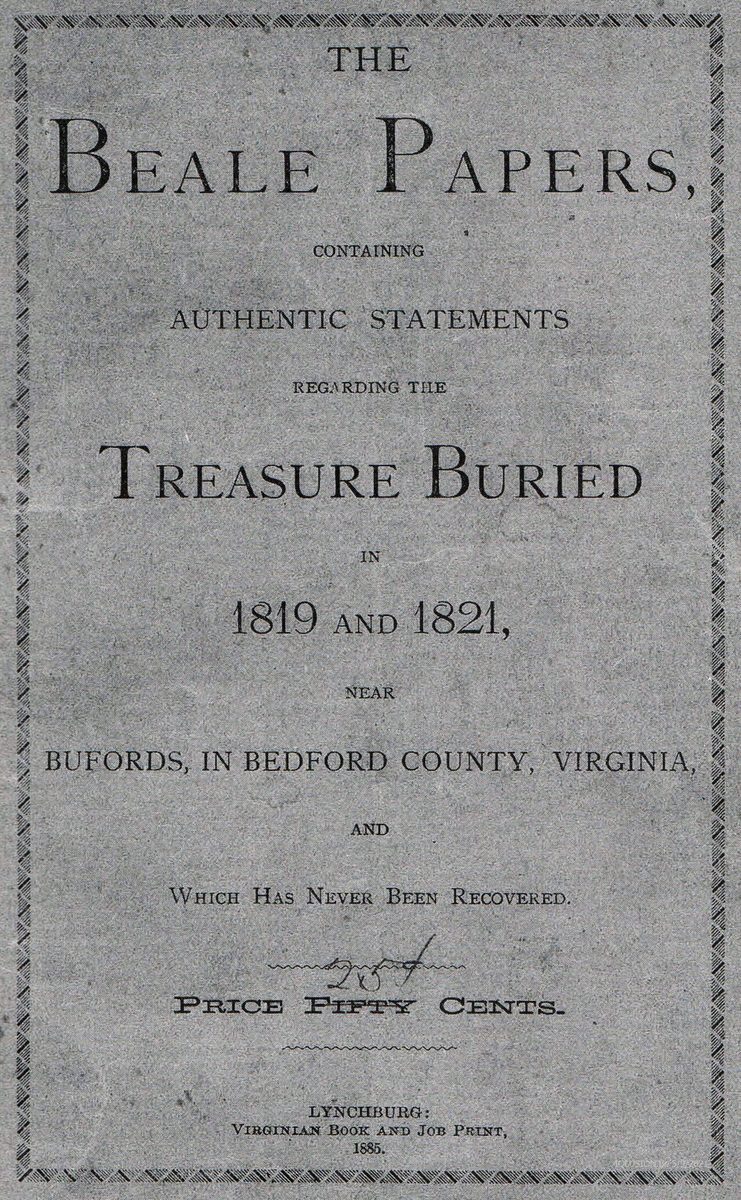
That a real man named Thomas J. Beale buried a genuine treasure of gold, silver and jewels in Bedford County, Virginia around 1820, and encoded its precise location, its contents and the names of his heirs in three number ciphers: the first and third of which, once decoded, would lead a finder straight to a fortune still waiting in the ground.
The middle cipher genuinely does decode against the Declaration of Independence, which keeps the legend alive, but statistical anomalies, anachronistic vocabulary, an unverifiable cast of characters and a century and a half of fruitless digging make a deliberate 1880s hoax the far stronger explanation.
Believed by: Generations of Bedford County treasure hunters, amateur cryptanalysts and pamphlet buyers
The full story
An iron box, three sheets of numbers, and a fortune in the ground
The story arrives entirely through a single anonymous source: a 23-page pamphlet titled The Beale Papers, Containing Authentic Statements Regarding the Treasure Buried in 1819 and 1821, Near Buford's, in Bedford County, Virginia, printed in Lynchburg in 1885 and sold for fifty cents. Its unnamed author claims to be relating events told to him by a Lynchburg innkeeper named Robert Morriss, and to be publishing them only after his own years of failure to solve the puzzle drove him to near ruin.
The tale it tells runs like this. In the winter of 1820, a well-mannered stranger giving his name as Thomas J. Beale boards at Morriss's Washington Hotel. He returns in 1822, and before departing leaves with Morriss a locked iron box holding, he says, papers of great value. A letter posted from St. Louis follows, instructing Morriss to open the box only if Beale and his companions fail to return within ten years, and promising that a friend will separately send the key needed to read what is inside. Beale, his party of some thirty Virginia adventurers, and the promised key letter are never heard from again.
Morriss, the story goes, waits far longer than instructed, finally breaking the box open in 1845. Inside are two plaintext letters signed by Beale and three sheets covered in numbers. The letters explain that Beale's party, hunting buffalo far to the west around 1817, stumbled onto a rich vein of gold and silver north of Santa Fe in what was then Mexican territory; that they mined it for years; and that they twice hauled the metal east and buried it, together with jewels bought in St. Louis, in a stone-lined vault about four miles from Buford's tavern in Bedford County. The three ciphers, Beale writes, encode respectively the treasure's location (Paper 1, 520 numbers), its contents (Paper 2, 763 numbers), and the names of the heirs entitled to shares (Paper 3, 618 numbers), 1,901 numbers in all. Morriss, unable to crack any of them, eventually hands the papers to the pamphlet's author, who cracks exactly one.
The cipher that actually works
Here is what keeps the Beale legend from being dismissed out of hand, and what has sent people digging in Bedford County for well over a century: the second cipher is genuinely solvable, and the method is beautiful. It is a book cipher. Take a numbered copy of the United States Declaration of Independence: word one, word two, word three, and so on. Then read each number in Paper 2 as pointing to a word in the document, and take the first letter of that word. Number 115 gives you the first letter of the 115th word; number 73 the first letter of the 73rd; and letter by letter, a message assembles itself.
What assembles is not gibberish. It is a clear, grammatical inventory: a deposit made “in the county of Bedford, about four miles from Buford's, in an excavation or vault, six feet below the surface of the ground,” consisting of roughly 2,921 pounds of gold, 5,100 pounds of silver, and jewels obtained in St. Louis, a hoard whose bullion alone, at modern metal prices, would run into the tens of millions of dollars. The passage even closes by directing the reader to Paper 1 for the vault's precise location and to Paper 3 for the owners' names. This is not a Rorschach blot that believers read meaning into; anyone with the pamphlet and a printed Declaration can reproduce the decode and get the same words. A real cipher, keyed to a real and specific document, really does sit at the center of the story.
From there the treasure-hunter's logic is almost irresistible. If Paper 2 was built on the Declaration and yields a true, checkable message, then Papers 1 and 3 are surely the same kind of object: book ciphers keyed to other documents that simply have not been identified yet. Solve the key text for Paper 1 and you have the exact spot. That is why generations of searchers have run the unsolved ciphers against the Bible, the Constitution, the Magna Carta, Shakespeare, the Louisiana Purchase and countless other candidate texts, and why the Beale ciphers still draw serious amateur cryptanalysts: the one solved paper is a standing proof of concept that the puzzle is real, and the reward for finishing it would be both a fortune and a permanent place in cryptographic history.
The seriousness of that interest is not confined to amateur treasure hunters. William Friedman, who built and led the U.S. Army's Signal Intelligence Service (the direct forerunner of the NSA) found the puzzle compelling enough to fold into his own training curriculum in the 1930s, and by his own account never fully let it go afterward. His verdict swung with the calendar: “On Mondays, Wednesdays, and Fridays, I think it is real,” he once said. “On Tuesdays, Thursdays, and Saturdays, I think it is a hoax.” Even in defeat he wrote that he had “tried to the best of my ability and now must confess myself beaten”, not the words of a man who considered the puzzle beneath him.
The puzzle also drew formal, funded research. Computer scientist Carl Hammer, director of computer sciences at Sperry Univac, ran the two undeciphered papers through a UNIVAC 1108 in the late 1960s, testing their numbers against the statistical signature of true randomness. His conclusion: “Beale Cyphers 1 and 3 are ‘for real.’ They are not random doodles but do contain intelligence and messages of some sort. Further attempts at decoding are indeed warranted.” Hammer helped found what became the Beale Cypher Association, whose first symposium in Washington, D.C. in 1969 drew roughly seventy attendees from the intelligence and computing worlds; Hammer himself later estimated that “at least 10% of the best cryptanalytic minds in the country” had, at some point, taken a serious run at the ciphers. A printout of his findings is preserved today at the National Cryptologic Museum in Fort Meade, Maryland.
The numbers that give the game away
The trouble is that a working second cipher proves only that someone built a working second cipher, and the closer cryptanalysts have looked at the other two papers, the more they look manufactured to appear encrypted rather than to hide anything. The decisive work came from cryptographer Jim Gillogly, whose 1980 paper in Cryptologia, pointedly titled “A Dissenting Opinion,” ran Paper 1 through the very same Declaration of Independence key that unlocks Paper 2. If Paper 1 were keyed to a different book, this should produce random letters. Instead it produced runs like ABFDEFGHIIJKLMMNOHPP, long, near-perfect alphabetical sequences.
The odds of such ordered strings appearing by chance are vanishingly small: by the American Cryptogram Association's estimate, worse than one in a hundred million million for the pattern as a whole. Gillogly's reading is damning and mundane: he pictured the hoaxer “selecting numbers more or less at random, but occasionally growing bored and picking entries from the numbered Declaration in front of him, in several cases choosing numbers with an alphabetical sequence.” A prankster idly copying consecutive words off the same document he used for Paper 2 would leave exactly this fingerprint. It is evidence not of a second hidden message, but of a fabricator filling a page with plausible-looking noise.
Investigator Joe Nickell's 1982 study found the “Beale” letters, supposedly written in 1822, salted with words and idioms that do not appear in documented English print until decades later (most notoriously stampeding, along with usages like improvised), reading throughout like the 1880s rather than the 1820s. Nickell could find no Thomas J. Beale who fit the story in the census, land or travel records where such a man ought to surface. And legendary NSA cryptanalysts William Friedman and Solomon Kullback, comparing the writing styles of “Beale” and the pamphlet's narrator, concluded the two texts came from a single author, meaning the whole cast collapses into one 1880s hand. Add the simplest fact of all: after 140 years of metal detectors, backhoes and radar, no coin, jewel or vault has ever been found.
That institutional attention cuts both ways, though. The most direct product of Friedman's own training program was skepticism, not confirmation: SIS trainees who worked through the ciphers came away concluding they were phony, and Friedman's wife and fellow cryptanalyst Elizebeth Friedman, herself one of the most accomplished codebreakers of the twentieth century, judged the whole affair to be of “diabolical ingenuity, specifically designed to lure the unwary reader” into “fruitless research”, a trap built to look solvable, not a genuine secret.
Hammer's own “for real” verdict fared little better under closer scrutiny. The alphabetical runs Gillogly identified in 1980 sit inside the very same statistical irregularity that Hammer's UNIVAC had flagged a decade earlier as a sign of hidden “intelligence”: Hammer could not deny the pattern was there, he simply disagreed with what it meant. And the Beale Cypher Association he helped build is, in hindsight, a data point against the treasure rather than for it: more than two hundred paying members and roughly a decade of symposia produced, over some thirty years of organized effort, no solved cipher and no found vault before the association quietly dissolved by 1999.
Why the shovels never stop
Belief in the Beale treasure is powered less by distrust of authority than by a nearly perfect design for sustaining hope. At its heart sits one thing that is true: the second cipher really does decode, and you can verify it yourself in an afternoon. That single verified success does enormous psychological work, because it lets a believer treat the two unsolved papers not as suspicious blanks but as puzzles that are merely unfinished. The failure is always framed as “we haven't found the right key book yet,” never as “there is nothing to find”, an unfalsifiable posture that no amount of empty digging can dislodge.
The stakes amplify everything. Most puzzles reward you with a moment of satisfaction; this one dangles a literal buried fortune, described down to the pound, in a real county you can drive to. That converts a cryptographic exercise into a lottery ticket, and lottery logic is notoriously resistant to expected-value reasoning: the tiny probability is swamped by the size of the imagined payoff. The narrative helps too: gentleman adventurers, a mine found while hunting buffalo, a locked box and a trusted innkeeper make a frontier romance people want to be true, which is precisely the condition under which motivated reasoning flourishes.
And there is the status prize. The Beale ciphers have beaten professional cryptanalysts for more than a century, so the amateur who cracked Paper 1 would not only get rich but would be remembered as the person who solved one of history's most famous codes. That is a powerful draw for exactly the self-taught puzzle-solver most likely to pour years into the attempt, and it helps explain why, even as each generation's searchers come up empty, a fresh generation keeps arriving to try again in the same Virginia hills.
Probably a hoax, not proven
The rating is disputed, but the dispute is lopsided. On one side sits a single, real, reproducible fact: Paper 2 decodes against the Declaration of Independence into a coherent description of a treasure. On the other sits a convergence of independent problems, each pointing the same way: Gillogly's alphabetical runs betraying a fabricator's hand in Paper 1; Nickell's anachronistic 1880s vocabulary in letters dated 1822; the total absence of any documented Thomas J. Beale; Friedman and Kullback's judgment that “Beale” and the narrator were one author; and 140 years of searching that has turned up precisely nothing.
The most economical explanation that accounts for all of it is that an enterprising author in the 1880s (quite plausibly connected to the pamphlet's publisher, James B. Ward, the only verifiable person in the affair) wrote an engaging treasure tale, built one genuinely solvable cipher on the Declaration as its hook, and padded the other two with authentic-looking numbers that were never meant to resolve into anything. That reading requires no lost key books, no vanished frontiersman and no unrecovered vault; the treasure hunters' reading requires all three, plus an explanation for why the fabrication signatures are there. We cannot prove a negative, and some small chance of a real hoard can never be fully closed off, which is why the verdict stays short of “debunked.” But on the evidence as it stands, the buried gold of Bedford County is best understood as a nineteenth-century bestseller that outlived its author, not a fortune waiting to be dug up.
What's still unexplained
- Whether the Beale story is a genuine early-nineteenth-century record or a deliberate 1880s hoax is the central, unresolved question behind the whole case. Joe Nickell's anachronistic vocabulary, the total absence of any documented Thomas J. Beale, and Friedman and Kullback's finding that 'Beale' and the pamphlet's narrator share a single writing style all point toward fabrication, but none of it is a signed confession, no draft or manuscript has ever surfaced, and serious researchers who spent decades on the ciphers, William Friedman among them, never fully resolved their own doubts either way.
- Whether Papers 1 and 3 are real, solvable ciphers or meaningless filler is a genuine, still-open technical question, not just a treasure hunter's hope. Jim Gillogly's 1980 discovery of alphabetical runs in Paper 1 is the strongest evidence yet that at least part of it is fabricated noise, but computer scientist Carl Hammer, who ran the earliest statistical analysis of the papers in the late 1960s, maintained even after Gillogly's finding that the numbers were unlike random filler and probably encoded something. No one has fully reconciled those two readings of the same data, and no proposed key text has ever produced a second decoded passage from either paper.
- Whether a real Thomas J. Beale ever existed is unresolved. No period census, land, military, or travel record has surfaced showing a man who matches the pamphlet's account, despite searches by researchers including Joe Nickell. That absence is suggestive but not conclusive: record-keeping in 1820s Bedford County was patchy, and a stranger who wintered there only twice before heading permanently west could plausibly leave little trace even if some version of him was real.
- If the whole account was invented, who actually wrote it is still not settled. James B. Ward is the pamphlet's named publisher and the only figure in the story whose existence is documented, which makes him the leading suspect, but he always maintained he was merely publishing a manuscript left in his care, no draft or confession in his hand has ever surfaced, and the Friedman-Kullback stylistic match shows only that one person wrote both the 'Beale' letters and the narrator's voice, not which real person that was.
Point by point
The claim: The second cipher decodes cleanly against the Declaration of Independence into a coherent inventory of the treasure, proving the ciphers are real and the other two must also hide messages.
What the record shows: The decode is real: numbering the words of the Declaration and reading each cipher number as the initial letter of that word produces a legible passage describing gold, silver and jewels in a Bedford County vault. But a working book cipher only proves someone built one: an 1880s author with the same Declaration in hand could construct a solvable second cipher as the pamphlet's centerpiece while filling the other two with numbers that spell nothing.
The claim: The first and third ciphers are simply keyed to different, still-undiscovered books, which is why they have not yet been solved.
What the record shows: When Jim Gillogly ran the first cipher through the same Declaration key, it did not stay random: it produced runs like ABFDEFGHIIJKLMMNOHPP. The odds of such near-alphabetical sequences arising by chance are astronomically small, and they point to a hoaxer who, growing bored while inventing numbers, occasionally copied consecutive entries off the numbered Declaration in front of him. That is evidence of fabrication, not of a second, undiscovered key text.
The claim: Beale's letters are authentic early-nineteenth-century documents from a 1822 frontiersman.
What the record shows: Joe Nickell's stylometric and historical study found the letters riddled with tells: words such as 'stampeding' and 'improvised' that have no securely documented English print usage until decades after 1822, phrasing characteristic of the 1880s, and no record of a Thomas J. Beale matching the story in the censuses, land rolls or travel accounts where such a man should appear. NSA cryptanalysts William Friedman and Solomon Kullback separately judged the 'Beale' and 'Ward' prose to be the work of a single hand.
The claim: The treasure is really out there; people just have not decoded the location yet.
What the record shows: In over 140 years of digging across Bedford County (with metal detectors, backhoes, ground-penetrating radar and, in some cases, unauthorized excavations that drew the sheriff), no vault, no coins and no jewels have ever been recovered. A buried hoard that has defeated that much sustained, motivated searching is, at minimum, not where the story says it is, and quite possibly never existed.
Timeline
- 1820By the pamphlet's account, a stranger calling himself Thomas J. Beale arrives at Robert Morriss's Washington Hotel in Lynchburg, Virginia, spending the winter there before departing in the spring.
- 1822Beale returns, and before leaving again entrusts Morriss with a locked iron box said to contain 'papers of value and importance,' asking him to keep it safe.
- 1822A follow-up letter from Beale, mailed from St. Louis, tells Morriss to open the box if neither Beale nor any of his party returns within ten years, and promises that a separate letter supplying the cipher's key will be sent from a friend. That key letter never arrives.
- 1845After more than two decades of silence, Morriss finally forces the box open, finding two plaintext letters signed by Beale and three sheets of numbers: the ciphers now labelled Papers 1, 2 and 3.
- c. 1862An elderly Morriss, unable to make progress, passes the papers to an unnamed younger friend, who by his own account spends years on them before decoding the second cipher against a copy of the Declaration of Independence.
- 1885That anonymous friend publishes the whole story, the three ciphers and the solved second text as a 50-cent pamphlet, The Beale Papers, printed in Lynchburg by James B. Ward, the only figure in the affair whose real existence is documented.
- 1980Cryptographer Jim Gillogly publishes 'The Beale Cipher: A Dissenting Opinion' in Cryptologia, showing that decoding the first cipher with the Declaration key yields improbable alphabetical letter-runs, a signature of construction, not of a hidden message.
- 1982Investigator Joe Nickell's literary and historical analysis finds no trace of Thomas J. Beale in period records and flags vocabulary and phrasing that read as 1880s, not 1820s, reinforcing the hoax case.
The middle cipher genuinely does decode against the Declaration of Independence, which keeps the legend alive, but statistical anomalies, anachronistic vocabulary, an unverifiable cast of characters and a century and a half of fruitless digging make a deliberate 1880s hoax the far stronger explanation.
Reviewed by Colin Peterson · Last reviewed July 9, 2026 · How we rate
Common questions
Is The Beale Ciphers true?
The middle cipher genuinely does decode against the Declaration of Independence, which keeps the legend alive, but statistical anomalies, anachronistic vocabulary, an unverifiable cast of characters and a century and a half of fruitless digging make a deliberate 1880s hoax the far stronger explanation.
What is The Beale Ciphers?
Three sheets of ciphered numbers, allegedly left in an iron box by a Virginia adventurer named Thomas J. Beale in 1822, are said to reveal the location, contents and rightful owners of a buried hoard of gold, silver and jewels worth tens of millions today. One of the three was cracked using the U.S. Declaration of Independence as a key;…
What does the evidence show?
The decode is real: numbering the words of the Declaration and reading each cipher number as the initial letter of that word produces a legible passage describing gold, silver and jewels in a Bedford County vault. But a working book cipher only proves someone built one: an 1880s author with the same Declaration in hand could construct a…
Why do people believe it?
The one solved cipher is genuinely, checkably real: anyone can number the Declaration of Independence and watch the second text resolve into an inventory of gold and silver, which makes the leap to 'the other two must work too' feel like common sense rather than credulity.
What is still unresolved?
Whether the Beale story is a genuine early-nineteenth-century record or a deliberate 1880s hoax is the central, unresolved question behind the whole case. Joe Nickell's anachronistic vocabulary, the total absence of any documented Thomas J. Beale, and Friedman and Kullback's finding that 'Beale' and the pamphlet's narrator share a single…
Sources
- 1.Beale ciphers, Wikipedia
- 2.The Beale Papers (1885 pamphlet, full text), Wikisource (1885)
- 3.The Beale Cipher: A Dissenting Opinion, James J. Gillogly, Cryptologia, Vol. 4, No. 2 (1980)
- 4.The Beale Treasure Ciphers, Simon Singh (from The Code Book)
- 5.Jim Gillogly's Beale sequence revisited, Cipher Mysteries (Nick Pelling) (2010)
- 6.The Quest to Break America's Most Mysterious Code — And Find $60 Million in Buried Treasure, Mental Floss
- 7.Beale Papers: transcription and analysis, The Cipher Foundation
- 8.8 of History's Most Mysterious Uncracked Codes, Mental Floss (Jon Mayer)
- 9.Computer Pioneers: Carl Hammer, IEEE Computer Society
- 10.Historical Releases: Beale Papers (declassified NSA documents), National Security Agency (2021)
Embed this case file on your site
Paste this snippet to show this case file as a small card, with a link back to the full write-up. Free to use.
<iframe src="https://theconspiratory.com/embed/beale-ciphers" title="The Conspiratory verdict" width="520" height="190" style="border:0;max-width:100%" loading="lazy"></iframe>Help us investigate
This is a living case file. If you spot an error or know evidence we missed, tell us, and weigh in on where you land.
Where do you land?
Cast your read on this one.
Comments
Add your take. Comments are read and approved by a human before they appear, so keep it on topic and civil. Please do not accuse named, living people of crimes.