The Oklahoma City bombing was a wider plot: a hidden John Doe 2, government foreknowledge, and explosives inside the building
By Colin PetersonJuly 12, 2026
Where the evidence lands →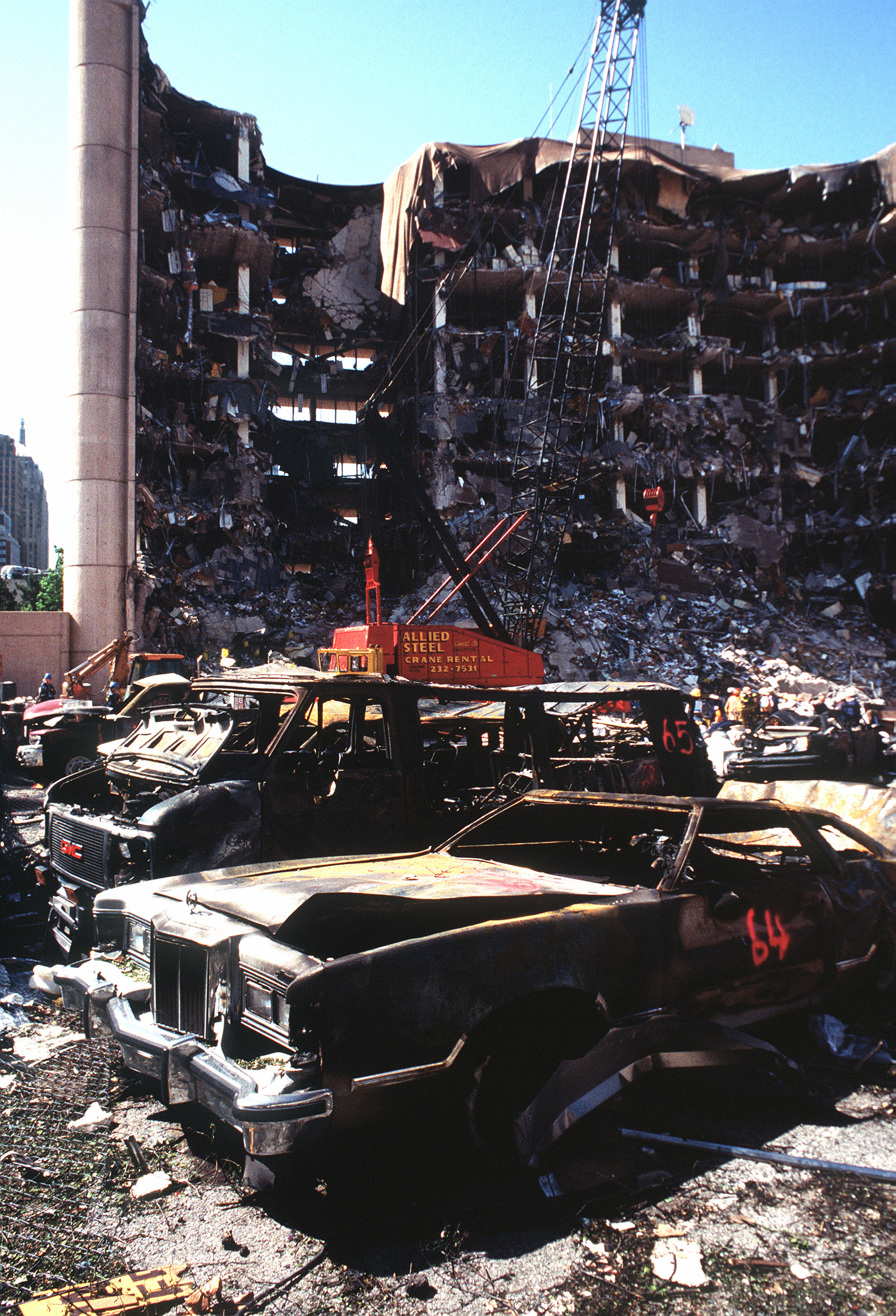
That the Oklahoma City bombing was not the work of a small group acting alone but of a wider conspiracy: that a second man captured in the FBI's own John Doe 2 sketch was a real additional bomber whose existence was buried, that federal agencies had advance warning of the attack and failed or chose not to stop it, and that the collapse of the Murrah Building required demolition charges placed inside it rather than a single truck bomb parked at the curb.
The spine of the case is settled. Timothy McVeigh built and detonated the truck bomb and was executed for it; Terry Nichols helped assemble it and is serving life; Michael Fortier admitted he knew. What stays unproven is everything larger: that a still-hidden John Doe 2 cell carried out the attack, that the government had advance knowledge, or that charges inside the Murrah Building brought it down. Official inquiries, the seismic record, and the engineering studies did not support internal explosives, and John Doe 2 was ultimately traced to an eyewitness confusing two different days.
Believed by: The suspicion never died. Public pressure produced an Oklahoma County grand jury that examined the wider-plot claims (1997 to 1998), and a two-year review by a US House subcommittee reported in 2006 that the FBI had failed to chase leads about who else might have helped. Neither found a proven second cell, but both kept the question of whether McVeigh and Nichols acted entirely alone alive for three decades.
The full story
What is not in dispute
Before weighing what is contested, it helps to fix what is not, because the settled core of this case is unusually solid. At 9:02 a.m. on 19 April 1995, a Ryder rental truck carrying roughly 4,800 pounds of ammonium nitrate fertilizer and fuel oil detonated at the curb of the Alfred P. Murrah Federal Building in downtown Oklahoma City. The north face of the nine-story building collapsed. One hundred and sixty-eight people died, among them 19 children, many in the second-floor daycare center. Until the attacks of September 2001, it was the deadliest act of terrorism ever carried out on American soil.
The bomber was identified within hours by an accident of routine policing. About 90 minutes after the blast, an Oklahoma state trooper stopped a yellow Mercury on the interstate north of the city because it had no license plate, and arrested the driver, Timothy McVeigh, a 27-year-old Army veteran, for carrying a concealed handgun. He was still in county custody two days later when the FBI connected the truck's vehicle identification number, recovered from the wreckage, to the rental and then to him. Terry Nichols, an Army friend who had helped gather the materials and mix the bomb, surrendered in Kansas the same day. A third man, Michael Fortier, who had known of the plan and said nothing, later pleaded guilty and testified against the other two.
The motive is documented in McVeigh's own words and actions. He was steeped in the anti-government militia culture of the early 1990s, enraged above all by the federal sieges at Ruby Ridge in 1992 and at the Branch Davidian compound near Waco, Texas, in 1993. He chose 19 April, the second anniversary of the Waco fire, deliberately. He was convicted and, on 11 June 2001, executed. None of that is what this file is about. The disputes begin at the edges of this established center: with a second face on a wanted poster, with what the government may have known, and with the physics of the collapse itself.
The second man, and the questions that outlived the trial
Give the suspicion its strongest form, because it does not begin in fantasy. It begins with the FBI's own conduct. In the first days, the Bureau released two sketches. One, John Doe 1, was plainly McVeigh. The other, John Doe 2, was a second, heavier, dark-haired man that witnesses at the Kansas body shop said had been present when the truck was rented. For weeks he was the object of one of the largest manhunts in American history, his face on every news broadcast. The government itself, in other words, told the public to look for a second bomber. When it later concluded there was none, that reversal struck many as too convenient.
The doubts did not stay on the fringe. Under pressure from survivors and from state legislator Charles Key, an Oklahoma County grand jury was convened to examine the wider-plot claims. More strikingly, a decade later a subcommittee of the US House of Representatives spent two years reviewing the case and issued a report sharply critical of the FBI, concluding that the Bureau had failed to be curious enough about whether other people, in the same web of far-right activists McVeigh moved through, had helped him. That was not a conspiracy theorist talking; it was a congressional oversight body.
Then there is the matter of what the government was watching. It is documented that the Bureau of Alcohol, Tobacco and Firearms had an informant reporting on Elohim City, a white-separatist compound near the Oklahoma-Arkansas border, and that McVeigh's phone records show a call to that compound in the weeks before the attack. To those inclined to suspicion, an informant inside the milieu, plus a nationwide search for a second man, plus a government that withheld thousands of documents until the eve of the execution, plus a congressional finding that the FBI left leads unpursued, add up to a picture that the official story of two men and a truck does not fully cover.
The government itself drew the second man's face, hunted him for weeks, and only later told the public he had never existed.
What the investigations actually found
Each of those threads has an answer, and the answers are more mundane than the theory, which is usually how these cases resolve. Start with John Doe 2, the strongest hook. The sketch came from a mechanic at Elliott's Body Shop in Junction City who recalled a second man with the customer who rented the Ryder truck on 17 April. Investigators eventually established that his description matched Sergeant Todd Bunting, a soldier who had rented a truck at the very same shop the next day, 18 April, with a companion. The witness had honestly merged two days into a single memory. Every other John Doe 2 sighting, and there were thousands, was run down and led nowhere. No forensic trace, no document, no physical evidence of an unidentified accomplice was ever found.
The Oklahoma County grand jury, after 18 months of hearing exactly these claims, reported at the end of 1998 that there was no evidence of a second bomber, no credible sign the government had advance warning of the attack, and no support for the idea of additional explosives inside the building. The foreknowledge claim in particular rests on an informant who was reporting on a compound in general terms, not on anyone who knew that the Murrah Building would be struck on a specific morning. The much-repeated story that federal workers were told to stay home that day was investigated and found baseless.
The claim of internal charges collapses hardest under the physical evidence. Retired General Benton Partin argued that the destruction of the columns required demolition charges placed against them. But engineers who studied the ruin disagreed. A structural analysis published by the American Society of Civil Engineers, together with later work by federal researchers, concluded that a blast of roughly 4,000 pounds of TNT-equivalent, going off a few feet from unreinforced concrete columns, is more than enough to destroy the nearest column and set off the chain of collapse that followed. And the seismographs that some pointed to as proof of two explosions were read the other way by the US Geological Survey: the two recorded signals were the ground wave and the slower air wave from one blast, not the signatures of two.
A second seismic blip is not a second bomb; it is the same explosion's sound catching up to its shock.
What remains, after all of it, is a documented conspiracy of three. The stolen fertilizer and racing fuel, the explosives taken from a Kansas quarry, the truck rental, the mixing of the bomb at a lake in Kansas, all trace to McVeigh and Nichols, with Fortier admitting he knew. The 2006 House report's real finding was narrower than its headline: the FBI could have chased more leads, but the review turned up no conclusive evidence of another conspirator, and none has been charged in the thirty years since.
Why a bigger story feels necessary
If the evidence points to a small plot, why has the larger one proven so durable? Part of the answer is proportion. The mind resists an equation in which two men, one truck, and a common fertilizer produce 168 coffins, 19 of them small. A hidden network, foreign paymasters, secret charges wired to the columns: each restores a sense that a catastrophe of this size must have had authors to match. The truth, that ordinary materials in the hands of two embittered men can level a federal building, is in some ways more frightening than any conspiracy, because it is so much easier to repeat.
The moment mattered too. The bomb went off on the anniversary of Waco, in the middle of a decade when Waco and Ruby Ridge had already convinced a real constituency that the federal government would kill its own citizens and then manage the story. To that audience, a cover-up was not a leap; it was the expected next move. And the government then behaved in ways that fed the expectation: it drew a second suspect and erased him, it lost track of thousands of its own documents until the last week before an execution, and a congressional committee eventually confirmed that its investigators had left stones unturned.
A conspiracy also does something the negligence story cannot: it gives the grief a target. A diffuse account, in which the horror is the work of a small group and the failures around it are the ordinary failures of large bureaucracies, offers no one to blame commensurate with the loss. A hidden cell or a complicit agency offers a villain the size of the wound. That is a powerful pull, and it does not require anyone involved to be lying.
A solid core, contested edges
The fair reading holds two things at once. The core of the Oklahoma City case is as solid as any in modern American history: McVeigh built and detonated the bomb and was executed for it, Nichols helped and is serving life, Fortier admitted his foreknowledge. The wider claims, on the current record, are unproven. John Doe 2 traces to a witness who merged two days at a body shop. The foreknowledge claim rests on general surveillance of an extremist scene, not on a specific warning ignored. The internal-explosives claim runs against the structural analysis and the seismic record alike.
This file does not pretend the questions are all closed. A few witnesses insisted they saw McVeigh with another man; a congressional subcommittee faulted the FBI for not running every lead to ground; the full informant reporting has never been completely public; and the last-minute document dump was ugly even if it was, as investigators found, incompetence rather than concealment. Those are real anomalies, and they are why the suspicion has outlived the executions and the appeals.
But an anomaly is an invitation to keep asking, not a finding of fact, and it is important to be precise about what this file does and does not say. It does not name any living person as a secret bomber, because no evidence supports doing so, and after three decades no additional conspirator has ever been identified or charged. The wider plot is a set of open questions resting on top of a thoroughly documented crime, not a proven second story hiding behind it.
What's still unexplained
- Why did more than one witness recall a companion? The official account attributes John Doe 2 to a mechanic conflating two days at the body shop, and the match to Sergeant Bunting is persuasive. Yet a handful of other witnesses in Oklahoma City and Kansas also described McVeigh with another man in the days around the attack, and those recollections were never all resolved to everyone's satisfaction, even if none produced an identifiable suspect.
- How hard did the FBI actually look at McVeigh's associates? The 2006 House subcommittee concluded the Bureau failed to fully pursue leads about people in the same far-right orbit, including a gang of bank robbers with overlapping connections. Whether that reflects ordinary investigative limits once the core case was solved, or a real gap that left an accomplice unpursued, is a question the subcommittee itself left open.
- What did the informant reporting reveal, and when? An ATF informant was providing information on the Elohim City compound before the bombing. The government's position is that nothing in that reporting amounted to advance warning of the Murrah attack. But the full contents and timing of that intelligence have never been completely aired in public, which keeps the foreknowledge question alive at the margins.
- Why were so many documents withheld until the last week? The Inspector General attributed the belated production of thousands of pages to human error and a broken records system rather than concealment. For many, an explanation that severe (that the government simply lost track of its own evidence in its largest domestic case) is itself hard to find reassuring.
Point by point
The claim: John Doe 2 was a real second bomber. The FBI drew his face, hunted him nationwide, and then quietly made him disappear.
What the record shows: John Doe 2 was real as a lead, but the trail runs to a mistake, not a cover-up. The sketch came from employees at Elliott's Body Shop in Junction City, Kansas, where the Ryder truck was rented on 17 April. One mechanic recalled a second, stockier man with the customer. Investigators later determined that the description closely matched Army Sergeant Todd Bunting, who had rented a truck at the same shop the following day, 18 April, accompanied by a companion. The witness had, in good faith, blended two different days into one memory. The FBI ran down thousands of John Doe 2 sightings and found no such accomplice, and no physical, forensic, or documentary evidence of an unidentified second bomber ever surfaced. The 1998 grand jury reached the same conclusion.
The claim: The government had prior knowledge. Informants were inside the far-right networks McVeigh moved through, so the attack should have been stoppable.
What the record shows: It is true that federal agencies were watching parts of that world. The Bureau of Alcohol, Tobacco and Firearms had run an informant who reported on Elohim City, a white-separatist compound near the Oklahoma-Arkansas line that McVeigh is documented to have telephoned. But watching a milieu is not foreknowledge of a specific plot. Multiple investigations, including the Oklahoma County grand jury and internal Justice Department reviews, found no credible evidence that any agency knew the Murrah Building would be attacked that morning. The widely repeated claim that federal employees were warned to stay away on 19 April was investigated and never substantiated. A general awareness of dangerous groups is not the same as a specific warning ignored.
The claim: The truck bomb could not have done it. The pattern of collapse required demolition charges placed on the building's own support columns.
What the record shows: This is the claim the physical evidence most directly contradicts. Retired Air Force Brigadier General Benton Partin argued in 1995 that the damage implied charges attached to the columns. But structural engineers who studied the wreckage concluded otherwise. A detailed analysis published by the American Society of Civil Engineers, and later work supported by federal researchers, found that a blast on the order of 4,000 pounds of TNT-equivalent, detonated a few feet from unreinforced concrete columns, is sufficient to shear the nearest column and trigger the progressive collapse that followed. Seismographs at the Oklahoma Geological Survey recorded the event, and analysis by the US Geological Survey concluded the two signals some cited as a second blast were the ground wave and the slower air wave from a single explosion, not two bombs.
The claim: Two men and a truck cannot explain a catastrophe this large. There had to be a wider network behind them.
What the record shows: The size of the horror does not, by itself, require a larger cell, and the documented conspiracy is genuinely small. The paper trail is dense: the stolen ammonium nitrate and racing fuel, the robbery of explosives and detonators from a Kansas quarry, the Ryder truck rental, and the mixing of the bomb are tied to McVeigh and Nichols, with Fortier testifying to advance knowledge of the plan. The 2006 House subcommittee did criticize the FBI for not fully chasing leads about who else McVeigh and Nichols may have had contact with, and that criticism is on the record. But the same review found no conclusive evidence of another conspirator, and in three decades no additional person has ever been charged or identified. That help was possible is a fair reading; that a wider cell is proven is not.
Timeline
- 1995-04-19At 9:02 a.m. a Ryder rental truck loaded with about 4,800 pounds of ammonium nitrate and fuel oil detonates outside the nine-story Murrah Federal Building, killing 168 people. Roughly 90 minutes later, Oklahoma state trooper Charlie Hanger stops Timothy McVeigh on Interstate 35 near Perry for driving without a license plate, and arrests him for carrying a concealed weapon.
- 1995-04-21Just as McVeigh is about to make bail on the traffic and weapons charges, he is identified as the bombing suspect and held. Terry Nichols surrenders to police in Herington, Kansas. The FBI releases sketches of two suspects: John Doe 1, resembling McVeigh, and John Doe 2, a second man described by witnesses at the Kansas body shop where the truck was rented.
- 1995A nationwide hunt for John Doe 2 follows, generating thousands of tips and sightings. Michael Fortier and his wife Lori, friends of McVeigh who knew of the plan in advance, agree to cooperate; Fortier later pleads guilty and testifies for the prosecution.
- 1997-06McVeigh is convicted on 2 June of all 11 federal counts and sentenced to death on 13 June. Prosecutors present a documented three-person conspiracy: McVeigh as the bomber, Nichols as the builder, and Fortier as a knowing accessory.
- 1997-12Terry Nichols is convicted in federal court of conspiracy and the involuntary manslaughter of eight federal agents, and is later sentenced to life in prison. A separate Oklahoma state trial in 2004 convicts him of 161 counts of murder, again drawing a sentence of life without parole.
- 1998-12After a campaign led by state legislator Charles Key and others, an Oklahoma County grand jury that spent 18 months examining the wider-plot claims concludes there is no evidence of a second bomber, no credible sign of advance government knowledge, and no support for the theory of additional explosives inside the building.
- 2001-05One week before McVeigh's scheduled 16 May execution, the FBI discloses that thousands of pages of investigative documents had never been turned over to the defense. Attorney General John Ashcroft delays the execution by a month so the material can be reviewed.
- 2001-06-11McVeigh is executed by lethal injection at the federal penitentiary in Terre Haute, Indiana, the first federal execution since 1963. He goes to his death claiming sole responsibility for driving and detonating the bomb.
- 2002-03The Justice Department's Office of the Inspector General reports that the belated document disclosure was the product of widespread human error and a flawed records system, not a deliberate effort to hide evidence.
- 2006-12A two-year review by the Oversight and Investigations Subcommittee of the US House International Relations Committee faults the FBI for failing to fully pursue leads about others who may have had contact with McVeigh or Nichols, but finds no conclusive evidence of a foreign hand or of a proven wider cell.
From the case file
The actual records: declassified, released, or leaked. We link straight to each document in its official archive, so you never have to take our word for it. Read the originals yourself.
Oklahoma City Bombing (OKBOMB) Investigative Files
The FBI's own released records from OKBOMB, the investigation that generated more than 27,000 investigative reports and 13,000 items of physical evidence. The Bureau's public account states that no evidence of conspirators beyond McVeigh, Nichols, and Fortier was corroborated and that no John Doe 2 was ever identified.
Read the document: FBI Vault →An Investigation of the Belated Production of Documents in the Oklahoma City Bombing Case
The Inspector General's inquiry into why thousands of pages of documents reached McVeigh's defense only a week before his scheduled execution. It found widespread human error and a broken records process across FBI field offices and the OKBOMB task force, but concluded the government did not willfully withhold material it knew was discoverable.
Read the document: DOJ Office of the Inspector General →The FBI Laboratory, Section G: Oklahoma City Bombing
The Inspector General's review of the FBI Laboratory examined the explosives-residue and blast evidence in the Oklahoma City case after a Bureau scientist alleged flawed lab practices. It criticized some analytical work but did not find that the forensic evidence pointed to explosives inside the building rather than the truck bomb.
Read the document: DOJ Office of the Inspector General →The Oklahoma City Bombing: Analysis of Blast Damage to the Murrah Building
A peer-reviewed structural engineering study of how the Murrah Building failed. It found the collapse consistent with a single truck bomb of roughly 4,000 pounds of TNT-equivalent detonated at the curb, directly contradicting claims that demolition charges inside the building were needed to explain the damage.
Read the document: ASCE Library →Other case files that cite the same sources
The spine of the case is settled. Timothy McVeigh built and detonated the truck bomb and was executed for it; Terry Nichols helped assemble it and is serving life; Michael Fortier admitted he knew. What stays unproven is everything larger: that a still-hidden John Doe 2 cell carried out the attack, that the government had advance knowledge, or that charges inside the Murrah Building brought it down. Official inquiries, the seismic record, and the engineering studies did not support internal explosives, and John Doe 2 was ultimately traced to an eyewitness confusing two different days.
Reviewed by Colin Peterson · Last reviewed July 12, 2026 · How we rate
Common questions
Is Oklahoma City bombing true?
The spine of the case is settled. Timothy McVeigh built and detonated the truck bomb and was executed for it; Terry Nichols helped assemble it and is serving life; Michael Fortier admitted he knew. What stays unproven is everything larger: that a still-hidden John Doe 2 cell carried out the attack, that the government had advance knowledge, or that charges inside the Murrah Building brought it down. Official inquiries, the seismic record, and the engineering studies did not support internal explosives, and John Doe 2 was ultimately traced to an eyewitness confusing two different days.
What is Oklahoma City bombing?
At 9:02 a.m. on 19 April 1995, a rented truck packed with roughly two tonnes of fertilizer-and-fuel explosive tore the face off the Alfred P. Murrah Federal Building in Oklahoma City, killing 168 people, 19 of them children. It was, until 2001, the deadliest terrorist attack in US history. The core facts were established quickly and are…
What does the evidence show?
John Doe 2 was real as a lead, but the trail runs to a mistake, not a cover-up. The sketch came from employees at Elliott's Body Shop in Junction City, Kansas, where the Ryder truck was rented on 17 April. One mechanic recalled a second, stockier man with the customer. Investigators later determined that the description closely matched A…
Why do people believe it?
The government faulted itself. The FBI sat on thousands of pages of documents until a week before the execution, and a congressional subcommittee later said the Bureau had not been curious enough to chase every lead. When the official record contains admitted failures, the leap to hidden ones feels short.
What is still unresolved?
Why did more than one witness recall a companion? The official account attributes John Doe 2 to a mechanic conflating two days at the body shop, and the match to Sergeant Bunting is persuasive. Yet a handful of other witnesses in Oklahoma City and Kansas also described McVeigh with another man in the days around the attack, and those rec…
Sources
- 1.Oklahoma City Bombing, Federal Bureau of Investigation (Famous Cases and Criminals)
- 2.An Investigation of the Belated Production of Documents in the Oklahoma City Bombing Case, U.S. Department of Justice, Office of the Inspector General (2002)
- 3.The FBI Laboratory: An Investigation into Laboratory Practices and Alleged Misconduct in Explosives-Related and Other Cases, Section G: Oklahoma City Bombing, U.S. Department of Justice, Office of the Inspector General (1997)
- 4.Oklahoma City bombing, Encyclopaedia Britannica
- 5.Oklahoma City bombing conspiracy theories, Wikipedia
- 6.The Oklahoma City Bombing: Analysis of Blast Damage to the Murrah Building, Journal of Performance of Constructed Facilities, American Society of Civil Engineers (1998)
- 7.Oklahoma City Bombing 1995, National Institute of Standards and Technology
- 8.Panel Faults FBI in Okla. Bombing Follow-Up, The Washington Post (2006)
- 9.Report rebukes FBI on Oklahoma City probe, NBC News / Associated Press (2006)
Embed this case file on your site
Paste this snippet to show this case file as a small card, with a link back to the full write-up. Free to use.
<iframe src="https://theconspiratory.com/embed/oklahoma-city-bombing" title="The Conspiratory verdict" width="520" height="190" style="border:0;max-width:100%" loading="lazy"></iframe>Help us investigate
This is a living case file. If you spot an error or know evidence we missed, tell us, and weigh in on where you land.
Where do you land?
Cast your read on this one.
Comments
Add your take. Comments are read and approved by a human before they appear, so keep it on topic and civil. Please do not accuse named, living people of crimes.