TWA Flight 800 was shot down by a missile, and the cause was covered up
By Colin PetersonJuly 12, 2026
Where the evidence lands →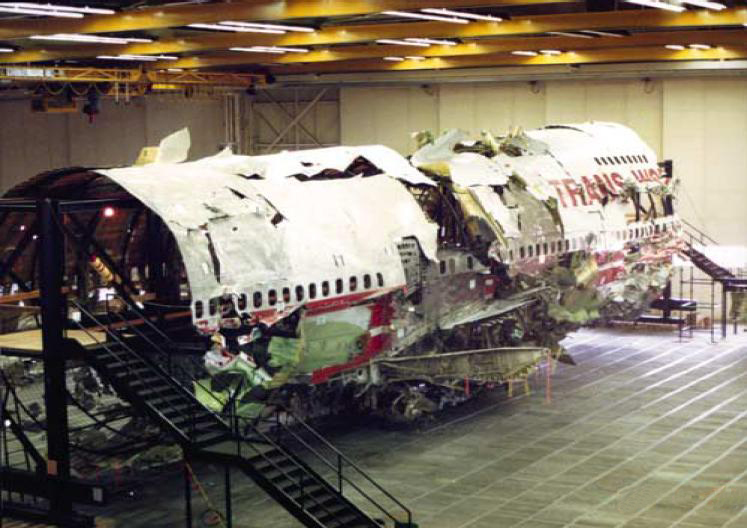
That TWA Flight 800 was not brought down by an internal fuel-tank explosion but was destroyed by a missile, either a terrorist weapon or an errant missile fired during a US Navy exercise off Long Island, and that federal agencies suppressed eyewitness accounts, radar data, and physical evidence in order to hide the true cause and avoid panic or blame.
A Boeing 747 really did explode and fall into the sea off Long Island, killing all 230 aboard, and dozens of witnesses genuinely reported a streak of light rising toward it. But the four-year NTSB investigation traced the blast to the center wing fuel tank, the reconstructed wreckage shows no missile penetration or warhead damage, and no missile residue was found. The shootdown-and-cover-up claim is unproven, and its physical core is contradicted by the reconstruction.
Believed by: Missile and cover-up versions have circulated since the first week of the crash and were amplified by a former investigator group, a 2013 documentary, and prominent figures over the years. The finding rated here is not the crash itself, which is undisputed, but the shootdown-and-cover-up claim, which remains unsupported by the physical evidence.
The full story
Twelve minutes off the runway
TWA Flight 800 lifted off from John F. Kennedy International Airport on the warm evening of 17 July 1996, a Boeing 747-100 bound for Paris and then Rome with 230 people aboard: 212 passengers and 18 crew. It was a routine transatlantic departure on an older but well-worn aircraft. About twelve minutes into the climb, at roughly 13,700 feet off the south shore of Long Island, the jet exploded.
To people on the beaches, on boats, and on the decks of aircraft passing overhead, the sky over the Atlantic near East Moriches tore open in a fireball that fell burning into the sea. There were no survivors. The cockpit voice recorder simply stopped, mid-word, with no warning and no distress call. Within hours the recovery of bodies and debris began across a debris field that stretched for miles, and within days the crash had become the center of one of the largest and most contested accident investigations in American history.
Two things were true from the start and have never been in dispute: the aircraft came apart in the air rather than hitting the water intact, and a great many people saw something in the sky just before it did. Everything argued since has turned on what that something was.
The streak of light and the missile that seemed obvious
Take the suspicion at its strongest, because it did not come from nowhere. Investigators gathered accounts from hundreds of witnesses, and a striking number described the same thing: a bright point or streak of light climbing upward from low over the water toward the aircraft, ending in the explosion. To an ordinary observer, and to more than a few trained ones, that is what a surface-to-air missile looks like. The image was so consistent that it drove the investigation's entire early phase.
The timing sharpened it. This was the summer of 1996, a year after the Oklahoma City bombing, still in the long shadow of the Lockerbie bombing that had destroyed another 747, and days before the Atlanta Olympics opened under a heightened terror alert. A wide-body airliner detonating in clear air off New York did not read, in that moment, like an accident. It read like an attack, and the FBI opened a full criminal investigation on exactly that premise.
A bright streak climbing from the water to a fireball is what a missile looks like, and in the summer of 1996 that is what a great many people assumed they had seen.
Then came the detail that gave the missile theory its darkest turn: US military activity in the area. If a Navy exercise had been underway off Long Island, the reasoning went, an errant missile could have struck the plane, and no service and no administration would ever admit to killing 230 civilians by accident. When former newsman Pierre Salinger announced that autumn that he held a document proving a Navy missile was responsible, the claim spread worldwide before it was checked. The pieces fit together into a story that was easy to tell and hard to shake: a shootdown, and a government with every reason to bury it.
What the reassembled airplane showed
The trouble for the missile story is the wreckage, and there was an extraordinary amount of it. Investigators recovered more than 95 percent of the aircraft from the seabed and rebuilt it, piece by piece, on a steel frame inside a hangar: one of the most complete crash reconstructions ever undertaken. A rebuilt airplane is not a matter of opinion. It is a physical object that either carries the signature of a missile strike or does not.
It did not. A proximity-fused missile warhead does something specific: it sprays dense, high-velocity fragments that punch a cluster of small holes through the skin from the outside in, petaled inward, ringed by pitting and explosive residue, often with warhead fragments lodged in the structure. The reconstruction showed no such external penetration pattern, no recovered warhead fragments, and no missile-propellant or warhead residue. The structural damage instead radiated outward from the center wing fuel tank, the signature of an explosion inside the airplane pushing out, not a weapon striking in. Traces of explosive found early were run down and attributed to the aircraft's earlier use in a bomb-detection training exercise, not to the crash.
The eyewitness problem was handed to the CIA, which analyzed the accounts alongside radar data and the flight recorders. Its conclusion was that the streak most witnesses described came after the initial blast: the explosion severed the nose section, the suddenly lighter fuselage pitched up and climbed while burning, and from the ground that rising ball of fire looked exactly like something ascending toward a target. The light was real. It was the airplane.
The damage radiated outward from the center fuel tank, not inward from a warhead, and the climbing light witnesses saw was the burning airplane itself.
After four years, the NTSB adopted its probable cause: an explosion of the center wing fuel tank, whose nearly empty volume held fuel vapor within its flammable range on a hot day, ignited most likely by a short circuit that carried excessive voltage into the tank through the fuel-gauging wiring. It was not a comfortable finding, but it was a serious one, and it reshaped aviation safety: the crash drove new requirements for fuel-tank inerting and wiring protection precisely because regulators accepted that a vapor explosion, not a weapon, had destroyed the airplane. The FBI, for its part, closed its criminal case in November 1997, reporting no evidence of a bomb or a missile.
Why the shootdown belief endures
Most conspiracy theories have to argue past a settled account. This one has an unusually strong starting point: a large body of honest witnesses who saw a light rise toward a doomed airplane. Telling those people that they watched a burning fuselage climb, not a missile ascend, asks them to overrule their own eyes on the most memorable night of their lives. Some never have, and it is not hard to see why.
The official cause did not help itself, at least at first hearing. “A fuel tank spontaneously exploded” sounds, to most people, like something that does not happen, and the instinct that it must be a cover for something more deliberate is understandable even though the danger turned out to be real and correctable. When the explanation for a catastrophe sounds less plausible than the catastrophe, suspicion rushes into the gap.
The shape of the investigation fed that suspicion too. A criminal inquiry running in parallel with a safety board, a spy agency producing an animated film of what witnesses saw, an airplane rebuilt in a hangar: to a doubtful public, that machinery can look less like thoroughness than like a production designed to reach a predetermined end. And a shootdown offers what an accident cannot. It supplies a cause with a face, a chain of responsibility, and the promise that someone, somewhere, knows the whole truth. That is a more bearable story than warm vapor and a spark in an empty tank.
A fuel-tank explosion, not a missile
The verdict has to hold two things apart. The crash is real, the deaths are real, and the eyewitness accounts of a streak of light are real and were never dismissed out of hand. Those are documented, and this file does not wave them away. What is not established is the claim rated here: that a missile, terrorist or military, destroyed the aircraft, and that federal agencies conspired to conceal it.
On the physical record, the best evidence describes an internal explosion of the center wing fuel tank. The reassembled airframe shows damage radiating outward, not the inward penetration and warhead residue a missile leaves; no launch platform, plume, or converging radar target was ever found; and the light witnesses saw fits the burning, climbing aircraft after the blast. Where the shootdown theory requires a warhead impact on the airplane, the reconstruction points the other way, which is why the NTSB, the FBI, and a later petition review all landed in the same place.
So the label is unproven, and deliberately so. No living person has been shown to have fired a missile at this aircraft or to have hidden one, and no agency has been shown to have buried the truth. Real questions remain open, above all the precise ignition source and the full reconciliation of every witness account, and they are reasons to keep the record honest rather than closed. But an unresolved detail is not a missile, and a genuinely mysterious, genuinely tragic accident is not, on this evidence, a proven shootdown.
What's still unexplained
- What, precisely, ignited the vapor has never been established with certainty. The NTSB identified a short circuit in the fuel-quantity gauging system as the most likely source but could not point to the exact fault or wire, and the report is candid that the ignition mechanism remains, in its specifics, undetermined.
- The eyewitness accounts have never been fully reconciled to everyone's satisfaction. The CIA's climbing-aircraft explanation fits the physics and the timing, but it was built partly from summaries rather than fresh interviews, and some witnesses have always insisted that what they saw rose from the surface before, not after, the explosion. The disagreement over sequence is genuine even if the physical evidence favors the official account.
- Why an aging design hazard went uncorrected for so long is its own uncomfortable question. The conditions that made the center wing tank flammable were not unique to this aircraft, and the crash forced a reckoning with fuel-tank flammability that regulators arguably should have addressed earlier. That is a failure of oversight, not evidence of a shootdown, but it is a real gap the case exposed.
- The early handling of trace evidence, including explosive residue later attributed to a training exercise, left room for doubt about how carefully the scene and the wreckage were managed in the first chaotic weeks. The innocent explanations have held up, but the initial confusion is part of why the suspicion never fully died.
Point by point
The claim: Dozens of witnesses saw a streak of light rise toward the plane, which can only mean a missile.
What the record shows: The witness accounts are real and were taken seriously; this is the strongest thread in the whole case. But a streak of light is a description, not an identification. The CIA, using the FBI's witness and radar data along with the flight recorders, concluded that the streak most witnesses described appeared after the initial blast and was the burning aircraft itself: its nose section broke away, the lightened fuselage pitched up and climbed briefly while trailing fire, which from the ground reads as an ascending point of light. Of the hundreds interviewed, only a portion described an object rising from the surface, and no witness account was matched to a launch point, a boat, or a plume on the water. A vivid light in the sky at dusk is consistent with both a missile and a self-destructing airliner; by itself it distinguishes neither.
The claim: A missile warhead detonating against the aircraft would leave unmistakable marks, and the recovered wreckage shows them.
What the record shows: This is where the physical record cuts hardest against the claim. More than 95 percent of the aircraft was recovered from the seabed and reassembled on a frame in a hangar, one of the most complete crash reconstructions ever attempted. A proximity-fused missile warhead sprays high-velocity fragments that punch a distinctive pattern of small entry holes, petaling inward, with explosive residue and pitting around them. Investigators found no such penetration pattern from outside the fuselage, no warhead fragments, and no missile-propellant or explosive residue attributable to a weapon. The damage radiates outward from the center wing fuel tank, consistent with an internal overpressure, not inward from an external strike. Chemical traces of explosive found early on were traced to a prior use of the aircraft in a bomb-detection training exercise, not to the crash.
The claim: A US Navy exercise was underway nearby, so a stray Navy missile is the obvious explanation.
What the record shows: There were military assets in the general region, which is part of why the scenario felt plausible. But the investigations found no vessel in position and no record of a launch, and the radar data reviewed by the NTSB and FBI showed no high-speed target converging on the aircraft. Reconstructing a missile shootdown requires not only a launch platform but a warhead impact on the airframe, and the reconstruction shows no such impact. A cover-up on the scale alleged would have to bind the Navy, the FBI, the CIA, and the NTSB, along with the manufacturers and independent experts who examined the wreckage, into a single silent account: a far heavier proposition than a fuel-tank fire.
The claim: The center wing fuel tank could not simply explode on its own, so the official cause is a fabrication to hide the missile.
What the record shows: The tank explosion is not a convenient guess; it is the documented finding of a four-year inquiry, and it exposed a real and previously underappreciated hazard. On a hot day, the nearly empty center wing tank, sitting above heat-generating air-conditioning packs, held fuel vapor within its flammable range. All that was missing was an ignition source, and the NTSB concluded the most likely one was a short circuit that let excessive voltage reach the tank through the fuel-quantity gauging wiring. The finding drove industry-wide changes, including fuel-tank inerting systems and wiring standards, precisely because regulators accepted that a fuel-air vapor explosion was the cause. Agencies do not usually rewrite aircraft certification rules to sustain a cover story.
Timeline
- 1996-07-17TWA Flight 800, a Boeing 747-100 flying from John F. Kennedy International Airport to Paris, explodes in mid-air about twelve minutes after takeoff and crashes into the Atlantic near East Moriches, Long Island. All 230 people aboard, 212 passengers and 18 crew, are killed.
- 1996-07Investigators collect accounts from hundreds of witnesses on shore and on the water. Some describe a streak of light rising from near the surface toward the aircraft immediately before the fireball, an image widely read as a missile trail.
- 1996-07Because a criminal cause cannot be ruled out at first, the FBI opens a parallel investigation alongside the NTSB, treating the crash as a possible act of terrorism or sabotage.
- 1996-11Former ABC newsman Pierre Salinger claims to hold a document showing a US Navy missile struck the plane. The FBI publicly rebuts the claim; the underlying paper turns out to trace back to material already circulating on the internet.
- 1997-11-18After sixteen months, the FBI closes its criminal investigation, stating there is no evidence of a bomb or a missile and no basis for a criminal case. The CIA, working from eyewitness and radar data supplied by the FBI, concludes the streak witnesses saw was the crippled, burning aircraft climbing after the initial explosion.
- 2000-08-23The NTSB adopts its final report, AAR-00/03, after reconstructing much of the airframe. It gives the probable cause as an explosion of the center wing fuel tank from ignition of the flammable fuel-air vapor, most likely from a short circuit that carried excessive voltage into the tank through fuel-gauging wiring.
- 2013-07-17A documentary featuring several former investigators revives the missile claim, alleging the physical evidence points to an external detonation and that the original inquiry was compromised.
- 2014-07-02The NTSB denies a petition to reopen the investigation, finding that the petitioners' radar analysis was flawed and that none of the physical evidence supports the theory that the streak of light was a missile.
- 2021-02-22The NTSB announces it will decommission the reassembled TWA 800 wreckage, kept for two decades as a training aid, and dispose of the recovered pieces respectfully. Investigators reaffirm the fuel-tank finding.
From the case file
The actual records: declassified, released, or leaked. We link straight to each document in its official archive, so you never have to take our word for it. Read the originals yourself.
Aircraft Accident Report AAR-00/03: In-flight Breakup Over the Atlantic Ocean, TWA Flight 800
The NTSB's final report after a four-year investigation. It gives the probable cause as an explosion of the center wing fuel tank from ignition of the flammable fuel-air vapor, most likely by a short circuit in the fuel-gauging wiring, and finds no evidence of a missile or bomb.
Read the document: NTSB Accident Reports →TWA Flight 800 Accident Investigation Docket (DCA96MA070)
The NTSB's public case page for the investigation, gathering the report, the reconstruction, and the supporting exhibits: the record from which the fuel-tank finding was drawn.
Read the document: NTSB Investigations →TWA Flight 800 Investigative Records
The FBI's released case file from its sixteen-month criminal investigation, which found no evidence of a bomb or a missile and closed without a criminal case in November 1997.
Read the document: FBI Records: The Vault →CIA Analysis of the TWA 800 Eyewitness Reports
The CIA's assessment, prepared from FBI-supplied witness and radar data, concluding that the streak of light most eyewitnesses described was the burning aircraft climbing after the initial explosion, not a missile ascending toward it.
Read the document: CIA FOIA Reading Room →Other case files that cite the same sources
A Boeing 747 really did explode and fall into the sea off Long Island, killing all 230 aboard, and dozens of witnesses genuinely reported a streak of light rising toward it. But the four-year NTSB investigation traced the blast to the center wing fuel tank, the reconstructed wreckage shows no missile penetration or warhead damage, and no missile residue was found. The shootdown-and-cover-up claim is unproven, and its physical core is contradicted by the reconstruction.
Reviewed by Colin Peterson · Last reviewed July 12, 2026 · How we rate
Common questions
Is TWA Flight 800 true?
A Boeing 747 really did explode and fall into the sea off Long Island, killing all 230 aboard, and dozens of witnesses genuinely reported a streak of light rising toward it. But the four-year NTSB investigation traced the blast to the center wing fuel tank, the reconstructed wreckage shows no missile penetration or warhead damage, and no missile residue was found. The shootdown-and-cover-up claim is unproven, and its physical core is contradicted by the reconstruction.
What is TWA Flight 800?
On 17 July 1996, TWA Flight 800, a Boeing 747 bound from New York to Paris, exploded in mid-air about twelve minutes after takeoff and fell into the Atlantic off East Moriches, Long Island, killing all 230 people aboard. Scores of people on the ground and on boats reported a streak of light climbing toward the aircraft just before the fi…
What does the evidence show?
The witness accounts are real and were taken seriously; this is the strongest thread in the whole case. But a streak of light is a description, not an identification. The CIA, using the FBI's witness and radar data along with the flight recorders, concluded that the streak most witnesses described appeared after the initial blast and was…
Why do people believe it?
The eyewitness accounts are genuine and numerous. Ordinary people, some of them experienced observers, watched something streak upward and end in a fireball, and telling them they misread a burning aircraft asks them to distrust their own eyes on a night they will never forget.
What is still unresolved?
What, precisely, ignited the vapor has never been established with certainty. The NTSB identified a short circuit in the fuel-quantity gauging system as the most likely source but could not point to the exact fault or wire, and the report is candid that the ignition mechanism remains, in its specifics, undetermined.
Sources
- 1.Aircraft Accident Report AAR-00/03: In-flight Breakup Over the Atlantic Ocean, Trans World Airlines Flight 800, National Transportation Safety Board (2000)
- 2.Accident Investigation Page: TWA Flight 800 (DCA96MA070), National Transportation Safety Board (2000)
- 3.TWA Flight 800 (FBI Records: The Vault), Federal Bureau of Investigation (1997)
- 4.CIA Analysis of Eyewitness Reports, Crash of TWA Flight 800, Central Intelligence Agency (FOIA Reading Room) (1997)
- 5.FBI: No criminal evidence behind TWA 800 crash, CNN (1997)
- 6.NTSB: No new probe of TWA 800, CNN (2014)
- 7.NTSB's TWA Flight 800 Reconstruction to be Decommissioned, National Transportation Safety Board (2021)
- 8.TWA Flight 800 conspiracy theories, Wikipedia (2024)
Embed this case file on your site
Paste this snippet to show this case file as a small card, with a link back to the full write-up. Free to use.
<iframe src="https://theconspiratory.com/embed/twa-flight-800" title="The Conspiratory verdict" width="520" height="190" style="border:0;max-width:100%" loading="lazy"></iframe>Help us investigate
This is a living case file. If you spot an error or know evidence we missed, tell us, and weigh in on where you land.
Where do you land?
Cast your read on this one.
Comments
Add your take. Comments are read and approved by a human before they appear, so keep it on topic and civil. Please do not accuse named, living people of crimes.