Sonny Liston took a dive in the 1965 Ali rematch, felled by a "phantom punch" that never really landed
By Colin PetersonJuly 16, 2026
Where the evidence lands →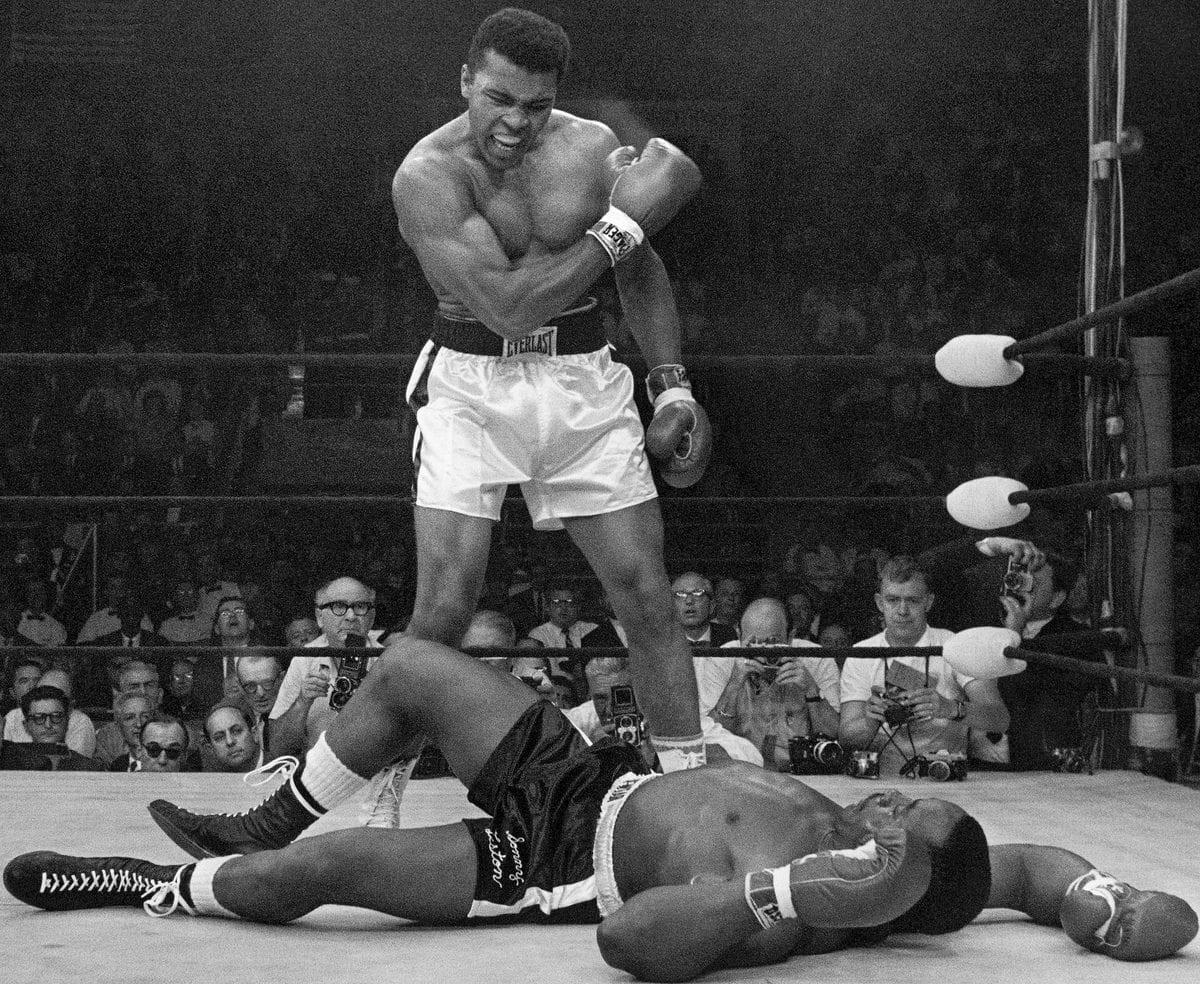
That Sonny Liston was not truly knocked out but went down on purpose, faking the effect of a punch that either missed or landed too lightly to fell a man of his size, and that he did so under pressure: to satisfy gambling or mob debts, out of fear of the Nation of Islam, or in exchange for a cut of Ali's future earnings. On this reading the "phantom punch" is aptly named because there was no real knockout blow at all, and the confusion of the count simply gave a prearranged surrender the appearance of a boxing result.
This is one of boxing's oldest unresolved arguments, and it stays unresolved for a reason. The knockdown was real and caught on film, and a row of qualified ringside witnesses, including two champions and a Sports Illustrated writer, insisted the short right hand landed cleanly. But the ending was a shambles: a referee who never counted, a timekeeper and a magazine publisher arguing over the seconds, and a fighter with a documented history of mob ties who many believed simply quit. No proof of a fix has ever surfaced, yet no account has fully put the suspicion to rest. As a claim that Liston deliberately lost, it remains genuinely disputed.
Believed by: A large share of boxing fans and some historians still suspect a dive, while many analysts and several credentialed ringside witnesses maintain the punch was legitimate; the sport itself has never reached a consensus
The full story
Nobody in the arena saw it, and the camera did
The nickname is the argument. A punch that thousands of paying spectators missed, that Liston himself could not describe afterwards, and that ended a heavyweight championship in under two minutes invites the obvious inference: there was no punch.
The film says otherwise. Slow-motion footage from the era shows Ali's right hand connecting with the side of Liston's jaw. Sports Illustrated's Tex Maule wrote that the blow carried enough force to lift Liston's weight-bearing left foot clear of the canvas, which is a mechanical detail rather than an impression, and one that a fighter choosing to fall does not produce. Ringside judgement went the same way from people with no stake in protecting Ali: Floyd Patterson and Jose Torres, both champions who knew what a knockdown looks like from a few feet away, said the punch landed.
What makes it invisible is what makes it effective. Ali threw a short, chopping right over a lead that Liston had already committed to, travelling perhaps a foot, at a moment when most of the crowd was watching the fighters' feet. Speed and brevity are why nobody saw it. They are not evidence that it was not there.
A count that never happened
The chaos afterwards is real and it is the strongest thing the fix theory has, because a bout that ends in visible disorder looks like a bout nobody had rehearsed properly.
The disorder traces to officiating rather than to a script. Jersey Joe Walcott, a former heavyweight champion but an inexperienced referee for an occasion of this size, never established a count. He could not hear the timekeeper over the arena, spent critical seconds trying to move Ali to a neutral corner, and then turned to Ring editor Nat Fleischer at ringside to ask what the tally was. By the time he stopped the fight, Liston had already got up.
Read that sequence carefully and it cuts the other way. A staged knockout requires the loser to stay down; Liston rose. The fight was waved off after he had risen, on the say-so of a magazine editor at ringside, because the official responsible had lost the count. That is a failure of administration producing an ending nobody could have planned, which is close to the opposite of a fix.
What Liston's record does and does not establish
Sonny Liston's connections to organised crime were real and are documented, and the suspicion around him was not invented after the fact. Former FBI agent William F. Roemer Jr. is on record saying investigators believed there very definitely had been a fix, and later documentaries carried secondhand mob claims that the fight would end in the first round.
None of that is proof, and it is worth being precise about why. A man with those associations is a plausible candidate for a fix, which is a statement about prior probability rather than about this fight. No payment has ever been traced, no participant has confessed, no prosecution followed, and the secondhand accounts appear decades later in a genre with obvious incentives to embellish. Roemer's belief is a belief held by someone well placed to have one, which is meaningful and is not the same as a finding.
The honest position holds two things together. Liston's history makes the theory reasonable to entertain. The film, the count and the absence of any traceable transaction make it impossible to establish. That is why this file rates the claim disputed rather than debunked: the case does not collapse, it simply never closes.
Two minutes that could not carry the weight
Some events are too small for the meaning attached to them. A heavyweight championship rematch, in a small arena in Lewiston, Maine, ended in one hundred and five seconds, and a public that had bought a war got a blur.
The moment also arrived loaded. Ali's ties to the Nation of Islam were a national controversy, Malcolm X had been killed three months earlier, and the atmosphere around the fight was thick with rumour about threats and pressure. A crowd primed to believe something dark was happening was handed an ending nobody could see.
Then the photograph did the rest. Neil Leifer's image of Ali standing over Liston, arm cocked, shouting down at him, is one of the most reproduced sports photographs ever taken, and it shows the aftermath rather than the punch. Generations have therefore encountered the fight as a picture of a man on the canvas with no visible reason for being there.
Unsolved is not the same as suspicious
Set out what is actually known and the case looks less like a mystery than like a mess. A real punch landed, on film, with corroboration from expert witnesses at ringside. A referee lost the count and stopped the fight after the fallen man had risen. A fighter with a documented past and no traceable payment took the loss and never explained it.
Nothing in that requires a conspiracy, and nothing in it excludes one. The rating here reflects that evenly. What can be said is that the two pieces of evidence people find most persuasive, that nobody saw the punch and that the ending looked wrong, both dissolve on inspection into ordinary explanations: a fast short right, and an official out of his depth.
Watch
What's still unexplained
- Why did Liston stay down? Defenders point to a genuine flash knockout from a sharp counter; doubters note he seemed alert moments later. Sixty years on, film and eyewitnesses still support both readings, and there is no way to settle what was happening inside a dead man's head.
- How much weight should decades-later fix claims carry? The mob and Nation of Islam theories rest largely on secondhand recollections and later books rather than contemporaneous documentation. In the absence of any charge or official finding, it remains unresolved how seriously to take testimony recorded so long after the night.
- Did the officiating chaos create the legend more than the punch did? A competently managed count might have produced an ordinary-looking knockout and no lasting scandal. It is an open question how much of the "fix" suspicion is really an artifact of Walcott's mishandled finish rather than anything Liston did.
Point by point
The claim: The punch was a phantom: it either missed or was far too light to knock out a fighter as big and durable as Liston.
What the record shows: Slow-motion film from the era shows Ali's right hand connecting with the side of Liston's jaw. Sports Illustrated's Tex Maule wrote that the blow carried enough force to lift Liston's weight-bearing left foot off the canvas, and ringside witnesses including former champion Floyd Patterson, light-heavyweight champion Jose Torres, and columnist Larry Merchant said they saw a clean, fast right hand land. Merchant and ringside doctors described it as a textbook short counter to the jaw, the kind that can produce a sudden knockout. The punch being hard to see from a distance is not the same as the punch not landing.
The claim: A real knockout would never look that strange; the confusion at the finish proves the whole thing was staged.
What the record shows: The confusion is documented, but it traces to officiating failure, not a script. Walcott, a former heavyweight champion refereeing a huge bout, never established a count and could not hear the timekeeper. He turned to Fleischer at ringside for the tally and then stopped the fight well after Liston had actually risen. By any modern standard the finish was botched. That mess makes the result look suspicious, but a chaotic count is evidence of poor refereeing, which is common, not of a prearranged dive, which would require far more.
The claim: Liston had motive and the means to take a dive: he owed the mob, and investigators concluded the fight was fixed.
What the record shows: Liston's ties to organized-crime figures earlier in his career are well documented, and fix allegations are real: former FBI agent William F. Roemer Jr. is quoted saying investigators believed "there very definitely had been a fix," and later documentaries aired secondhand mob claims that the bout would end in round one. But no charge, indictment, or official finding of a fixed fight was ever produced, and secondhand recollections decades later are not proof. Motive and reputation raise suspicion; they do not establish that this particular knockdown was faked.
The claim: Liston went down out of fear, not for money: he believed the Nation of Islam would kill him, or him and his family, if he beat Ali.
What the record shows: The atmosphere was genuinely charged. The rematch followed Malcolm X's assassination, Liston's camp said it had received threats, and authors such as Paul Gallender later claimed Nation of Islam pressure or intimidation drove Liston to lose. These accounts are contested and rest largely on later testimony rather than contemporaneous proof. They describe a plausible climate of fear, but a climate of fear is not documentation that Liston chose to fall from a punch he could have taken.
The claim: The first fight was also a quit job, so the pattern shows Liston made a habit of surrendering to Ali.
What the record shows: In the 1964 bout Liston retired on his stool before the seventh round citing a shoulder injury, and doctors diagnosed a torn tendon in his left shoulder; a minority still suspected he quit deliberately, but no evidence such as a telling shift in the betting odds ever supported a fix. Two disputed endings against the same opponent feed the suspicion of a pattern, yet each has an innocent explanation on the record, and neither has ever been proven a fraud. A pattern of doubt is not a pattern of proven dives.
Timeline
- 1964-02-25Cassius Clay, a roughly 7-to-1 underdog, upsets Sonny Liston in Miami Beach when Liston quits on his stool before the seventh round, citing a shoulder injury. Doctors diagnose a torn tendon in the left shoulder, but a minority immediately wonders aloud whether Liston, a former champion with a criminal past and mob associations, threw the fight. The seed of suspicion is planted a year before the rematch.
- 1964-03Days after the win, the new champion announces his conversion to the Nation of Islam and takes the name Muhammad Ali. The rematch will be staged against a backdrop of intense racial and religious tension, heightened after the February 1965 assassination of Malcolm X, a former Nation of Islam figure who had become Ali's estranged mentor.
- 1965-05-25Before a tiny crowd at the Central Maine Youth Center in Lewiston, Maine, one of the smallest ever for a heavyweight title fight, Ali drops Liston with a short right hand at 1:44 of the first round. Many spectators, and Liston himself, say they never saw it. Ali stands over the fallen champion, waving a glove and yelling at him to get up and fight.
- 1965-05-25The count collapses into chaos. Referee Jersey Joe Walcott, busy trying to move Ali to a neutral corner, never picks up a count. Timekeeper Francis McDonough counts on his own; Ring Magazine publisher Nat Fleischer, seated beside him, shouts to Walcott that Liston had been down past ten. Liston rises at about 1:56, the fighters briefly square off, and Walcott stops the bout at 2:12, awarding Ali a knockout.
- 1965-05-26Newspapers and radio erupt with cries of "fix" and "fake." Because the punch was so fast and the count so garbled, the knockout is widely portrayed as a fraud. The label "phantom punch" spreads within days and sticks permanently.
- 1965Sports Illustrated's Tex Maule, reviewing film, argues the punch was real and hard, writing that it lifted Liston's weight-bearing left foot off the canvas. Ringside champions Floyd Patterson and Jose Torres, and columnist Larry Merchant, say they saw a clean, legitimate right hand land on the jaw. The defenders and the doubters split, and the split never closes.
- 1970-12-30Sonny Liston is found dead at his Las Vegas home; the body is discovered in early January 1971. The official causes are listed as heart failure and lung congestion, with heroin also found. His murky death revives every old theory about his life, including the fix talk around Lewiston, and gives the phantom-punch legend a darker afterlife.
- 1995An HBO documentary and later accounts air specific fix allegations: former FBI agent William F. Roemer Jr. states investigators concluded "there very definitely had been a fix," and gym figures recount mobster claims that the fight would end in the first. Separately, author Paul Gallender and others advance the theory that Nation of Islam threats, not the mob, drove Liston to lose. None of it is ever proven in court or by any official finding.
This is one of boxing's oldest unresolved arguments, and it stays unresolved for a reason. The knockdown was real and caught on film, and a row of qualified ringside witnesses, including two champions and a Sports Illustrated writer, insisted the short right hand landed cleanly. But the ending was a shambles: a referee who never counted, a timekeeper and a magazine publisher arguing over the seconds, and a fighter with a documented history of mob ties who many believed simply quit. No proof of a fix has ever surfaced, yet no account has fully put the suspicion to rest. As a claim that Liston deliberately lost, it remains genuinely disputed.
Reviewed by Colin Peterson · Last reviewed September 2, 2026 · How we rate
Common questions
Is Liston's "phantom punch" true?
This is one of boxing's oldest unresolved arguments, and it stays unresolved for a reason. The knockdown was real and caught on film, and a row of qualified ringside witnesses, including two champions and a Sports Illustrated writer, insisted the short right hand landed cleanly. But the ending was a shambles: a referee who never counted, a timekeeper and a magazine publisher arguing over the seconds, and a fighter with a documented history of mob ties who many believed simply quit. No proof of a fix has ever surfaced, yet no account has fully put the suspicion to rest. As a claim that Liston deliberately lost, it remains genuinely disputed.
What is Liston's "phantom punch"?
On May 25, 1965, Muhammad Ali knocked Sonny Liston down in the first round of their rematch in Lewiston, Maine, with a short right hand so quick that much of the crowd never saw it, the blow forever after called the "phantom punch." The finish was chaotic: referee Jersey Joe Walcott lost track of the count, Liston rose and was then ruled…
What does the evidence show?
Slow-motion film from the era shows Ali's right hand connecting with the side of Liston's jaw. Sports Illustrated's Tex Maule wrote that the blow carried enough force to lift Liston's weight-bearing left foot off the canvas, and ringside witnesses including former champion Floyd Patterson, light-heavyweight champion Jose Torres, and colu…
Why do people believe it?
The punch really was hard to see. When thousands of spectators and even the man on the receiving end say they missed the blow, a knockout with no visible cause invites the natural conclusion that there was no real cause at all.
What is still unresolved?
Why did Liston stay down? Defenders point to a genuine flash knockout from a sharp counter; doubters note he seemed alert moments later. Sixty years on, film and eyewitnesses still support both readings, and there is no way to settle what was happening inside a dead man's head.
Sources
- 1.A quick, hard right and a needless storm of protest, Sports Illustrated (2015)
- 2.Muhammad Ali, Sonny Liston and the 'Phantom Punch' Title Bout, 1965, Time (2015)
- 3.Muhammad Ali vs. Sonny Liston, Wikipedia (2026)
- 4.Ali's "Phantom Punch" Controversy Explained, PBS
- 5.May 25, 1965: Ali vs Liston II, Phantom Punch Or Fix?, The Fight City
- 6.The Phantom Punch Hits 50: Ali, Liston and Boxing's Most Controversial Fight Ever, Bleacher Report (2015)
- 7.Ali v. Liston II: A Controversial Encore, Muhammad Ali Center
- 8.Muhammad Ali, Sonny Liston, and the Legacy of the 'Phantom Punch', BET
- 9.Young Muhammad Ali knocks out Sonny Liston for first world title, History.com
Embed this case file on your site
Paste this snippet to show this case file as a small card, with a link back to the full write-up. Free to use.
<iframe src="https://theconspiratory.com/embed/ali-liston-phantom-punch" title="The Conspiratory verdict" width="520" height="190" style="border:0;max-width:100%" loading="lazy"></iframe>Help us investigate
This is a living case file. If you spot an error or know evidence we missed, tell us, and weigh in on where you land.
Where do you land?
Cast your read on this one.
Comments
Add your take. Comments are read and approved by a human before they appear, so keep it on topic and civil. Please do not accuse named, living people of crimes.