The Axeman of New Orleans was a single serial killer who terrorized the city in 1918 and 1919 and was never caught
By Colin PetersonJuly 8, 2026
Where the evidence lands →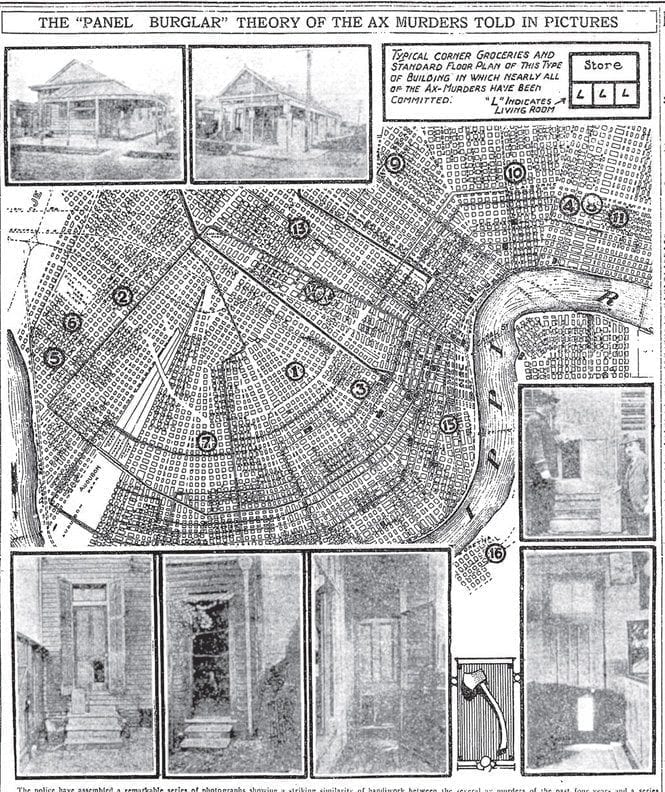
That the New Orleans attacks of 1918 and 1919 were the work of one serial killer, the Axeman, operating to a consistent method and motive; that this figure authored the famous jazz letter; and, in the most popular version, that his identity was eventually discovered even though he was never brought to trial.
Between May 1918 and October 1919 a series of nighttime axe and hatchet attacks, several of them fatal, struck households in and around New Orleans, many of them Italian immigrant grocers. That much is documented in contemporary police records and newspapers. The claim we rate is narrower and larger: that the attacks were all the work of one person, dubbed the Axeman, whose identity was later established. On the evidence the case is unproven. No attacker was ever charged and convicted for the string of crimes, no single hand across all the incidents was ever proved, and the best-known named suspect rests on a story that later researchers could not verify. The crimes are real and remain officially unsolved; the popular narrative that ties them into one solved-but-hidden figure is not supported.
Believed by: A broad general audience of true-crime and local-history readers; New Orleans cultural memory treats the case as a defining local mystery, and the jazz-letter episode is widely retold
The full story
What the record actually shows
Start with what is not in dispute. Between May 1918 and October 1919, a series of nighttime attacks struck households in New Orleans and its surrounding towns. Intruders entered homes, often through a rear door or a chiseled panel, and struck sleeping occupants with an axe or hatchet, frequently a tool already kept on the property. Several people were killed and others were gravely injured. Many, though not all, of the households were those of Italian immigrant grocers who lived behind or above their shops.
These crimes are recorded in contemporary police reports and in the city's newspapers, which soon began linking the incidents and gave the unknown assailant a name: the Axeman. Out of respect for the victims and their descendants, this file does not dwell on the details of the injuries. The essential, sober fact is enough: real people were harmed in their homes, and no one was ever convicted for the series.
So the question here is not whether the attacks happened. They did. The question is whether the familiar story built on top of them, that this was one identifiable serial killer whose name is now known, is supported by the evidence, or whether it is a legend that grew in the retelling.
The case for one killer
The single-Axeman reading did not come from nowhere. Look across the incidents and a family resemblance appears: an axe or hatchet taken up at the scene, entry forced at the back of the house, attacks on sleeping victims in the small hours, and a striking cluster of Italian grocer households. To investigators and reporters living through it, that pattern read like a signature.
Then came the letter. In mid-March 1919 a New Orleans paper printed a note signed by someone claiming to be the killer, written in florid, theatrical language and promising to spare any home where jazz was playing on the night of March 19. The city answered with music. Dance halls sold out, house parties filled the blocks, and by the accounts that survive, no attack was reported that night. Whoever wrote it, the letter and the response are real, and they gave the case a voice and a personality.
A shared method, a taunting letter, and a city playing jazz in the dark to save itself: it is one of the most cinematic true-crime stories America has, and its shape is exactly what makes a single villain feel inevitable.
The honest version of the believer's case is not that the killer was identified beyond doubt. It is that the crimes clustered in time, place, method, and victim type tightly enough that a single hand is a reasonable hypothesis, and that the fear was real enough to make an entire city dance.
Where the neat story loosens
A reasonable hypothesis is not a proven fact, and the gap between the two is where this case actually lives. The similarities that bind the incidents are real but loose. Axe attacks and break-ins at small grocers were not the property of a single offender in that era, victim accounts differed, and the newspapers themselves did much of the linking, deciding which crimes belonged to the story and which did not. Some incidents folded into the legend may have been separate crimes or copycats. No forensic thread was ever run through the whole series.
The investigations that did proceed tended to fall apart. One grocer was arrested and charged after an attack at his premises, then acquitted. In the Gretna case, a survivor accused neighbors who were convicted and then freed when she took the accusation back. These are not the marks of a case closing in on one culprit; they are the marks of a frightened city and an overstretched inquiry reaching, more than once, for the wrong answer.
The jazz letter, the emotional center of the whole legend, is on the shakiest ground of all. Its authorship was never verified. It has long been suspected of being a hoax or a press-driven stunt, with a local musician among the names floated as the real writer. A dramatic letter proves the city was gripped by fear and by its newspapers. It does not prove there was one killer, and it certainly does not name him.
The suspect who dissolves on inspection
The most popular version of the story goes further than one killer: it claims the Axeman was eventually identified, even though he never stood trial. Because a real person's name is attached to that claim, it deserves careful handling, and this file will not repeat an accusation the record cannot support.
The identification rests largely on a single named suspect popularized by a 1946 book and by later crime writers, tied to a supposed 1921 revenge killing in Los Angeles in which the widow of one victim was said to have shot him dead. It is a satisfying ending. It is also, on examination, unsupported. A true-crime researcher who searched New Orleans and Los Angeles public, police, and court records and newspaper archives could not find evidence of the man, of the Los Angeles shooting, or of the widow said to have carried it out.
An identification that vanishes when someone checks the archives is not an identification. It is a story. Naming a specific person as the killer, in these circumstances, is exactly the move a neutral account should refuse: there was no trial, no conviction, and no verified documentary basis, and the person so named is entitled to the same presumption of innocence as anyone else the record cannot convict.
Why the legend endures
Unsolved violence leaves a vacuum, and human beings are poor at tolerating one. A scatter of separate, unexplained attacks is genuinely harder to live with than a single, knowable villain, so the mind consolidates: it prefers one Axeman with a method and a motive to the messier, more frightening possibility that several bad things happened and no one was ever held to account.
The jazz motif did the rest. Few true-crime stories come with a set piece as vivid as a whole city playing music in the dark to ward off a killer, and that image, tying the case to the birthplace of jazz, guaranteed it would be retold forever. Retelling smooths. Each version rounds off the ambiguity a little more, until the named suspect and the tidy ending arrive as if they were settled fact.
And New Orleans, more than most places, keeps its ghosts. The Axeman lives on in tours, songs, and local lore as a character rather than a case file, and a good character does not need footnotes. The result is a legend that is far more certain than the evidence beneath it, which is precisely the pattern this project exists to name.
Unsolved, not one known hand
Hold the two things apart. The crimes are real. In 1918 and 1919, people in and around New Orleans were attacked in their homes and killed, and the case is, to this day, officially unsolved. Nothing here diminishes that, and the victims deserve to be remembered as people, not as props in a ghost story.
The claim we rate is the larger one: that all the incidents were a single serial killer, that he authored the jazz letter, and that his identity was ultimately discovered. The shared method is suggestive but never proved to be one hand, the letter's authorship was never established, the Mafia motive is a hypothesis rather than a finding, and the famous named suspect rests on a story that later research could not confirm. No one was tried and convicted for the series.
That is not a cover-up and it is not a solution. It is the honest state of a hundred-year-old cold case: a real and terrible sequence of crimes, a city's unforgettable response, and a legend that has grown far more confident than the record it stands on. The right posture is to hold the fear and the loss as real, and to decline the neat ending the evidence has never earned.
What's still unexplained
- How many of the 1918 and 1919 attacks were truly the work of one person, and how many were separate crimes or copycats swept into the same story by the press, is something the surviving records cannot settle.
- Who actually wrote the jazz letter, whether the real attacker, a hoaxer, or someone connected to a newspaper, was never established and probably cannot be now.
- Whether an organized-crime or anti-Italian motive drove any of the attacks, as opposed to ordinary robbery of cash-holding grocers, remains an open historical question rather than a proven one.
Point by point
The claim: All the 1918 and 1919 attacks were committed by the same person, following one signature method.
What the record shows: The shared features are real but loose. Many attacks involved an axe or hatchet, often a tool found at the home, forced entry through a rear door or panel, and Italian grocer households. Those similarities drove the single-killer framing at the time. But axe attacks and burglaries of small grocers were not unique to one hand in that era, victim accounts and details varied, and some incidents folded into the legend may have been separate crimes or copycats. A common method across cases is suggestive; it is not proof of one attacker, and no forensic link across the series was ever established.
The claim: The jazz letter proves a taunting, theatrical killer was behind the attacks.
What the record shows: The letter exists and was printed in a New Orleans paper in mid-March 1919, and the jazz-filled night that followed is well documented. What is not established is that the real attacker wrote it. Its authorship was never verified, and it has long been suspected of being a hoax or a newspaper-driven stunt, with a local musician among those floated as the writer. A dramatic letter making the rounds tells us the city was gripped by fear and by the press; it does not identify or even confirm a single perpetrator.
The claim: The Italian-grocer pattern shows the crimes were an organized Mafia or Black Hand campaign.
What the record shows: Several victims were Italian immigrant grocers, and organized-crime extortion against that community existed in the period, so contemporaries and later writers reached for the Mafia. But the pattern also has a simpler read: grocers kept cash and lived behind or above their shops, making them targets for ordinary robbery, and the Italian-community focus may partly reflect which crimes the press chose to link. The Mafia framing is a plausible hypothesis that was never proved, not a demonstrated fact.
The claim: The identity of the Axeman was eventually discovered, even though he was never tried.
What the record shows: This rests mainly on a single named suspect popularized by mid-century and later crime writers, tied to a supposed 1921 revenge killing in Los Angeles. When a true-crime researcher searched New Orleans and Los Angeles public, police, and court records and newspaper archives, he could not find evidence for the man, the Los Angeles shooting, or the widow said to have carried it out. The most-repeated solution therefore has no verified documentary basis and is now widely treated as an urban legend. The case remains officially unsolved.
The claim: That the attacks stopped after October 1919 shows a single killer had been stopped.
What the record shows: The series does appear to end in late 1919, which the legend reads as a lone offender dying, moving, or being killed. But a cluster of crimes ending is consistent with many explanations: heightened policing and public vigilance, an arrest for an unrelated offense, a move, a death from any cause, or the simple fact that loosely linked separate crimes were never one campaign to begin with. An ending is not, by itself, an identification.
Timeline
- 1918-05On the night of May 22 to 23, 1918, Joseph Maggio, an Italian grocer, and his wife Catherine were attacked in their living quarters and did not survive. An axe and a razor found at the scene became the template newspapers would use to link later cases.
- 1918-06On June 27, 1918, Louis Besumer, a grocer, and Harriet Lowe were attacked in rooms behind his store. Both were gravely hurt. Besumer was later arrested and charged over Lowe's death but was acquitted in 1919, an early sign of how uncertain the investigation was.
- 1918-08Through the late summer of 1918 further nighttime attacks and prowler reports were recorded across the city and suburbs. Newspapers began treating the incidents as a single campaign and gave the unknown assailant the name that stuck: the Axeman.
- 1919-03-10In Gretna, across the river, Charles and Rosie Cortimiglia and their infant daughter were attacked in their home. The parents survived; the child did not. Rosie later accused neighbors, who were convicted and then freed when she recanted, another line of inquiry that collapsed.
- 1919-03In mid-March 1919 a New Orleans newspaper printed a letter signed as the Axeman, styling its author a spirit and demon, and promising to spare any household playing jazz at a set hour on the night of March 19. Its true authorship was never established.
- 1919-03-19On the night named in the letter, dance halls filled and bands played across the city. No attack was reported that night. The episode fused the killings to jazz in popular memory and inspired a piece of sheet music published soon after.
- 1919-10On the night of October 27, 1919, Mike Pepitone was attacked and killed at home, the last incident commonly attributed to the Axeman. No one was ever convicted for the series, and the attacks then stopped as abruptly as they had begun.
- 1921-12In December 1921 a Los Angeles killing was later linked, in retellings, to a man named as an Axeman suspect. Decades on, researchers combing the records could not confirm the man, the shooting, or the connection, and the story is now widely regarded as legend.
From the case file
The actual records: declassified, released, or leaked. We link straight to each document in its official archive, so you never have to take our word for it. Read the originals yourself.
Between May 1918 and October 1919 a series of nighttime axe and hatchet attacks, several of them fatal, struck households in and around New Orleans, many of them Italian immigrant grocers. That much is documented in contemporary police records and newspapers. The claim we rate is narrower and larger: that the attacks were all the work of one person, dubbed the Axeman, whose identity was later established. On the evidence the case is unproven. No attacker was ever charged and convicted for the string of crimes, no single hand across all the incidents was ever proved, and the best-known named suspect rests on a story that later researchers could not verify. The crimes are real and remain officially unsolved; the popular narrative that ties them into one solved-but-hidden figure is not supported.
Reviewed by Colin Peterson · Last reviewed July 8, 2026 · How we rate
Common questions
Is The Axeman of New Orleans true?
Between May 1918 and October 1919 a series of nighttime axe and hatchet attacks, several of them fatal, struck households in and around New Orleans, many of them Italian immigrant grocers. That much is documented in contemporary police records and newspapers. The claim we rate is narrower and larger: that the attacks were all the work of one person, dubbed the Axeman, whose identity was later established. On the evidence the case is unproven. No attacker was ever charged and convicted for the string of crimes, no single hand across all the incidents was ever proved, and the best-known named suspect rests on a story that later researchers could not verify. The crimes are real and remain officially unsolved; the popular narrative that ties them into one solved-but-hidden figure is not supported.
What is The Axeman of New Orleans?
For roughly eighteen months in 1918 and 1919, residents of New Orleans lived under the shadow of a series of nighttime attacks in which intruders broke into homes, frequently those of Italian immigrant grocers, and struck sleeping occupants with an axe or hatchet, often a tool already on the premises. Several people were killed and other…
What does the evidence show?
The shared features are real but loose. Many attacks involved an axe or hatchet, often a tool found at the home, forced entry through a rear door or panel, and Italian grocer households. Those similarities drove the single-killer framing at the time. But axe attacks and burglaries of small grocers were not unique to one hand in that era,…
Why do people believe it?
The core facts are genuinely frightening and genuinely unsolved. Real people were attacked in their beds, several fatally, and no one was ever convicted, which leaves a vacuum that a clean single-villain story rushes to fill.
What is still unresolved?
How many of the 1918 and 1919 attacks were truly the work of one person, and how many were separate crimes or copycats swept into the same story by the press, is something the surviving records cannot settle.
Sources
- 1.Axeman of New Orleans, Wikipedia (2024)
- 2.The Mysterious Axman's Jazz, The Historic New Orleans Collection (2019)
- 3.The history of Axman, a New Orleans serial killer in 1918, NOLA.com / The Times-Picayune (2024)
- 4.The Axeman of New Orleans, Country Roads Magazine (2019)
- 5.The Axe Murderer Who Loved Jazz, WBUR, Endless Thread (2018)
- 6.The Axeman of New Orleans, Legends of America (2023)
- 7."The Axeman Cometh": New Orleans Residents Play Jazz All Night to Placate a Serial Killer, American Songwriter (2023)
- 8.The Axman of New Orleans (text of the 1919 letter), The Louisiana Anthology (1919)
Embed this case file on your site
Paste this snippet to show this case file as a small card, with a link back to the full write-up. Free to use.
<iframe src="https://theconspiratory.com/embed/axeman-of-new-orleans" title="The Conspiratory verdict" width="520" height="190" style="border:0;max-width:100%" loading="lazy"></iframe>Help us investigate
This is a living case file. If you spot an error or know evidence we missed, tell us, and weigh in on where you land.
Where do you land?
Cast your read on this one.
Comments
Add your take. Comments are read and approved by a human before they appear, so keep it on topic and civil. Please do not accuse named, living people of crimes.