A snapping turtle the size of a dining table, nicknamed Oscar, lived in a lake near Churubusco, Indiana, and eluded every attempt to catch it
By Colin PetersonJuly 8, 2026
Where the evidence lands →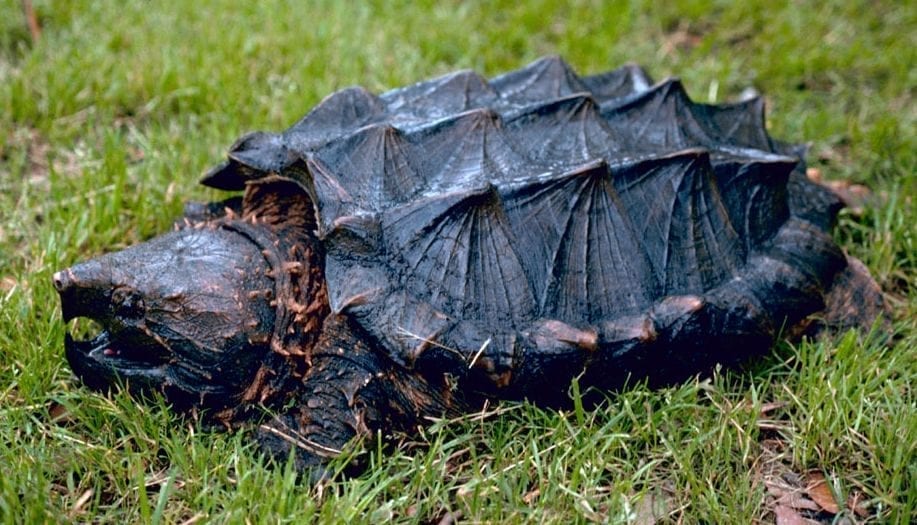
That a single, extraordinarily large snapping turtle, weighing on the order of 500 pounds and far exceeding any documented freshwater turtle native to the region, lived in Fulk Lake near Churubusco, Indiana in 1948 and 1949, was seen by multiple credible witnesses, and repeatedly evaded capture during a month-long hunt.
The events are real and well documented: in 1948 and 1949 residents of Churubusco, Indiana reported an enormous snapping turtle in Fulk Lake, and a chaotic, nationally covered hunt followed. What remains unproven is the extraordinary claim at the heart of the legend, that the animal was a turtle of roughly 500 pounds, a size no freshwater turtle native to Indiana approaches. The creature was never captured, weighed, photographed clearly, or otherwise physically confirmed, so the giant-turtle claim cannot be substantiated. The most likely reading, that witnesses saw a genuinely large but ordinary snapping or soft-shell turtle whose size grew in the retelling, fits the evidence better than a record-shattering monster. This file rates the specific claim, not the town, the witnesses, or the fond festival the story left behind.
Believed by: The town of Churubusco embraced the story wholeheartedly and still celebrates it, and the legend is a fixture of Indiana folklore and popular cryptid roundups, though it is generally told as beloved local lore rather than pressed as literal zoology
The full story
What is documented
Start with what is not in dispute, because a surprising amount of this story is solid. In July 1948, two men fishing on Fulk Lake near Churubusco, Indiana, Ora Blue and Charley Wilson, reported seeing a snapping turtle of unusual size. The lake belonged to a farmer named Gale Harris, who said he and others saw the creature too. The name attached to it, Oscar, nodded back to Oscar Fulk, an earlier owner who was said to have described a giant turtle in the same water around the turn of the century.
In the spring of 1949 a Fort Wayne wire-service reporter put the tale on the national wires, and it became a genuine sensation. Newspapers across the country followed the hunt. Harris tried, in turn, to trap the animal behind stakes and chicken wire, to send a diver into the murk, and finally to drain the lake outright. A Life magazine photographer, Mike Shea, came and reportedly shot hundreds of frames. Crowds gathered at the farm.
And then nothing was caught. Traps came up empty, the diving attempt was undone by the wrong equipment, a dam broke, rain refilled the basin, and Harris fell ill with appendicitis. A pair of men who claimed to have captured the beast turned out to be showing off a purchased sea turtle. By late 1949 the hunt was over. So the question this file weighs is not whether any turtle was seen. It is whether the specific, legendary claim, a snapping turtle of around 500 pounds, has anything behind it beyond estimate and retelling.
The case for a real giant
The believer's case is more respectable than most cryptid stories can claim, and it deserves stating fairly. These were not anonymous rumors. The first witnesses were named local men, fishing a lake they knew, and the landowner himself said he saw the animal. Several people, over more than one season, described the same thing: a very large turtle.
The response was not idle gossip either. Harris poured real money, labor, and eventually his own health into catching the creature, draining his own lake to do it. People do not usually dike off and pump out a body of water over a fish story they do not believe. The sincerity of the effort is itself a kind of testimony.
There is even a plausible natural candidate. An alligator snapping turtle, the largest freshwater turtle on the continent, can reach a couple hundred pounds and look genuinely prehistoric. If one had somehow reached that Indiana lake, far outside its native range, it would have been a shocking sight to anyone who found it lurking in the mud, and it could easily anchor every honest report of something huge.
Named neighbors, a landowner who drained his own lake, and a real species big enough to startle anyone: the impulse to believe something large was down there is not foolish. The question is only how large.
That is the strongest version: not that a 500-pound monster is proven, but that a real and unusually big turtle plausibly lived in Fulk Lake, seen by credible people and hunted in earnest, and that dismissing the whole affair as invention would be unfair to the record.
Where the giant claim breaks down
The trouble is the number. A believable core (a big turtle, sincerely reported) got wrapped in an unbelievable figure, and it is the figure the legend rests on. No freshwater turtle native to Indiana comes close to 500 pounds. Common snapping turtles, which do live there, rarely pass 35 to 50 pounds. Even the alligator snapping turtle, which does not, tops out around 200 to 250 and lives hundreds of miles to the south.
The reported weight also grew over time, from an already remarkable 500 pounds toward tales of a thousand-pound relic. That trajectory is the signature of a tall tale ripening, not of a fact being confirmed. Real measurements shrink or stabilize as evidence comes in; legends inflate, because nothing is anchoring them.
And nothing ever did anchor this one. No animal was landed. No clear photograph emerged, despite a professional shooting hundreds of frames and crowds carrying their own cameras. No body, no shell, no measurement. The one apparent capture was a hoax. In an event this heavily attended, the complete absence of a single clear image of a surfacing giant is not a neutral gap; it is evidence against the giant.
The failures of the hunt, so often cited as proof of a cunning beast, have flatly ordinary explanations. A muddy, weed-choked lake hides any turtle. The draining collapsed because a dam broke and rain fell, and because the man leading it got sick, not because the quarry outmaneuvered anyone. You do not need a monster to explain why people failed to find a turtle in murky water.
How a turtle grows in the telling
It is worth dwelling on the mechanism, because it explains the whole case without anyone lying. Size estimates of half-submerged reptiles are among the least reliable things a witness can offer. Wildlife handlers report the pattern constantly: someone insists a snapping turtle is 100 pounds, and the scale says 30. Fear, murky water, and a fast glimpse all push the estimate up.
Now add the social machinery. A striking first report gets repeated, and each repetition rounds the number upward, because a bigger turtle is a better story and no one present can check it against a scale. A wire reporter files it, national papers amplify it, and crowds arrive already primed to see something enormous, so a shell breaking the surface reads as vast. The estimate becomes a fact by being said often, not by being measured.
None of this requires a hoax at the core. It only requires an ordinary large turtle, an unreliable first guess, and an excited town with a newspaper deadline. That combination reliably manufactures a monster, and it fits every feature of the Beast of Busco better than a record-breaking reptile that left no trace.
A turtle you glimpse in muddy water and never weigh can be any size you fear it is. The legend did not need a lie, only a guess that nobody could correct.
Why the legend endures
The most interesting fact about the Beast of Busco may be that its failure to resolve is exactly why it survives. An unsolved, good-natured mystery is a renewable resource, and Churubusco had the wisdom to adopt rather than debunk it.
Part of the appeal is that Oscar is a gentle monster. A giant turtle threatens no one; it is more curiosity than menace, a creature a whole town can root for and even love. That warmth is unusual in monster lore and makes the story easy to pass to children, put on a float, and print on a T-shirt.
Part is civic identity. Beginning around 1950 the town leaned in, styling itself Turtle Town and building the annual Turtle Days festival, with turtle races and a parade, around Oscar. The legend stopped being a claim to be settled and became a tradition to be kept. A community with a festival riding on a mystery has every reason to leave it a mystery.
And part is the pure pleasure of the one-that-got-away. The tale of a giant creature almost caught, foiled by a broken dam and a rainstorm, is a shape people love to tell. It asks nothing and rewards the telling, which is why it has outlived everyone who was standing at the lake in 1949.
A real hunt, an unproven giant
Hold the two claims apart. That residents saw a large turtle in Fulk Lake and mounted a real, nationally covered hunt for it is documented and true. That the animal was a roughly 500-pound giant, a turtle beyond anything science records for the region, is a different assertion, and it was never captured, weighed, clearly photographed, or otherwise confirmed. The extraordinary size rests on eyewitness estimates in murky water and on a figure that grew with each retelling, while the physical record is empty.
This is not a charge that anyone lied. The likeliest truth is ordinary and human: a genuinely big snapping or soft-shell turtle, glimpsed and misjudged, its size swelling through repetition until a town, a wire reporter, and a photographer had turned it into a legend. That is not fraud; it is how folklore is made, out of a real animal and an unmeasurable guess.
So Oscar keeps his place: not as a confirmed cryptid, but as a cherished local legend built on a real and unresolved event. The honest posture is to enjoy the story, credit the witnesses their sincerity, and decline the leap from a big turtle nobody could catch to a giant one nobody could prove. The turtle races each June are the fitting monument, a mystery a town chose to keep rather than close.
What's still unexplained
- How large was the turtle that witnesses actually saw? Reports of a genuinely big snapping or soft-shell turtle are plausible, and the honest unresolved question is where reality ended and the 500-pound figure began, not whether any turtle existed.
- Could the animal have been an out-of-range alligator snapping turtle, perhaps released or escaped, that was larger than the local norm? It would still fall well short of the legendary weight, but it is a natural candidate that has never been confirmed or ruled out.
- What became of the creature? If a large turtle was present, it may simply have died, buried itself, or lived out its life unseen after the water refilled. The lack of a body proves nothing either way and remains a small genuine loose end.
Point by point
The claim: Multiple credible local witnesses independently saw a turtle of extraordinary size, so something genuinely huge was in the lake.
What the record shows: Several residents did report a large turtle, and there is little reason to think they were lying about seeing an animal. But eyewitness size estimates of partly submerged reptiles are notoriously unreliable, especially in murky water and especially when the animal is unsettling. Naturalists note that people routinely guess a snapping turtle at 100 pounds when it weighs about 30. Honest sightings of a big turtle are entirely compatible with an ordinary animal; they do not establish a 500-pound one.
The claim: The turtle was estimated at around 500 pounds, making it a creature unknown to science in the region.
What the record shows: That figure is the core of the legend and the least supported part of it. The largest freshwater turtle in North America, the alligator snapping turtle, tops out around 200 to 250 pounds and is not native to northern Indiana. Common snapping turtles, which are native, rarely exceed 35 to 50 pounds. A 500-pound specimen would be a zoological sensation with no physical basis here, and later retellings inflated the figure further, toward a thousand-pound prehistoric monster, which is a hallmark of a growing tall tale rather than a firming fact.
The claim: A month-long, well-organized hunt shows people took the creature seriously and expected to catch it.
What the record shows: The hunt was real, earnest, and expensive in effort, and that sincerity is not in dispute. But effort is not evidence of the target. Every method tried, trapping, diving, netting, and draining, came up empty, and the one apparent capture was a hoax involving a purchased sea turtle. A hunt that produces no animal, no clear photo, and no measurement is consistent with there being no giant turtle at all, only a normal one, or with the target simply eluding capture. It cannot confirm the extraordinary claim.
The claim: A Life magazine photographer documented the site, lending the story national, journalistic weight.
What the record shows: National coverage confirms the story was a genuine sensation, not that the turtle was genuinely giant. The Life photographer reportedly shot hundreds of frames and produced nothing usable showing the animal. Press attention followed the human drama of the hunt, a stubborn farmer draining his lake before a crowd, which is inherently newsworthy regardless of what lived in the water. The absence of a single clear photograph, in an event swarming with cameras, weighs against a large, surfacing creature.
The claim: The turtle repeatedly evaded capture, suggesting an unusually large and cunning animal.
What the record shows: Repeated failure to catch it is better explained by ordinary difficulty than by an extraordinary quarry. Fulk Lake was murky and mud-bottomed, ideal cover for any turtle, which can bury itself and stay submerged for long stretches. The draining attempt collapsed for mundane reasons, a broken dam, rain, and the owner's illness, not because the animal outwitted anyone. Turtles are hard to find in muddy water whatever their size, so the escapes require no giant to explain them.
Timeline
- 1898According to local tradition, a farmer named Oscar Fulk reports seeing a giant turtle in the roughly seven-acre lake on his land near Churubusco, Indiana. He tells neighbors but lets the matter drop, and the story fades into local memory.
- 1948-07Two Churubusco men, Ora Blue and Charley Wilson, say they see a huge turtle while fishing on the same lake, by then known as Fulk Lake and owned by farmer Gale Harris. Their estimate of its size is enormous. Harris and others report seeing the creature as well.
- 1949A wire-service reporter out of Fort Wayne picks up the story and sends it onto the national wires. Newspapers across the country run the tale of the giant Indiana turtle, and Churubusco becomes briefly famous. The turtle is nicknamed Oscar, after Oscar Fulk.
- 1949-03Harris and volunteers make organized attempts to catch the turtle. Accounts describe cornering something large in shallow water inside a pen of stakes and chicken wire, though nothing is landed. An attempt to send a diver into the murky lake fails when the wrong equipment is delivered to the farm.
- 1949-03A photographer for Life magazine, Mike Shea, spends time at the site and reportedly shoots hundreds of frames. None of the images clearly document the turtle, and the pictures are deemed unusable. No clear photograph of Oscar is ever produced.
- 1949-04Two men from Indianapolis claim to have captured the beast, briefly appearing to end the hunt. The animal turns out to be a sea turtle they had obtained, an apparent attempt to cash in on the frenzy, and the hoax is quickly exposed.
- 1949Harris resorts to draining the lake, pumping water into a diked-off area and a drainage ditch. As the water drops toward mud, a dam gives way and the lake refloods. Harris also contracts appendicitis, and heavy rain refills the basin. The turtle, if it was ever there, is never recovered.
- 1949-10Newspaper accounts place the last reported sighting in mid-October, with the turtle said to have surfaced before a crowd. After that the hunt is effectively over. Oscar is never captured, weighed, or confirmed, and the episode passes into folklore.
- 1950Churubusco leans into its fame, adopting the identity of Turtle Town and launching what becomes the annual Turtle Days festival each June, complete with turtle races and a parade. The legend of Oscar is preserved and celebrated rather than resolved.
The events are real and well documented: in 1948 and 1949 residents of Churubusco, Indiana reported an enormous snapping turtle in Fulk Lake, and a chaotic, nationally covered hunt followed. What remains unproven is the extraordinary claim at the heart of the legend, that the animal was a turtle of roughly 500 pounds, a size no freshwater turtle native to Indiana approaches. The creature was never captured, weighed, photographed clearly, or otherwise physically confirmed, so the giant-turtle claim cannot be substantiated. The most likely reading, that witnesses saw a genuinely large but ordinary snapping or soft-shell turtle whose size grew in the retelling, fits the evidence better than a record-shattering monster. This file rates the specific claim, not the town, the witnesses, or the fond festival the story left behind.
Reviewed by Colin Peterson · Last reviewed July 8, 2026 · How we rate
Common questions
Is Beast of Busco true?
The events are real and well documented: in 1948 and 1949 residents of Churubusco, Indiana reported an enormous snapping turtle in Fulk Lake, and a chaotic, nationally covered hunt followed. What remains unproven is the extraordinary claim at the heart of the legend, that the animal was a turtle of roughly 500 pounds, a size no freshwater turtle native to Indiana approaches. The creature was never captured, weighed, photographed clearly, or otherwise physically confirmed, so the giant-turtle claim cannot be substantiated. The most likely reading, that witnesses saw a genuinely large but ordinary snapping or soft-shell turtle whose size grew in the retelling, fits the evidence better than a record-shattering monster. This file rates the specific claim, not the town, the witnesses, or the fond festival the story left behind.
What is Beast of Busco?
In the summer of 1948, two men fishing on Fulk Lake near Churubusco, Indiana said they had seen a snapping turtle of astonishing size, and the following spring the sighting exploded into a national spectacle. Over several weeks in 1949 the lake's owner, farmer Gale Harris, tried to trap, dive for, net, and finally drain the water to capt…
What does the evidence show?
Several residents did report a large turtle, and there is little reason to think they were lying about seeing an animal. But eyewitness size estimates of partly submerged reptiles are notoriously unreliable, especially in murky water and especially when the animal is unsettling. Naturalists note that people routinely guess a snapping tur…
Why do people believe it?
The sightings were real reports from real, named neighbors, not an anonymous rumor. When people you know say they saw something in the local lake, the story carries a weight that a distant tale never could, and the human sincerity at the center of it is genuine.
What is still unresolved?
How large was the turtle that witnesses actually saw? Reports of a genuinely big snapping or soft-shell turtle are plausible, and the honest unresolved question is where reality ended and the 500-pound figure began, not whether any turtle existed.
Sources
- 1.Beast of Busco, Wikipedia (2024)
- 2.Could Citizens of This Indiana Town Have Seen a 500-Pound Turtle?, Smithsonian Magazine (2023)
- 3.Unsolved Histories: A Giant Turtle, A Stubborn Man, and Dredging Up a Myth, Michigan Quarterly Review, University of Michigan (2015)
- 4.Hoosier Monsters and Where to Find Them, Indiana University Libraries (2018)
- 5.The Beast Of Busco: The Mystery Of Indiana's 500-Pound Turtle Sightings, IFLScience (2023)
- 6.Indiana's Fulk Lake, Home to 'The Beast of Busco,' Is Up for Sale, Mental Floss (2021)
- 7.Churubusco lake home to the legendary 'Beast of Busco' is on the market, WANE 15 (2021)
- 8.Churubusco, IN - Monster Turtle of Fulk Lake, Roadside America (2020)
Embed this case file on your site
Paste this snippet to show this case file as a small card, with a link back to the full write-up. Free to use.
<iframe src="https://theconspiratory.com/embed/beast-of-busco" title="The Conspiratory verdict" width="520" height="190" style="border:0;max-width:100%" loading="lazy"></iframe>Help us investigate
This is a living case file. If you spot an error or know evidence we missed, tell us, and weigh in on where you land.
Where do you land?
Cast your read on this one.
Comments
Add your take. Comments are read and approved by a human before they appear, so keep it on topic and civil. Please do not accuse named, living people of crimes.