A petrified 10-foot giant was dug up on a New York farm in 1869
By Colin PetersonJuly 18, 2026
Where the evidence lands: Contradicted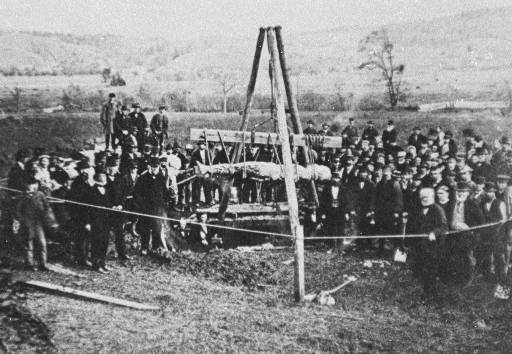
That the object exhumed on the Newell farm in Cardiff, New York, in October 1869 was a genuine antiquity: either the petrified body of a giant human, possibly one of the 'giants in the earth' described in the Book of Genesis, or an ancient carved statue left by a vanished civilization, and therefore real physical evidence of a lost race of giants.
Contradicted. The Cardiff Giant was a deliberate fraud. It was not a petrified man and not an ancient statue: it was a block of gypsum quarried in Iowa, carved by stonecutters in Chicago in 1868, and buried on the farm of William 'Stub' Newell by his cousin George Hull, who then had it 'discovered' a year later. Scientists identified it as a carving within weeks, and Hull confessed before the year was out. It is rated debunked.
Believed by: Thousands of paying visitors in the autumn of 1869, plus clergy who read it as a biblical giant; scientists and the press exposed it within weeks
The full story
A giant at the bottom of a well
On the morning of October 16, 1869, two laborers named Gideon Emmons and Henry Nichols were digging a well behind the barn on William “Stub” Newell's farm in Cardiff, a hamlet south of Syracuse, New York. A few feet down, their shovels struck what looked at first like buried stone and then, as they cleared the dirt, like a foot. They kept digging and uncovered the recumbent figure of an enormous man, roughly ten feet long, lying on his side as if asleep, his features worn and his surface pocked and gray. Word tore through the countryside within hours.
By the next day Newell had a tent up over the pit and was charging admission. Visitors came by the hundreds, first at around a quarter and soon at half a dollar a head, to stand at the edge of the hole for a few minutes and stare. Some wept. Local clergymen declared it a petrified man from before the Flood, perhaps one of the giants named in the Book of Genesis. Others, looking at the same figure, saw an ancient statue carved by a lost race. Almost no one at the pit's edge guessed the truth, which was stranger and more ordinary than either theory: the giant had been put there on purpose, less than a year before, by the farmer's own cousin.
The man behind it was George Hull, a cigar maker from Binghamton with a sharp mind, a taste for argument, and no patience for religious literalism. The Cardiff Giant was his design from quarry to burial, and for a few weeks in the autumn of 1869 it was the most talked-about object in America.
How the giant was made
By Hull's own later account, the idea was born in an argument. Some years earlier he had quarreled with a Methodist revivalist over the passage in Genesis that reads, “There were giants in the earth in those days.” The preacher took it literally; Hull, a skeptic, did not. Turning the dispute over in his mind, he hit on a scheme that was equal parts practical joke, argument by demonstration, and moneymaking venture: he would manufacture a giant, bury it, let it be “discovered,” and watch how eagerly people, clergy included, would treat a carved rock as proof of scripture.
In 1868 he arranged for a block of gypsum about ten feet long to be quarried near Fort Dodge, Iowa, and shipped, under a cover story, to Chicago. There a German stonecutter named Edward Burghardt and his workmen carved it into the figure of a naked man, working behind screens to muffle the noise and keep the project secret. To age the fresh stone, they went over the surface with acid to dull and weather it and stippled it all over with darning needles set in a block, mimicking the pores of skin. The finished figure, weighing close to three thousand pounds, was crated and sent east.
In November 1868 the crate reached the Cardiff farm of Hull's cousin, Stub Newell, and one night the two men and a few helpers buried the giant in a pit behind the barn. Then Hull did the hardest thing a hoaxer can do: he waited. For nearly a year the giant lay in the ground while the disturbed earth settled and grew over, so that when the time came, there would be no fresh dirt to give the game away. The following autumn, Newell hired the well-diggers and pointed them, with no particular explanation, at precisely the right patch of ground.
Why a nation wanted a giant
It is tempting to laugh at the crowds who paid to see a lump of carved gypsum, but the belief made a kind of sense in 1869 that it does not today. Most Americans read the Bible as literal history, and Genesis said, without hedging, that giants had once walked the earth. To a devout visitor standing over the pit, the figure was not a curiosity so much as a vindication: here, at last, was something you could see and touch that seemed to confirm the oldest stories. Hull had chosen his target precisely because he knew how badly some people wanted that confirmation.
The sciences that could have settled the question quickly were, in the public mind, still finding their feet. Geology and the young field of paleontology were decades from commanding general trust, and the idea that a Yale professor's reading of tool marks should outweigh a local minister's testimony was not yet obvious to everyone. Into that gap the giant slipped easily. It helped, too, that this was the age of P. T. Barnum, who had spent decades teaching the public to pay for the pleasure of a marvel and to relish the very argument over whether a thing was genuine.
The giant did not appear on a stage. It came out of the bottom of a farmer's well, and that plainness was its greatest disguise.
The staging carried much of the persuasion. A showman's exhibit invites suspicion, but a figure found by hired hands digging a well on an unremarkable farm arrived wrapped in the credibility of accident. And there was the brute fact of the thing's size. Faced with a three-thousand-pound stone man, ordinary reasoning ran that surely no one would go to such staggering trouble to deceive them, an instinct that Hull, who had gone to exactly that trouble, was counting on.
The unmasking
The giant's reign was short because the physical evidence was, to a trained eye, damning. The most quoted verdict came from Othniel C. Marsh, the Yale paleontologist, who examined the figure and called it “of very recent origin, and a most decided humbug.” His reasoning was simple and hard to answer: the giant was made of gypsum, a soft and water-soluble mineral, yet its surface was still smooth and its tool marks still sharp. Anything of that material buried for centuries in damp New York soil would have dissolved and eroded; a fresh, crisp carving had plainly not been in the ground long at all.
Marsh was not alone. Andrew Dickson White, the first president of Cornell University, inspected the figure and was struck by the same tell-tale details, including the pointlessness of digging a well at that exact spot. As scholars converged on the same conclusion, the paper trail began to surface: the gypsum quarried in Iowa, the block shipped to Chicago, the stonecutters who carved it. Cornered by his own increasingly public scheme, George Hull confessed. He laid out the whole plan, from the argument over Genesis to the midnight burial, and the “petrified man” was revealed as a months-old carving.
The most famous coda involves Barnum. Refused when he offered to buy the giant from the syndicate that then owned it, the showman simply had a plaster copy made and exhibited it in New York as the genuine article, declaring the Cardiff original the fake. The syndicate, led by the banker David Hannum, sued. It is here that the line about a “sucker born every minute” attached itself to the tale, usually credited to Hannum rather than, as legend has it, to Barnum, though the quotation is not securely documented in any source from the time. When the case reached court in early 1870, the judge effectively confirmed what science already had: he would not help the owners of one fake giant sue over a copy of it. Both giants were frauds, and the law declined to referee between them.
Carved, buried, then confessed
On the central claim, that the Cardiff Giant was a genuine petrified man or an ancient statue, the rating is debunked, and it was debunked within weeks of its discovery rather than generations later. The figure was carved gypsum, quarried in Iowa in 1868, shaped by stonecutters in Chicago, artificially aged, and buried on a relative's farm to be found on cue. Scientists read the fraud off the stone almost at once, and the hoaxer himself confessed the details. There is no residual mystery about what the object was or how it got there.
What endures is not a puzzle but a lesson, which is why the Cardiff Giant is often called America's most famous humbug. It is a near-perfect specimen of how a hoax works: it fed a wish people already held (that scripture might be literally confirmed), arrived through a channel that looked innocent, wore the borrowed authority of sheer size, and outran the slower voice of expertise just long enough to make its money. The giant still lies on display today at the Farmers' Museum in Cooperstown, New York, not as evidence of a lost race but as a monument to how willingly a public can be fooled when it wants the story to be true.
What's still unexplained
- Accounts differ on the exact sums: Hull's costs to build and bury the giant are usually put in the low thousands of dollars, and his sale of a majority interest is most often reported at $23,000, but period and later figures vary, so the precise economics of the hoax are approximate rather than settled.
- The famous line 'there's a sucker born every minute' is woven into the giant's story but is not securely documented in any contemporary source; it is popularly credited to David Hannum (or misattributed to Barnum) and may be a later embellishment. The debunking of the giant does not depend on who, if anyone, actually said it.
Point by point
The claim: It was a genuine petrified man, a real human body turned to stone over the ages.
What the record shows: Petrifaction does not preserve a person as a smooth statue of homogeneous rock. The figure was a single block of gypsum, a soft mineral quarried in Iowa, with no bones, no internal structure, and none of the anatomy a fossilized body would show. Scientists who examined it, including Yale's Othniel C. Marsh, identified it immediately as carved stone, not organic remains.
The claim: Even if not a body, it was an ancient statue left by a lost civilization, and so still a real antiquity.
What the record shows: The stone told against that too. Marsh pointed out fresh chisel and tool marks and a still-glossy surface, impossible on soluble gypsum that had supposedly lain for centuries in wet ground, which would have dissolved and pitted it. The figure had been artificially aged with acid and pricked with needles to simulate pores. It was a months-old carving dressed up to look old, as its own maker soon admitted.
The claim: Workers just happened to strike it while digging an ordinary well, so it must have been there a very long time.
What the record shows: The 'well' was dug at the exact spot where the figure had been buried, on the farm of George Hull's own cousin, and there was no sensible reason to sink a well there. Andrew Dickson White noted the oddity of the location at the time. The discovery was staged: Hull had buried the carving in November 1868 and had Newell hire diggers to find it nearly a year later.
The claim: Thousands of people paid to see it and came away convinced, which shows how compelling the evidence was.
What the record shows: Crowd size measures publicity and showmanship, not authenticity. Newell and later the Hannum syndicate charged admission and promoted the figure heavily; wanting to believe in a biblical giant did the rest. The paying crowds coexisted with a swift scientific verdict of fraud, and the giant kept drawing spectators even after it was publicly known to be fake, as a curiosity rather than a genuine relic.
The claim: The confession was forced, and the real story was covered up by the scientific establishment.
What the record shows: There is nothing hidden here. George Hull voluntarily and repeatedly described how he commissioned the carving, from the Fort Dodge gypsum to the Chicago stonecutters to the midnight burial, and named the men involved. The physical evidence, the paper trail of the quarrying and shipping, and Hull's own detailed account all agree. The giant survives today at the Farmers' Museum in Cooperstown, New York, exhibited openly as a hoax.
Timeline
- 1866–1867George Hull, a cigar maker from Binghamton, New York, and a religious skeptic, argues with a Methodist revivalist about the passage in Genesis stating that 'there were giants in the earth in those days.' Hull later says the exchange gave him the idea to manufacture a giant and see how many people would take it for real (and pay to do so).
- 1868Hull has a roughly ten-foot block of gypsum quarried near Fort Dodge, Iowa, and shipped to Chicago, where the stonecutter Edward Burghardt and his workmen carve it into a recumbent naked man. The surface is treated with acid and stippled with darning needles to fake age and pores; the finished figure is shipped east in secret.
- November 1868The carved figure is hauled to the Cardiff, New York, farm of Hull's cousin, William 'Stub' Newell, and buried behind the barn under cover of night. Hull then waits nearly a year to let the ground settle and the trail cool.
- October 16, 1869Newell hires two laborers, Gideon Emmons and Henry Nichols, to dig a well behind the barn at the very spot where the figure lies. They strike stone, uncover the 'giant,' and within hours the discovery is the talk of the county.
- Late October 1869Newell erects a tent over the pit and charges admission, first around 25 cents and soon 50 cents, to view the figure for a few minutes. Hundreds of visitors a day arrive by wagon and rail; local clergy and some observers insist it is a petrified man or an ancient idol.
- Late October 1869Hull sells a three-quarter interest in the giant for a reported $23,000 to a syndicate of local businessmen led by the Syracuse banker David Hannum, who move it to Syracuse to exhibit it to still larger crowds.
- November 1869Yale paleontologist Othniel C. Marsh examines the figure and pronounces it 'of very recent origin, and a most decided humbug,' noting fresh tool marks and polish that soluble gypsum could never have kept through centuries underground. Andrew Dickson White, the president of Cornell, and other scholars reach the same conclusion.
- December 1869P. T. Barnum, refused a sale, has a plaster copy made and exhibits it in New York City as the 'real' giant, prompting Hannum's syndicate to sue. It is in this episode that the line about a sucker being born every minute enters the story, quoted by Hannum about Barnum's customers rather than, as legend holds, by Barnum himself.
- December 1869 – February 1870Under mounting exposure, George Hull confesses that he commissioned and buried the figure. In February 1870 a court, hearing the syndicate's suit against Barnum, effectively confirms both giants are fakes: the judge declines to help one hoaxer sue another over a copy of a fraud.
Contradicted. The Cardiff Giant was a deliberate fraud. It was not a petrified man and not an ancient statue: it was a block of gypsum quarried in Iowa, carved by stonecutters in Chicago in 1868, and buried on the farm of William 'Stub' Newell by his cousin George Hull, who then had it 'discovered' a year later. Scientists identified it as a carving within weeks, and Hull confessed before the year was out. It is rated debunked.
Reviewed by Colin Peterson · Last reviewed July 18, 2026 · How we rate
Common questions
Is Cardiff Giant true?
Contradicted. The Cardiff Giant was a deliberate fraud. It was not a petrified man and not an ancient statue: it was a block of gypsum quarried in Iowa, carved by stonecutters in Chicago in 1868, and buried on the farm of William 'Stub' Newell by his cousin George Hull, who then had it 'discovered' a year later. Scientists identified it as a carving within weeks, and Hull confessed before the year was out. It is rated debunked.
What is Cardiff Giant?
In October 1869, workers digging a well behind William 'Stub' Newell's barn in Cardiff, New York, struck what looked like a giant petrified man, ten feet long and lying just below the surface. Word spread instantly, a tent went up, and thousands paid to file past the figure while clergy and curiosity-seekers argued over whether it was an…
What does the evidence show?
Petrifaction does not preserve a person as a smooth statue of homogeneous rock. The figure was a single block of gypsum, a soft mineral quarried in Iowa, with no bones, no internal structure, and none of the anatomy a fossilized body would show. Scientists who examined it, including Yale's Othniel C. Marsh, identified it immediately as c…
Why do people believe it?
The Bible was widely read as literal history, and Genesis states plainly that 'there were giants in the earth in those days.' A ten-foot man pulled from a farm field looked, to many, like physical confirmation of scripture, which is exactly the reaction Hull engineered after arguing the point with a revivalist.
What is still unresolved?
Accounts differ on the exact sums: Hull's costs to build and bury the giant are usually put in the low thousands of dollars, and his sale of a majority interest is most often reported at $23,000, but period and later figures vary, so the precise economics of the hoax are approximate rather than settled.
Sources
- 1.Cardiff Giant, Encyclopaedia Britannica
- 2.The Cardiff Giant Was Just a Big Hoax, Smithsonian Magazine (2017)
- 3.The Cardiff Giant Fools the Nation, 145 Years Ago, HISTORY (A&E Television Networks)
- 4.The Cardiff Giant: The Biggest Hoax of the 19th Century, JSTOR Daily (2019)
- 5.A Very Tall Tale: Photograph of the Cardiff Giant (ca. 1869), The Public Domain Review
- 6.The Cardiff Giant (1869), Hoaxes.org (The Museum of Hoaxes)
- 7.“A Remarkable Deception”: The Cardiff Giant Hoax, Massachusetts Historical Society (Beehive blog) (2017)
- 8.Cardiff Giant, Wikipedia
Embed this verdict on your site
Paste this snippet to show our sourced verdict as a small card, with a link back to the full case file. Free to use.
<iframe src="https://theconspiratory.com/embed/cardiff-giant" title="The Conspiratory verdict" width="520" height="190" style="border:0;max-width:100%" loading="lazy"></iframe>Help us investigate
This is a living case file. If you spot an error or know evidence we missed, tell us, and weigh in on where you land.
Where do you land?
Cast your read on this one.
Comments
Add your take. Comments are read and approved by a human before they appear, so keep it on topic and civil. Please do not accuse named, living people of crimes.