Catalhoyuk, the 9,000-year-old Neolithic town in Turkey, was the seat of a mother-goddess civilization (and, in some tellings, a product of extraterrestrial contact)
By Colin PetersonJuly 8, 2026
Where the evidence lands →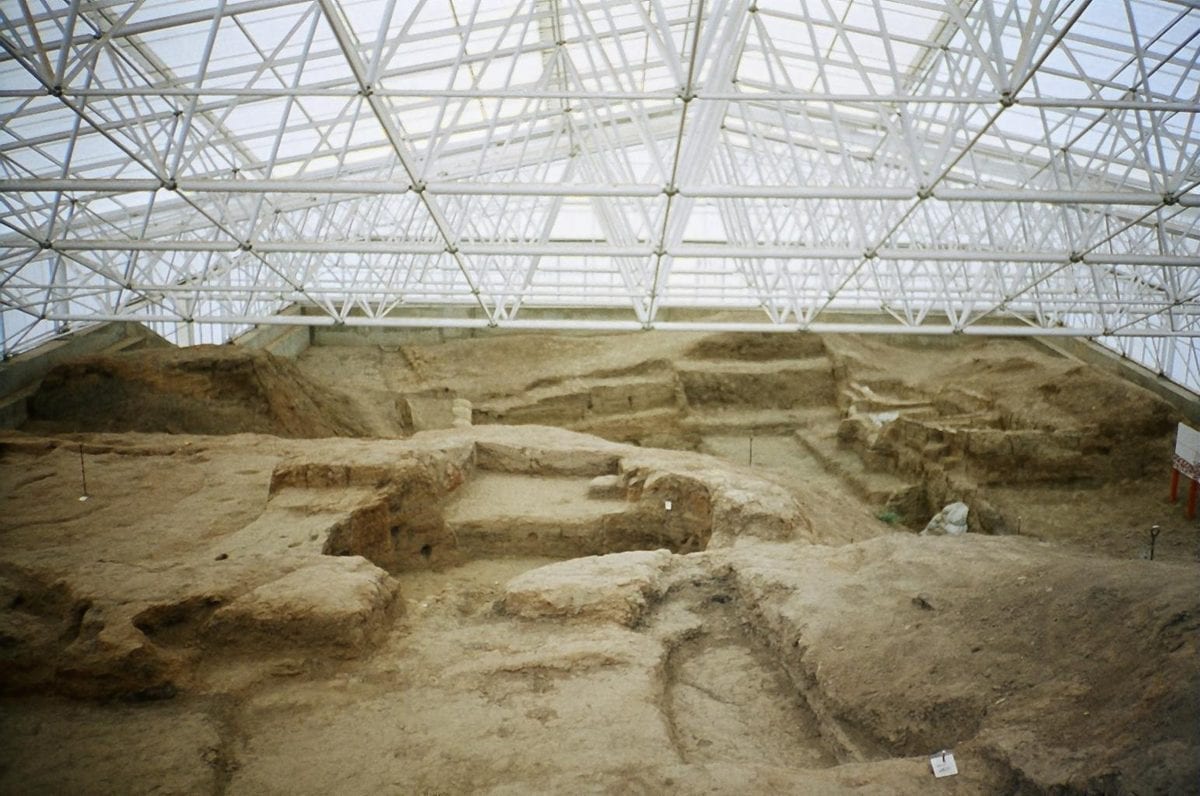
That Catalhoyuk was not simply an ordinary, if remarkable, Neolithic farming town but the seat of a peaceful, woman-ruled civilization built around the worship of a single great Mother Goddess, and, in the ancient-astronaut version, that its layout, art, and sophistication point to contact with or guidance by extraterrestrial visitors.
The site is entirely real and among the most thoroughly excavated Neolithic settlements on Earth: a large mudbrick town on the Konya Plain in central Turkey, occupied from roughly 7100 to 5950 BCE, dug by James Mellaart in the 1960s and by an Ian Hodder-led international project from 1993 to 2018, and inscribed as a UNESCO World Heritage Site in 2012. What is on the record is not in question. The claim we rate is the fringe interpretation layered on top: that the town was a peaceful matriarchal civilization organized around worship of an omnipotent Mother Goddess, or, in the ancient-astronaut version, that its art and planning reflect contact with extraterrestrials. The famous Mother Goddess theory traces to Mellaart, who is now known to have forged supporting material, and the alien claim has no evidentiary basis at all. Recent ancient-DNA work does show a genuinely female-centered, matrilineal social pattern, but that is a finding about kinship, not proof of a goddess cult or of visitors from the stars.
Believed by: Two loosely related audiences: Goddess-spirituality and feminist-spirituality communities, who treat the site as evidence of a lost peaceful matriarchy, and ancient-astronaut enthusiasts, who fold it into a wider extraterrestrial-contact narrative. Mainstream archaeologists accept the site as a remarkable Neolithic town while rejecting both framings.
The full story
What is documented
Start with the solid ground, because there is a great deal of it. Catalhoyuk is a large Neolithic settlement on the Konya Plain in central Turkey, occupied for well over a thousand years, from roughly 7100 to 5950 BCE. Its people farmed grain, herded animals, made pottery, and traded for obsidian and Mediterranean shell. They built rectangular mudbrick houses packed so tightly that there were no streets; you walked across the rooftops and dropped into your home through a hole in the roof.
The interiors are what made the site famous. Walls carried geometric designs, hunting scenes, and rows of plastered bull skulls; clay figures were shaped and, in some cases, buried; and the dead were interred beneath the floors of the houses where the living slept. First excavated by James Mellaart in the early 1960s and then dug again from 1993 to 2018 by a large international project under Ian Hodder, using micromorphology, isotope analysis, and ancient DNA, it is one of the most intensively studied prehistoric towns anywhere. In 2012 UNESCO placed it on the World Heritage List.
None of that is contested here, and none of it needs defending. The question this file weighs is the layer of interpretation built on top of the archaeology: that Catalhoyuk was a Mother Goddess civilization ruled by women, or, in a stranger version, a place touched by extraterrestrials. The town is real. The claims are the issue.
The case for the goddess
The Mother Goddess reading did not come from nowhere, and its honest version deserves a fair hearing. Mellaart, the man who first opened the site, kept finding female figurines, some of them corpulent and seated, one famously flanked by two felines and recovered from a grain bin. He identified rooms he called shrines, and he read the whole assemblage as the material of a religion centered on a great goddess, in a society where women held real standing.
That interpretation was taken up and amplified by Marija Gimbutas and, from the 1970s, by a growing Goddess-spirituality movement that saw in Catalhoyuk a glimpse of a peaceful, woman-honoring past predating later patriarchal states. For many people the appeal was not idle: here, apparently, was archaeological support for the idea that human society had not always been arranged the way it is now.
And the newest science gave the theme a genuine jolt. A large 2025 ancient-DNA study reported that Catalhoyuk households were matrilineal, traced through the mother's line, with daughters tending to stay in the maternal house and some women given notably rich burials.
A town full of female figures, buried beneath the floors of houses that passed from mother to daughter. It is easy to see why people reached for the word goddess, and why the reach still feels compelling today.
At its strongest, then, the case is this: a striking body of female imagery, an unusually flat and non-hierarchical social world, and now DNA evidence of female-centered kinship, all pointing to a society in which women mattered in a way that later history would obscure.
Where the goddess claim breaks down
The distance between women mattered here and this was an omnipotent-goddess civilization ruled by women is where the evidence runs out and interpretation takes over.
The most serious problem is the source. Its original champion, James Mellaart, is now known to have forged evidence. A 2018 investigation of his estate concluded he had faked murals and inscriptions over a span of decades, and the earlier Dorak affair centered on treasures he described but could never produce. Claims that rest specifically on his reconstructed drawings and his labeling of rooms as shrines cannot be taken at face value.
When Hodder's team re-excavated with modern methods, the picture softened rather than confirmed the cult. Many figurines turned up in ordinary, even lowly contexts (household debris, grain bins), not enshrined as idols, and a number are not clearly female or divine at all. Isotope work found men and women eating similar diets and living broadly similar lives. Hodder concluded there was little support for a dominant Mother Goddess or for rigid gender rule, and he reframed the figures in terms of ancestry, daily life, and aging.
The 2025 DNA result, properly read, does not rescue the old theory either. Matrilineal describes how kinship and houses were reckoned; it is not the same as matriarchal political rule, and neither is the same as a goddess religion. The geneticists documented social structure, not theology. It is a real and important finding about a female-centered society, and it is quietly substituted, in popular retellings, for a claim about worship that the study never makes.
The extraterrestrial detour
The alien version of Catalhoyuk deserves less patience, because it rests on nothing the goddess theory can at least point to. In this telling, the town's size, its planning, and its art are simply too advanced for Neolithic people, so outside help, contact with or guidance by extraterrestrials, is invoked to explain them.
Every part of that premise fails on the archaeology. Catalhoyuk is impressive, but it is impressive in thoroughly human ways: mudbrick houses rebuilt in place over generations, roof-access architecture, farming and herding, pottery, weaving, and regional trade in obsidian and shell. Each material is local or traded from a known source, and each technique is documented across the Neolithic Near East. The famous 'map' mural, sometimes waved around as impossible knowledge, is at most a picture of the twin-peaked Hasan Dag volcano the townspeople could see on the horizon and near which they gathered obsidian, and at least an abstract geometric pattern resembling a leopard skin. Scholars argue about which; neither reading requires visitors from space.
The ancient-astronaut move is always the same: declare that ancestors could not have done it, then fill the manufactured gap with aliens. The gap is the error. The people of Catalhoyuk did it.
The deeper flaw is the assumption underneath. Treating a sophisticated early town as evidence of alien contact means deciding, in advance, that human beings nine thousand years ago were incapable of their own achievements. The excavated record says otherwise at every turn, and no artifact from the site has ever pointed beyond human hands.
Why the stories took hold
Both fringe readings caught on for reasons that have more to do with us than with the Neolithic, and it is worth naming them, because the underlying town is remarkable enough without either.
The goddess story spread because it came from authority and answered a need. Mellaart was the discoverer, so his interpretation traveled with the prestige of the find itself, arriving in the wider culture long before the forgeries and the cautious re-excavation caught up. And it offered something people wanted: apparent proof of a peaceful, woman-honoring past, a usable history for a movement, that gradually detached from what the digging actually showed.
The alien story spread because it fits a ready-made template. Once a place is old, famous, and a little mysterious, popular pseudoarchaeology slots it into the same recurring narrative it applies to pyramids and standing stones, a narrative that consistently underrates ancestral ingenuity and overrates the need for an external explanation.
And both are helped along by compression. A careful finding, matrilineal household organization, is easy to flatten into “science proves the matriarchy,” which loops back to prop up the goddess-cult claim the research never endorsed. A live scholarly debate about a mural becomes “the world's oldest map,” which becomes evidence of impossible knowledge. Each step feels small; the accumulated drift is large.
A real town, fringe readings
Hold the layers apart. The town is real and richly documented: a large, long-lived, unusually egalitarian Neolithic settlement whose art, architecture, and burials are genuinely extraordinary and require no embellishment. On that, there is no dispute. The fringe interpretations are another matter. The omnipotent-goddess civilization traces to an excavator now known to have forged evidence, and it was softened rather than confirmed by decades of rigorous re-excavation. The extraterrestrial reading has no evidentiary basis at all.
This is not a dismissal of the site's real surprises. Catalhoyuk genuinely was female-centered in its kinship, as recent DNA work shows, and genuinely flat in its social hierarchy, as UNESCO noted. Those are important, hard-won findings. What the record does not support is the further leap from a female-centered society to a goddess religion ruled by women, or from a sophisticated early town to visitors from the stars.
The honest posture is to let the archaeology be as strange and impressive as it actually is, and to resist finishing its story with an ending it did not supply. The people of Catalhoyuk built one of the first great towns, honored their dead beneath their own floors, and passed their houses from mother to daughter. That is a real achievement, and it belongs to them.
What's still unexplained
- What the figurines meant to the people who made them is genuinely unresolved. They plainly mattered, but whether they represent deities, ancestors, fertility, social roles, or something else is still debated, and the discredited goddess-idol reading is only one discarded option among several live ones.
- How to interpret the new matrilineal DNA evidence is an open and active question. It reliably shows female-centered kinship, but what that implied for authority, ritual, and daily power is not settled, and it should not be quietly upgraded into proof of a goddess religion.
- Which of Mellaart's original observations survive his forgeries is still being sorted out. Some genuine features were recorded alongside fabricated ones, and disentangling the reliable record from the invented material remains ongoing work.
- Whether the famous 'map' mural depicts Hasan Dag erupting or an abstract pattern with a leopard skin is a legitimate scholarly disagreement that has nothing to do with the fringe claims and remains unresolved on the archaeology itself.
Point by point
The claim: The abundance of female figurines proves Catalhoyuk worshipped a single great Mother Goddess and was ruled by women.
What the record shows: The figurines are real and numerous, but the leap to an omnipotent goddess cult is Mellaart's interpretation, not a demonstrated fact. Later excavators found the clay figures scattered in ordinary contexts, including rubbish and grain bins, not enshrined as idols, and note that many are not obviously female or divine. Ian Hodder's team argued the objects may relate to daily life, ancestry, or aging rather than to formal deity worship. A recurring female image can reflect many things; reading it as proof of a ruling goddess religion assumes the conclusion.
The claim: James Mellaart, who discovered the site, documented shrines, goddess murals, and inscriptions that establish the cult.
What the record shows: Mellaart is now known to have fabricated evidence. A 2018 investigation of his estate by Eberhard Zangger concluded that he had forged murals and Luwian-style inscriptions over decades, and the earlier Dorak affair involved drawings of treasures he could never produce. Some of his reconstructions cannot be checked against surviving originals. This does not erase the genuine finds, but it means claims resting specifically on his interpretive drawings and 'shrines' carry little weight without independent confirmation.
The claim: Modern DNA work confirms Catalhoyuk was a matriarchy, vindicating the goddess theory.
What the record shows: A 2025 Science study did find a matrilineal pattern: households traced through the female line, with women often staying in the maternal house while men moved between them, and some women receiving elaborate burials. That is a striking result about kinship and residence. But matrilineal is not the same as matriarchal rule, and neither is the same as a Mother Goddess religion. The researchers describe social organization, not theology. The finding supports a female-centered social structure and undercuts the older 'male-dominated origins of civilization' assumption, without establishing the specific cult Mellaart imagined.
The claim: A wall painting at Catalhoyuk is the world's oldest map and depicts a volcanic eruption, showing knowledge beyond a simple Neolithic town.
What the record shows: This is a genuine scholarly debate, not an anomaly requiring outside help. Mellaart read one mural as a plan of the town beneath the erupting twin-peaked Hasan Dag volcano, and a 2014 study dated a real eruption of Hasan Dag to the right era. But other archaeologists argue the 'volcano' resembles a leopard skin and the 'houses' are an abstract geometric pattern like others at the site. Either way, a Neolithic community living within sight of a volcano and using nearby obsidian needs no extraterrestrial explanation for depicting its own landscape.
The claim: The town's size, planning, and art are too advanced for the period, implying contact with extraterrestrials.
What the record shows: There is no evidence for alien involvement, and the premise is false. Catalhoyuk is impressive but fully consistent with human Neolithic capability: mudbrick houses rebuilt in place over centuries, roof-access architecture, farming, herding, weaving, pottery, and long-distance trade in obsidian and shell. The 'too advanced' framing recycles the standard ancient-astronaut move of underestimating ancestral ingenuity. Every material at the site is local or regionally traded, every technique is documented elsewhere in the Neolithic Near East, and nothing recovered points beyond human hands.
The claim: Catalhoyuk was a uniquely peaceful, egalitarian utopia, evidence of a lost golden age erased by later patriarchal societies.
What the record shows: The site does show unusually flat social organization: no palaces, no obvious elite quarter, broadly similar houses and diets. UNESCO cited that egalitarianism in its listing. But 'egalitarian for its era' is not a utopia. Bioarchaeology finds healed and unhealed injuries, hard physical labor, and high child mortality, and the dense, smoky, closely packed houses were a difficult place to live. Reading the archaeology as a peaceful goddess paradise imports a modern ideal onto a demanding Neolithic town.
Timeline
- 1958British archaeologist James Mellaart, surveying the Konya Plain, identifies the East Mound of Catalhoyuk as a major prehistoric settlement.
- 1961-1965Mellaart excavates a series of houses and finds elaborate wall paintings, plaster reliefs, bull-horn installations, and numerous female figurines. He interprets many buildings as shrines and argues the town was a cult center devoted to a Mother Goddess in a matriarchal society.
- 1965Turkish authorities halt Mellaart's excavations amid the fallout from the earlier 'Dorak affair', a controversy over drawings of treasures he said he had seen but could not produce. Work at the site stops for decades.
- 1974Lithuanian-American archaeologist Marija Gimbutas begins publishing her influential thesis of a prehistoric, peaceful, goddess-worshipping Old Europe. Catalhoyuk's figurines are widely adopted as a centerpiece of the Mother Goddess narrative by the emerging Goddess-spirituality movement.
- 1993A new, long-term international project under Ian Hodder (then of Cambridge, later Stanford) reopens the site with modern scientific methods: micromorphology, residue analysis, systematic recording, and later ancient-DNA and isotope studies.
- 2004-2005Isotope and bioarchaeological studies from the Hodder project find men and women ate similar diets and led broadly similar lives. Hodder concludes there is little evidence for a dominant Mother Goddess cult or for rigid gender hierarchy, and reframes the figurines in more varied terms.
- 2012UNESCO inscribes the Neolithic Site of Catalhoyuk on the World Heritage List, citing its long occupation, distinctive streetless architecture, and evidence of an egalitarian social order.
- 2018After Mellaart's death, geoarchaeologist Eberhard Zangger and Mellaart's son examine his apartment and conclude he had forged murals and inscriptions over decades, including material used to bolster his interpretations. The same year, the Hodder-led fieldwork phase concludes.
- 2025-2026A large ancient-DNA study published in Science reports that Catalhoyuk households were organized matrilineally, with female offspring tending to remain in the maternal house and richer burial treatment for some women. The finding revives interest in the site's gender dynamics while stopping well short of confirming a goddess cult.
From the case file
The actual records: declassified, released, or leaked. We link straight to each document in its official archive, so you never have to take our word for it. Read the originals yourself.
The site is entirely real and among the most thoroughly excavated Neolithic settlements on Earth: a large mudbrick town on the Konya Plain in central Turkey, occupied from roughly 7100 to 5950 BCE, dug by James Mellaart in the 1960s and by an Ian Hodder-led international project from 1993 to 2018, and inscribed as a UNESCO World Heritage Site in 2012. What is on the record is not in question. The claim we rate is the fringe interpretation layered on top: that the town was a peaceful matriarchal civilization organized around worship of an omnipotent Mother Goddess, or, in the ancient-astronaut version, that its art and planning reflect contact with extraterrestrials. The famous Mother Goddess theory traces to Mellaart, who is now known to have forged supporting material, and the alien claim has no evidentiary basis at all. Recent ancient-DNA work does show a genuinely female-centered, matrilineal social pattern, but that is a finding about kinship, not proof of a goddess cult or of visitors from the stars.
Reviewed by Colin Peterson · Last reviewed July 8, 2026 · How we rate
Common questions
Is Catalhoyuk mysteries true?
The site is entirely real and among the most thoroughly excavated Neolithic settlements on Earth: a large mudbrick town on the Konya Plain in central Turkey, occupied from roughly 7100 to 5950 BCE, dug by James Mellaart in the 1960s and by an Ian Hodder-led international project from 1993 to 2018, and inscribed as a UNESCO World Heritage Site in 2012. What is on the record is not in question. The claim we rate is the fringe interpretation layered on top: that the town was a peaceful matriarchal civilization organized around worship of an omnipotent Mother Goddess, or, in the ancient-astronaut version, that its art and planning reflect contact with extraterrestrials. The famous Mother Goddess theory traces to Mellaart, who is now known to have forged supporting material, and the alien claim has no evidentiary basis at all. Recent ancient-DNA work does show a genuinely female-centered, matrilineal social pattern, but that is a finding about kinship, not proof of a goddess cult or of visitors from the stars.
What is Catalhoyuk mysteries?
Catalhoyuk is a sprawling Neolithic settlement on the Konya Plain of central Turkey, first excavated by British archaeologist James Mellaart in the early 1960s and dug again, far more rigorously, by an international team under Ian Hodder from 1993 to 2018. Its houses were packed wall to wall and entered through the roof, its walls carrie…
What does the evidence show?
The figurines are real and numerous, but the leap to an omnipotent goddess cult is Mellaart's interpretation, not a demonstrated fact. Later excavators found the clay figures scattered in ordinary contexts, including rubbish and grain bins, not enshrined as idols, and note that many are not obviously female or divine. Ian Hodder's team a…
Why do people believe it?
The site is genuinely extraordinary, which makes big claims feel proportionate. A town of thousands of people, painted walls, plastered skulls, and burials beneath the floors is so evocative that an ordinary explanation can seem too small for it, and grand narratives rush to fill the gap.
What is still unresolved?
What the figurines meant to the people who made them is genuinely unresolved. They plainly mattered, but whether they represent deities, ancestors, fertility, social roles, or something else is still debated, and the discredited goddess-idol reading is only one discarded option among several live ones.
Sources
- 1.Neolithic Site of Çatalhöyük, UNESCO World Heritage Centre (2012)
- 2.History of the Excavations, Çatalhöyük Research Project
- 3.Was there a belief in the Mother Goddess at Çatalhöyük?, Çatalhöyük Research Project
- 4.Female lineages and changing kinship patterns in Neolithic Çatalhöyük, Science (2025)
- 5.Stone Age farmers' households passed from mother to daughter, Science (AAAS) (2025)
- 6.Archaeologists find ancient matrilineal society in Turkiye's Catalhoyuk, Al Jazeera (2026)
- 7.James Mellaart Forged Documents throughout His Life, Luwian Studies (2018)
- 8.There She Blew! Volcanic Evidence Of The World's First Map, NPR (2014)
- 9.Çatalhöyük, Smarthistory
Embed this case file on your site
Paste this snippet to show this case file as a small card, with a link back to the full write-up. Free to use.
<iframe src="https://theconspiratory.com/embed/catalhoyuk" title="The Conspiratory verdict" width="520" height="190" style="border:0;max-width:100%" loading="lazy"></iframe>Help us investigate
This is a living case file. If you spot an error or know evidence we missed, tell us, and weigh in on where you land.
Where do you land?
Cast your read on this one.
Comments
Add your take. Comments are read and approved by a human before they appear, so keep it on topic and civil. Please do not accuse named, living people of crimes.