The Copiale cipher, an encrypted 18th-century manuscript, was genuinely decoded in 2011 to reveal the rituals of a secret ophthalmological society
By Colin PetersonJuly 8, 2026
Where the evidence lands: Proven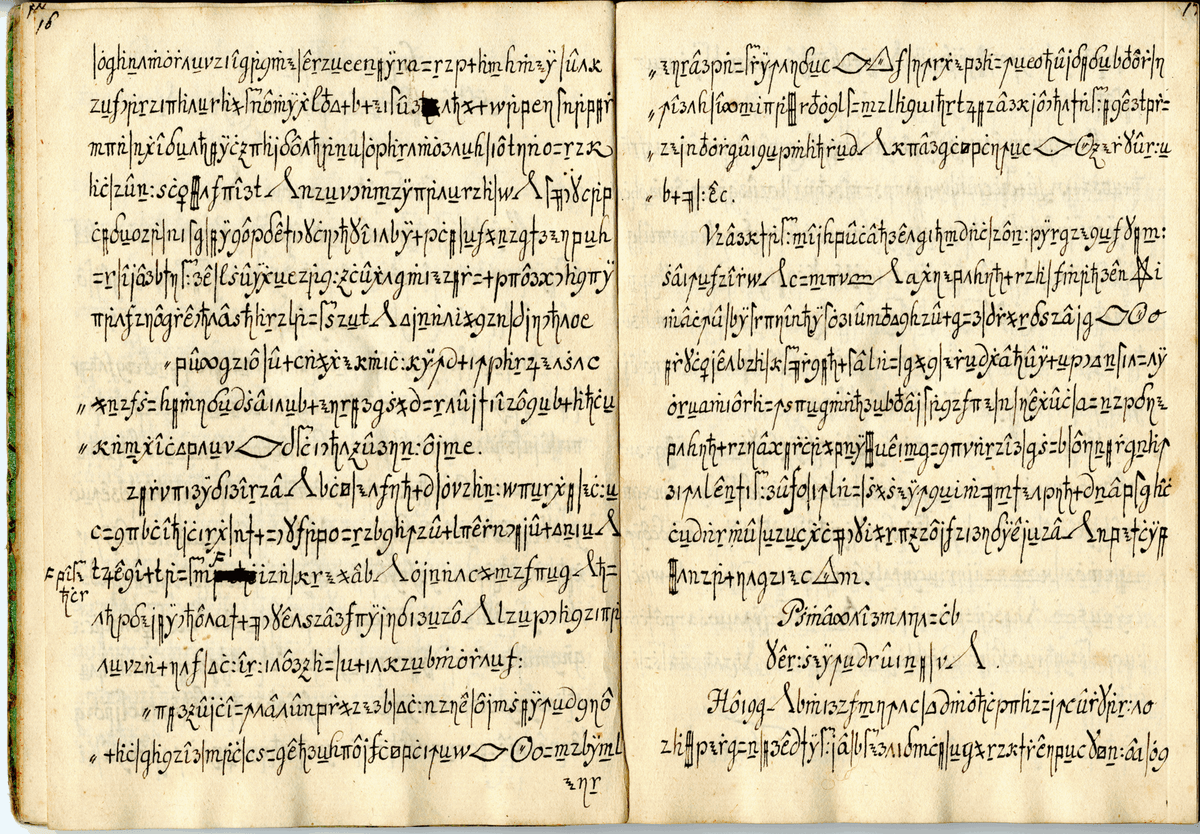
That the Copiale cipher, long an unread 18th-century manuscript, was authentically deciphered in 2011 by a USC and Uppsala University team, and that the recovered German plaintext genuinely records the initiation ceremonies, oaths, and internal rules of a real secret society, the Oculist Order, whose ritual centered on the eye and which had ties to Freemasonry.
Proven. What is on the record here is unusually clean. The Copiale cipher is a real bound manuscript of roughly 105 pages and about 75,000 handwritten characters, enciphered in abstract symbols mixed with Roman and Greek letters, that resisted reading for well over two centuries. In 2011 an international team led by Kevin Knight of the University of Southern California, with Beata Megyesi and Christiane Schaefer of Uppsala University, cracked it using computational methods and showed that the underlying text is German. The claim we rate, that the decipherment is genuine and that the plaintext sets out the initiation rituals of an 18th-century German secret society known as the Oculists, is substantiated. The solution is peer reviewed, reproducible, and internally coherent as a ritual manual, and it has been accepted by cryptographers and historians. What remains open is narrower: the identity of every member, the full meaning of the manuscript's later political passages, and why a society fascinated with the eye chose to encipher its ceremonies at such length.
Believed by: Effectively the scholarly mainstream. Because this is a solved cipher rather than a live conspiracy, the relevant audience is cryptographers, computational linguists, and historians of Freemasonry and secret societies, who accept the decipherment; the case also draws a wide popular readership fascinated by the idea of a real code broken after 260 years.
The full story
What is documented
Start with the object itself, because it is real and can be held. The Copiale cipher is a bound manuscript of roughly 105 pages containing about 75,000 handwritten characters, written on good-quality paper and dressed in gold and green brocade. Its text is a dense stream of abstract symbols mixed with Roman and Greek letters, with no headings, no obvious breaks, and no key. The name comes from a word, read as Copiales, inked inside the volume. For well over two hundred years, no one could read a line of it.
In 2011, that changed. A team led by computer scientist Kevin Knight of the University of Southern California, working with linguists Beata Megyesi and Christiane Schaefer of Uppsala University in Sweden, treated the manuscript as a machine-translation problem and broke it. The underlying language proved to be German, and the recovered plaintext described the initiation rituals and internal organization of an 18th-century secret society, the high enlightened Oculist Order of Wolfenbuttel.
So the question this file weighs is not whether the manuscript is genuine, or whether it was solved. Both are settled, in the peer-reviewed and scholarly literature and by independent reproduction of the key. The question is only how solid the reading is, and how far it can be pushed, and on that the record is reassuringly specific.
Two and a half centuries of silence
It is worth honoring how genuinely forbidding this text was, because the mystery was not manufactured. The manuscript combines the ordinary and the exotic in a way built to mislead: familiar Roman letters sit beside Greek characters, diacritics, zodiac-like marks, and invented signs, and the natural assumption, that the letters you recognize are where the meaning lives, is exactly the trap.
The volume also carried an aura. It surfaced from holdings tied to the old academy in East Berlinand, after the Cold War, passed into a private collection, a provenance that lent it the feel of a recovered relic. A beautifully bound book of unreadable symbols, silent since the age of Frederick the Great, is the kind of artifact around which legends grow, and the Copiale cipher was often mentioned in the same breath as history's famously unsolved texts.
A gilded book, tens of thousands of strange symbols, and more than two hundred years without a single readable sentence. The wonder was not that people were fascinated; it was that the fascination turned out to have a concrete answer.
That is the honest strength of the case as intrigue: a real, physical, genuinely opaque manuscript, of real age, that had defeated every prior reader. The mystery deserved its reputation. What makes this case unlike the perpetual puzzles is simply that the mystery was resolved.
How the code fell
The solution is, in the best sense, deflating: it is method, not magic. Knight's background is in machine translation, and he approached the cipher the way one approaches an unknown language, beginning with a careful, machine-readable transcription and then measuring how often each symbol appears and which symbols keep company with which.
The team worked through roughly 80 candidate languages, testing the statistics of the symbols against the statistics of real text. The breakthrough was a reversal of the obvious. The Roman letters were largely nulls, decoys that helped mark spaces and distract the reader, while the abstract symbols carried the actual German. Once that inversion was in place, the scheme revealed itself as a homophonic substitution, in which several different symbols can stand for the same sound, a design specifically meant to flatten the frequency patterns that usually betray a simple cipher.
None of this rested on a hunch about hidden meaning. It rested on counting, on hypothesis and test, and on the willingness to abandon the intuitive reading of the letters. The result was published, key and all, which is why it could be checked. That is the important point for a skeptic: the claim is not “we found a message we like,” but “here is the substitution, apply it and read the same German we did.” A solution that survives independent reproduction is a solution, not a story.
Inside the Oculist Order
What the German actually says is stranger than the code. The opening section is a manual of initiation for a fraternity that took the eye as its master symbol. A candidate for membership, the text describes, has a single hair plucked from his eyebrow; he is asked to read, as a test of sight; and he undergoes a symbolic operation on the eyes, a ritual enactment of passing from blindness into secret vision.
The society names itself the high enlightened Oculist Order, tied to Wolfenbuttel, and has been associated with Count Friedrich August von Veltheim. Here a caution matters, and the honest reporting supplies it: for all the ophthalmic imagery, the members were not necessarily eye doctors. The eye is a metaphor for insight and hidden knowledge, the currency of an initiatory brotherhood, rather than evidence of a surgeons' guild.
The firmer historical thread runs to Freemasonry. Scholars read the Oculists as a fraternal body carrying Masonic-style rites in a era when the Catholic Church had condemned the Craft, following the 1738 papal bull against Freemasonry. A discreet order, cloaking its ceremonies in cover imagery and an elaborate cipher, is exactly what that climate would be expected to produce, and the recovered text fits the period rather than straining against it.
Why it still fascinates
The Copiale cipher occupies an unusual place: it is a mystery that was solved, and it is beloved precisely for the shape of that resolution. Part of the pull is the romance of the sealed book. A gilded volume of secret signs is an almost archetypal image, and the promise that it might contain something momentous is deeply satisfying to imagine.
Part is the victory of modern method over old secrecy. The idea that software built to translate languages could reach back and unlock an 18th-century brotherhood's private rites has an appealing symmetry, the present decoding the past. It is a story about tools as much as about the Oculists, and it flatters the sense that with enough cleverness, no locked door stays locked.
And part is simply the content. An eye-obsessed secret society, with plucked eyebrow hairs and symbolic surgery and oaths in a darkened room, sounds like invented gothic, and the fact that it is recovered from a real cipher rather than dreamed up gives it a frisson that fiction cannot match. The fascination is well earned, and, unlike most such fascinations, it survives contact with the answer.
Cracked, and confirmed
Keep the parts distinct. The decipherment is real: a genuine 18th-century manuscript, broken in 2011 by a named USC and Uppsala team using published, reproducible methods, yielding coherent German that describes the initiation rituals and organization of the Oculist Order. That reading is peer reviewed, internally consistent across the manuscript, and accepted by cryptographers and historians. On the claim as steered, that the cipher was authentically solved and revealed a real secret society, the rating is Proven.
What substantiation does not mean is that every question is closed. The society's full membership, the meaning of the manuscript's later political passages, the exact nature of its tie to Freemasonry and to Count von Veltheim, and the reason for enciphering ritual at such length all remain live topics for historians. These are the ordinary loose ends of a recovered document, not cracks in the decipherment.
The lesson cuts against the usual grain of this encyclopedia. Most files here restrain a leap from mystery to certainty. This one records the rarer event: a real enigma, long treated as impenetrable, resolved by patient work into a specific and verifiable answer. The eye that the Oculists made their emblem is a fitting one for the case, which turned on learning, at last, how to see what had been in plain sight the whole time.
Watch
What's still unexplained
- Who exactly belonged to the Oculist Order, and how large and long-lived was it? The ritual and rules survive in the plaintext, but a full roster and the society's precise history remain incompletely documented.
- What do the manuscript's later, more political sections mean? Reporting notes that beyond the initiation material the text turns to other matters, and the fuller interpretation of those passages is still being worked out by historians.
- Why encipher ritual at such length in the first place? The choice to render an entire ceremonial manual in an elaborate homophonic code, rather than simply keeping it private, raises questions about how seriously the order feared exposure and what else it wished to hide.
- How firm is the link between the Oculists and specific individuals such as Count von Veltheim, and between the order and organized Freemasonry? The connections are supported but not exhaustively pinned down, and the boundary between ophthalmic metaphor and any real medical interest is not fully settled.
Point by point
The claim: The manuscript was genuinely a readable message, not decorative gibberish or an unbreakable hoax.
What the record shows: The decipherment produces coherent, connected German prose that reads as a structured ritual manual, with an initiation ceremony, oaths, and organizational rules, not isolated words that could be coaxed from noise. The method and the symbol assignments were published, so the reading is reproducible: given the same key, the same symbols yield the same text throughout the volume. That internal consistency across tens of thousands of characters is what distinguishes a real solution from a lucky guess.
The claim: The ordinary Roman letters in the manuscript were the key to the code.
What the record shows: The opposite proved true, which is why earlier readers stalled. The team found that the familiar Roman letters were largely nulls, decoys used to mark word spaces and to distract, while the abstract signs (drawn from Greek letters, diacritics, and graphic marks) carried the meaning. Once the roles were inverted, the homophonic substitution, where several symbols can stand for the same German sound, fell into place.
The claim: The plaintext describes an actual secret society organized around the eye.
What the record shows: The recovered German names a high enlightened Oculist Order and details a ceremony steeped in ophthalmic imagery: a candidate has a hair plucked from the eyebrow, is presented with texts to read to test his sight, and undergoes a symbolic operation on the eyes representing the gain of secret vision. The eye is the society's governing metaphor, threaded through the ritual rather than mentioned in passing.
The claim: The Oculists were literally practicing eye surgeons.
What the record shows: This is where care is needed. The society's symbolism is ophthalmological, and it has been linked to a figure interested in the eye, Count Friedrich August von Veltheim, but historians caution that the members were not necessarily physicians. The eye functions as ritual metaphor. The stronger and better supported link is to Freemasonry: scholars read the order as a fraternal body preserving Masonic-style rites in a period when the Church had condemned the Craft.
The claim: The code was broken by inspired guesswork about its secret meaning.
What the record shows: It was broken by method. Knight approached the text as a translation problem, using software to measure symbol frequencies and co-occurrences, then systematically ruling out languages and testing the null-versus-signal hypothesis. The work was carried out by named researchers at USC and Uppsala and published in the peer-reviewed and scholarly literature, which is why the result is treated as settled rather than as one more speculative reading.
Timeline
- 1738Pope Clement XII issues the bull In eminenti apostolatus, condemning Freemasonry and forbidding Catholics from joining. In the German states this pushes fraternal and Masonic activity toward discretion and toward societies operating under cover names and private ritual.
- 1740sA fraternity later identified in the manuscript as the high enlightened Oculist Order is associated with Wolfenbuttel and with Count Friedrich August von Veltheim. Its symbolism revolves around the eye, ophthalmic imagery, and the passage from blindness to sight, and historians link its membership to Masonic circles.
- 1760-1780The Copiale manuscript is produced: a bound volume of roughly 105 pages and about 75,000 enciphered characters on good-quality paper, gilt and bound in brocade, written in a homophonic system that mixes abstract symbols with Roman and Greek letters. A word inked in the book, read as Copiales, later gives the cipher its name.
- 20th centuryThe volume survives in the holdings tied to the former Academy in East Berlin and, after the Cold War, passes into a private collection. Its contents remain unread; the mixture of exotic symbols and ordinary letters had defeated every earlier attempt to make sense of it.
- 2011A machine-readable transcription reaches Kevin Knight at the University of Southern California Information Sciences Institute. He teams with Beata Megyesi and Christiane Schaefer of Uppsala University, and they attack the text with statistical methods drawn from machine translation, quantifying how the symbols co-occur.
- 2011The team tests roughly 80 candidate languages before recognizing the key insight: the Roman letters are largely nulls, decoys marking spaces and misleading the reader, while the abstract symbols carry the real message. The plaintext resolves into readable German.
- 2011-06The group presents its results in the paper The Copiale Cipher at an Association for Computational Linguistics workshop in Portland, Oregon, laying out the homophonic substitution scheme and the reconstructed German text.
- 2011-10USC and Uppsala publicize the decipherment, and it draws international coverage. The recovered opening pages are shown to describe an initiation ceremony, complete with an eye-themed ritual, for the Oculist Order.
From the case file
The actual records: declassified, released, or leaked. We link straight to each document in its official archive, so you never have to take our word for it. Read the originals yourself.
Proven. What is on the record here is unusually clean. The Copiale cipher is a real bound manuscript of roughly 105 pages and about 75,000 handwritten characters, enciphered in abstract symbols mixed with Roman and Greek letters, that resisted reading for well over two centuries. In 2011 an international team led by Kevin Knight of the University of Southern California, with Beata Megyesi and Christiane Schaefer of Uppsala University, cracked it using computational methods and showed that the underlying text is German. The claim we rate, that the decipherment is genuine and that the plaintext sets out the initiation rituals of an 18th-century German secret society known as the Oculists, is substantiated. The solution is peer reviewed, reproducible, and internally coherent as a ritual manual, and it has been accepted by cryptographers and historians. What remains open is narrower: the identity of every member, the full meaning of the manuscript's later political passages, and why a society fascinated with the eye chose to encipher its ceremonies at such length.
Reviewed by Colin Peterson · Last reviewed July 8, 2026 · How we rate
Common questions
Is The Copiale cipher true?
Proven. What is on the record here is unusually clean. The Copiale cipher is a real bound manuscript of roughly 105 pages and about 75,000 handwritten characters, enciphered in abstract symbols mixed with Roman and Greek letters, that resisted reading for well over two centuries. In 2011 an international team led by Kevin Knight of the University of Southern California, with Beata Megyesi and Christiane Schaefer of Uppsala University, cracked it using computational methods and showed that the underlying text is German. The claim we rate, that the decipherment is genuine and that the plaintext sets out the initiation rituals of an 18th-century German secret society known as the Oculists, is substantiated. The solution is peer reviewed, reproducible, and internally coherent as a ritual manual, and it has been accepted by cryptographers and historians. What remains open is narrower: the identity of every member, the full meaning of the manuscript's later political passages, and why a society fascinated with the eye chose to encipher its ceremonies at such length.
What is The Copiale cipher?
For more than two and a half centuries, a gilt-bound volume filled with strange symbols sat unread. Known as the Copiale cipher, after a word inked inside it, the manuscript runs to about 105 pages and 75,000 characters written in a mixture of abstract signs, Roman letters, and Greek letters, with no obvious way in. In 2011 a team led by…
What does the evidence show?
The decipherment produces coherent, connected German prose that reads as a structured ritual manual, with an initiation ceremony, oaths, and organizational rules, not isolated words that could be coaxed from noise. The method and the symbol assignments were published, so the reading is reproducible: given the same key, the same symbols y…
Why do people believe it?
The solution is reproducible. Unlike claimed readings of famously unsolved texts, the Copiale decipherment publishes its key, and anyone applying it recovers the same German throughout the manuscript. Reproducibility is exactly the quality that separates a genuine break from wishful pattern-matching, and it is present here.
What is still unresolved?
Who exactly belonged to the Oculist Order, and how large and long-lived was it? The ritual and rules survive in the plaintext, but a full roster and the society's precise history remain incompletely documented.
Sources
- 1.Copiale cipher, Wikipedia
- 2.USC Scientist Cracks Mysterious "Copiale Cipher", USC Today (University of Southern California) (2011)
- 3.Language scholars solved 18th-century cipher, Uppsala University (2011)
- 4.Computer scientist cracks mysterious 'Copiale Cipher', ScienceDaily (2011)
- 5.'Copiale Cipher': Mysterious Code Broken At Last, NPR (2011)
- 6.Copiale Cipher: How a secret society's code was finally cracked, The Christian Science Monitor (2011)
- 7.The Copiale Cipher, Association for Computational Linguistics Anthology (Knight, Megyesi, Schaefer) (2011)
- 8.The Copiale Cipher (decipherment project), Stockholm University / Uppsala University
Embed this verdict on your site
Paste this snippet to show our sourced verdict as a small card, with a link back to the full case file. Free to use.
<iframe src="https://theconspiratory.com/embed/copiale-cipher" title="The Conspiratory verdict" width="520" height="190" style="border:0;max-width:100%" loading="lazy"></iframe>Help us investigate
This is a living case file. If you spot an error or know evidence we missed, tell us, and weigh in on where you land.
Where do you land?
Cast your read on this one.
Comments
Add your take. Comments are read and approved by a human before they appear, so keep it on topic and civil. Please do not accuse named, living people of crimes.