Alien civilizations have built Dyson spheres around distant stars, and astronomers may have already spotted them
By Colin PetersonJuly 8, 2026
Where the evidence lands →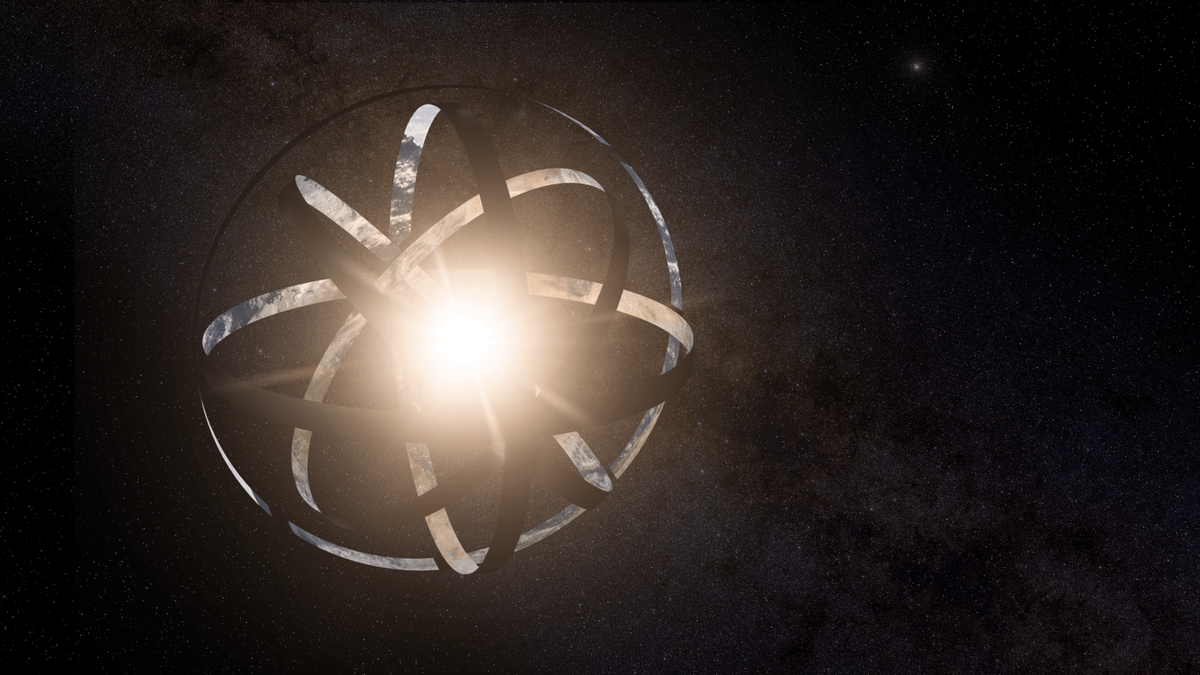
That one or more alien civilizations have constructed Dyson spheres, or Dyson swarms, around their stars to harvest stellar energy, and that astronomers have already identified real examples, most often pointing to the unexplained dimming of Boyajian's Star or to the infrared-excess candidates flagged by recent surveys, which believers read as engineered megastructures rather than natural phenomena.
The Dyson sphere is real science, not a fringe invention. In 1960 the physicist Freeman Dyson published a one-page note in Science proposing that a sufficiently advanced civilization would surround its star with energy-collecting structures and that the waste heat, re-radiated as infrared, could be searched for from Earth. That search is a legitimate, ongoing branch of SETI: Fermilab's Richard Carrigan combed IRAS data, Penn State's G-hat project scanned 100,000 galaxies, and Project Hephaistos flagged seven infrared-excess stars in 2024. The claim we rate is narrower and larger: that such a structure has actually been detected, that a specific anomaly (the dimming of Boyajian's Star, or the Hephaistos candidates) is a confirmed alien megastructure. Every candidate to date has a natural explanation on the table (dust, background galaxies, ordinary infrared excess), none has been confirmed as artificial, and no verifiable physical evidence ties any object to an engineered origin. A theoretical concept and an open search are not the same as a discovery.
Believed by: The concept itself is mainstream among astronomers and is a standard target of technosignature research. The stronger claim, that a Dyson sphere has been or is about to be found, draws a wide popular audience of space enthusiasts, science-fiction readers, and SETI followers, amplified whenever a new infrared anomaly makes headlines.
The full story
What is documented
Start with what is solid, because here the foundation is unusually respectable. In 1960, the physicist Freeman Dyson published a short paper in Sciencetitled “Search for Artificial Stellar Sources of Infrared Radiation.” His argument was economical: a civilization whose energy appetite kept growing would eventually want to capture a large share of its own star's output, and the most efficient way to do that would be to surround the star with collectors. Whatever those collectors absorbed, they would have to re-radiate as waste heat, which means such a structure should glow in the infrared. Dyson's point was practical: that glow could be searched for from Earth.
Two things about the original idea are routinely garbled. First, Dyson never proposed a solid shell wrapped around a star; he described a swarm of independently orbiting structures, and he later said plainly that a rigid sphere would be mechanically impossible. Second, this was a genuine research proposal, not a prediction that such things exist. It told astronomers where to look, not what they would find.
And astronomers did look. Fermilab's Richard Carrigancombed the Infrared Astronomical Satellite catalog; Penn State's G-hat project scanned 100,000 galaxies in WISE data; and in 2024 Project Hephaistos published seven infrared-excess stars as candidates. So what is documented is a real theoretical concept and a real, decades-long search. The question this file weighs is the next one: has that search actually found anything?
The case at its strongest
The honest version of the excitement is worth stating, because it is better grounded than most. Unlike a roadside sighting, the Dyson-sphere search has credentials: a landmark paper by a major physicist, a place in the Kardashev framework that organizes the whole field of technosignatures, and active programs at respected institutions. When people say scientists are hunting for alien megastructures, that is literally true.
The anomalies are real, too. Boyajian's Star, KIC 8462852, dimmed by as much as 22 percent in irregular, deep dips that no ordinary planet or orbiting disk cleanly explained, and a Penn State team openly noted that this was the sort of thing a megastructure might do. Project Hephaistos did not invent its seven candidates; they are genuine stars with genuine, hard-to-explain infrared excess, pulled from millions of objects by careful filtering.
There is also a clean physical logic to the search. A structure that harvests starlight cannot store all that energy; it must dump the excess as heat, and heat means an infrared signature at a predictable range of temperatures. That gives the hunt a specific, falsifiable target rather than a vague hope, which is exactly what makes it science.
A celebrated physicist proposed it, a formal framework organizes it, and real telescopes chase real anomalies. The search for Dyson spheres is legitimate. The leap is in treating a candidate as a catch.
That is the case at full strength: not that a megastructure has been proven, but that the concept is sound, the method is principled, and the sky keeps producing objects strange enough to be worth a second look. Anyone who waves the whole subject away as nonsense is not engaging with the actual science.
Where the detection claim breaks down
The gap is between two very different statements: here is an unexplained signal worth investigating and here is a confirmed alien megastructure. Everything in the record supports the first. Nothing in it has yet reached the second.
Take the flagship case. When astronomers measured how Boyajian's Star dimmed across different colors, they found it faded more in blue than in red. A solid object, a panel or a shell, would block every wavelength about equally, casting a gray shadow. Fine dust does not: it scatters blue light more strongly, which is precisely the pattern observed. That single measurement points hard toward an uneven cloud of circumstellar dust and away from anything engineered. The star is still not fully understood, but the specific megastructure reading is contradicted by the data, not confirmed by it.
The Hephaistos candidates tell a similar story. Infrared excess has many prosaic causes, and the most awkward is simple bad luck: a distant galaxy that shines brightly in the infrared, lying by chance almost directly behind a foreground star, can mimic the exact signature a partial Dyson sphere would produce. Follow-up work on the candidates found evidence of just this kind of background contamination for at least some of them, and radio checks turned up no artificial signals. The team said from the start these were candidates, not detections.
And the broad appeal to decades of searching cuts the wrong way. The surveys by Carrigan, by G-hat, and by Hephaistos were built to catch Dyson's waste-heat glow, and every one of them reported the same thing: sources worth checking, nothing confirmed as artificial. A long hunt with no positive result is a null result, not a suppressed success. The honest summary of the field is that the method works, the search is real, and so far the sky has handed back candidates that keep resolving into dust, disks, and distant galaxies.
The trouble with an invisible signal
It is worth pausing on why infrared excess in particular gets over-read, because the same trap recurs with every new candidate. The signature Dyson predicted is not a beacon or a message; it is faint, technical, and, crucially, one that nature also produces in abundance.
Warm dust glows in the infrared. Protoplanetary and debris disks glow in the infrared. Background galaxies glow in the infrared. So when a survey finds a star with more infrared than expected, an artificial structure is only one entry on a long list of ordinary explanations, and by far the least likely one. The correct order of operations, which the serious searchers follow, is to exhaust the natural causes first and reach for engineering only if nothing else fits. The popular version inverts this, treating any unexplained glow as presumptively alien until proven otherwise.
That inversion is seductive because it is nearly unfalsifiable in the moment. As long as a candidate has not been fully run down, one can insist it might be the real thing; and because astronomical follow-up is slow, there is always a window in which the exotic reading cannot be strictly disproven. But not-yet-explained is not the same as explained-by-aliens. It is simply the ordinary state of a candidate under study.
A signal nature can fake is a poor place to declare victory. The waste-heat glow of a Dyson swarm looks, at first glance, exactly like dust, a disk, or a galaxy behind the star, which is why every candidate has to be exhausted before it can be believed.
The discipline of the field is to keep the burden where it belongs. An unexplained infrared source earns more observation, not a headline. The candidates that have been chased down have so far dissolved into mundane causes, and the ones still open are open, not confirmed.
Why the idea grips us
Few scientific concepts have escaped the journals as completely as the Dyson sphere, and its hold on the imagination is worth understanding on its own terms, because it shapes how each new candidate is received.
It grips us because it is legitimate at the root. The idea carries the authority of Freeman Dyson and the machinery of real SETI programs, so belief in a detection feels less like credulity than like keeping up with cutting-edge astronomy. The respectable origin is a large part of the pull.
It grips us because fiction got there first. From Olaf Stapledon's Star Maker in 1937 through decades of science fiction, the star-enclosing megastructure is one of the most familiar images in the genre. Audiences meet real candidates already carrying a vivid mental picture, so a news story about infrared excess slots straight into a narrative they have rehearsed for years.
And it grips us because of what a confirmation would mean. To detect the engineering of another civilization by its heat signature would answer the oldest question there is, whether we are alone, and it would answer it not with a fuzzy anecdote but with hard physics. That is a profoundly attractive prospect, and attraction has a way of shortening the distance between “candidate” and “discovery” in the retelling. The result is that a careful list of stars-to-check keeps arriving in the public square as a list of megastructures-found.
Concept sound, detection unconfirmed
Hold the two claims apart, because the whole discipline of this case lives in the gap. The concept and the search are real: Dyson's 1960 proposal is sound, the waste-heat signature is a principled target, and working astronomers have spent decades hunting for it in earnest, producing a legitimate stream of candidates. On that, there is nothing to debunk. But the detection claim is not established: no infrared-excess star, and no dimming event, has been confirmed as an engineered structure. Boyajian's Star fades in a way that points to dust; the Hephaistos candidates keep resolving toward background galaxies and other natural sources; and every systematic survey has returned candidates worth checking rather than a catch worth announcing.
This is not a dismissal of the science, and it should not be mistaken for one. The Dyson sphere is not a hoax or a crank idea, and the searches are exactly the kind of open, falsifiable inquiry that ought to be encouraged. There are genuine loose ends here, the full behavior of Boyajian's Star among them, and they deserve more observation, not a shrug.
The one step this file will not take is the leap from we found an anomaly to we found a megastructure. That step needs a confirmed artificial signature that no natural process can produce, and the record has not supplied it. Until it does, the right posture is the one the best researchers already hold: keep searching, keep the burden on the extraordinary claim, and call a candidate a candidate. A real idea and an honest search sit on top of this case; a discovery does not.
Watch
What's still unexplained
- The dimming of Boyajian's Star is not completely explained even now. Dust accounts for the color-dependent fading, but the full pattern of dips, including a possible long-period recurrence, is still an active research problem. That residual mystery is real; it is a reason to keep observing, not a confirmed megastructure.
- Some Project Hephaistos candidates remain unresolved. Background-galaxy contamination explains part of the sample, but not every candidate has been definitively identified as a natural source, and follow-up is ongoing. Unexplained is the honest label, and it sits some distance short of artificial.
- The theoretical detectability of Dyson swarms is itself unsettled. Recent papers debate what temperature, completeness, and spectral shape a real structure would present, and whether current surveys would even catch a partial or unusual one. The search's own sensitivity limits are a live scientific question.
- Whether such structures exist at all within observable range is genuinely open. Decades of null results constrain how common obvious Dyson spheres can be nearby, but they cannot rule out rarer, fainter, or more distant ones, which is precisely why the search continues rather than closing.
Point by point
The claim: The dramatic dimming of Boyajian's Star is best explained by an alien megastructure passing in front of it.
What the record shows: The dimming is genuinely unusual, but the megastructure reading has lost ground to a natural one. When astronomers watched the star dim across multiple wavelengths, they found it faded more in blue light than in red. A large opaque object, such as a solid panel or shell, would block all colors about equally; fine dust blocks blue light more strongly, exactly the pattern observed. That points to an uneven cloud of circumstellar dust, not an engineered structure. The star is still not fully explained, which is why it remains interesting, but the specific alien-megastructure claim is contradicted by the color of the dimming, not supported by it.
The claim: Project Hephaistos found seven stars with infrared excess that ordinary astrophysics cannot explain, so these are Dyson spheres.
What the record shows: The Hephaistos team was careful to call these candidates, not detections, and their own follow-up undercuts the leap to megastructures. Infrared excess around a star has many mundane causes: warm circumstellar dust, disks, and, crucially, chance alignment with a distant galaxy that is bright in the infrared. Later analysis of the same candidates found evidence of exactly that kind of background contamination for at least some of them, and radio imaging turned up no artificial signals. An unexplained infrared glow is a reason to look closer, not a confirmed structure. Naming the candidates after a Greek god of craft does not make them crafted.
The claim: Decades of searching prove the technology is out there; we just have not pinned down the right star yet.
What the record shows: The searches prove the opposite of a detection: they are systematic hunts that have so far returned no confirmed megastructure. Carrigan's IRAS survey, the G-hat galaxy scan, and the Hephaistos stellar survey were all designed to catch the waste-heat signature Dyson predicted, and all reported candidates worth checking but nothing established as artificial. A long search without a positive result is evidence that, if such structures exist within range, they have not yet been found, not evidence that they have. The absence of a detection cannot be reported as a hidden success.
The claim: A Dyson sphere must exist somewhere, because any advanced civilization would inevitably build one.
What the record shows: This is an argument from assumption, not from observation. It rests on a chain of premises (that technological civilizations are common, that they keep expanding their energy use indefinitely, that stellar engineering is the path they choose, and that they are close enough and long-lived enough for us to see) each of which is unproven. Dyson himself offered the idea as a thing worth searching for, not a thing certain to be found. Even if the reasoning is sound in the abstract, it tells us where to point telescopes; it does not substitute for a signal in one.
The claim: Governments or institutions are hiding a confirmed Dyson sphere detection to avoid public panic.
What the record shows: There is no evidence of concealment, and the structure of the field argues against it. Dyson-sphere searches are run in the open by university and national-lab astronomers who publish candidates in peer-reviewed journals and post their data to public archives; the Hephaistos candidate list, the G-hat results, and Carrigan's flagged sources are all in the literature. A genuine confirmation would be the discovery of a lifetime, competed for by rival teams worldwide, not something a single body could bury. The visible record is one of published non-detections, which is the opposite of a suppressed detection.
Timeline
- 1937The science-fiction novelist Olaf Stapledon, in Star Maker, imagines advanced civilizations enclosing their stars to trap every ray of energy. Dyson later credited the book as the seed of the idea, and the image of a star-girdling structure enters the culture decades before it enters a journal.
- 1960-06Freeman Dyson publishes Search for Artificial Stellar Sources of Infrared Radiation in Science. He argues that a technological civilization's growing energy demand would lead it to capture its star's output, and that the structure would re-radiate absorbed starlight as detectable far-infrared. He proposes searching for such infrared signatures directly.
- 1960sCommentators and later writers popularize the mental picture of a solid shell enclosing a star. Dyson repeatedly clarifies that a rigid sphere is mechanically implausible and that he meant a loose swarm, a Dyson swarm, of independently orbiting collectors. The rigid-shell image sticks in the public imagination anyway.
- 1964The Soviet astronomer Nikolai Kardashev proposes his scale of civilizations by energy use. A Type II civilization, one that harnesses the full output of its star, is essentially the Dyson-sphere builder, and the scale gives the concept a formal place in the framework of the search for extraterrestrial intelligence.
- 2009Richard Carrigan, a retired Fermilab physicist, publishes results of a search through the Infrared Astronomical Satellite (IRAS) catalog for objects glowing at Dyson-sphere temperatures. Out of roughly a quarter-million sources he flags a small number for follow-up but finds no compelling evidence of any megastructure.
- 2015Penn State's Jason Wright leads the G-hat (Glimpsing Heat from Alien Technologies) survey, scanning about 100,000 galaxies in WISE infrared data for the waste-heat signature of a galaxy-spanning (Kardashev Type III) civilization. None is found. The same year, Wright's team notes that the strange dimming of the star KIC 8462852 is the kind of signal a megastructure might produce.
- 2015-2018KIC 8462852, nicknamed Boyajian's Star or Tabby's Star after astronomer Tabetha Boyajian, becomes a media sensation as the alien megastructure star. Its irregular, deep dimming defies easy explanation, and the Dyson-swarm idea is floated. Subsequent multi-wavelength observations show the dimming is stronger in blue than red light, pointing to fine dust, not a solid structure.
- 2024-05Project Hephaistos publishes its second-stage results: seven M-dwarf stars showing unexplained mid-infrared excess consistent with partial Dyson-sphere models, drawn from Gaia, 2MASS, and WISE data. The authors present them as candidates requiring follow-up, not confirmations, and flag natural interlopers as the leading concern.
- 2025Follow-up work on the Hephaistos candidates, including radio imaging and archival diagnostics, finds that background contamination, notably distant infrared-bright galaxies aligned with the stars, can account for at least some of the excess. No candidate is confirmed as artificial, and the search continues.
The Dyson sphere is real science, not a fringe invention. In 1960 the physicist Freeman Dyson published a one-page note in Science proposing that a sufficiently advanced civilization would surround its star with energy-collecting structures and that the waste heat, re-radiated as infrared, could be searched for from Earth. That search is a legitimate, ongoing branch of SETI: Fermilab's Richard Carrigan combed IRAS data, Penn State's G-hat project scanned 100,000 galaxies, and Project Hephaistos flagged seven infrared-excess stars in 2024. The claim we rate is narrower and larger: that such a structure has actually been detected, that a specific anomaly (the dimming of Boyajian's Star, or the Hephaistos candidates) is a confirmed alien megastructure. Every candidate to date has a natural explanation on the table (dust, background galaxies, ordinary infrared excess), none has been confirmed as artificial, and no verifiable physical evidence ties any object to an engineered origin. A theoretical concept and an open search are not the same as a discovery.
Reviewed by Colin Peterson · Last reviewed July 8, 2026 · How we rate
Common questions
Is Dyson spheres true?
The Dyson sphere is real science, not a fringe invention. In 1960 the physicist Freeman Dyson published a one-page note in Science proposing that a sufficiently advanced civilization would surround its star with energy-collecting structures and that the waste heat, re-radiated as infrared, could be searched for from Earth. That search is a legitimate, ongoing branch of SETI: Fermilab's Richard Carrigan combed IRAS data, Penn State's G-hat project scanned 100,000 galaxies, and Project Hephaistos flagged seven infrared-excess stars in 2024. The claim we rate is narrower and larger: that such a structure has actually been detected, that a specific anomaly (the dimming of Boyajian's Star, or the Hephaistos candidates) is a confirmed alien megastructure. Every candidate to date has a natural explanation on the table (dust, background galaxies, ordinary infrared excess), none has been confirmed as artificial, and no verifiable physical evidence ties any object to an engineered origin. A theoretical concept and an open search are not the same as a discovery.
What is Dyson spheres?
A Dyson sphere is a hypothetical megastructure that an advanced civilization might build to capture a large fraction of its star's energy. Freeman Dyson introduced the idea to the scientific literature in 1960, not as a solid shell but as a swarm of orbiting collectors, and pointed out that such a structure would betray itself by glowing…
What does the evidence show?
The dimming is genuinely unusual, but the megastructure reading has lost ground to a natural one. When astronomers watched the star dim across multiple wavelengths, they found it faded more in blue light than in red. A large opaque object, such as a solid panel or shell, would block all colors about equally; fine dust blocks blue light m…
Why do people believe it?
The idea comes with real scientific pedigree. This is not a tabloid invention; it originates with Freeman Dyson, a celebrated physicist, in the pages of Science, and it is pursued by working astronomers at Fermilab, Penn State, and elsewhere. That legitimacy lends the stronger claim, that one has been found, a credibility that most fring…
What is still unresolved?
The dimming of Boyajian's Star is not completely explained even now. Dust accounts for the color-dependent fading, but the full pattern of dips, including a possible long-period recurrence, is still an active research problem. That residual mystery is real; it is a reason to keep observing, not a confirmed megastructure.
Sources
- 1.Search for Artificial Stellar Sources of Infrared Radiation, Science (Freeman J. Dyson) (1960)
- 2.Dyson sphere, Wikipedia
- 3.What are Dyson spheres, and how do we look for them?, Space.com (2023)
- 4.'Dyson sphere' legacy: Freeman Dyson's wild alien megastructure idea will live forever, Space.com (2020)
- 5.Project Hephaistos - II. Dyson sphere candidates from Gaia DR3, 2MASS, and WISE, Monthly Notices of the Royal Astronomical Society (Oxford Academic) (2024)
- 6.The G-hat Infrared Search for Extraterrestrial Civilizations with Large Energy Supplies. III. The Reddest Extended Sources in WISE, arXiv (Griffith, Wright et al.) (2015)
- 7.Mysterious Dimming of Tabby's Star May Be Caused by Dust, NASA Jet Propulsion Laboratory (2018)
- 8.The Dyson Sphere Search, Centauri Dreams (2022)
- 9.Kardashev scale, Wikipedia
Embed this case file on your site
Paste this snippet to show this case file as a small card, with a link back to the full write-up. Free to use.
<iframe src="https://theconspiratory.com/embed/dyson-sphere" title="The Conspiratory verdict" width="520" height="190" style="border:0;max-width:100%" loading="lazy"></iframe>Help us investigate
This is a living case file. If you spot an error or know evidence we missed, tell us, and weigh in on where you land.
Where do you land?
Cast your read on this one.
Comments
Add your take. Comments are read and approved by a human before they appear, so keep it on topic and civil. Please do not accuse named, living people of crimes.