The moai of Easter Island were too large for the Rapa Nui to carve and move, so they must be the work of aliens or a vanished advanced civilization
By Colin PetersonJuly 8, 2026
Where the evidence lands: Contradicted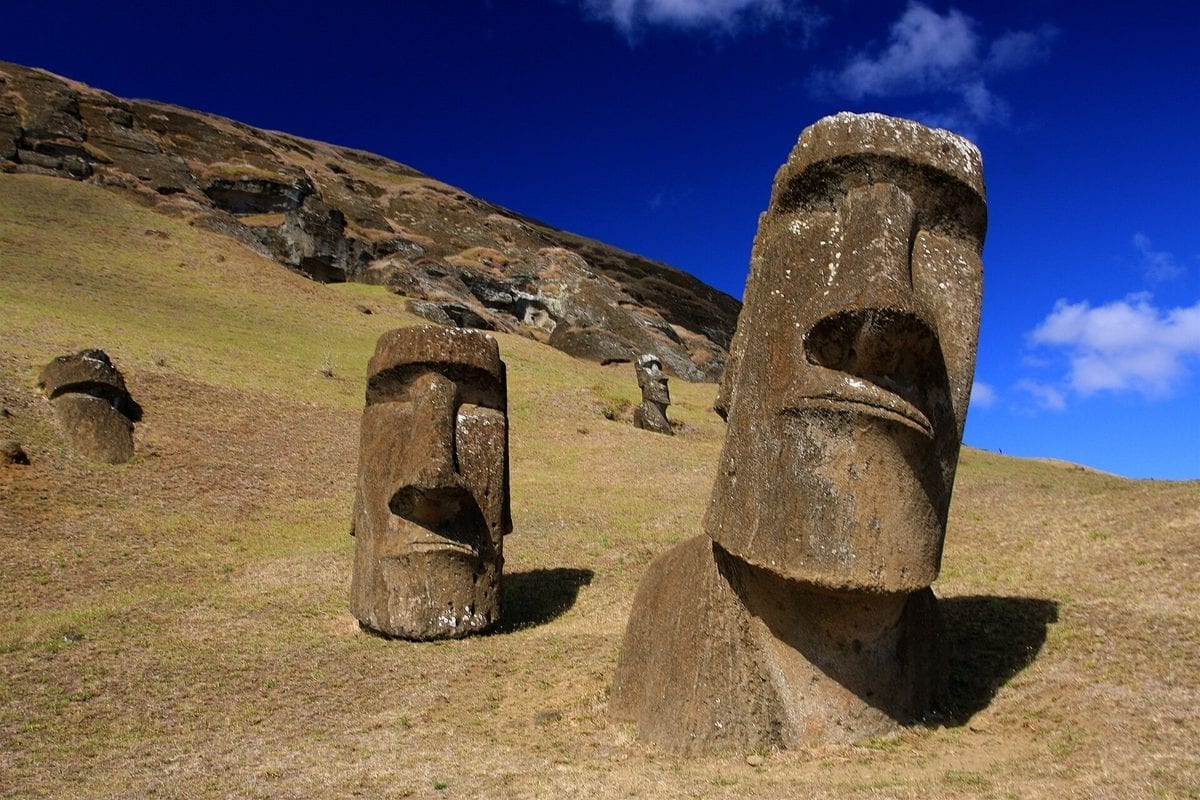
That the moai of Easter Island are too numerous, too large, and too heavy to have been carved and transported by the island's Polynesian inhabitants using stone tools and rope, and that their creation therefore requires extraterrestrial visitors, a lost advanced civilization, or some vanished technology.
Contradicted. What is on the record is not in doubt: the moai were carved from volcanic tuff at the Rano Raraku quarry and raised on stone platforms (ahu) by the Rapa Nui people, a Polynesian society that settled the island around AD 1200. That is the real, respected history and it is left standing. The claim we rate is the fringe overlay popularized from the 1960s: that the statues were beyond the reach of a Polynesian society using stone tools and rope, and therefore point to extraterrestrials or a lost super-technology. That claim is debunked. Islanders and researchers have carved replicas with basalt tools and moved multi-ton statues upright with nothing but rope and manpower, and the moai match a Polynesian sculptural tradition found across the Pacific.
Believed by: A popular audience for ancient-astronaut and lost-civilization media rather than any archaeologist; the specialist consensus has always credited the Rapa Nui themselves
The full story
What is documented
Start with what is not in dispute, because on Easter Island the record is unusually generous. The island, called Rapa Nui by its people, was settled around AD 1200 by Polynesian voyagers who crossed thousands of miles of open ocean by canoe. Their descendants carved nearly a thousand moai, monumental stone figures representing deified ancestors, and raised them on ceremonial platforms called ahu.
We know how the statues were made because the evidence was never hidden. At the Rano Raraku quarry, unfinished moai still lie in the rock face where carvers left them, some barely outlined, others nearly free. Around them are the discarded basalt picks used to peck the soft volcanic tuff into shape. Modern 3D surveys have mapped dozens of separate carving areas across the crater, the signature of an organized, clan-based industry that worked the stone for generations.
The moai were images of ancestors, and to the Rapa Nui they held mana, a spiritual power thought to protect the clan once a statue was raised on its ahu and given its eyes. This is a living cultural heritage, not a riddle left by strangers. The question this file weighs is narrower and stranger: the popular idea that the islanders could not have done any of it.
The case people make
The intuition behind the fringe claim is worth stating fairly, because it comes from a real experience. Stand on Rapa Nui, the most isolated inhabited island on Earth, thousands of miles from any continent, and the giant faces do feel impossible. How did a small population on a treeless-looking rock carve statues weighing dozens of tons, and then move them for miles to the coast?
From that honest astonishment grew a bolder story. In 1968, Erich von Daniken's Chariots of the Gods? presented the moai as a headline exhibit for ancient astronauts, suggesting that marooned extraterrestrials had carved the statues, perhaps as a signal to be rescued. Variants swapped the aliens for a lost advanced civilization or a vanished technology, but the shape was the same: the achievement was too great for the people who obviously lived there.
The wonder is real and worth keeping. The mistake is to convert “I can hardly believe people did this” into “people did not do this.”
It did not help that the island's own history was long told as a grim mystery: a society that supposedly wrecked its environment and collapsed. A civilization painted as doomed and inexplicable is a short step from one imagined never to have been fully in charge of its own monuments. That backdrop gave the alien and lost-technology framing room to breathe.
How the statues moved
The claim rests entirely on the word impossible, and that word has been tested and broken, repeatedly, by human beings with rope.
Rapa Nui tradition never said the statues were carried. It said they walked to their platforms, and that turns out to be close to the literal truth. In 1982 the Czech engineer Pavel Pavel rocked a concrete replica forward with ropes in a stepping motion. In 2012 archaeologists Terry Hunt and Carl Lipo walked a 4.35-ton replica down a road using three ropes and just 18 people, moving it about 100 meters in under an hour. In 2025 they published a physics and 3D-modeling study of nearly a thousand moai arguing that the road statues were engineered to be walked: a wide, D-shaped base and a forward lean, exactly the geometry of an object meant to rock side to side and step forward.
The carving is just as demystified. The unfinished statues in the quarry, still attached to the bedrock, show the method in progress; the basalt tools that did the work lie beside them. And the statues are not stylistically alien at all. They belong to a Polynesian tradition of ancestor figures and monumental stonework found across the Pacific. When islanders and researchers have set out to carve and raise moai by traditional means, they have succeeded.
An explanation that requires stranded aliens has to explain, on top of everything else, why the aliens left behind exactly the tools, the half-finished work, the roads, and the physics that a human crew would leave. It never does.
The collapse that was not a mystery
Much of the eerie atmosphere around Rapa Nui comes from the idea that its people simply vanished, as if the island had swallowed a civilization whole. That framing has been substantially revised, and the revision matters, because a real historical tragedy was being misread as a supernatural one.
The popular ecocide story held that the islanders felled their forests to move statues, starved, and collapsed before Europeans arrived. Recent work complicates that sharply. Deforestation was real but gradual, and much of it is now attributed to introduced Polynesian rats eating palm seeds as well as to human clearing. Ancient-genome studies published in Nature describe a population that grew steadily up to European contact rather than one that destroyed itself in prehistory.
The catastrophic depopulation came later, and its causes are human and documented: Peruvian slave raidsin 1862 and 1863 carried off much of the island's people, and introduced disease, including smallpox, killed many of those who returned. This is history, not enigma. Reading a natural human tragedy inflicted from outside as evidence of some cosmic mystery gets the story exactly backward and does the Rapa Nui a disservice.
Why the alien story persists
If the answers are this clear, why does the fringe version keep its grip? Largely because it satisfies things the correct explanation does not.
It flatters the sense of wonder. The moai are genuinely astonishing, and an astonishing cause feels more fitting than patient carving and clever rope work. It rides remoteness: an island improbable enough to settle seems to license an improbable explanation for everything on it. And it arrived pre-packaged, through a global best-seller and decades of television that put the moai on the poster for ancient astronauts.
There is also a quieter, less flattering current. To insist that a non-European, non-industrial society could not have engineered its own monuments is a habit pseudo-archaeology falls into again and again, with Rapa Nui, with the pyramids, with sites across the Americas and Africa. The healthiest correction is not to make the moai less wondrous, but to place the wonder where it belongs: with the Rapa Nui people who conceived, carved, and walked them.
The islanders built them
Hold the two questions apart, as always. The documented archaeology of Easter Island, who made the moai, how, when, and why, is settled, well sourced, and left standing here as the respected record it is. The moai are a Polynesian achievement, carved from quarry tuff with stone tools and raised by the ancestors of the people who live on Rapa Nui today.
The claim we rate is only the paranormal and lost-technology overlay: that the statues exceed what the islanders could have done and therefore require aliens or a vanished super-culture. That claim depends on a single word, impossible, and that word has been disproven by experiment, by the unfinished statues in the quarry, and by the physics of the walking roads. On that claim the verdict is Contradicted.
None of this diminishes the island. It relocates the marvel. The moai are not less remarkable for having been made by people; they are more so. The honest response to standing among them is not to reach for a spaceship, but to recognize how much a determined human community, with rope, stone, and a tradition of walking their ancestors home, was able to do.
Watch
What's still unexplained
- Experiments have shown that walking the statues upright is possible and fits the road moai, but the exact mix of methods used across every statue, and whether some were also moved horizontally, is still actively debated among archaeologists.
- The tempo and causes of the island's deforestation, and how much was human clearing versus rat predation on palm seeds, remain subjects of ongoing research.
- Why so many moai were left unfinished or abandoned in and around the Rano Raraku quarry, and what that says about how carving ended, is not fully settled.
- The degree to which pre-European Rapa Nui society experienced stress and reorganization (versus a dramatic collapse) is being revised as new agricultural, climate, and genetic evidence comes in.
Point by point
The claim: The moai are too large and heavy for a small stone-age Polynesian society to have carved with hand tools.
What the record shows: Unfinished statues still lie in the Rano Raraku quarry, mid-carving, surrounded by the discarded basalt picks that shaped them. The process is directly readable in the rock: the figure was pecked out of the soft tuff face, undercut to a keel, then broken free. Recent 3D surveys mapped roughly 30 distinct quarrying areas across the crater, evidence of an organized, clan-based carving industry, not a single impossible feat.
The claim: There was no way to move dozens of multi-ton statues miles across the island, so the transport itself is inexplicable.
What the record shows: It has been done, more than once, by people. Pavel Pavel in 1982 and Hunt and Lipo in 2012 walked replica moai upright using only rope and a small crew; the 2012 team moved a 4.35-ton statue about 100 meters in under an hour with 18 people. The road statues share a wide, forward-leaning base ideal for rocking side to side, exactly what an object built to be walked would look like.
The claim: The statues match no local tradition and appear alien in origin.
What the record shows: They are a Polynesian tradition. Ancestor figures and monumental stonework appear across Polynesia, and the moai represent deified ancestors whose mana (spiritual power) was thought to protect the clan once the statue was raised on its ahu and given eyes. The style is continuous with Rapa Nui and wider Pacific carving, not a break from it.
The claim: The Rapa Nui society mysteriously vanished, hinting that something beyond human history happened here.
What the record shows: The most severe depopulation is documented and human: Peruvian slave raids in 1862–1863 and introduced disease, including smallpox, devastated the island after European contact. Ancient-genome studies published in Nature find a population that grew steadily up to contact rather than one that self-destructed in prehistory, undercutting the idea of an inexplicable disappearance.
The claim: The island was a barren rock with no timber, so moving the statues would have been physically impossible.
What the record shows: Rapa Nui was forested when it was settled and was deforested only gradually over centuries, a process now attributed partly to introduced Polynesian rats eating palm seeds as well as human clearing. The islanders had rope, manpower, prepared transport roads, and, for upright walking, needed no logs at all.
Timeline
- c. 1200Polynesian voyagers settle Rapa Nui after crossing thousands of miles of open Pacific in double-hulled canoes. Radiocarbon dating and later genetic work place the arrival around AD 1200.
- c. 1250–1500The great age of moai carving. Working the soft volcanic tuff of the Rano Raraku crater with harder basalt hand tools, the Rapa Nui produce most of the roughly 900 statues, images of deified ancestors, and raise them on ceremonial platforms called ahu.
- 1722-04-05The Dutch navigator Jacob Roggeveen becomes the first European to record the island, arriving on Easter Sunday and giving it the name that stuck. He describes standing statues and a living population.
- c. 1770s–1860sDuring a period the Rapa Nui remember as the huri moai (statue toppling), the moai on the ahu are pulled down amid social and environmental stress. By the late 19th century none remain standing on their platforms.
- 1862–1863Peruvian slave raids abduct a large share of the population, and returning survivors bring smallpox. Together with earlier introduced disease, this drives a catastrophic post-contact population collapse that later writers would mistake for a purely self-inflicted prehistoric one.
- 1955–1956Thor Heyerdahl's Norwegian expedition studies the island and watches islanders re-erect a moai on its ahu using logs, stones, and rope, documented in his popular book Aku-Aku.
- 1968Erich von Daniken's Chariots of the Gods? presents the moai as evidence of ancient astronauts, seeding the mass-market idea that the statues were beyond the islanders' means, even though he cited Heyerdahl's ordinary explanations in his own bibliography.
- 1982Czech engineer Pavel Pavel and a team use rope to rock a concrete replica forward in a walking motion, an early experimental demonstration that upright transport by a small crew was feasible.
- 2012Archaeologists Terry Hunt and Carl Lipo walk a 4.35-ton replica moai down a road with 18 people and three ropes, matching the wide, D-shaped bases and forward lean of the statues found along the island's ancient roads.
- 2025Hunt and Lipo publish a physics and 3D-modeling analysis of nearly 1,000 moai in the Journal of Archaeological Science, arguing the road statues were engineered to be walked upright, and answering critics of the earlier trials.
Contradicted. What is on the record is not in doubt: the moai were carved from volcanic tuff at the Rano Raraku quarry and raised on stone platforms (ahu) by the Rapa Nui people, a Polynesian society that settled the island around AD 1200. That is the real, respected history and it is left standing. The claim we rate is the fringe overlay popularized from the 1960s: that the statues were beyond the reach of a Polynesian society using stone tools and rope, and therefore point to extraterrestrials or a lost super-technology. That claim is debunked. Islanders and researchers have carved replicas with basalt tools and moved multi-ton statues upright with nothing but rope and manpower, and the moai match a Polynesian sculptural tradition found across the Pacific.
Reviewed by Colin Peterson · Last reviewed July 8, 2026 · How we rate
Common questions
Is Easter Island moai true?
Contradicted. What is on the record is not in doubt: the moai were carved from volcanic tuff at the Rano Raraku quarry and raised on stone platforms (ahu) by the Rapa Nui people, a Polynesian society that settled the island around AD 1200. That is the real, respected history and it is left standing. The claim we rate is the fringe overlay popularized from the 1960s: that the statues were beyond the reach of a Polynesian society using stone tools and rope, and therefore point to extraterrestrials or a lost super-technology. That claim is debunked. Islanders and researchers have carved replicas with basalt tools and moved multi-ton statues upright with nothing but rope and manpower, and the moai match a Polynesian sculptural tradition found across the Pacific.
What is Easter Island moai?
On Easter Island, called Rapa Nui by its people, nearly a thousand monumental stone figures stand, lie, or wait half-carved in the quarry that made them. Because the island is one of the most remote inhabited places on Earth and the largest moai weigh dozens of tons, a durable popular idea holds that its small Polynesian population could…
What does the evidence show?
Unfinished statues still lie in the Rano Raraku quarry, mid-carving, surrounded by the discarded basalt picks that shaped them. The process is directly readable in the rock: the figure was pecked out of the soft tuff face, undercut to a keel, then broken free. Recent 3D surveys mapped roughly 30 distinct quarrying areas across the crater…
Why do people believe it?
The scale is genuinely awe-inspiring. Standing among giant faces on the most isolated inhabited island on Earth, it is emotionally easy to feel that ordinary people could not have done this, and that feeling does a lot of the persuasive work before any argument is made.
What is still unresolved?
Experiments have shown that walking the statues upright is possible and fits the road moai, but the exact mix of methods used across every statue, and whether some were also moved horizontally, is still actively debated among archaeologists.
Sources
- 1.Easter Island's statues actually 'walked' and physics backs it up, Binghamton University News (2025)
- 2.Easter Island's statues actually 'walked,' and physics backs it up, Phys.org (2025)
- 3.Drones, physics and rats: Studies show how the people of Rapa Nui made and moved the giant statues, The Conversation (2025)
- 4.Easter Island quarry reveals how Polynesians made enigmatic stone statues, CNN (2025)
- 5.Easter Island's Ancient Population Never Faced Ecological Collapse, Suggests Another Study, Smithsonian Magazine (2024)
- 6.Ancient Rapanui genomes reveal resilience and pre-European contact with the Americas, Nature (via PubMed Central) (2024)
- 7.“Scholars Will Call it Nonsense”, Expedition Magazine, Penn Museum (2011)
- 8.How Ancient Easter Island statues “walked”, NOVA, PBS (2024)
- 9.Moai, Wikipedia (2026)
Embed this verdict on your site
Paste this snippet to show our sourced verdict as a small card, with a link back to the full case file. Free to use.
<iframe src="https://theconspiratory.com/embed/easter-island-moai" title="The Conspiratory verdict" width="520" height="190" style="border:0;max-width:100%" loading="lazy"></iframe>Help us investigate
This is a living case file. If you spot an error or know evidence we missed, tell us, and weigh in on where you land.
Where do you land?
Cast your read on this one.
Comments
Add your take. Comments are read and approved by a human before they appear, so keep it on topic and civil. Please do not accuse named, living people of crimes.