The globsters that wash ashore are the carcasses of unknown sea monsters, giant octopuses, or surviving prehistoric creatures
By Colin PetersonJuly 8, 2026
Where the evidence lands: Contradicted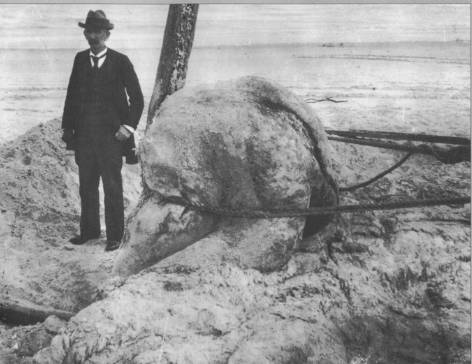
That globsters, the large unidentified organic masses that wash ashore, are the carcasses of creatures unknown to science: colossal octopuses, undiscovered deep-sea monsters, sea serpents, or prehistoric animals surviving into the present, rather than the decayed remains of familiar whales, sharks, and other known species.
Contradicted. Globsters are real: large, shapeless organic masses do wash up on beaches, and before the age of DNA testing they genuinely stumped observers. That much is not in dispute. The claim we rate is the sea-monster interpretation, that these masses are unknown giants, colossal octopuses, or surviving plesiosaurs. That claim is debunked. Every globster subjected to modern microscopy, biochemistry, or DNA analysis, from the 1896 St. Augustine Monster to the 2003 Chilean Blob, has resolved to the decomposed remains of a known animal, overwhelmingly the collagen-and-blubber sac of a whale or the featureless carcass of a basking shark. A few older cases were destroyed or never sampled and so remain formally unidentified, which is noted below and is a gap in the record, not evidence for a monster.
Believed by: Popular audiences and 19th- and 20th-century newspapers that ran the finds as sea-serpent scoops, along with a strand of cryptozoology that treats unidentified carcasses as evidence for undiscovered giants
The full story
What is documented
Start with what is not in doubt. Large, pale, formless masses of organic tissue really do wash up on beaches, and they really can be hard to identify at a glance. They arrive with no obvious head, no eyes, often no visible bones, and sometimes a coat of coarse fibers that reads, at first, as fur. The naturalist and cryptozoologist Ivan T. Sanderson coined the word globster in 1962 for one such carcass found on the Tasmanian coast in 1960, and the label has been applied ever since to every big, shapeless, unidentified lump that comes ashore.
The record of these finds is long and well attested. A carcass on Stronsay in the Orkney Islands in 1808 was named as a new species. The St. Augustine Monster of 1896 was photographed and sampled in Florida. The Chilean Blob of 2003 was weighed at some 13 tons and filmed by news crews. These are documented events, and the initial difficulty of naming the masses was genuine, not invented.
So the question this file weighs is not whether globsters exist. They do. It is whether the dramatic interpretation attached to them, that they are unknown sea monsters, colossal octopuses, or surviving prehistoric animals, holds up once the masses are actually examined. That is the claim on trial, and it is a very different thing from the carcasses themselves.
The case people make
The monster reading did not come from nowhere, and its strongest form is worth stating fairly. A globster genuinely does not look like any animal a beachgoer can name. It is boneless, headless, sometimes larger than a bus, and occasionally bristling with hair-like strands. Confronted with that in person, the guess that it is something unknown is not stupid; it is the honest reaction of an eye that has never seen a whale reduced to a naked sac of blubber.
The interpretation also drew, at times, on real scientific authority. When the St. Augustine mass came ashore, a Yale zoologist first proposed an enormous octopus and even gave it a name, Octopus giganteus. When the Stronsay carcass was found, naturalists in Edinburgh assigned it a brand-new species. For a while, in other words, credentialed experts were on the side of the marvel, and that lent the monstrous version a weight that an ordinary rumor would never have carried.
A boneless giant on the sand, named by professors as a new species or a colossal octopus, was not a story people had to be tricked into believing. The wonder was the reasonable first impression. The error was refusing to update when the tissue was finally read.
Add to this that the answers arrived slowly. Decades often passed between a find and a definitive identification, and in that gap the sea-monster version was the only story on offer. The fair version of the case is not that any globster has been shown to be a monster, but that these masses were, for a long time, a real and open puzzle that serious people took seriously.
Where the claim breaks down
An open puzzle is one thing. The leap from we cannot yet name this to therefore it is a creature unknown to science is where the evidence stops and the story takes over, and modern methods have closed the gap decisively.
The central fact is that the featurelessness of a globster is a predictable stage of decay, not a mysterious anatomy. When a large whale dies, its heavy skeleton and skull can detach and sink, leaving behind a tough outer envelope of skin, blubber, and collagen with no bones inside. Scavengers and surf then remove the eyes, fins, and other identifying parts. What remains is a pale, shapeless, boneless mass, which is exactly the globster form. The very traits offered as evidence of the unknown, no bones, no head, no features, are the signature of a rotted known animal.
And where the tissue has actually been tested, the answer is monotonous. The St. Augustine samples were identified as whale collagen by Gennaro in 1971 and confirmed by Pierce and colleagues in 1995 with electron microscopy and biochemistry, which found no invertebrate tissue at all. The 2003 Chilean Blob was sequenced in 2004 and came back a 100 percent DNA match to sperm whale. The 1808 Stronsay Beast was reidentified as a basking shark, whose carcass reliably rots into a false long-necked, maned shape. Even the hairy coat dissolves under a microscope into frayed collagen fibers rather than fur. The famous 2004 study summed up the pattern in three words: nothing but whales.
The basking shark illusion
One mechanism deserves its own moment, because it explains so many of the older sea-serpent reports that shade into the globster file: the decomposing basking shark.
A basking shark is a huge, harmless plankton-feeder. When it dies and rots, it falls apart in a very particular way. The gill apparatus and the whole lower jaw drop off first, leaving the small braincase perched at the end of the exposed spinal column. The result, to an observer on a beach, looks uncannily like a small head on a long neck, with a trailing body and often a fringe of exposed muscle fibers along the back that reads as a mane. It is, in effect, a ready-made plesiosaur, manufactured by ordinary decay.
This is not speculation after the fact. It is the documented explanation for the Stronsay carcass and for a string of later “sea serpent” corpses that were eventually sampled and traced to sharks. Once you know the shape a rotting basking shark takes, a surprising number of historical monsters resolve into the same animal seen at the same stage of decomposition.
The sea does not need to hide a monster to produce one. A dead basking shark, left to rot, builds a passable plesiosaur out of a spine and a skull, and hands it to the next person who walks the beach.
Why the monster keeps coming back
If every tested globster is a whale or a shark, why does the next one still make headlines as a possible monster? The answer says more about how the finds are experienced and reported than about the biology.
It rides a real and powerful strangeness. A boneless mass the size of a truck is genuinely uncanny, and the gap between how alien it looks and how mundane it turns out to be is wide enough that the mundane answer always feels like a letdown. Wonder is the first reaction, and wonder is sticky.
It is helped by the lag. The exciting claim lands the day the carcass is found; the DNA result, if it comes at all, lands months or years later, to far less attention. In the interval, the sea-monster framing is the only story in circulation, and for many people it is the version that stays. The correction rarely travels as far as the marvel.
And it draws on a durable appetite for hidden giants. The deep ocean really is under-explored, which makes “an unknown creature washed ashore” feel plausible in a way that other conspiracy shapes do not. Cryptozoology supplies a standing template into which each new blob is dropped, so the ordinary explanation can be recast as a dull official line concealing something more wonderful, even when the wonderful thing keeps testing as a whale.
Always an ordinary animal
Hold the two things apart. Globsters are real, they are strange, and for a long time they were a legitimate puzzle that fooled reasonable observers and even trained scientists. None of that is in dispute. But the specific claim we rate, that these masses are unknown sea monsters, giant octopuses, or surviving prehistoric creatures, is contradicted by every case that has actually been examined. Collagen studies, electron microscopy, and DNA sequencing return the same verdict again and again: decomposed whale, or featureless shark. On that claim the rating is Contradicted.
This is not a denial that the sea holds surprises, nor a mockery of the people who guessed wrong before the tools existed to check. It is a refusal to let the drama of a shapeless carcass override what the tissue plainly says. The missing head, the missing bones, the hair-like coat: each is a known product of decay, not a clue to a new animal.
The honest posture is to keep sampling the next one. A handful of old globsters were lost before anyone could test them and are now beyond reach, and those stay formally unidentified. That is a limit of the evidence, not a foothold for the monster. Wherever the science has been allowed to run, the answer has been the same ordinary one, and the difference between an untested mystery and a tested creature is the whole of this case.
What's still unexplained
- A number of historical globsters were buried, dumped back into the sea, or left to rot before anyone took a sample. Those specific carcasses, including some early Tasmanian and other cases, are now formally unidentifiable. That is a gap in the record from lost evidence, not positive support for a monster, since the tested cases are unanimous.
- Eyewitness measurements and drawings of the oldest finds, made before photography was routine, may exaggerate or distort size and shape. How much some legendary dimensions owe to honest error is hard to reconstruct now.
- Why decomposing basking sharks so reliably assume a false long-necked, plesiosaur-like form, and how often that specific illusion has seeded sea-serpent reports beyond the named globsters, is a genuine and interesting biological question that sits alongside the debunking rather than against it.
Point by point
The claim: Globsters have no bones, no head, and no recognizable features, so they cannot be known animals.
What the record shows: The missing features are exactly what advanced decomposition produces, not a sign of an unknown body plan. When a large whale dies, its skeleton and skull can separate from the skin and sink, leaving behind a tough outer sac of blubber and collagen with no bones inside it. Wave action, scavengers, and bacteria then strip away eyes, fins, and other identifying parts. The result is a shapeless, boneless, sometimes hairy-looking mass, which is precisely the globster form. The absence of features is the fingerprint of a rotted known animal, not the anatomy of a new one.
The claim: The St. Augustine Monster of 1896 was a giant octopus, as a Yale scientist first proposed.
What the record shows: The scientist who proposed it, Addison Verrill, retracted the idea himself and reclassified the mass as whale tissue. Every subsequent test confirmed him. Gennaro in 1971 found collagen; Pierce and colleagues in 1995, using electron microscopy and biochemistry, found only the collagen matrix of whale blubber and no invertebrate tissue; and 2004 DNA work on preserved samples placed the material with whales. The giant-octopus reading was a first guess that was corrected within the same decade and buried by a century of analysis.
The claim: The 2003 Chilean Blob was an enormous unknown octopus from the deep ocean.
What the record shows: DNA settled it directly. Researchers amplified and sequenced a mitochondrial gene from the 13-ton mass and found it 100 percent identical to sperm whale. The Blob was a large piece of the animal's adipose and connective tissue, the partial remains of a dead sperm whale, not a cephalopod of any size. The lead study spelled out the general result in its title: nothing but whales.
The claim: Some globsters are covered in hair or fur, which no whale or shark has, so they must be something else.
What the record shows: The fibers are not hair. As the collagen matrix in decomposing whale skin and blubber breaks down, it frays into coarse, hair-like strands. Nineteenth- and early-twentieth-century observers, seeing a bristly coat on a boneless mass, reasonably guessed at a furred or unknown creature, but microscopy shows the strands are unraveled connective-tissue fibers, not mammalian or reptilian hair. The Tasmanian and Trunko cases both show this pseudo-hair.
The claim: A carcass named as a brand-new species, like the 1808 Stronsay Beast, must have been a genuine unknown.
What the record shows: A formal species name reflects the guess of the moment, not a confirmed discovery. The Stronsay carcass was named Halsydrus pontoppidani by naturalists working from decayed remains and eyewitness measurements, but later anatomical analysis identified it as a basking shark. A rotting basking shark loses its gill structure and lower jaw and takes on a false long-necked, maned, plesiosaur-like profile, which has fooled observers repeatedly. The Latin binomial documents the error; it does not vindicate it.
Timeline
- 1808After a September storm, islanders on Stronsay in Orkney find a decaying 55-foot carcass with a long neck, a mane, and what look like limbs. Naturalists in Edinburgh name it a new species, Halsydrus pontoppidani. Later anatomical work concludes it was a basking shark, whose decomposed body characteristically loses its lower jaw and takes on a false long-necked, maned shape.
- 1896-12Two boys find a vast pale mass, roughly 18 feet long and estimated at several tons, on the beach near St. Augustine, Florida. Dr. DeWitt Webb documents and photographs it. Yale zoologist Addison Verrill first proposes an enormous octopus, Octopus giganteus, then reverses himself and identifies the mass as whale tissue.
- 1960-08A large, boneless carcass, described as having no eyes and no defined head and covered in fine bristles, comes ashore near the Interview River in western Tasmania. It is measured at roughly 20 by 18 feet and estimated at several tons, and its identity is debated for years.
- 1962Writing about the Tasmanian mass, cryptozoologist Ivan T. Sanderson coins the portmanteau globster. The word spreads and is applied retroactively to every large unidentified organic mass that washes up anywhere in the world.
- 1971Marine biologist Joseph F. Gennaro re-examines tissue preserved from the 1896 St. Augustine carcass and concludes it is collagen, the tough connective protein found in whale skin and blubber, not octopus muscle.
- 1995Sidney K. Pierce and colleagues publish a detailed study in The Biological Bulletin applying electron microscopy and biochemistry to the St. Augustine samples. They find no invertebrate tissue, only the collagenous matrix of whale blubber, most likely from a sperm whale.
- 2003-07A 13-ton, gelatinous mass about 40 feet across washes ashore at Los Muermos in Chile. Local scientists initially speculate it could be an unknown giant octopus, and the find makes headlines worldwide as the Chilean Blob.
- 2004Pierce and collaborators sequence DNA from the Chilean Blob and find it is a 100 percent match to sperm whale. Their paper, comparing it with samples from other famous globsters, carries the blunt subtitle Nothing but Whales.
- 2010Long-lost photographs of Trunko, a fibrous mass reported at Margate, South Africa in 1924 and long cited as a mystery, are rediscovered and identified as a classic whale-derived globster: a detached sac of blubber and collagen.
Contradicted. Globsters are real: large, shapeless organic masses do wash up on beaches, and before the age of DNA testing they genuinely stumped observers. That much is not in dispute. The claim we rate is the sea-monster interpretation, that these masses are unknown giants, colossal octopuses, or surviving plesiosaurs. That claim is debunked. Every globster subjected to modern microscopy, biochemistry, or DNA analysis, from the 1896 St. Augustine Monster to the 2003 Chilean Blob, has resolved to the decomposed remains of a known animal, overwhelmingly the collagen-and-blubber sac of a whale or the featureless carcass of a basking shark. A few older cases were destroyed or never sampled and so remain formally unidentified, which is noted below and is a gap in the record, not evidence for a monster.
Reviewed by Colin Peterson · Last reviewed July 8, 2026 · How we rate
Common questions
Is Globsters true?
Contradicted. Globsters are real: large, shapeless organic masses do wash up on beaches, and before the age of DNA testing they genuinely stumped observers. That much is not in dispute. The claim we rate is the sea-monster interpretation, that these masses are unknown giants, colossal octopuses, or surviving plesiosaurs. That claim is debunked. Every globster subjected to modern microscopy, biochemistry, or DNA analysis, from the 1896 St. Augustine Monster to the 2003 Chilean Blob, has resolved to the decomposed remains of a known animal, overwhelmingly the collagen-and-blubber sac of a whale or the featureless carcass of a basking shark. A few older cases were destroyed or never sampled and so remain formally unidentified, which is noted below and is a gap in the record, not evidence for a monster.
What is Globsters?
Every few years, a huge, pale, shapeless lump of tissue washes onto a beach somewhere in the world. It has no obvious head, no eyes, no visible bones, and sometimes a coat of coarse fibers that look like hair or fur. The naturalist Ivan T. Sanderson coined the word globster in 1962 for one such Tasmanian mass, and the label has since stu…
What does the evidence show?
The missing features are exactly what advanced decomposition produces, not a sign of an unknown body plan. When a large whale dies, its skeleton and skull can separate from the skin and sink, leaving behind a tough outer sac of blubber and collagen with no bones inside it. Wave action, scavengers, and bacteria then strip away eyes, fins,…
Why do people believe it?
The masses are genuinely, viscerally strange. A boneless, headless, house-sized lump on a beach looks nothing like a whale or a shark to an untrained eye, so the leap to something monstrous feels natural rather than credulous.
What is still unresolved?
A number of historical globsters were buried, dumped back into the sea, or left to rot before anyone took a sample. Those specific carcasses, including some early Tasmanian and other cases, are now formally unidentifiable. That is a gap in the record from lost evidence, not positive support for a monster, since the tested cases are unani…
Sources
- 1.Globster, Wikipedia (2026)
- 2.Globsters: Mysterious Marine Monster Masses, Live Science (2014)
- 3.7 Bizarre Globsters That Have Washed Ashore, Mental Floss (2021)
- 4.The Saint Augustine Monster, Smithsonian Institution Archives (2015)
- 5.The Myth of the St. Augustine Monster, JSTOR Daily (2019)
- 6.Microscopic, Biochemical, and Molecular Characteristics of the Chilean Blob and a Comparison With the Remains of Other Sea Monsters: Nothing but Whales, The Biological Bulletin (2004)
- 7.DNA tests solve mystery of Chilean sea 'blob', CBC News (2004)
- 8.Scientists Solve Chilean 'Blob' Mystery, ScienceDaily (2004)
- 9.Trunko, Wikipedia (2026)
Embed this verdict on your site
Paste this snippet to show our sourced verdict as a small card, with a link back to the full case file. Free to use.
<iframe src="https://theconspiratory.com/embed/globster" title="The Conspiratory verdict" width="520" height="190" style="border:0;max-width:100%" loading="lazy"></iframe>Help us investigate
This is a living case file. If you spot an error or know evidence we missed, tell us, and weigh in on where you land.
Where do you land?
Cast your read on this one.
Comments
Add your take. Comments are read and approved by a human before they appear, so keep it on topic and civil. Please do not accuse named, living people of crimes.