The Goseck Circle is a genuine 7,000-year-old Neolithic enclosure deliberately aligned to the winter solstice, Europe's oldest known solar observatory
By Colin PetersonJuly 8, 2026
Where the evidence lands: Proven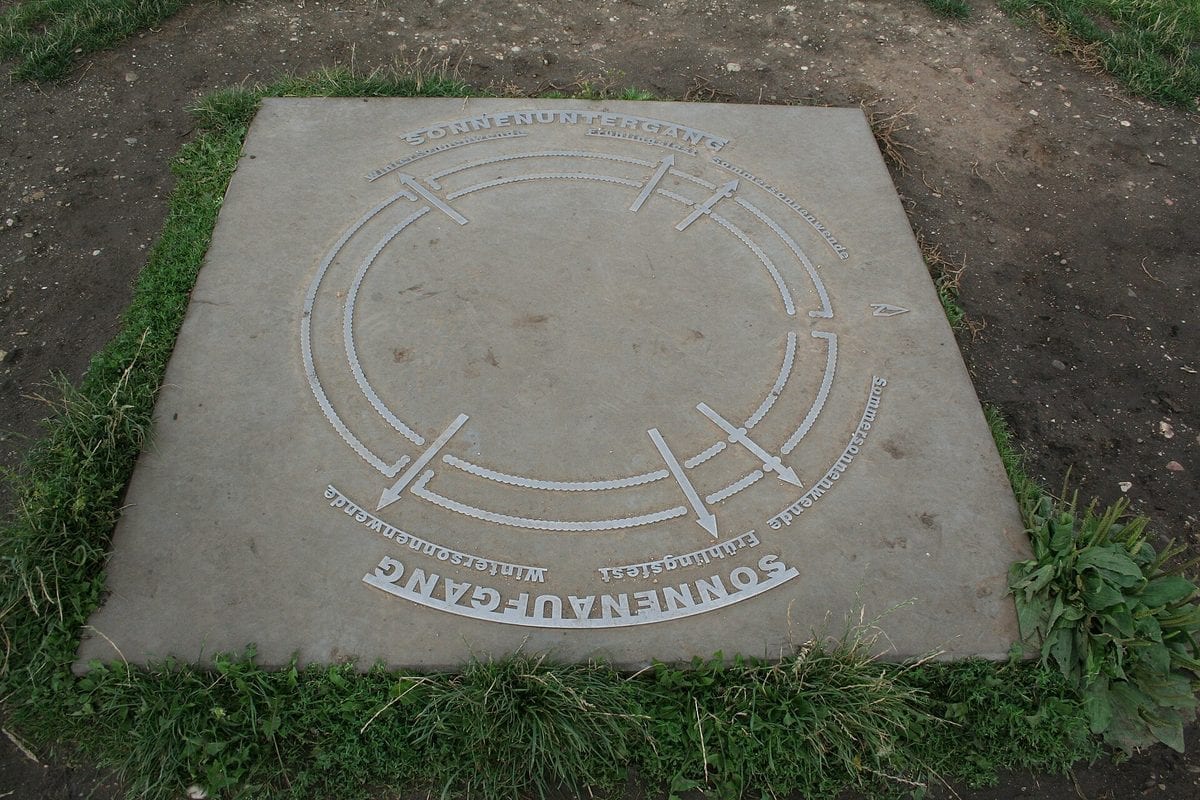
In its documented form: that the Goseck Circle is an authentic Neolithic enclosure built around 4900 BC whose southern gates were intentionally aligned to the sunrise and sunset of the winter solstice, making it a functioning solar and calendrical marker. In the inflated forms addressed and rejected here: that it is the product of a technologically advanced lost civilization or extraterrestrial visitors, that it is part of one continuous ancient sky-cult directly connected to the Nebra sky disc, or that it operated as a precision astronomical observatory in the modern instrumental sense.
Proven. What is on the record is solid. Near Goseck in Saxony-Anhalt, Germany, aerial photography in 1991 revealed a buried circular enclosure that was fully excavated between 2002 and 2004 by the Martin-Luther-University of Halle-Wittenberg and the State Office for Heritage Management and Archaeology Saxony-Anhalt. Radiocarbon dating places its construction around 4900 BC, and its two southern gates align with sunrise and sunset on the winter solstice for that latitude and era. The claim we rate is the modest, testable one: that this is a real, dated Neolithic ring whose gates were purposely set to the solstice sun. On the evidence that claim is substantiated, which is why it predates Stonehenge and the Egyptian pyramids by roughly two thousand years and is fairly called Europe's oldest known solar observatory. Held separate, and unproven, are the exotic overlays some attach to it: that it is the work of a lost advanced or extraterrestrial civilization, that it is directly linked to the far later Nebra sky disc, or that it functioned as a precision year-round instrument rather than a ritual and calendrical site. Those are addressed below and do not have the record behind them.
Believed by: The core finding is accepted by mainstream archaeologists and astronomers, and the site is a public monument on Saxony-Anhalt's Himmelswege (Sky Paths) heritage route. The inflated versions, a lost super-civilization or ancient-astronaut authorship, live in a separate popular audience drawn to prehistoric mysteries.
The full story
What is documented
Begin with what the spade actually turned up, because here the record is unusually firm. In 1991, on a reconnaissance flight over Saxony-Anhalt, the aerial archaeologist Otto Braasch photographed a faint circular mark in a field near the village of Goseck. Crop and soil discolourations over a long-buried ditch had traced the outline of a large ring, invisible from the ground.
Excavation between 2002 and 2004, led by François Bertemes of the Martin-Luther-University of Halle-Wittenberg together with the State Office for Heritage Management and Archaeology, revealed the structure in detail: an outer circular ditch roughly 75 metres across, two concentric rings of wooden palisade, and three narrow gates set to the north, southeast, and southwest. Radiocarbon dating placed its construction at about 4900 BC, the work of the Neolithic Stroked Pottery culture, with the site in use for perhaps two centuries.
The decisive detail is the geometry of the southern gates. For this latitude and era, the southeast and southwest gates frame the points on the horizon where the sun rises and sets on the winter solstice, the shortest day of the year. Stand at the centre on that morning and the sunrise appears in one gate; that evening it sets in the other. This is a real, dated, deliberately sky-aligned monument, older than Stonehenge and the pyramids by some two thousand years. None of that is in dispute, and this file does not dispute it. The question is only how much weight the site can bear beyond it.
The substantiated core
It is worth stating plainly how strong the genuine case is, because the sober version needs no exaggeration to impress. The alignment is not a hopeful guess. The southern gates sit at the measured azimuths of the winter-solstice sun for central Germany around 4800 BC, and the same solar orientation recurs across a whole family of Central European circular enclosures, the Kreisgrabenanlagen or rondels, of which some 120 to 150 are known. A pattern that repeats on purpose at many sites is design, not chance.
The people who built it had every reason to watch the sun. The winter solstice is the turning point of the agricultural year, the moment after which the days lengthen again, and marking it lets a farming community anchor a calendarand coordinate the demanding solar year with the easier-to-count lunar month. Comprehensive study of the fully excavated site concluded that, from near the centre, the sun's key rising and setting points could be anticipated to within a few days. That is a working calendar, and it is remarkable that human beings were keeping one in the fifth millennium BC.
A ring of earth and timber, raised two thousand years before Stonehenge, whose gates still catch the solstice sun exactly where its builders set them. The real story needs no embellishment to be extraordinary.
So the substantiated claim is specific and secure: an authentic Neolithic enclosure, radiocarbon-dated, whose architecture encodes a deliberate solar alignment. That is why it is fairly called Europe's oldest known solar observatory, so long as the word observatory is understood in its Stone Age sense, and it is the foundation on which everything else in this case has to be judged.
Where the story inflates
The trouble begins when the solid core is used as a launch pad. A real solstice alignment gets stretched into claims the evidence does not support: that the ring is the relic of a lost advanced civilization, that outside or extraterrestrial knowledge was needed to build it, or that it forms one continuous, sophisticated sky-cult directly linked to the Nebra sky disc.
Take the “too advanced for the Stone Age” premise first. It collapses on contact with how the alignment actually works. Aligning two gates to the solstice sun requires nothing but patient naked-eye observation across a few years, marking where the sunrise stops creeping along the horizon and turns back. No metal, no writing, and no instruments are needed, only attention and time, both of which Neolithic farmers had in abundance. And Goseck is not a solitary miracle demanding a special explanation; it is one node in a widespread tradition of enclosures built by ordinary agricultural communities, which is exactly what a home-grown human practice looks like rather than a gift from a vanished elite.
The Nebra sky disc connection is the tidiest overreach. The disc was found about 25 kilometres away, which sounds like corroboration until the dates are added: the disc is a Bronze Age object from around 1800 to 1600 BC, roughly three thousand years after Goseck was built and abandoned. A general regional interest in the sky across millennia is possible, but a direct, continuous link between the two has never been shown, and the researchers closest to the material say as much: the connection remains speculative and unproven.
The trouble with “observatory”
Even without aliens or lost civilizations, one word quietly does more work than it should: observatory. It conjures a precision instrument, a Stone Age telescope tracking the heavens with scientific accuracy all year round. The evidence describes something both older and different.
What the excavation supports is that specific gates mark specific solar events, above all the winter solstice, and that these could be anticipated to within a few days. That is a calendar and a focus for ceremony, not a running programme of measurement. The ditch was full of ritual material, including a striking concentration of cattle skull fragments and horn cores, which tells us the sun-watching was bound up with ceremony and belief. The most likely reading is a sacred place that was also a calendar, where the turning of the year was observed and marked with rite, not a detached scientific facility.
Archaeologists themselves keep this question open. The function of these circular enclosures is still debated: calendar, ceremonial arena, gathering place, defended space, even livestock pen have all been proposed, and Goseck was probably several of these at once. The northern gate, unlike the two southern ones, has no clear solar meaning, and suggestions that it pointed to a star or a meridian remain tentative.
Calling Goseck the oldest solar observatory is fair shorthand. Reading modern precision astronomy back into a ring of Neolithic fenceposts is not. The gap between those two is where the story quietly inflates.
Why it captivates
Goseck fascinates for reasons that are mostly to its credit, and the pull toward embellishment comes less from the site than from what we bring to it.
It rides a genuine astonishment. The unadorned fact, that people were aligning architecture to the solstice sun seven thousand years ago, before Stonehenge, before the pyramids, is staggering, and a wonder that large seems to demand a story to match. A plain account of patient farmers watching the horizon can feel too modest for a monument this old.
It is amplified by framing and proximity. Billed as the oldest solar observatory in the world, the site arrives wrapped in the vocabulary of precision science, and its nearness to the celebrated Nebra sky disc invites the mind to draw a line between them. Two famous sky-finds on the same map are hard to leave unconnected, even when three thousand years lie between them.
And it fits a familiar template. The assumption that ancient people could not have achieved such things on their own, so someone more advanced must have, has been draped over Stonehenge, the pyramids, and countless other sites. Goseck gets slotted into a story the audience already knows, which is comfortable precisely because it asks nothing new. The harder, truer marvel is that ordinary human beings, unaided, were this observant this early.
A real observatory, exotic overlays
Keep the claims apart, because the whole discipline of this case is in the gap between them. The documented core is real and secure: an authentic Neolithic enclosure near Goseck, radiocarbon-dated to around 4900 BC, whose southern gates were deliberately aligned to the sunrise and sunset of the winter solstice, one of a wider family of such circular enclosures across Central Europe. On that claim the rating is Proven, and it is why the site earns its billing as Europe's oldest known solar observatory.
What does not follow, and what the record does not carry, is the exotic overlay: that the ring is the work of a lost advanced or extraterrestrial civilization, that it is directly tied to the far later Nebra sky disc, or that it functioned as a precision year-round instrument rather than a sacred site that also kept a calendar. Those claims are held separate here, and on the present evidence they are unproven. A real solstice alignment does not import a vanished super-culture, and geographic proximity does not bridge a three-thousand-year gap.
The honest posture is to let the genuine wonder stand without the inflation. Seven thousand years ago, a farming community on a rise above the Saale watched the sun to its lowest point and built two gates to hold it. That is astonishing, and it is enough. The extraordinary answer to “how could they?” is not a lost civilization or a visitor from elsewhere; it is that they were people much like us, watching the sky with patience, and getting it right.
What's still unexplained
- The precise function of Goseck, and of circular enclosures generally, is still debated among mainstream archaeologists. Calendar, ceremonial arena, meeting place, and enclosure have all been proposed, and the fair answer is that it was probably several of these at once, with the exact weighting unresolved.
- How the alignments were used in practice, whether chiefly to time agricultural or ritual events, or to reconcile a lunar count with the solar year, is inferred rather than directly documented, since no written record survives from a preliterate culture.
- The orientation of the northern gate is less clearly solar than the two southern gates, and proposals for what, if anything, it marked (a meridian or a stellar reference) remain tentative.
- Why the whole tradition of these enclosures arose and then was abandoned within a few centuries across Central Europe is a genuine open question, separate from the astronomy and not explained by it.
Point by point
The claim: Such a precise solar alignment, built seven thousand years ago, is beyond ordinary Stone Age farmers and points to a lost advanced civilization or outside (even extraterrestrial) knowledge.
What the record shows: It does not. Aligning two gaps in a fence to where the sun rises and sets on the shortest day of the year requires patient naked-eye observation over a handful of years, not advanced instruments or outside help. Neolithic farming communities had every reason to track the solar year, and the archaeology shows exactly who built it: the local Stroked Pottery culture, using the timber, earth, and labour available to any village of the period. Goseck is not a lone marvel either. It belongs to a family of some 120 to 150 circular enclosures across Central Europe, many with similar solar orientations, which is the signature of a shared human tradition, not a vanished super-civilization.
The claim: Goseck is directly connected to the famous Nebra sky disc, evidence of one continuous, sophisticated ancient sky-cult in the region.
What the record shows: The two are close in space and far apart in time. The Nebra sky disc was found roughly 25 kilometres away, but it dates to the Bronze Age, around 1800 to 1600 BC, some three thousand years after Goseck was built and abandoned. A shared regional interest in the sky is plausible in the loosest sense, but a direct link between a fifth-millennium-BC enclosure and a second-millennium-BC bronze object has never been demonstrated. Researchers who note the geographic proximity are explicit that any connection is speculative and, so far, unproven.
The claim: The site was a precision astronomical observatory, a Stone Age instrument tracking the sun and stars year-round with scientific accuracy.
What the record shows: The word observatory does a lot of work here. What the excavation supports is that the gates mark the winter solstice sunrise and sunset, and that from the centre the sun's extreme positions could be anticipated to within a few days. That is a calendar and a ritual focus, not a precision instrument in the modern sense, and it does not imply continuous, accurate year-round measurement. Archaeologists still debate the balance of functions (calendar, ceremony, gathering place, even livestock enclosure), and the abundant ritual finds in the ditch suggest the solar alignment was woven into ceremony rather than serving detached science.
The claim: The solstice alignment is really just pareidolia: with three gates and a wide horizon, something was bound to line up by chance.
What the record shows: This underrates the measurement. The southeast and southwest gates sit at the azimuths of the winter-solstice sunrise and sunset for central Germany around 4800 BC, not at random points on the circle, and the same solar orientation recurs across many contemporaneous enclosures. A pattern that repeats deliberately at dozens of sites is not coincidence; it is design. The alignment is the substantiated part of this case, corroborated by field measurement and by comparison with the wider rondel tradition.
The claim: The whole thing is essentially a modern reconstruction, so its ancient significance is manufactured for tourists.
What the record shows: The reconstruction stands on genuine, excavated Neolithic foundations. The buried ditch and the postholes of the original palisades were dug, recorded, and radiocarbon-dated before anything was rebuilt, and the 2005 timber rings were raised on the footprint of the authentic structure to make it legible to visitors. Interpreting the site as a heritage attraction does not erase the fact that the underlying monument is real and demonstrably ancient.
Timeline
- c. 4900 BCA Neolithic community of the Stroked Pottery culture (Stichbandkeramik) builds the enclosure on a plateau above the Saale: an outer circular ditch about 75 metres across, two concentric rings of wooden palisade, and three narrow gates set to the north, southeast, and southwest.
- c. 4800 BCFor this latitude and epoch, the southeast and southwest gates frame the point on the horizon where the sun rises and sets at the winter solstice, the two lowest positions of the sun in the year, separated by an angle of roughly 97 degrees as seen from the centre.
- c. 4700–4600 BCAfter perhaps two centuries of use, the enclosure is abandoned, in keeping with the wider tradition of Central European circular enclosures (Kreisgrabenanlagen, or rondels) that flourished and then faded across a few generations. The wooden palisades decay and the ditch silts up, leaving only subsurface traces.
- 1991During a reconnaissance flight, aerial archaeologist Otto Braasch photographs a faint circular discolouration in a field near Goseck. Crop and soil marks over the buried ditch betray the outline of a large ring long invisible from ground level.
- 2002Systematic excavation begins under François Bertemes of the Martin-Luther-University of Halle-Wittenberg, working with the State Office for Heritage Management and Archaeology Saxony-Anhalt. Postholes of the palisades, the gate structures, and finds within the ditch are recovered and mapped.
- 2004The dig is completed. Radiocarbon dating fixes construction at around 4900 BC, and the ditch yields ritual material, including a striking concentration of cattle skull fragments and horn cores, pointing to a sacred as well as a practical function.
- 2005-12-21A reconstruction of the palisade rings, using about 1,675 oak posts standing some 2.5 metres tall, is completed on the original site and opened to the public on the winter solstice. Visitors can now stand at the centre and watch the solstice sun through the reconstructed gates.
- 2023A comprehensive study of the fully excavated enclosure is published, concluding that Goseck served as both a sacred place and an astronomical reference, where the rising and setting of the sun at key moments of the year could be observed and anticipated to within a few days. The exact balance of ritual and calendar functions remains under active discussion.
Proven. What is on the record is solid. Near Goseck in Saxony-Anhalt, Germany, aerial photography in 1991 revealed a buried circular enclosure that was fully excavated between 2002 and 2004 by the Martin-Luther-University of Halle-Wittenberg and the State Office for Heritage Management and Archaeology Saxony-Anhalt. Radiocarbon dating places its construction around 4900 BC, and its two southern gates align with sunrise and sunset on the winter solstice for that latitude and era. The claim we rate is the modest, testable one: that this is a real, dated Neolithic ring whose gates were purposely set to the solstice sun. On the evidence that claim is substantiated, which is why it predates Stonehenge and the Egyptian pyramids by roughly two thousand years and is fairly called Europe's oldest known solar observatory. Held separate, and unproven, are the exotic overlays some attach to it: that it is the work of a lost advanced or extraterrestrial civilization, that it is directly linked to the far later Nebra sky disc, or that it functioned as a precision year-round instrument rather than a ritual and calendrical site. Those are addressed below and do not have the record behind them.
Reviewed by Colin Peterson · Last reviewed July 8, 2026 · How we rate
Common questions
Is The Goseck Circle true?
Proven. What is on the record is solid. Near Goseck in Saxony-Anhalt, Germany, aerial photography in 1991 revealed a buried circular enclosure that was fully excavated between 2002 and 2004 by the Martin-Luther-University of Halle-Wittenberg and the State Office for Heritage Management and Archaeology Saxony-Anhalt. Radiocarbon dating places its construction around 4900 BC, and its two southern gates align with sunrise and sunset on the winter solstice for that latitude and era. The claim we rate is the modest, testable one: that this is a real, dated Neolithic ring whose gates were purposely set to the solstice sun. On the evidence that claim is substantiated, which is why it predates Stonehenge and the Egyptian pyramids by roughly two thousand years and is fairly called Europe's oldest known solar observatory. Held separate, and unproven, are the exotic overlays some attach to it: that it is the work of a lost advanced or extraterrestrial civilization, that it is directly linked to the far later Nebra sky disc, or that it functioned as a precision year-round instrument rather than a ritual and calendrical site. Those are addressed below and do not have the record behind them.
What is The Goseck Circle?
Near the village of Goseck, on a rise above the Saale river in Saxony-Anhalt, Germany, a ring of ditches and wooden palisades sat buried and forgotten until a 1991 reconnaissance flight caught its outline as a discolouration in a crop field. Excavated between 2002 and 2004, the enclosure turned out to be roughly 75 metres across, built a…
What does the evidence show?
It does not. Aligning two gaps in a fence to where the sun rises and sets on the shortest day of the year requires patient naked-eye observation over a handful of years, not advanced instruments or outside help. Neolithic farming communities had every reason to track the solar year, and the archaeology shows exactly who built it: the loc…
Why do people believe it?
The true facts are astonishing on their own. A deliberately sky-aligned ring built around 4900 BC predates Stonehenge and the Egyptian pyramids by roughly two thousand years, and a genuine wonder of that scale invites the mind to reach for an equally dramatic backstory.
What is still unresolved?
The precise function of Goseck, and of circular enclosures generally, is still debated among mainstream archaeologists. Calendar, ceremonial arena, meeting place, and enclosure have all been proposed, and the fair answer is that it was probably several of these at once, with the exact weighting unresolved.
Sources
- 1.Goseck Circle, Wikipedia
- 2.Solar Observatory Goseck, Himmelswege (Saxony-Anhalt)
- 3.Research history: The Goseck site, eMuseum Himmelswege (State of Saxony-Anhalt)
- 4.Sacred place and astronomical observatory: New research on the Middle Neolithic circular enclosure of Goseck, Phys.org (2023)
- 5.State Museum of Prehistory (Landesmuseum für Vorgeschichte), Halle, Landesmuseum für Vorgeschichte Halle
- 6.Astronomical aspects of Kreisgrabenanlagen (Neolithic circular ditch systems): an interdisciplinary approach, Proceedings of the International Astronomical Union (Cambridge University Press)
- 7.Orientation of the northern gate of the Goseck Neolithic rondel, arXiv (Ridderstad) (2009)
- 8.Goseck Circle: The Oldest Known Solar Observatory, Ancient Origins
Embed this verdict on your site
Paste this snippet to show our sourced verdict as a small card, with a link back to the full case file. Free to use.
<iframe src="https://theconspiratory.com/embed/goseck-circle" title="The Conspiratory verdict" width="520" height="190" style="border:0;max-width:100%" loading="lazy"></iframe>Help us investigate
This is a living case file. If you spot an error or know evidence we missed, tell us, and weigh in on where you land.
Where do you land?
Cast your read on this one.
Comments
Add your take. Comments are read and approved by a human before they appear, so keep it on topic and civil. Please do not accuse named, living people of crimes.