The green fireballs seen over New Mexico's atomic installations from 1948 were intelligently controlled craft, not meteors, and the government has hidden what they were
By Colin PetersonJuly 8, 2026
Where the evidence lands →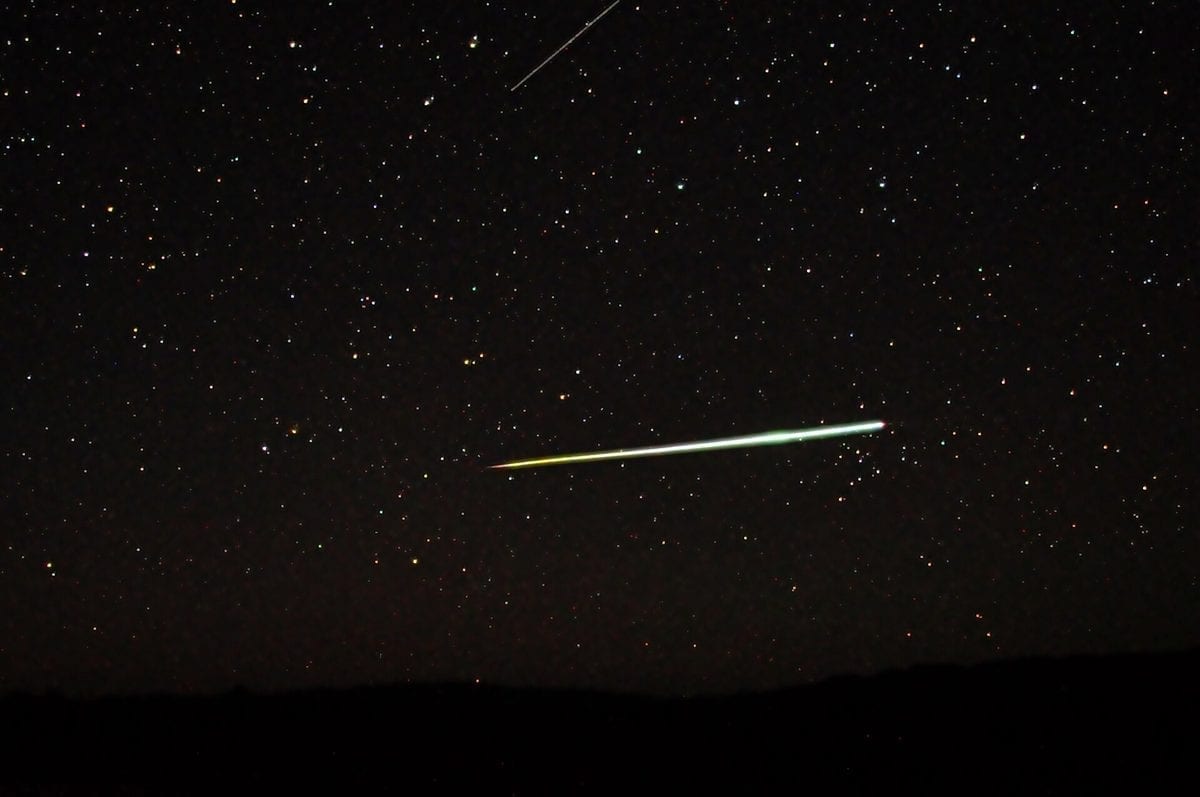
That the green fireballs reported over New Mexico from 1948 were not natural meteors but intelligently controlled devices, variously identified as Soviet reconnaissance vehicles, secret American test craft, or objects of non-human origin, deliberately surveilling the atomic-weapons complex, and that the U.S. government determined or suspected as much and has concealed the true explanation behind a bland verdict of natural phenomena.
The sightings are real and well documented: from late 1948 into the early 1950s, pilots, scientists, and security officers repeatedly reported brilliant green fireballs streaking, often nearly horizontally, over New Mexico near Los Alamos, Sandia, Kirtland, and White Sands. The Air Force took them seriously enough to convene a 1949 Los Alamos conference and to run a dedicated study, Project Twinkle, whose 1951 final report leaned toward a natural, meteoric explanation while conceding it had gathered almost no hard data. The claim we rate is narrower and larger: that the fireballs were intelligently controlled devices (Soviet, secret American, or non-human) and that their true nature is being concealed. That claim is unproven. Meteor expert Lincoln LaPaz argued forcefully that the objects were not ordinary meteors, and no wreckage was ever found; but no instrument ever captured a calibrated track, no craft or debris was recovered, and Twinkle's own conclusion was natural phenomena. Unexplained does not mean artificial.
Believed by: A durable case in UFO and UAP research, cited for decades as an early instance of unexplained objects clustering over nuclear sites. It draws a wider audience whenever new files are released, tapping the broad and repeatedly polled belief that the U.S. government knows more about aerial phenomena than it discloses.
The full story
What is documented
Start with what is not in dispute, because a surprising amount of this case is solid. Late in November 1948, people around Albuquerque, New Mexico began reporting brilliant green lights in the night sky. Over the following weeks the reports grew more frequent and more detailed, and they came from observers whose word carried weight: airline and military pilots, federal agents, and security officers at the atomic installations.
The sightings clustered over the most sensitive ground in the country. Los Alamos and Sandia, the heart of the atomic-weapons program, together with Kirtland Field and the ranges near White Sands, sat at the center of the reports. The objects were described as vivid green fireballs, some appearing at full brightness in an instant and traveling on a strikingly flat, nearly horizontal path before fading, often without any sound.
The government did not ignore this. In February 1949 it gathered senior scientists at Los Alamos, among them Edward Teller and the meteoriticist Lincoln LaPaz, to try to explain the fireballs; they could not agree. Later the Air Force stood up a small dedicated study, Project Twinkle, to catch the objects on camera. So the question this file weighs is not whether the fireballs were real, or whether officials took them seriously. Both are settled. It is whether the larger claim built on top of them, that they were intelligently controlled craft whose nature has been concealed, has been established. It has not.
The case people make
The suspicion did not come from nowhere, and its honest version is genuinely arresting. Begin with the quality of the witnesses. These were not anonymous reports from a dark highway. Pilots trained to identify what they fly among, intelligence officers, and personnel cleared to work beside the nation's atomic secrets were describing the same vivid, oddly behaved green fireballs, over and over.
Then there is the expert dissent. Lincoln LaPaz was not a hobbyist; he ran an institute devoted to meteorites and was one of the country's foremost meteor authorities. He interviewed scores of witnesses, plotted trajectories, and combed the ground where any real meteorite should have landed. He found nothing: no fragments, no crater, no scorch. And he concluded, on the record, that the objects were not conventional meteorites, citing their silence, their instant full brightness, and their flat horizontal flight.
Finally there is the setting. Strange objects appearing precisely over Los Alamos and Sandia, at the opening of the Cold War, with a nuclear-armed rival racing to catch up, made the idea of deliberate reconnaissance feel not paranoid but prudent. The Air Force plainly worried about exactly that, which is why it convened its scientists and funded a study.
Credible witnesses, a leading meteor expert saying these were not meteors, and a wave of the objects over the atomic-weapons complex at the height of Cold War fear. That is not a campfire story, and it earned the serious attention it received.
That is the case at full strength: not that a Soviet or alien craft has been proven, but that trained observers and a real scientist recorded something over the nation's nuclear heart that the government itself could not explain, and took seriously enough to investigate.
What the Air Force actually found
Here is where the record and the legend part ways. The Air Force did take the fireballs seriously, and then it tried to measure them, and the measuring is the part the exotic version tends to skip.
Project Twinkle was meant to triangulate the fireballs with three linked cinetheodolite camera stations near Holloman and White Sands, which could have fixed their true speed, altitude, and path. In practice, budget shortfalls and a shortage of cameras left a single roving station that kept being in the wrong place. It captured almost nothing usable. The study that was supposed to convert eyewitness wonder into hard data instead produced a near void of it.
That failure, not a conspiracy, best explains the bland final report of November 1951, which attributed most sightings to ordinary man-made and natural causes and found no indication that even the green fireballs were anything but natural phenomena. A study that never photographed its quarry could hardly prove that quarry was an aircraft, a spacecraft, or anything else. Its weak conclusion follows from weak evidence, which is just what one would expect from a project that failed to catch the phenomenon it was built to catch.
And the declassified files cut against a cover-up, not for one. The transcript of the 1949 Los Alamos conference, part of the July 2026 release, shows the nation's leading physicists candidly admitting they could not explain the fireballs and floating competing guesses. Manufactured cover stories do not usually preserve a record of the experts openly stumped. The picture is of an institution that was genuinely puzzled and then, having gathered little, shrugged.
The measurement that never happened
The heart of the exotic case is a set of behaviors that meteors are said not to show: appearing at full brightness in an instant, flying flat and horizontal, making no sound, glowing an unusual green. It is important to be precise about where those claims come from, because it changes what they can prove.
They come, almost entirely, from human description, not from instruments. Estimating the altitude, distance, speed, and even the trajectory of a brief fireball at night, against a dark sky with no reference points, is one of the least reliable things the eye can be asked to do, and it trips up careful observers routinely. A distant, high, shallow meteor can look flat and horizontal; color can come from composition or from the atmosphere; the absence of sound is exactly what one expects from an event tens of miles away. None of this proves the fireballs were mundane. It means the anomalous features were never nailed down.
This is why Twinkle's failure matters so much. A working triangulation network would have produced a calibrated track, and a calibrated track would have answered the whole question: it would have shown whether the objects truly flew in ways no meteor can, or only appeared to. That measurement was never made. LaPaz saw this clearly, which is why he attacked the study as inadequate and demanded an intensive, systematic investigation. He was right that the case deserved one; he did not get it.
An anomaly described by good witnesses but never measured by an instrument is a real mystery and a poor proof. The green fireballs are the first and the second at once.
So the standoff is symmetrical. The skeptics never demonstrated that the fireballs were only unusual meteors, and the believers never demonstrated that they were craft. What survives is a genuine, unmet need for data: an object no one photographed well enough to identify.
Why it endures
Of the early Cold War aerial mysteries, the green fireballs are among the most durable, and they endure for reasons partly to their credit and partly independent of what the objects were.
They endure because the witnesses were trustworthy. Most conspiracy narratives ask you to trust unnamed sources over officials. This one offers the reverse: named pilots, cleared personnel, and a distinguished scientist, describing something over the nation's atomic laboratories that the government itself could not resolve. That combination earns a hearing flimsier stories never get.
They endure because the setting is irresistible. Unexplained lights over the very sites that built the bomb, at the dawn of the nuclear standoff, is a story that seems to write its own meaning. The pattern of anomalies clustering near nuclear facilities has become a recurring motif in UFO and UAP lore, and the green fireballs are one of its founding chapters.
And they endure because the case never closed and keeps reopening. A mystery resolved with a confident answer fades; one abandoned with a shrug, its records dribbling out for three-quarters of a century, stays raw. Each declassification, most recently the 1949 conference transcript in July 2026, hands the story back to a new audience, and the government's own long silence reads, to many, as the mark of something withheld rather than the residue of a study that simply failed.
Real fireballs, no craft proven
Keep the two claims apart, because the discipline of this case lives in the gap between them. The phenomenon was real: a documented wave of unexplained green fireballs, reported by credible observers over New Mexico's atomic installations, taken seriously enough that the Air Force convened its top scientists and funded a study. On that, there is no argument. But the artificial-craft conclusion is not established: no wreckage was ever recovered, no instrument ever captured a calibrated track, the anomalous behaviors rest on eyewitness description rather than measurement, and Project Twinkle's own verdict, however thinly supported, was natural phenomena.
This is not a debunking, and it should not be read as one. The green fireballs were not a hoax or a lie, and they have never been cleanly explained away. Lincoln LaPaz was a serious scientist whose doubts about the meteor explanation deserve to be taken seriously, and the failure to ever properly measure the objects is a real loss, not a comfort.
What it refuses is only the final leap: from we could not explain it to therefore it was a hidden craft. That step needs evidence the record never produced, because the one study that might have produced it failed. Until a calibrated track, a physical fragment, or a document showing officials concluded otherwise comes to light, the green fireballs remain what the Los Alamos conference of February 1949 left them: brilliant, badly measured, and unexplained.
What's still unexplained
- What the green fireballs actually were remains genuinely unresolved. Project Twinkle's natural-phenomena conclusion was reached on almost no instrument data, and no fully satisfying account has ever explained every reported feature.
- How much of the anomalous behavior (instant appearance, flat horizontal flight, silence) was real and how much was the ordinary unreliability of eyewitness estimates of nighttime fireballs is the pivotal unanswered question, and without a calibrated track it cannot be settled.
- Why LaPaz's call for an intensive, systematic study was never funded, leaving the best chance to gather hard data unrealized, is a legitimate historical grievance separate from what the objects were. The failure to measure is itself part of the story.
- Whether the New Mexico clustering reflects a phenomenon that truly targeted atomic sites or simply a concentration of trained, motivated observers in restricted airspace is not resolved by the surviving record.
Point by point
The claim: A meteor expert, Lincoln LaPaz, concluded the fireballs were not ordinary meteors, so they must have been artificial craft.
What the record shows: LaPaz's judgment is the strongest single element of the case, and it is genuine: the leading meteoriticist in the country studied the reports up close, found no debris where meteorites should have fallen, and listed features (silence, instantaneous full brightness, near-horizontal flight, an unusual green color) that he considered atypical of conventional meteors. That is a real anomaly from a credible source. But not an ordinary meteorite is a long way from an intelligently controlled craft. LaPaz himself did not settle on a spacecraft; he weighed secret devices and unusual natural phenomena alike, and other scientists at Los Alamos, including Joseph Kaplan, thought an unusual meteoric or upper-atmosphere process remained possible. Ruling out the textbook meteorite does not select artificial over every other natural explanation.
The claim: The fireballs clustered over Los Alamos, Sandia, Kirtland, and White Sands, so they were deliberately surveilling the atomic complex.
What the record shows: The geographic clustering is real and was exactly what alarmed officials. But New Mexico in 1948 was also where the country concentrated its most watchful, best-briefed observers: laboratory security, range personnel, intelligence officers, and pilots primed to report anything unusual over restricted airspace. A phenomenon that occurred more widely could be reported far more densely there simply because that is where trained, cleared, motivated witnesses were looking up. Clustering of reports around sensitive sites is consistent with intelligent targeting, but it is equally consistent with a reporting bias, and the record cannot distinguish the two.
The claim: The Air Force ran a secret study, Project Twinkle, which proves the government took the objects seriously as a real threat.
What the record shows: It does show that, and the point is worth conceding plainly: the Air Force convened its top scientists and funded a dedicated instrumented study, which it would not have done over nothing. But taking a phenomenon seriously does not mean concluding it was a craft. Twinkle was small, underfunded, and hobbled by too few cameras; it largely failed to record the fireballs at all, and its final report leaned toward natural phenomena because it had not gathered evidence of anything artificial. Official concern establishes that the mystery was real, not that the exotic answer to it is true.
The claim: Project Twinkle's natural-phenomena verdict was a whitewash to hide what the government really knew.
What the record shows: There is no evidence for a cover-up, and the documentary record cuts the other way. The declassified files, including the 1949 conference transcript, show scientists candidly admitting they could not explain the fireballs, which is not how a manufactured cover story reads. Twinkle's weak conclusion is better explained by weak data: a single roving camera station that kept missing the events could hardly prove anything, natural or artificial. A bland verdict resting on a failed measurement effort is what institutional shrugging looks like, not necessarily what concealment looks like.
The claim: The fireballs behaved in ways meteors cannot: appearing instantly, flying flat and horizontal, and making no sound.
What the record shows: These reported features are the crux, and they rest almost entirely on eyewitness description rather than on instruments. Judging the trajectory, altitude, speed, and sound of a brief nighttime fireball, with no fixed reference points, is notoriously unreliable, and even careful observers routinely misjudge such events. Some of the cited traits also have prosaic analogues: green coloration can come from the object's composition or from atmospheric effects, and unusual entry geometry can produce long, shallow paths. Because Twinkle never captured a calibrated track, it was never established whether the fireballs truly violated meteoric behavior or only appeared to. The anomaly is genuine; the measurement that would resolve it was never made.
Timeline
- 1948-11Residents around Albuquerque, New Mexico begin reporting mysterious green flares or lights in the night sky. Air Force intelligence at Kirtland Field at first assumes they are ordinary flares, but the volume and brilliance of the reports keep rising.
- 1948-12-05On a single night two separate aircrews, one civilian and one military, report a bright green ball of fire over New Mexico. One crew says the object raced toward their aircraft, prompting the pilot to swerve. The descriptions liken it to a huge green meteor, but the behavior unsettles the observers.
- 1948-12Dr. Lincoln LaPaz, head of the University of New Mexico's Institute of Meteoritics and a leading meteor expert, is brought in. He interviews scores of witnesses, plots flight paths, and searches the ground where any meteorite should have fallen. He finds no fragments, no crater, no burn. He himself sees one of the fireballs.
- 1948-12-20LaPaz writes to the Air Force that the objects are atypical of meteors: silent, appearing at full intensity instantly, holding constant brightness, and traveling on a nearly horizontal path. He later tells officials he considers a conventional meteorite fall most unlikely, and privately weighs whether the fireballs could be secret devices, American or Soviet.
- 1949-02-16A conference convenes at Los Alamos Scientific Laboratory, drawing senior physicists including Edward Teller and laboratory director Norris Bradbury, meteor experts Lincoln LaPaz and Joseph Kaplan, and military and intelligence officers. The group debates meteors, electrical phenomena, and other ideas but cannot agree on what the fireballs are. Kaplan tells LaPaz he knows of no secret project that would explain them.
- 1949-12After further sightings and continued concern about objects near atomic installations, the Air Force authorizes a dedicated study. It is soon organized as Project Twinkle, a small photographic and observation effort run under contract by Land-Air, Inc.
- 1950Project Twinkle sets up an instrumented watch near Holloman Air Force Base and White Sands, intending to triangulate the fireballs with 35-mm cinetheodolite cameras. Budget shortfalls and equipment shortages leave a single roving station that repeatedly misses the phenomenon. Almost no usable instrument data is collected.
- 1951-11The Project Twinkle final report concludes that most observed light phenomena can be attributed to ordinary man-made and natural causes, and finds no indication that even the strange green fireballs are anything but natural phenomena. LaPaz criticizes the study as inadequate, arguing the fireballs merited intensive, systematic investigation the project never delivered. Twinkle is terminated the following month.
- 2026-07The Pentagon's fourth batch of declassified UAP records, released under a government transparency push, includes the transcript of the February 1949 Los Alamos conference. It renews public interest in the case, showing prominent scientists openly stating that the fireballs did not fit any known explanation at the time.
From the case file
The actual records: declassified, released, or leaked. We link straight to each document in its official archive, so you never have to take our word for it. Read the originals yourself.
Other case files that cite the same sources
The sightings are real and well documented: from late 1948 into the early 1950s, pilots, scientists, and security officers repeatedly reported brilliant green fireballs streaking, often nearly horizontally, over New Mexico near Los Alamos, Sandia, Kirtland, and White Sands. The Air Force took them seriously enough to convene a 1949 Los Alamos conference and to run a dedicated study, Project Twinkle, whose 1951 final report leaned toward a natural, meteoric explanation while conceding it had gathered almost no hard data. The claim we rate is narrower and larger: that the fireballs were intelligently controlled devices (Soviet, secret American, or non-human) and that their true nature is being concealed. That claim is unproven. Meteor expert Lincoln LaPaz argued forcefully that the objects were not ordinary meteors, and no wreckage was ever found; but no instrument ever captured a calibrated track, no craft or debris was recovered, and Twinkle's own conclusion was natural phenomena. Unexplained does not mean artificial.
Reviewed by Colin Peterson · Last reviewed July 8, 2026 · How we rate
Common questions
Is The green fireballs true?
The sightings are real and well documented: from late 1948 into the early 1950s, pilots, scientists, and security officers repeatedly reported brilliant green fireballs streaking, often nearly horizontally, over New Mexico near Los Alamos, Sandia, Kirtland, and White Sands. The Air Force took them seriously enough to convene a 1949 Los Alamos conference and to run a dedicated study, Project Twinkle, whose 1951 final report leaned toward a natural, meteoric explanation while conceding it had gathered almost no hard data. The claim we rate is narrower and larger: that the fireballs were intelligently controlled devices (Soviet, secret American, or non-human) and that their true nature is being concealed. That claim is unproven. Meteor expert Lincoln LaPaz argued forcefully that the objects were not ordinary meteors, and no wreckage was ever found; but no instrument ever captured a calibrated track, no craft or debris was recovered, and Twinkle's own conclusion was natural phenomena. Unexplained does not mean artificial.
What is The green fireballs?
Late in 1948, people around Albuquerque, New Mexico began reporting brilliant green lights in the night sky. Over the following months the reports multiplied and sharpened: airline and military pilots, federal agents, and laboratory security officers described vivid green fireballs, some appearing at full brightness in an instant and tra…
What does the evidence show?
LaPaz's judgment is the strongest single element of the case, and it is genuine: the leading meteoriticist in the country studied the reports up close, found no debris where meteorites should have fallen, and listed features (silence, instantaneous full brightness, near-horizontal flight, an unusual green color) that he considered atypic…
Why do people believe it?
The witnesses were credible and specific. These were not roadside tipsters but airline and military pilots, federal agents, and laboratory security officers, people trained to observe and cleared to work around the nation's atomic secrets, reporting the same striking phenomenon. That professional pedigree gives the case a weight ordinary…
What is still unresolved?
What the green fireballs actually were remains genuinely unresolved. Project Twinkle's natural-phenomena conclusion was reached on almost no instrument data, and no fully satisfying account has ever explained every reported feature.
Sources
- 1.Green fireballs, Wikipedia
- 2.When Mysterious Green Fireballs Worried the US Government, History.com (A&E Television Networks) (2023)
- 3.Declassified 'green fireball' records raise questions about 1949 sightings, Newsweek (2026)
- 4.Trump UFO Files Revive 1949 Los Alamos Green Fireball Mystery, Los Angeles Magazine (2026)
- 5.The Report on Unidentified Flying Objects, Chapter 4 (Green Fireballs, Project Twinkle, Little Lights, and Grudge), Edward J. Ruppelt, via Wikisource (1956)
- 6.Project Twinkle Final Report, November 1951, Air Force Historical Research Agency, via Internet Archive (1951)
- 7.Key Revelations From 4th Batch of Pentagon UFO Files, The Epoch Times (2026)
Embed this case file on your site
Paste this snippet to show this case file as a small card, with a link back to the full write-up. Free to use.
<iframe src="https://theconspiratory.com/embed/green-fireballs" title="The Conspiratory verdict" width="520" height="190" style="border:0;max-width:100%" loading="lazy"></iframe>Help us investigate
This is a living case file. If you spot an error or know evidence we missed, tell us, and weigh in on where you land.
Where do you land?
Cast your read on this one.
Comments
Add your take. Comments are read and approved by a human before they appear, so keep it on topic and civil. Please do not accuse named, living people of crimes.