The hoop snake takes its tail in its mouth, rolls after victims like a wheel, and stings them to death with a venomous tail
By Colin PetersonJuly 8, 2026
Where the evidence lands: Contradicted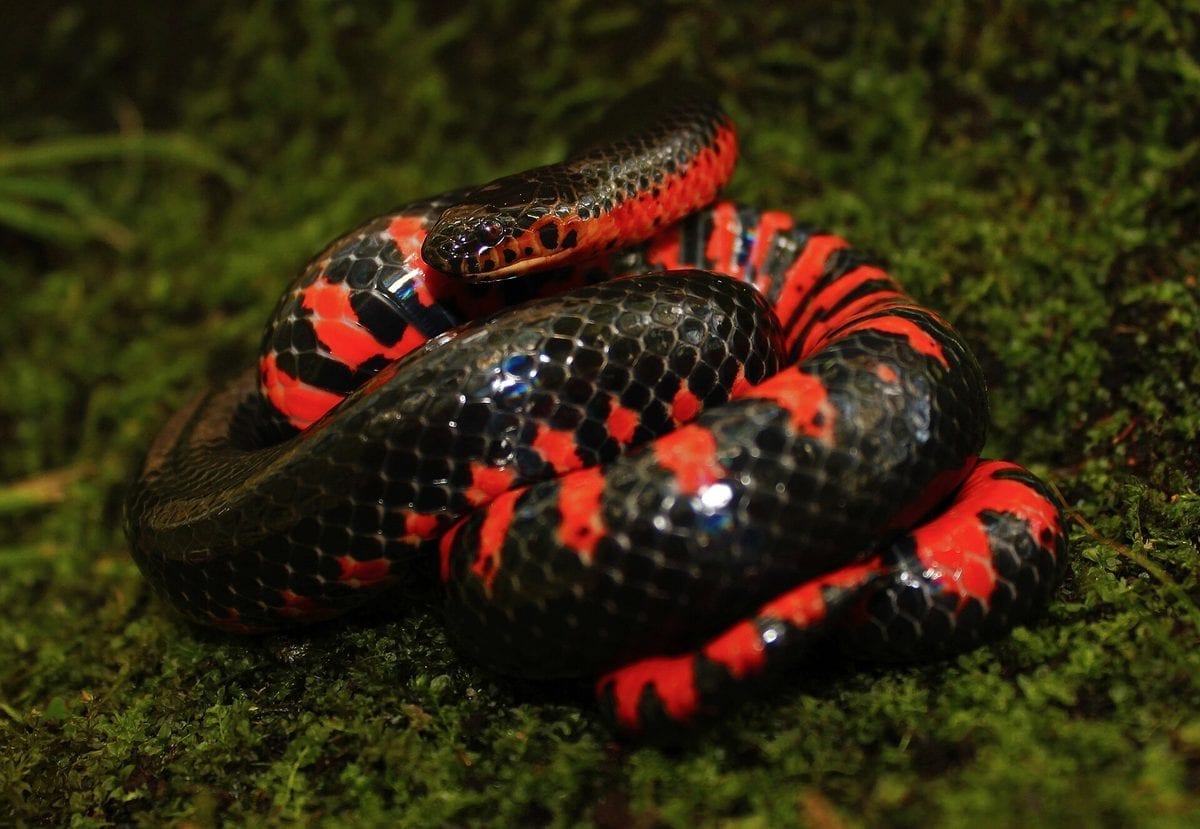
That a real species of snake can seize its own tail in its jaws to form a stiff hoop, roll rapidly downhill or across open ground in pursuit of a person or animal, and kill by driving a venomous, horn-like stinger at the tip of its tail into the victim, with the venom potent enough to wither a tree struck by accident.
Contradicted. No snake known to zoology can grasp its tail in its mouth, form a rigid wheel, and roll in pursuit of prey, and none carries venom in a stinging tail. The hoop snake is folklore, a tall tale of the American frontier with older roots in Old World serpent lore. The record is real enough: colonial travelers wrote the story down, rural communities passed it on for generations, and it almost certainly grew from real snakes, above all the harmless mud snake, whose pointed tail scale earned it the nickname stinging snake. The claim we rate, that such a creature actually exists, is debunked. A genuinely curious footnote, the recently filmed cartwheeling escape of an unrelated Asian snake, is noted below and does not resurrect the legend.
Believed by: Historically a piece of rural and frontier folklore in the American South, Appalachia, the northern logging camps, and later Canada and Australia; today told mainly as a tall tale rather than a sincere belief, though sightings are still reported now and then
The full story
What the record shows
Start with what is genuinely documented, because with a folk creature the paper trail is the real history. The hoop snake is old. The earliest written American account appears in 1784, in the travel book A Tour in the United States of America by the loyalist wanderer John Ferdinand Smyth Stuart, who relayed the story of a stinging snake that could take its tail in its mouth and roll after prey. The motif is older still: the tail-devouring ouroboros is ancient, and classical writers described rolling and self-biting serpents long before any of it reached the American woods.
From there the trail runs through the nineteenth-century oral tradition of the South and Appalachia and into the tall-tale catalogue of the northern logging camps, where the hoop snake took its place among the fearsome critters, the invented beasts of frontier humor. The legend is real, in the sense that it has been told, written, and retold for well over two centuries across the United States and later Canada and Australia. What has never entered the record is a specimen, a photograph, a film, or any physical trace of the animal itself.
So the question this file weighs is not whether people have told the story. They plainly have. It is whether the thing they described, a serpent that becomes a wheel and stings with a poisoned tail, is an animal that lives in the world or a picture that lives in the telling.
The story people tell
The honest version of the belief deserves a fair hearing, because it is not built on nothing. The people who told it were often people who spent their lives outdoors and knew snakes well. And there is a real animal underneath.
The mud snake (Farancia abacura) is a genuine species of the southeastern United States, and its country names read like a summary of the legend: stinging snake, horn snake, hoop snake. Its tail really does end in a sharp, spine-like scale, which it presses against the slippery prey it eats. Anyone who has picked one up and felt that point jab the skin has, in effect, met the raw material of the myth. Add the way a resting snake can lie in a loose coil, and the way a startled snake can move downhill with alarming speed, and you have several true fragments that a good story can assemble into a rolling, stinging hoop.
The believer's case, put at its strongest, is not that a poison wheel truly chases people. It is that the legend is grounded in real encounters with a real, oddly tailed snake, and that centuries of people across a continent do not invent a creature out of thin air.
The mud snake is real, its tail really is pointed, and its nicknames really do include hoop snake. Everything the legend needs to get started is true. The trouble begins with everything it adds.
Where the claim breaks down
The mud snake explains the story. It does not deliver the creature. Every element that makes a hoop snake a hoop snake fails on contact with anatomy.
The wheel is impossible. A snake is a long, flexible chain of vertebrae built to push sideways against the ground. Biting its own tail would give it a limp, collapsing loop, not a rigid rim that could hold a circle and roll. There is no muscle or skeletal structure that turns a snake into a wheel, and no snake has ever been observed to do it. The resemblance to the ouroboros is telling: that, too, is a symbol, drawn by people, not a behavior recorded in the field.
The venomous tail is impossible.Snakes that inject venom do so through fangs in the mouth. A tail has no venom gland and no way to deliver one. The mud snake's famous tail point is exactly what herpetologists describe it as: a hard scale, useful for gripping prey, and completely harmless to a human. The detail of a sting that kills a struck tree is tall-tale decoration, the sort of unfalsifiable flourish that makes a story memorable and betrays it as a story.
The absence is total.More than two centuries of telling have produced no carcass, no captive specimen, no clear photograph. In the 1930s the Bronx Zoo's celebrated reptile curator Raymond Ditmars is reported to have posted a cash reward for proof, and it went unclaimed. A real animal common enough to enter the folklore of three countries would, somewhere in all that time, have left something on a lab bench. The hoop snake never has, because there is nothing to catch.
The cartwheel footnote
One recent discovery is worth handling carefully, because it looks, at a glance, like it might hand the legend a lifeline. It does not, but it is genuinely interesting.
In 2023, researchers published the first documented case of active cartwheeling in a snake. The dwarf reed snake (Pseudorabdion longiceps), a small, harmless species of Southeast Asia, was filmed pulling itself into an S-shaped loop and tumbling downhill for a second or two to startle a predator and get away. Outlets including London's Natural History Museum reported it, and the footage is real. So snakes can, in a narrow and specific sense, roll.
But the dwarf reed snake is not the hoop snake, and the gap between them is the whole idea. It does not bite its own tail. It does not form a closed hoop. It does not pursue anything; the tumble is a frantic escape that lasts a moment and exhausts the animal. It has no stinger and no venomous tail, and it lives half a world away from the Appalachian hollows where the hoop snake was born. A brief defensive somersault by a tiny, unrelated snake confirms that evolution can produce rolling in a snake. It does not confirm a poison wheel that chases people.
A real snake that tumbles to escape is a marvel of biology. It is also the clearest way to see what the hoop snake never was: a hunter, a hoop, and a poison all at once.
Why it endures
The hoop snake survives for the same reasons the best folklore always does, and understanding them explains the belief without needing the beast.
It has a true anchor. Because the mud snake is real and its tail really is pointed, the legend never feels wholly invented; it always has a piece of firsthand experience to point back to. A story with one true detail is far stickier than one with none.
It does social work. On the frontier and in the logging camps the tale entertained, tested a newcomer's credulity, and dramatized the real risks of the woods, so communities had reasons to keep telling it that had nothing to do with whether it was true. That is how a creature outlives every generation that meets it.
And it exploits memory. A sudden encounter with a fast snake is just the kind of event that recollection sharpens and exaggerates, and a person who already knows the legend will file an ambiguous sighting under the shape they expect. The hoop snake is less a mistake about biology than a small triumph of storytelling, which is why it has rolled on for so long.
A legend, not an animal
Hold the two things apart. The legend is real, well documented, and rooted in a real animal: people have told the hoop snake story since at least 1784, and the harmless mud snake, with its sharp tail and its telling nicknames, is a plausible source. The creature is not. A serpent that bites its tail into a rigid wheel, rolls in pursuit, and kills with a venomous stinger runs against snake anatomy at every point and has left no specimen, photo, or physical trace in more than two centuries. On that claim the rating is Contradicted.
None of this diminishes the story or the people who told it. Folklore of this quality is worth preserving as folklore, and the real snakes behind it, the coiling mud snake, and now the cartwheeling dwarf reed snake, are more interesting than the myth once you look closely. The honest position is to enjoy the tale, credit its real ingredients, and decline the one thing it asks that the natural world will not supply: an actual rolling, stinging hoop in the grass.
What's still unexplained
- Which real snakes, beyond the mud snake, contributed to the legend in different regions, and how the story crossed from Old World serpent lore into a distinctly American frontier tale, are questions of folklore history rather than zoology.
- The dwarf reed snake's confirmed cartwheeling shows that active rolling escape can evolve in snakes; whether any other species performs comparable rolling behaviors that observers might have folded into hoop-snake stories is a legitimate open zoological question, distinct from the folkloric claim of a tail-biting, tree-killing wheel.
- The exact provenance and terms of Raymond Ditmars's widely reported reward for proof of a hoop snake are repeated across many secondary sources but deserve careful primary sourcing, a minor historical loose end that has no bearing on whether the animal exists.
Point by point
The claim: A snake can grasp its tail in its jaws, lock into a rigid circle, and roll after prey like a wheel.
What the record shows: No snake has the anatomy to do this, and none has ever been documented doing it. A snake's body is a long chain of vertebrae built for lateral undulation, not a rigid rim that can hold a circle and carry rolling momentum. Biting its own tail would not create a stiff wheel; it would create a limp loop that collapses. Herpetologists across generations reject the behavior, and the ouroboros it resembles is a symbol, not a field observation. The mud snake sometimes rests in a loose coil, which may inspire the image, but resting in a loop is not rolling in pursuit.
The claim: The hoop snake kills with a venomous stinger at the tip of its tail, strong enough to wither a tree.
What the record shows: No snake carries venom in its tail. Venomous snakes deliver venom through fangs in the mouth, and a tail has neither venom glands nor a delivery apparatus. The detail almost certainly comes from the mud snake, whose tail ends in a hard, pointed scale it uses to prod and grip prey. That point can feel sharp, but it injects nothing and is harmless to people. The tree-killing venom is pure tall-tale embellishment, the kind of vivid, unfalsifiable flourish that spreads a good story.
The claim: Centuries of eyewitness reports, from 1784 to today, are too many to be pure invention.
What the record shows: Longevity and volume are features of successful folklore, not signs of a real animal. The reports are anecdotal, undocumented, and easily explained by misidentified snakes, especially the mud snake with its pointed tail, and by the natural human tendency to repeat and embellish a striking story. In the 1930s the Bronx Zoo's Raymond Ditmars is reported to have put up a cash reward for proof; no one ever collected it. A creature that leaves no specimen, photo, or carcass across more than two centuries is behaving exactly as a legend does.
The claim: The legend must be true because it is clearly based on a real snake.
What the record shows: It is based on a real snake, and that is why the creature itself is not real. The mud snake supplies the raw material: a genuine species, a genuinely sharp tail tip, a habit of coiling, and a memorable set of nicknames. Folklore built the wheel, the pursuit, and the poison on top of that harmless kernel. Explaining where a myth came from does not confirm it; the real animal accounts for the story without any need for a rolling serpent.
The claim: Snakes have now been filmed rolling, so the hoop snake may be real after all.
What the record shows: The 2023 discovery of cartwheeling in the dwarf reed snake is real and remarkable, but it is not the hoop snake. That Southeast Asian species tucks into an S-loop and tumbles downhill for a second or two to startle predators and escape. It does not bite its own tail, does not form a closed hoop, does not chase anything, and has no venomous tail. A brief defensive tumble by a small, unrelated snake half a world away is a fascinating piece of biology, not support for the folklore beast.
Timeline
- AntiquityOld World serpent lore already contains the seed of the idea. The ouroboros, a snake devouring its own tail, is an ancient symbol, and classical writers such as Pliny the Elder and later Isidore of Seville describe the amphisbaena, a serpent imagined to roll or move in ways ordinary snakes do not. The rolling, self-biting serpent is an old motif long before it reaches North America.
- 1784The earliest known written account of an American hoop snake appears in A Tour in the United States of America by the loyalist traveler John Ferdinand Smyth Stuart, published in London. He describes a stinging snake said to take its tail in its mouth and roll after prey, delivering a deadly wound with the point of its tail.
- 19th centuryThe story spreads and settles into the oral tradition of the American South and Appalachia, passed between farmers, hunters, and children as a warning about the woods. Regional names accumulate, including hoop snake, hoopsnake, and stinging snake.
- Late 1800s to early 1900sThe hoop snake joins the roster of fearsome critters, the tall-tale beasts of North American logging camps and frontier humor, alongside creatures like the hodag and the squonk. It appears in printed collections of lumberjack lore and becomes a staple of exaggerated frontier storytelling.
- 1930sRaymond Ditmars, the prominent curator of reptiles at New York's Bronx Zoo, is widely reported to have offered a standing cash reward for verifiable proof of a hoop snake. The reward is never claimed, and no specimen or credible physical evidence is ever produced.
- 20th centuryHerpetologists identify the likely real-world basis for the legend. The mud snake (Farancia abacura) of the southeastern United States, a harmless species also called the stinging snake, horn snake, and hoop snake, ends in a sharp, spine-like tail scale it presses against prey. The point is completely harmless to humans, but it is easy to mistake for a stinger.
- 20th to 21st centuryOccasional sighting reports continue in the United States, Canada, and Australia, but no verified specimen, photograph, or film of a rolling, tail-stinging snake ever surfaces. The hoop snake settles into the record as folklore and a minor cryptid rather than an accepted animal.
- 2023Researchers publish the first documented case of active cartwheeling in a snake, the dwarf reed snake (Pseudorabdion longiceps) of Southeast Asia, which loops its body and rolls downhill for a second or two to escape predators. Reported by outlets including London's Natural History Museum, it is a genuine rolling behavior in a real, unrelated snake, and nothing like the hoop snake's tail-biting wheel or venomous sting.
Contradicted. No snake known to zoology can grasp its tail in its mouth, form a rigid wheel, and roll in pursuit of prey, and none carries venom in a stinging tail. The hoop snake is folklore, a tall tale of the American frontier with older roots in Old World serpent lore. The record is real enough: colonial travelers wrote the story down, rural communities passed it on for generations, and it almost certainly grew from real snakes, above all the harmless mud snake, whose pointed tail scale earned it the nickname stinging snake. The claim we rate, that such a creature actually exists, is debunked. A genuinely curious footnote, the recently filmed cartwheeling escape of an unrelated Asian snake, is noted below and does not resurrect the legend.
Reviewed by Colin Peterson · Last reviewed July 8, 2026 · How we rate
Common questions
Is The hoop snake true?
Contradicted. No snake known to zoology can grasp its tail in its mouth, form a rigid wheel, and roll in pursuit of prey, and none carries venom in a stinging tail. The hoop snake is folklore, a tall tale of the American frontier with older roots in Old World serpent lore. The record is real enough: colonial travelers wrote the story down, rural communities passed it on for generations, and it almost certainly grew from real snakes, above all the harmless mud snake, whose pointed tail scale earned it the nickname stinging snake. The claim we rate, that such a creature actually exists, is debunked. A genuinely curious footnote, the recently filmed cartwheeling escape of an unrelated Asian snake, is noted below and does not resurrect the legend.
What is The hoop snake?
The hoop snake is one of the oldest and most durable creatures of American folklore: a serpent said to bite its own tail, stiffen into a circle, and roll downhill after a fleeing victim like a runaway wheel, building terrifying speed before straightening at the last instant to drive a venomous stinger in its tail into flesh or tree. The…
What does the evidence show?
No snake has the anatomy to do this, and none has ever been documented doing it. A snake's body is a long chain of vertebrae built for lateral undulation, not a rigid rim that can hold a circle and carry rolling momentum. Biting its own tail would not create a stiff wheel; it would create a limp loop that collapses. Herpetologists across…
Why do people believe it?
It is a genuinely great story. A serpent that turns itself into a wheel and rolls downhill after you, then stabs with a poison tail, is vivid, frightening, and easy to retell, exactly the shape of tale that survives for centuries in oral tradition.
What is still unresolved?
Which real snakes, beyond the mud snake, contributed to the legend in different regions, and how the story crossed from Old World serpent lore into a distinctly American frontier tale, are questions of folklore history rather than zoology.
Sources
- 1.Hoop snake, Wikipedia (2026)
- 2.All About the Hoop Snake: Separating Fact From Fiction, HowStuffWorks (2023)
- 3.'hoop snake': meaning and origin, Word Histories (2024)
- 4.A Tour in the United States of America (2 vols.), John Ferdinand Smyth Stuart, via Internet Archive (1784)
- 5.Mud Snake (Farancia abacura), Savannah River Ecology Laboratory, University of Georgia (2023)
- 6.Red-bellied Mudsnake (Farancia abacura reinwardtii), Florida Museum, University of Florida (2023)
- 7.Raymond Ditmars, Wikipedia (2026)
- 8.Snake that cartwheels away from predators described for the first time, Natural History Museum (London) (2023)
Embed this verdict on your site
Paste this snippet to show our sourced verdict as a small card, with a link back to the full case file. Free to use.
<iframe src="https://theconspiratory.com/embed/hoop-snake" title="The Conspiratory verdict" width="520" height="190" style="border:0;max-width:100%" loading="lazy"></iframe>Help us investigate
This is a living case file. If you spot an error or know evidence we missed, tell us, and weigh in on where you land.
Where do you land?
Cast your read on this one.
Comments
Add your take. Comments are read and approved by a human before they appear, so keep it on topic and civil. Please do not accuse named, living people of crimes.