The undeciphered Indus script of the Bronze Age Indus Valley Civilization has been cracked, revealing the lost language of Harappa
By Colin PetersonJuly 8, 2026
Where the evidence lands →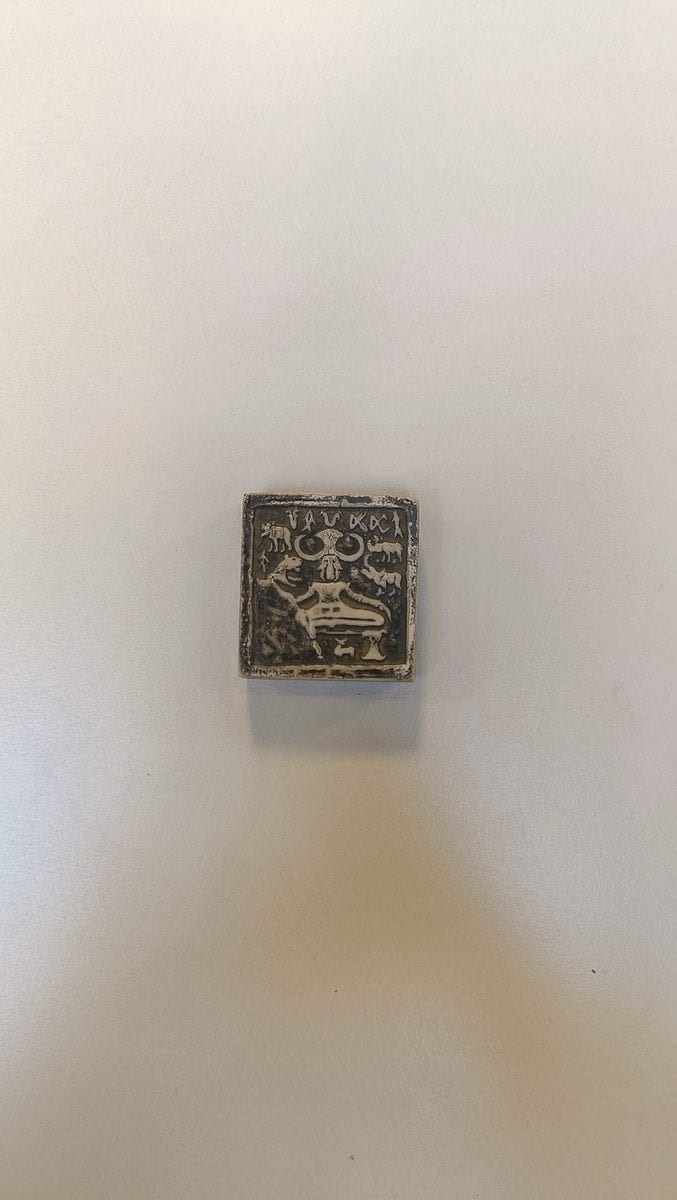
That the meaning of the Indus script is known: that one of the competing decipherments has actually succeeded, whether the widely promoted proto-Dravidian reading that assigns the common fish sign the value min (fish or star), an Indo-Aryan or Sanskrit reading, or a claimed computational or artificial-intelligence solution, and that by extension the language, identity, and messages of the Indus people can now be read from their seals.
The Indus script is real and well documented: some 4,000 inscribed objects (mostly small seals, tablets, and pottery) carrying more than 400 distinct signs, produced by the Indus Valley Civilization at its height, roughly 2600–1900 BCE. It has never been deciphered, and a century of scholarship has produced no reading that the field accepts. The claim we rate is the recurring assertion that it has been solved, that a particular decipherment (most often a proto-Dravidian reading, but also Indo-Aryan or Sanskrit ones) or a particular exotic interpretation is the answer. That claim is unproven. There is no bilingual text like the Rosetta Stone, the inscriptions are extremely short (about five signs on average), the underlying language is unknown, and scholars do not even agree that the signs encode speech at all. Confident proposals exist and some are serious scholarship; none has been demonstrated. Undeciphered is not the same as unsolvable, but it is also not the same as solved.
Believed by: A wide field, from serious academic camps (proto-Dravidian and Indo-Aryan readings each have credentialed advocates) to lone hobbyist decipherers who announce solutions online. The question also carries strong cultural and political charge in South Asia, where the script's language bears on debates about the origins of Dravidian and Indo-Aryan speakers.
The full story
What is documented
Start with what is solid, because a great deal is. Between roughly 2600 and 1900 BCE, the Indus Valley Civilization flourished across a vast area of what is now Pakistan and north-western India, with major cities at Harappa, Mohenjo-daro, and Dholavira. Its people left behind a distinctive system of signs, carved most often into small stone seals and impressed on tablets and pottery.
The corpus is real and reasonably large: on the order of 4,000 inscribed objects carrying more than 400 distinct signs, many of them paired with images of animals such as the unicorn-like bull that recurs on the seals. The writing generally runs right to left. And it is genuinely, uncontroversially undeciphered. The first Harappan seal was published in 1875, serious attempts to read the script began in the 1920s, and a full century later there is still no decipherment that scholars accept.
So the question this file weighs is not whether the script exists, or whether it is undeciphered. Both are settled. It is whether the recurring claim built on top of that mystery, that someone has now actually cracked it, whether by a proto-Dravidian reading, a Sanskrit one, or a computer, has been established. It has not.
The case that it can be read
The optimistic case is not foolish, and its best version deserves a fair hearing. The strongest camp holds that the language behind the script is Dravidian, an argument developed over decades by scholars including Asko Parpola using careful comparative work and early computer analysis.
Its showpiece is the reading of the common fish sign. In Dravidian languages the word for fish is min, which is also the word for star. If the Indus scribes used the fish sign for its sound rather than its picture, a technique well attested in other early scripts, then fish-plus-modifier signs could spell the names of stars or planets, a reading that fits a culture plausibly concerned with the calendar and the sky. It is an elegant idea, and it is the kind of internal coherence that a real decipherment would show.
Supporters add that the signs behave statistically like a language. The 2009 study led by Rajesh Rao in Science found that the script's conditional entropy, a measure of how predictable each sign is given the one before it, sat closer to natural languages than to rigid or random nonlinguistic systems. On this view the material really is writing, the Dravidian key is promising, and decipherment is a matter of time and effort rather than a lost cause.
A large corpus, a recurring sign with a beautiful bilingual pun built into a living language, and statistics that look linguistic. If the Indus script is readable at all, this is roughly what the road to reading it would look like.
That is the case at full strength: not that the script has been translated, but that there is a serious, sober line of evidence suggesting it is a real language of a known family, and that patient work along these lines might eventually succeed.
Why no decipherment holds up
Here is the pivot. Everything above supports one modest word: promising. The claim we rate needs a much stronger word: solved. Nothing in the record crosses that distance.
The decisive obstacle is that there is no bilingual text. Egyptian hieroglyphs fell to Champollion because the Rosetta Stone carried the same decree in a known language alongside them. The Indus corpus has no such key, and no long passages either. Inscriptions run about five signs on average, and the longest, the Dholavira signboard, has only around ten. With no grammar exposed by lengthy texts and no external anchor, a proposed reading cannot be checked. The proto-Dravidian solutions work by assuming the language first and then fitting signs to it, which is exactly the move that cannot validate itself.
The result is a field full of mutually incompatible solutions. The script has been read as Dravidian, as Indo-Aryan, as Sanskrit, and as other tongues, each by a confident author, each incompatible with the rest. A genuine decipherment does the opposite: it converges. When Michael Ventris cracked Linear B, independent readers could apply the values and arrive at the same words. Nothing like that reproducibility has happened here. Coexisting confident answers are the signature of an unsolved problem, not a solved one.
As for the computers, they have delivered real description and no translation. Modeling which sign follows which, or estimating the corpus's entropy, characterizes the patterns; it does not assign verifiable meanings when the language is unknown and no bilingual exists. Reports that artificial intelligence has read the script consistently claim more than the underlying work supports. Better tools have sharpened the puzzle; they have not finished it.
The deeper doubt: is it even writing?
There is a further problem that most decipherment claims quietly assume away. It is not settled that the Indus signs record spoken language at all.
In 2004, Steve Farmer, Richard Sproat, and Michael Witzel argued that the system is nonlinguistic. Their case rests on features that sit oddly with true writing: the inscriptions are extraordinarily short, a striking number of signs appear only once, and there are no long texts anywhere, across a civilization that lasted centuries and traded over long distances. Writing systems used to record speech, they note, tend to leave behind at least some lengthy inscriptions. The Indus system leaves none. On their reading, the signs may have functioned like heraldry or religious and economic emblems, marking people, goods, or deities without spelling out words.
This is not a settled defeat for the linguistic view. The 2009 entropy paper was a direct response, and its authors argue the statistics favor language; skeptics such as Sproat reply that the entropy measure does not cleanly separate language from non-language when proper controls are applied. The dispute continues. But notice what its mere existence does to the decipherment claims. Every proposed reading takes for granted that there is a language to read. If the nonlinguistic thesis is right, no key will ever fit, because there is no lock.
You cannot translate a text into a language until you have shown it is a text in a language. That first step, obvious as it sounds, has never been securely taken for the Indus script.
The honest position is symmetrical. The nonlinguistic camp has not proven the signs are meaningless as speech, and the linguistic camp has not proven they encode it. That basic uncertainty, unresolved after a century, is itself a reason to treat any confident decipherment with caution.
Why the script keeps getting cracked
New decipherments of the Indus script arrive with almost seasonal regularity, and they keep coming for reasons that have less to do with the seals than with us.
They ride the romance of a silent civilization. The Indus built great cities and then went quiet, and the promise of suddenly hearing its voice is intoxicating. The reading of Egyptian and Maya scripts supplies a heroic template, the lone genius with the key, that makes solving the Indus feel like a prize waiting to be claimed, most concretely in the one-million-dollar reward announced in 2025.
They carry a political charge. Whether the language was Dravidian or Indo-Aryan touches deep and sensitive questions about the origins of South Asian peoples, so a decipherment is never only academic; it can seem to settle who was there first. That gives advocates on each side a powerful motive to believe a reading that favors their story, and to present a hypothesis as a proof.
And they exploit a gap that is easy to miss. Between describing the sign patterns, which computers do well, and reading them, which no one has done, lies a chasm that technical language papers over. A statistical result about entropy or sign order is real work, but reported through the frame of “cracking the code” it becomes, in the retelling, a solution. The boldest claim is always the most satisfying, and “we still do not know” makes for a poor headline.
Undeciphered, not solved
Keep the two claims apart, because the discipline of this case lives in the gap between them. The script and its mystery are real: a large corpus of genuine Bronze Age inscriptions, more than 400 signs, undeciphered after a hundred years of effort. On that there is no dispute. The claim that it has been solved is not established: no reading has been demonstrated, the competing decipherments contradict one another, there is no bilingual key and no long text to check them against, and it is not even settled that the signs encode language.
This is not a dismissal of the scholars. The Dravidian hypothesis is serious work, the entropy studies are serious work, and the computer analyses have genuinely advanced how the corpus is understood. Taking the anomaly seriously and proposing readings is exactly what should happen. What the evidence does not support is the leap from a promising hypothesis to a finished decipherment, and that leap is what the claim we rate, in its many versions, keeps making.
A million-dollar prize sits unclaimed for a reason. Until a bilingual surfaces, a longer text is found, or a reading is produced that independent scholars can reproduce and agree on, the Indus script remains what it has been for a century: one of the great genuine unsolved puzzles of the ancient world, and not yet solved by anyone.
Watch
What's still unexplained
- Whether the Indus signs encode spoken language at all is genuinely unresolved. The nonlinguistic thesis and the linguistic-entropy rebuttal remain in open dispute, and the field has no agreed answer to this most basic question about the material.
- What language, or language family, lies behind the script (Dravidian, Indo-Aryan, Austroasiatic, or something now lost) is unknown, and without that anchor even a correct sign inventory cannot be turned into readings that can be checked.
- Why the inscriptions are so uniformly short, with no long texts and nothing resembling a bilingual, is unexplained. It may reflect the writing's function (seals and tags rather than literature) or a limit on what the system could express; either way it is the central obstacle to decipherment.
- What the seals were actually for, whether they marked ownership, trade goods, administrative units, clans, or deities, remains debated, and the answer would sharply constrain what the accompanying signs could plausibly mean.
Point by point
The claim: The script has been deciphered as Dravidian, with signs like the fish reliably read through Dravidian words such as min.
What the record shows: The Dravidian hypothesis is a serious and carefully argued position, advanced by scholars such as Asko Parpola, and the fish-equals-min reading is clever: min means both fish and star in Dravidian languages, which fits a plausible astral or calendrical use. But a plausible reading is not a proven one. The proposals rest on assuming in advance that the language is Dravidian and then finding signs that can be made to fit, without any bilingual text or external corpus to check the results against. Other equally credentialed scholars reject the readings, and the field as a whole has not accepted them. It remains a hypothesis, not a solution.
The claim: There is no Rosetta Stone, but modern computers and artificial intelligence have now cracked what humans could not.
What the record shows: Computational methods have produced genuinely useful results, such as statistical models of which signs tend to follow which, and estimates of the corpus's structure. What they have not produced is a decipherment. Machine analysis can describe the patterns in the signs, but with no known language behind them and no bilingual anchor, it cannot assign meanings that can be verified. Announcements that AI has read the script consistently outrun what the underlying work shows. The tools sharpen the questions; they have not answered them.
The claim: The inscriptions are short because they are complete records, so the meaning should be recoverable from the corpus alone.
What the record shows: The brevity is exactly the problem, not a shortcut around it. Inscriptions average roughly five signs, and the longest single text, the Dholavira signboard, has only about ten. Decipherment of ancient scripts has historically depended either on a bilingual key (as with Egyptian hieroglyphs and the Rosetta Stone) or on long texts that expose grammar and repetition. The Indus corpus offers neither. With no long passages to reveal sentence structure and no known related language, the corpus by itself is too thin to constrain the many readings that can be forced onto it.
The claim: The signs are obviously a written language, so it is only a matter of time before the right key unlocks them.
What the record shows: That the signs encode spoken language is widely assumed but not established. In 2004 Farmer, Sproat, and Witzel argued the system may be nonlinguistic: a set of symbols used for religious, political, or economic marking rather than for recording speech. The 2009 entropy study by Rao and colleagues pushed back, and the two sides have contested the statistics ever since. This is not a fringe quibble; it is a live scholarly dispute about the most basic property of the material. If the signs are not writing, no linguistic key will ever fit, and that possibility has not been ruled out.
The claim: A confident published decipherment means the script is solved, whatever cautious academics say.
What the record shows: New decipherments are announced regularly, some by amateurs and some by scholars, and each typically reads the script as a language its author already favors. The recurrence is itself the tell: proto-Dravidian, Indo-Aryan, Sanskrit, and other solutions coexist, mutually incompatible, each internally confident. A genuine decipherment converges, is reproducible, and lets independent readers arrive at the same translations, as happened with Linear B. Nothing of the kind has occurred here. A published claim is a proposal entering the debate, not a verdict ending it.
Timeline
- c. 2600 BCEDuring the Mature Harappan phase (roughly 2600–1900 BCE), the Indus Valley Civilization uses a system of signs across its cities, inscribing them chiefly on small steatite seals, terracotta tablets, and pottery. The script is generally written right to left, and inscriptions are typically only a handful of signs long.
- 1875Alexander Cunningham of the Archaeological Survey of India publishes a drawing of a seal found at Harappa, showing a bull and a line of unfamiliar symbols. It is the first modern notice of the script, though its significance is not yet understood; the Harappan civilization itself has not yet been recognized.
- 1924John Marshall, Director-General of the Archaeological Survey of India, publicly announces the discovery of the Indus Valley Civilization based on excavations at Harappa and Mohenjo-daro. The inscribed seals are recognized as the writing of a previously unknown Bronze Age culture, and the race to read them begins.
- 1960s–1980sA Finnish team led by Asko Parpola and a Soviet team led by Yuri Knorozov independently apply computer-assisted analysis to the corpus. Parpola advances the influential hypothesis that the underlying language is Dravidian, reading the frequent fish sign via the Dravidian word min, which means both fish and star. The reading is suggestive but cannot be confirmed without external keys.
- 2004Steve Farmer, Richard Sproat, and Michael Witzel publish The Collapse of the Indus-Script Thesis, arguing that the sign system is not writing at all. They point to the extreme brevity of inscriptions, the large number of signs that appear only once, and the absence of long texts, proposing the symbols served nonlinguistic religious, political, or social functions.
- 2009Rajesh Rao and colleagues publish a paper in Science arguing the opposite: that the script's conditional entropy (the statistical predictability of one sign following another) resembles natural languages more than nonlinguistic sign systems. Critics, including Sproat, counter that the entropy measure does not reliably separate language from non-language, and the debate remains unresolved.
- 2011Rao presents the computational approach to a general audience in a TED talk, framing the script as a grand unsolved puzzle. Interest grows, but no accepted reading emerges, and periodic announcements by individual researchers claiming to have deciphered the script continue to appear without gaining scholarly consensus.
- 2025-01At a conference in Chennai marking the centenary of the civilization's discovery, Tamil Nadu Chief Minister M. K. Stalin announces a one-million-dollar prize for anyone who can decipher the script. The offer underscores both the enduring fascination and the fact that, a century on, no decipherment has been accepted.
The Indus script is real and well documented: some 4,000 inscribed objects (mostly small seals, tablets, and pottery) carrying more than 400 distinct signs, produced by the Indus Valley Civilization at its height, roughly 2600–1900 BCE. It has never been deciphered, and a century of scholarship has produced no reading that the field accepts. The claim we rate is the recurring assertion that it has been solved, that a particular decipherment (most often a proto-Dravidian reading, but also Indo-Aryan or Sanskrit ones) or a particular exotic interpretation is the answer. That claim is unproven. There is no bilingual text like the Rosetta Stone, the inscriptions are extremely short (about five signs on average), the underlying language is unknown, and scholars do not even agree that the signs encode speech at all. Confident proposals exist and some are serious scholarship; none has been demonstrated. Undeciphered is not the same as unsolvable, but it is also not the same as solved.
Reviewed by Colin Peterson · Last reviewed July 8, 2026 · How we rate
Common questions
Is The Indus script true?
The Indus script is real and well documented: some 4,000 inscribed objects (mostly small seals, tablets, and pottery) carrying more than 400 distinct signs, produced by the Indus Valley Civilization at its height, roughly 2600–1900 BCE. It has never been deciphered, and a century of scholarship has produced no reading that the field accepts. The claim we rate is the recurring assertion that it has been solved, that a particular decipherment (most often a proto-Dravidian reading, but also Indo-Aryan or Sanskrit ones) or a particular exotic interpretation is the answer. That claim is unproven. There is no bilingual text like the Rosetta Stone, the inscriptions are extremely short (about five signs on average), the underlying language is unknown, and scholars do not even agree that the signs encode speech at all. Confident proposals exist and some are serious scholarship; none has been demonstrated. Undeciphered is not the same as unsolvable, but it is also not the same as solved.
What is The Indus script?
For roughly seven centuries at the height of the Bronze Age, the cities of the Indus Valley Civilization (Harappa, Mohenjo-daro, Dholavira, and hundreds of other sites across what is now Pakistan and north-western India) produced tens of thousands of objects marked with a distinctive system of signs. Carved most often into small stone se…
What does the evidence show?
The Dravidian hypothesis is a serious and carefully argued position, advanced by scholars such as Asko Parpola, and the fish-equals-min reading is clever: min means both fish and star in Dravidian languages, which fits a plausible astral or calendrical use. But a plausible reading is not a proven one. The proposals rest on assuming in ad…
Why do people believe it?
The romance of a lost language is powerful. The Indus was one of the great Bronze Age civilizations, with planned cities and long-distance trade, yet it is mute to us, and the idea that a clever key could suddenly let those people speak is irresistible. The Rosetta Stone and the reading of Egyptian hieroglyphs supply a template that make…
What is still unresolved?
Whether the Indus signs encode spoken language at all is genuinely unresolved. The nonlinguistic thesis and the linguistic-entropy rebuttal remain in open dispute, and the field has no agreed answer to this most basic question about the material.
Sources
- 1.Indus script, Wikipedia
- 2.Indus Script, World History Encyclopedia (2020)
- 3.Will the Indus Valley script ever be deciphered?, Live Science (2024)
- 4.Entropic Evidence for Linguistic Structure in the Indus Script, Science (2009)
- 5.The Collapse of the Indus-Script Thesis: The Myth of a Literate Harappan Civilization, Electronic Journal of Vedic Studies (Farmer, Sproat & Witzel) (2004)
- 6.Introduction to the Study of the Indus Script, Harappa.com
- 7.Conditional entropy and the Indus Script, Language Log (University of Pennsylvania) (2009)
- 8.Tamil Nadu CM announces $1 million for deciphering Indus Valley script, Business Standard (2025)
Embed this case file on your site
Paste this snippet to show this case file as a small card, with a link back to the full write-up. Free to use.
<iframe src="https://theconspiratory.com/embed/indus-script" title="The Conspiratory verdict" width="520" height="190" style="border:0;max-width:100%" loading="lazy"></iframe>Help us investigate
This is a living case file. If you spot an error or know evidence we missed, tell us, and weigh in on where you land.
Where do you land?
Cast your read on this one.
Comments
Add your take. Comments are read and approved by a human before they appear, so keep it on topic and civil. Please do not accuse named, living people of crimes.