The kappa is a real, undiscovered aquatic creature living in Japan's rivers and ponds, not merely a figure of folklore
By Colin PetersonJuly 8, 2026
Where the evidence lands →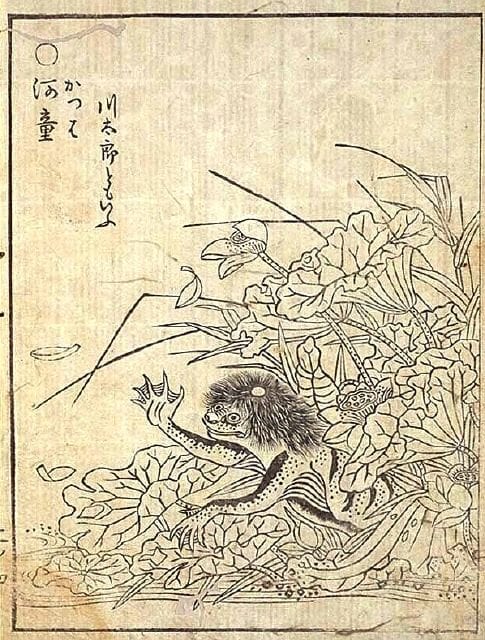
That beyond its status as folklore, the kappa is or was a real biological creature, an undiscovered amphibious animal inhabiting Japan's rivers, lakes, and ponds, whose existence is evidenced by centuries of consistent descriptions, eyewitness encounters, and preserved physical remains.
The kappa is one of the most beloved and thoroughly documented figures in Japanese folklore: a water-dwelling yokai attested in Edo-period art and treatises, recorded by folklorists such as Yanagita Kunio, and honored at temples and festivals to this day. That cultural record is real and important. The claim we rate is narrower: that a literal, biological kappa exists as an undiscovered animal. No verified specimen has ever been produced. The mummified “kappa” remains kept at some temples, when examined, turn out to be composites assembled from other animals' parts, in the manner of the Fiji mermaid. Absent a single confirmed body, tissue sample, or living animal, the literal-creature claim rests on tradition and testimony rather than evidence. None of that diminishes the kappa as folklore; it simply distinguishes a cherished story from a catalogued species.
Believed by: Historically, villagers throughout Japan, especially communities living beside rivers and ponds where the tales carried a practical warning; today the kappa is cherished nationwide as a cultural icon and mascot, while belief in a literal animal is largely the province of cryptozoology enthusiasts
The full story
What the folklore holds
Start with what is genuinely documented, because the kappa is one of the richest and best-recorded figures in all of Japanese folklore. The word is often read as river child, and the creature it names is a water yokai: a supernatural being tied to rivers, ponds, and marshes. In the classic depiction it is about the size of a child, greenish or yellow, with a beaked face, webbed hands and feet, and a turtle-like shell on its back.
Its most distinctive feature sits on top of its head: a shallow dish, the sara, holding water. That water is said to be the source of the kappa's strength, and the tales turn on it. Trick a kappa into bowing, so the story goes, and the dish empties and its power drains away. The kappa of legend is by turns helpful, mischievous, and dangerous; it is famously fond of cucumbers, and it loves to test its considerable strength.
This tradition is attested in Edo-period paintings and treatises, in temple relics, in regional legends, and in the work of folklorists. The question this file weighs is therefore not whether the kappa exists as folklore, which is beyond dispute, but whether the separate, literal claim holds: that behind the stories lives a real, undiscovered animal.
The case for a real creature
The argument for a literal kappa is more textured than an outsider might expect, and it deserves a fair hearing. It rests, first, on physical objects. More than one temple and collection in Japan keeps what is presented as a kappa relic: a mummified hand at Tokyo's Sogen-ji, the Kappa-dera, and preserved remains elsewhere said to come from creatures captured centuries ago. To a visitor these are not abstractions but things behind glass.
It rests, second, on longevity and reach. The tradition spans centuries and the whole of the country, with an early textual antecedent in the eighth-century Nihon Shoki and a dense body of Edo-period art and writing. Believers ask, reasonably, why a purely invented creature would be described so persistently and in such recurring detail.
Third, it points to a plausible living model. The Japanese giant salamander is a large, strange amphibian that lurks in exactly the rivers the kappa is said to haunt, and it is easy to imagine a startled encounter with one giving rise to a monster.
A creature with a temple, a district named for it, preserved remains, and a thousand years of stories does not feel like fiction. That is the honest pull of the case, and it is worth stating plainly.
Taken together, relics one can visit, an ancient and consistent record, and a real animal that might have inspired it all, the case for something behind the legend is not frivolous. It is the reason the kappa has never quite been filed away as mere make-believe.
Where the literal claim breaks down
Each pillar, examined closely, supports the folklore far better than it supports a hidden species. Take the relicsfirst, since they are the most tangible. The mummified “kappa” specimens that have actually been studied are composites: fabrications assembled from the parts of other animals, with monkey, owl, and ray among those identified. This is precisely the craft that produced the Fiji mermaid, a monkey's upper body stitched to a fish's tail and sold as a marvel. The kappa relics are real and fascinating objects, but they are made, not caught.
The ancient record, read carefully, documents a story growing rather than an animal recurring. The Nihon Shoki's early reference is to a mizuchi, a water serpent, not to the kappa as later imagined. The familiar creature, dish and beak and shell, took shape mainly in the Edo period, and its scholarly name at the time, suiko or water tiger, was borrowed from Chinese water-monster lore. A centuries-long paper trail of an evolving, partly imported legend is not the same as centuries of sightings of one stable creature.
The giant salamander cuts the other way from how it is usually offered. If a known animal plausibly seeded the image, that explains the folklore without requiring any second, undiscovered species. And the descriptions, far from being uniform, vary considerably by region, exactly as a widely told oral tradition would.
What is missing is the one thing that would settle it: a single verified body, a tissue sample, a living animal examined by anyone. After centuries of belief and many claimed remains, that evidence has never appeared. The literal creature is not disproven so much as unsupported.
The warning in the water
To understand why the kappa persisted so powerfully, it helps to see what it did. In village life the kappa functioned, among other things, as a cautionary figure: a reason, sharp enough for a child to remember, to stay away from deep and fast water.
Rivers and ponds drown people, then as now, and often without warning. A culture that personified that danger as a clever creature waiting below the surface was encoding a real hazard in a form that stuck. Some of the darker tales, in which a kappa pulls a victim under, are best read soberly in this light: as folklore doing the serious work of marking danger, not as a taste for the gruesome.
The proof that this reading is alive is on the riverbanks today, where warning signs still show a cartoon kappa beside deep water. The friendly modern mascot and the old river-demon are the same figure, still saying the same thing: the water can take you, so take care.
A monster that keeps children away from drowning is not evidence of a monster. It is evidence of a culture that knew how to teach a hard lesson and make it last.
Why the kappa endures
Belief in a literal kappa has largely faded, yet the kappa itself has never been more visible. Its survival says a good deal about how folklore lives in a modern country, and about the difference between loving a figure and thinking it swims in the river.
Part of the answer is that the kappa is anchored in the real world. It has temples and relics, a Tokyo district and a bridge that carry its name, festivals, and centuries of art. A legend with that many physical footholds keeps its grip long after the belief behind it loosens.
Part of it is scholarship and affection together. When Yanagita Kunio recorded the kappa lore of Tono in the early twentieth century, he helped move the creature from the riverbank into the library, where it became an object of study and pride. From there it slid easily into manga, merchandise, and mascotry, beloved precisely because it is understood as a story worth keeping.
And part of it is that the kappa still means something. It stands for the danger and mystery of water, for a certain mischievous cleverness, and for a way of respecting nature by imagining it as watchful. A figure that carries that much can thrive as culture without needing to be counted as a species.
A cherished story, not a species
Hold the two claims apart, as this file always tries to. The kappa as folkloreis real, documented, and important: a water yokai woven through Japan's art, texts, temples, and everyday warnings, and worth taking seriously on its own terms. Nothing here questions that, and the tradition deserves respect rather than ridicule.
The kappa as a literal, undiscovered animal is a different proposition, and it is not carried by the evidence. The preserved remains, where tested, are crafted composites; the ancient record traces a legend forming and traveling rather than one creature being seen again and again; the plausible living model, the giant salamander, explains the story without a second species; and no verified body, sample, or living animal has ever been produced.
That distinction is not an attack on the kappa. It is a boundary drawn between a genuine and living cultural tradition, which stands, and a biological assertion that has never met its burden of proof. The kappa can remain exactly what it has been for centuries, one of the great figures of Japanese folklore, without needing to be an entry in a field guide.
What's still unexplained
- What real experiences seeded the earliest kappa tales? Encounters with giant salamanders, drownings, and river hazards are plausible ingredients, but reconstructing how a specific creature-image emerged from them is a genuine and unresolved question in folklore studies.
- How much of the kappa is home-grown and how much is borrowed? The overlap with the Chinese suiko or shuihu shows cultural exchange, and untangling the native and imported strands of the tradition remains an open scholarly problem.
- Not every preserved “kappa” has been scientifically examined. Those that have were shown to be composites, and there is little reason to expect the rest to differ, but a full accounting of these artifacts would settle the question of the physical remains more completely.
- Why does the kappa endure so vividly when belief in a literal creature has faded? Its journey from feared river-dweller to friendly mascot is a live question about how folklore adapts and survives in a modern society.
Point by point
The claim: Preserved kappa remains kept in temples and collections prove the creature was real.
What the record shows: The mummified “kappa” specimens that have been examined turn out to be composites: skilfully joined pieces of other animals, with monkey, owl, and ray parts among those identified. This is the same craft that produced the Fiji mermaid, a monkey's torso sewn to a fish's tail. These objects are genuine artifacts of Edo-period artistry and belief, but they are made things, not the bodies of an unknown species.
The claim: A real animal must lie behind the legend, most likely the Japanese giant salamander.
What the record shows: The Japanese giant salamander, a large river-dwelling amphibian, is often suggested as an inspiration, and it may well have fed the imagination that shaped the kappa. But that is a claim about the origin of a story, not evidence of a distinct kappa species. The salamander is a known, catalogued animal; identifying it as a source explains the folklore rather than confirming a separate hidden creature.
The claim: Descriptions of the kappa are remarkably consistent across centuries and regions, as one would expect of a real animal.
What the record shows: The descriptions actually vary a good deal by region, in size, color, and habits, and the shared core owes much to a common oral tradition and to borrowing from Chinese water-monster lore (the suiko). Consistency that comes from a widely told, culturally transmitted story is what folklore looks like; it is not a fingerprint of biology.
The claim: Ancient texts document the kappa as far back as the eighth century.
What the record shows: The earliest cited reference, in the Nihon Shoki, is to a mizuchi, a water serpent, not to the kappa as later understood. The familiar kappa, with its head dish, shell, and beak, took shape much later, chiefly in the Edo period. A long paper trail records the growth of a legend over time, which is different from a long record of sightings of one stable animal.
The claim: Generations of eyewitnesses reported encounters with kappa, so something real was being seen.
What the record shows: Encounter accounts are abundant in folklore, but none has yielded physical verification: no confirmed body, no tissue, no living animal held and studied. Reports cluster around exactly the dangerous waters where the kappa served as a cautionary figure, and they fit cultural expectation closely. Sincere testimony shaped by a shared story is not the same as biological evidence.
Timeline
- 720The Nihon Shoki, one of Japan's oldest classical chronicles, records a mizuchi, a water serpent, said to dwell in a river and menace travelers. It is not yet the kappa as later imagined, but it marks an early strand of the water-monster tradition the kappa would inherit.
- 1603Through the Edo period (1603–1867) the kappa crystallizes into its recognizable form in paintings, woodblock prints, and popular tales. Its features settle: the head dish, the beak, the shell, the webbed hands, and a fondness for cucumbers and for testing its strength against humans and horses.
- 1610Edo-period natural-history treatises discuss the creature under the name suiko (water tiger), an adaptation of the Chinese shuihu, showing how the kappa drew on older Chinese water-monster lore as scholars tried to fit it into a system of natural knowledge.
- 1750Edo artisans begin producing mummified “kappa” curiosities, assembled from the parts of monkeys, owls, rays, and other animals. Sold and exhibited as marvels, they anticipate the later Fiji mermaid and blur the line between belief, showmanship, and craft.
- 1814In the Asakusa district of Edo (now Tokyo), a local legend ties a merchant named Kihachi, who worked to control flooding, to helpful kappa of the Sumida River. He is later associated with the temple Sogen-ji, which becomes known as the Kappa-dera and lends its name to the nearby Kappabashi district.
- 1818According to regional accounts, a kappa is supposedly shot near a riverbank in what is now the Mimata area of Miyazaki Prefecture, and its remains are preserved locally, one of several “captured kappa” traditions attached to specific towns.
- 1910The folklorist Yanagita Kunio publishes Tono Monogatari (Tales of Tono), recording beliefs from the Tono region, including a number of kappa legends. The book becomes a foundation of Japanese folklore studies and helps preserve local kappa lore in print.
- 1950Across the twentieth century the kappa migrates from feared river-dweller to friendly national icon, appearing in manga, as town and product mascots, and on riverside warning signs whose cartoon kappa reminds children that deep water is dangerous.
- 2014Bones described as a kappa's are put on public display at the Miyakonojo Shimazu Residence in Miyazaki, drawing renewed attention to the tradition of preserved “kappa” remains, and to the longstanding questions about what such curiosities actually are.
The kappa is one of the most beloved and thoroughly documented figures in Japanese folklore: a water-dwelling yokai attested in Edo-period art and treatises, recorded by folklorists such as Yanagita Kunio, and honored at temples and festivals to this day. That cultural record is real and important. The claim we rate is narrower: that a literal, biological kappa exists as an undiscovered animal. No verified specimen has ever been produced. The mummified “kappa” remains kept at some temples, when examined, turn out to be composites assembled from other animals' parts, in the manner of the Fiji mermaid. Absent a single confirmed body, tissue sample, or living animal, the literal-creature claim rests on tradition and testimony rather than evidence. None of that diminishes the kappa as folklore; it simply distinguishes a cherished story from a catalogued species.
Reviewed by Colin Peterson · Last reviewed July 8, 2026 · How we rate
Common questions
Is The kappa true?
The kappa is one of the most beloved and thoroughly documented figures in Japanese folklore: a water-dwelling yokai attested in Edo-period art and treatises, recorded by folklorists such as Yanagita Kunio, and honored at temples and festivals to this day. That cultural record is real and important. The claim we rate is narrower: that a literal, biological kappa exists as an undiscovered animal. No verified specimen has ever been produced. The mummified “kappa” remains kept at some temples, when examined, turn out to be composites assembled from other animals' parts, in the manner of the Fiji mermaid. Absent a single confirmed body, tissue sample, or living animal, the literal-creature claim rests on tradition and testimony rather than evidence. None of that diminishes the kappa as folklore; it simply distinguishes a cherished story from a catalogued species.
What is The kappa?
The kappa is a water yokai of Japanese folklore: roughly child-sized, greenish, with a beaked face, webbed limbs, a turtle-like shell, and a water-filled dish (sara) on the crown of its head that is said to be the source of its strength. In the tales it can be helpful, mischievous, or dangerous, drawn to rivers and ponds and fond of cucu…
What does the evidence show?
The mummified “kappa” specimens that have been examined turn out to be composites: skilfully joined pieces of other animals, with monkey, owl, and ray parts among those identified. This is the same craft that produced the Fiji mermaid, a monkey's torso sewn to a fish's tail. These objects are genuine artifacts of Edo-period artistry and…
Why do people believe it?
The kappa did real cultural work. As a warning against drowning it gave communities a vivid, memorable reason to keep children away from deep rivers and ponds, so the belief was reinforced every time it kept someone safe. A story that useful is a story people hold onto.
What is still unresolved?
What real experiences seeded the earliest kappa tales? Encounters with giant salamanders, drownings, and river hazards are plausible ingredients, but reconstructing how a specific creature-image emerged from them is a genuine and unresolved question in folklore studies.
Sources
- 1.Kappa | Water Demon, Shapeshifting & Trickster, Encyclopaedia Britannica (2024)
- 2.Kappa, World History Encyclopedia (2022)
- 3.Kappa (folklore), Wikipedia (2026)
- 4.“Kappa”: The Terror of Japan's Rivers, Nippon.com (2019)
- 5.Kappa, American Museum of Natural History (OLogy)
- 6.Yokai Senjafuda: Kappa, University of Oregon (Mellon Projects / GLAM)
- 7.Bones of mythical Japanese water demon to go on public display, SoraNews24 (2014)
- 8.Kappa-dera, Wikipedia (2025)
Embed this case file on your site
Paste this snippet to show this case file as a small card, with a link back to the full write-up. Free to use.
<iframe src="https://theconspiratory.com/embed/kappa" title="The Conspiratory verdict" width="520" height="190" style="border:0;max-width:100%" loading="lazy"></iframe>Help us investigate
This is a living case file. If you spot an error or know evidence we missed, tell us, and weigh in on where you land.
Where do you land?
Cast your read on this one.
Comments
Add your take. Comments are read and approved by a human before they appear, so keep it on topic and civil. Please do not accuse named, living people of crimes.