The Soviet NKVD murdered roughly 22,000 Polish officers and citizens at Katyn in 1940, then blamed Nazi Germany and covered it up for half a century
By Colin PetersonJuly 18, 2026
Where the evidence lands: Proven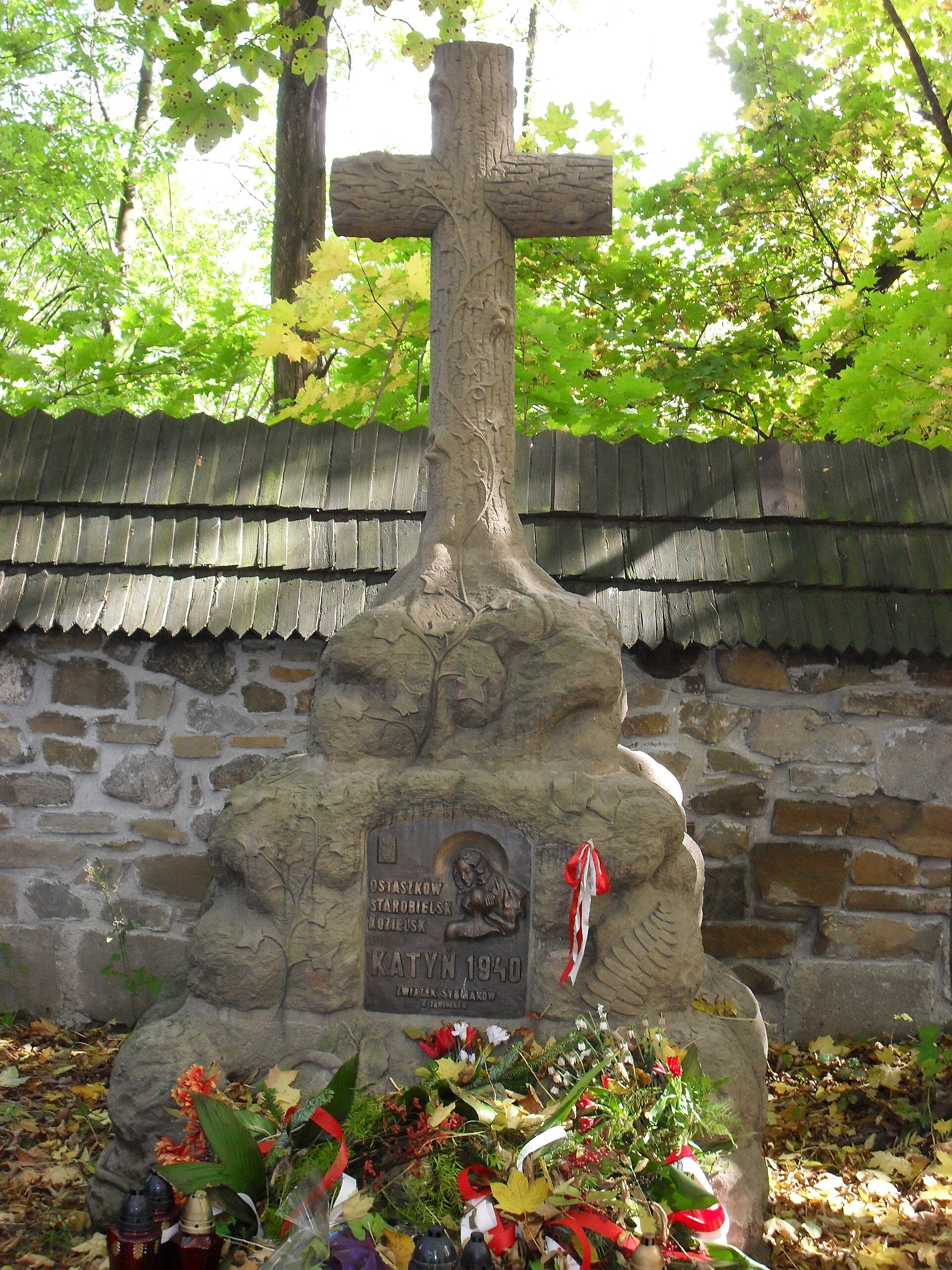
That the massacre of Polish officers and citizens found in the Katyn Forest was carried out not by Nazi Germany, as the Soviet Union claimed for decades, but by the Soviet NKVD in the spring of 1940 on the direct written order of Joseph Stalin and the Politburo; that the USSR built and defended a false counter-narrative blaming the Germans; and that the Western Allies, principally the United States and Britain, knowingly suppressed evidence of Soviet guilt to preserve the wartime alliance.
Proven. The historical record now confirms it. On Stalin and Beria's written order of 5 March 1940, the Soviet secret police shot roughly 22,000 Polish prisoners of war and citizens in the spring of 1940; the USSR then blamed Nazi Germany for nearly fifty years. The Soviet state itself admitted NKVD guilt in 1990, handed over the signed killing order, and Russia's Duma reaffirmed it in 2010. Contemporaneous US intelligence pointed to Soviet guilt and was suppressed to protect the wartime alliance, a suppression documented by the 1952 Madden Committee and by memos declassified in 2012. Rated substantiated. What remains argued is narrower: exact victim totals and how high US foreknowledge reached.
Believed by: The settled conclusion of Polish and Western historians, the US Congress (1952), the Soviet government (1990) and the Russian Duma (2010); still partly disputed inside Russia, where Communist Party deputies and some state voices continue to defend the discredited Nazi-guilt version
The full story
An order signed at the top
Most massacres of this scale leave their authorship in doubt. Katyn does not, because the order survives. On 5 March 1940, the head of the Soviet secret police, Lavrentiy Beria, sent Joseph Stalin a memorandum recommending that the Polish officers, police, and officials held in three NKVD camps be shot without trial as incorrigible enemies of Soviet power. The Politburo endorsed it the same day. The document carries the signatures of Stalin, Vyacheslav Molotov, Kliment Voroshilov, and Anastas Mikoyan, with Lazar Kaganovich and Mikhail Kalinin recorded in favor. It authorized the execution of up to 25,700 people.
The prisoners had been taken in September 1939, when the Soviet Union invaded eastern Poland under the secret terms of the Molotov–Ribbentrop Pact, dividing the country with Nazi Germany. Poland's officer corps was also its educated class in uniform: reserve officers who in civilian life were doctors, lawyers, engineers, professors, and priests. Killing them was not a battlefield act but a deliberate decapitation of a nation's leadership. Over roughly six weeks in April and May 1940 the NKVD carried the sentence out, shooting the prisoners in small groups at the Katyn Forest, at the NKVD prison in Kalinin, and at Kharkiv, and burying them in mass graves.
The document authorized the execution of up to 25,700 people, and it was signed at the very top.
The Nazis find the graves
The bodies stayed hidden until the war turned. By 1943 the Smolensk region, including the Katyn Forest, was under German occupation. On 13 April 1943, Berlin radio announced that German forces had uncovered mass graves of Polish officers and that the killers were the Soviets. The announcement was, transparently, a propaganda weapon: Germany hoped to fracture the alliance between the USSR and the Western powers by turning Poland's grief against Moscow.
That the messenger had motives did not make the message false, and the forensic picture supported it. The victims wore Polish winter uniforms and carried letters, diaries, and newspapers that stopped in the spring of 1940, before any German soldier had reached the area. An international team of forensic pathologists assembled by the Germans, and separately the Polish Red Cross, examined the graves and found the decay and documentation consistent with a 1940 killing. The dead had been shot in the back of the head, many with their hands bound, in a manner that matched NKVD practice.
The Polish government-in-exile in London, unwilling to take Berlin's word but unable to ignore the evidence, asked the neutral International Committee of the Red Cross to investigate. Stalin seized on the request. Casting it as collaboration with Nazi propaganda, he broke off diplomatic relations with the Polish government, a rupture that shaped the postwar fate of Poland itself. The Allies, needing the Red Army to keep bleeding the Wehrmacht, did not press him.
The counter-investigation
When the Red Army retook the Smolensk region in the autumn of 1943, the Soviet Union set about producing an official version of Katyn that reversed the blame. In January 1944 it convened a commission under Nikolai Burdenko, president of the USSR Academy of Medical Sciences. Its very name announced the verdict in advance: it was styled the commission to establish the shooting of Polish prisoners of war by the German-Fascist invaders.
The commission concluded, as instructed, that the Germans had shot the Poles in the autumn of 1941, after capturing them intact from Soviet camps. The finding rested on testimony from witnesses later shown to have been coerced by the NKVD and NKGB, and on documents planted in the graves to move the date forward by more than a year. It was, in the phrase historians use, a scene of lies dressed as forensics. Moscow then tried to have Katyn charged as a German atrocity at the Nuremberg tribunal in 1946, but the prosecution collapsed for lack of credible proof, and the tribunal's judgment made no finding against Germany on Katyn. The Burdenko version nonetheless became fixed Soviet doctrine, taught and enforced across the Eastern bloc, for the next forty-six years.
The commission's name announced its verdict before it began: the shooting ‘by the German-Fascist invaders.’
What Washington knew and buried
The most uncomfortable strand of the story is not Soviet but American. In May 1943 the Germans flew a group of captured Allied officers to the graves, expecting them to serve as unwilling propaganda witnesses. Two American prisoners, Lieutenant Colonel John H. Van Vliet Jr. and Captain Donald B. Stewart, came away privately convinced the killings were Soviet work, judging from the age of the bodies and the state of their clothing and boots. Both, still prisoners, managed to relay that conclusion to US Army intelligence in coded messages. Documents released by the National Archives in 2012 preserve the exchange, including a coded query asking Van Vliet for his opinion and Stewart's later account that a message went to Washington reporting that, in his and Van Vliet's view, the German claims about Katyn were substantially correct.
After the war Van Vliet wrote up his findings in a 1945 report to the Army. It pointed to Soviet guilt, and it went missing; the copy could not be found when investigators later sought it, and Van Vliet was asked to reconstruct it in 1950. When the House select committee chaired by Representative Ray Madden examined the whole record in 1951 and 1952, it heard 81 witnesses and gathered depositions and exhibits, and it concluded unanimously that the NKVD had committed the massacre. It went further, and this was its most damning finding: that US officials had possessed evidence of Soviet guilt and had suppressed or discounted it, out of a desire to keep the wartime alliance intact. The committee recommended the case be taken to an international court, a recommendation the government did not act on.
How high the knowledge reached is the point still argued. That intelligence pointing to Soviet guilt existed in 1943, and that it was not allowed to disturb the alliance, is documented. Whether President Roosevelt himself understood and consciously chose to bury it, or whether the conclusion was filtered out below him by officials making the same calculation, the surviving record does not fully resolve.
How the record reads now
The turn came with the Soviet system's own collapse. On 13 April 1990, during a visit by Poland's leader Wojciech Jaruzelski to Moscow, Mikhail Gorbachev formally acknowledged, through the state news agency TASS, that the NKVD had carried out the Katyn killings, ascribing direct responsibility to Beria and his men. He handed the Polish side copies of the camp prisoner lists, and in the following years the archives yielded the signed 5 March 1940 order itself. The state that had lied about Katyn for half a century produced the proof of its own guilt.
The acknowledgment was reaffirmed, if incompletely, by Katyn's successor state. In November 2010 the Russian State Duma passed a declaration stating that the massacre had been carried out on the direct order of Stalin and other Soviet leaders, over the objections of Communist Party deputies who voted against it and continued to defend the old German-guilt story. Russia's own criminal investigation, however, was closed in 2004 with much of its material still classified, and the Russian state has declined to call the killings genocide or to open the full file, so the reckoning remains partial.
What is settled is the core of the case, and it is settled to an unusual degree. A government murdered roughly 22,000 prisoners on a written order signed at the top, blamed its enemy, built a fake investigation to prove the lie, and was shielded for years by allies who found the truth inconvenient. Each of those claims was once dismissed as wartime propaganda; each is now documented, much of it by the very governments that once denied it. The parts that remain open (the exact toll, the full depth of American foreknowledge, the limits of Russia's acknowledgment) sit at the edges of a finding whose center no longer moves.
The state that had lied about Katyn for half a century produced the proof of its own guilt.
What's still unexplained
- The exact number of victims is not fixed. The signed order authorized up to 25,700 executions across categories; the best-known internal Soviet figure is 21,857 from 1959; and incomplete or destroyed records leave the precise total for Katyn and the associated sites an estimate rather than a count. This is a question of margins, not of authorship.
- How high US foreknowledge reached, and how deliberate the suppression was, is still argued. The Madden Committee found the government suppressed evidence to protect the alliance, and the 2012 memos show intelligence pointing to Soviet guilt reached Washington in 1943, but whether President Roosevelt himself grasped and consciously buried the conclusion, or whether it was filtered out at lower levels, is not fully settled by the surviving record.
- Russia's legal acknowledgment remains incomplete and contested. Moscow admitted responsibility in 1990 and the Duma affirmed it in 2010, but Russia's official investigation was closed in 2004 with much of its file kept secret, the state has declined to classify the killings as genocide, and Communist Party figures and some state-aligned voices periodically revive the discredited German-guilt version.
- Whether Britain's wartime suppression matched America's is less fully documented. A 1943 report by the British ambassador to the Polish government, Owen O'Malley, privately concluded Soviet guilt was likely, yet London, like Washington, kept the alliance's needs ahead of the finding; the full internal paper trail on the British side is thinner than the American one.
Point by point
The claim: The Katyn killings were carried out by the Soviet NKVD, not by Nazi Germany.
What the record shows: Confirmed, and by the perpetrator's own government. The murders were ordered in writing on 5 March 1940, when the Katyn area was still under Soviet control, more than a year before German forces reached it. In 1990 the Soviet Union publicly admitted NKVD guilt, and Gorbachev handed Poland copies of the signed Politburo order and the camp prisoner lists. Forensic dating of the graves, the victims' 1940 correspondence and newspapers found on the bodies, and the German-issued ammunition used (the NKVD had bought it before the war) all point the same way.
The claim: Because the Nazis announced the graves, the evidence is tainted German wartime propaganda.
What the record shows: The messenger was propagandizing; the underlying facts held up anyway. Germany did exploit Katyn to split the Allies, and its 1943 announcement was self-serving. But the Soviet state's own 1990 admission and the 2010 Duma declaration, made against Moscow's every interest, independently confirm what the Germans charged. The task here is to separate a true fact from the tainted mouth that first spoke it, and multiple non-German lines of evidence converge on Soviet guilt.
The claim: The Soviet Union maintained for decades that Germany was responsible.
What the record shows: Confirmed, and the machinery of that denial is documented. The 1944 Burdenko Commission produced a report titled to presume German guilt before it began, relying on witnesses later shown to have been coerced and on documents planted to backdate the killings to 1941. Soviet prosecutors even tried to enter Katyn as a German crime at the Nuremberg tribunal, where it quietly failed for lack of proof. Moscow defended the Burdenko version until 1990.
The claim: The United States knew Katyn was a Soviet crime and deliberately suppressed the evidence.
What the record shows: Proven, with narrower edges still argued. The 1952 Madden Committee concluded that US officials had evidence of Soviet guilt from 1943 and withheld or downplayed it to preserve the alliance. Documents declassified by the National Archives in 2012 include the coded 1943 messages from captured US officers Van Vliet and Stewart naming the Soviets, routed to military intelligence; Van Vliet's 1945 report to the Army was subsequently reported missing. What remains debated is how high in the government the knowledge reached and how deliberate, versus merely negligent, the suppression was.
The claim: No official body of the responsible state ever accepted Soviet guilt; it is a Western or Polish claim.
What the record shows: It is now the position of the successor state itself. On 13 April 1990 the Soviet government, via TASS and with Gorbachev's authority, acknowledged that the NKVD carried out the killings and ascribed direct responsibility to Beria and his subordinates. In November 2010 the Russian State Duma voted 342 to acknowledge, in a formal declaration, that Katyn was 'carried out on the direct order of Stalin and other Soviet leaders.' Russia's own military prosecutors had earlier investigated the case as well.
The claim: The figure of exactly 22,000 victims is precisely established.
What the record shows: The scale is beyond dispute; the exact count is not. The most-cited Soviet internal figure, from Shelepin's 1959 note, is 21,857, and 'roughly 22,000' is the standard shorthand. Because Soviet records were incomplete and some files were destroyed, historians treat the total as an estimate rather than a settled tally, and figures cited range from about 21,800 to over 22,000. The uncertainty is at the margins; it does not touch the fact or authorship of the massacre.
Timeline
- 1939-09Under the secret protocol of the Molotov–Ribbentrop Pact, the Soviet Union invades eastern Poland weeks after Germany invades from the west. The Red Army takes hundreds of thousands of prisoners; captured Polish officers, police, and officials are concentrated in NKVD camps at Kozelsk, Starobelsk, and Ostashkov.
- 1940-03-05NKVD chief Lavrentiy Beria sends Stalin a memo proposing that the imprisoned Poles, described as hardened counter-revolutionaries, be shot. The Politburo order approving the execution of up to 25,700 prisoners is signed the same day by Stalin, Molotov, Voroshilov, Mikoyan, and (by proxy) Kaganovich and Kalinin.
- 1940-04 to 1940-05Over roughly six weeks the NKVD shoots an estimated 22,000 prisoners. Officers from Kozelsk are killed in the Katyn Forest near Smolensk; police from Ostashkov at the NKVD prison in Kalinin (buried at Mednoye); prisoners from Starobelsk at Kharkiv (buried at Piatykhatky). A 1959 note by KGB chief Alexander Shelepin fixes the total at 21,857.
- 1943-04-13German forces, now occupying the Smolensk region, announce the discovery of mass graves in the Katyn Forest and blame the Soviet Union. Berlin radio broadcasts the find and invites international observers, including a commission of forensic experts and Allied prisoners of war.
- 1943-04The London-based Polish government-in-exile asks the International Committee of the Red Cross to investigate. Stalin uses the request as a pretext to break diplomatic relations with the Polish government, casting the appeal as collusion with Nazi propaganda.
- 1943-05American prisoners of war, among them Lieutenant Colonel John H. Van Vliet Jr. and Captain Donald B. Stewart, are taken by their German captors to view the exhumed graves. Both conclude the killings were Soviet work and, still in captivity, relay that judgment to US Army intelligence in coded messages.
- 1944-01After the Red Army retakes the area, the Soviet Union convenes the Burdenko Commission, which stages a counter-investigation and concludes the Germans shot the Poles in the autumn of 1941. The finding, built on coerced testimony and predated documents, becomes the official Soviet line for the next forty-six years.
- 1952-12A US House select committee chaired by Representative Ray Madden unanimously concludes the NKVD committed the massacre and finds that the US government suppressed or ignored evidence of Soviet guilt during and after the war to protect the alliance.
- 1990-04-13On a visit by Polish leader Wojciech Jaruzelski to Moscow, Mikhail Gorbachev formally admits NKVD responsibility and hands over copies of the original camp lists and killing order. In 2010 the Russian State Duma passes a declaration affirming that Katyn was carried out on Stalin's direct order.
From the case file
The actual records: declassified, released, or leaked. We link straight to each document in its official archive, so you never have to take our word for it. Read the originals yourself.
The Katyn Forest Massacre: Final Report of the Select Committee to Conduct an Investigation (H. Rept. 82-2505)
The select committee's final report, which unanimously concluded the Soviet NKVD carried out the massacre and found that US officials had held and suppressed evidence of Soviet guilt to protect the wartime alliance. It recommended the case go before an international tribunal.
Read the document: govinfo →Records Relating to the Katyn Forest Massacre at the National Archives
NARA's collection of Katyn records, including over a thousand pages declassified in 2012: State, War Department, Army, and OSS files, plus the coded 1943 messages from captured US officers Van Vliet and Stewart pointing to Soviet guilt.
Read the document: US National Archives →Other case files that cite the same sources
Proven. The historical record now confirms it. On Stalin and Beria's written order of 5 March 1940, the Soviet secret police shot roughly 22,000 Polish prisoners of war and citizens in the spring of 1940; the USSR then blamed Nazi Germany for nearly fifty years. The Soviet state itself admitted NKVD guilt in 1990, handed over the signed killing order, and Russia's Duma reaffirmed it in 2010. Contemporaneous US intelligence pointed to Soviet guilt and was suppressed to protect the wartime alliance, a suppression documented by the 1952 Madden Committee and by memos declassified in 2012. Rated substantiated. What remains argued is narrower: exact victim totals and how high US foreknowledge reached.
Reviewed by Colin Peterson · Last reviewed July 18, 2026 · How we rate
Common questions
Is Katyn massacre true?
Proven. The historical record now confirms it. On Stalin and Beria's written order of 5 March 1940, the Soviet secret police shot roughly 22,000 Polish prisoners of war and citizens in the spring of 1940; the USSR then blamed Nazi Germany for nearly fifty years. The Soviet state itself admitted NKVD guilt in 1990, handed over the signed killing order, and Russia's Duma reaffirmed it in 2010. Contemporaneous US intelligence pointed to Soviet guilt and was suppressed to protect the wartime alliance, a suppression documented by the 1952 Madden Committee and by memos declassified in 2012. Rated substantiated. What remains argued is narrower: exact victim totals and how high US foreknowledge reached.
What is Katyn massacre?
Katyn is the rare conspiracy that turned out to be exactly what its accusers said: a mass murder by one government, pinned on another, and buried by both sides of an alliance for reasons of state. In the spring of 1940 the Soviet NKVD executed roughly 22,000 Polish army officers, police, and members of the intelligentsia on a written ord…
What does the evidence show?
Confirmed, and by the perpetrator's own government. The murders were ordered in writing on 5 March 1940, when the Katyn area was still under Soviet control, more than a year before German forces reached it. In 1990 the Soviet Union publicly admitted NKVD guilt, and Gorbachev handed Poland copies of the signed Politburo order and the camp…
Why do people believe it?
Because it is true, and unusually well documented: the killing order survives with Stalin's signature on it, and the government that carried out the crime eventually admitted authorship and produced the paperwork itself, which almost never happens.
What is still unresolved?
The exact number of victims is not fixed. The signed order authorized up to 25,700 executions across categories; the best-known internal Soviet figure is 21,857 from 1959; and incomplete or destroyed records leave the precise total for Katyn and the associated sites an estimate rather than a count. This is a question of margins, not of a…
Sources
- 1.Records Relating to the Katyn Forest Massacre at the National Archives, U.S. National Archives and Records Administration (2012)
- 2.The Katyn Forest Massacre: Final Report of the Select Committee to Conduct an Investigation (H. Rept. 2430, 82d Congress), U.S. House of Representatives (the Madden Committee) (1952)
- 3.Stalin's Killing Field, Studies in Intelligence, Central Intelligence Agency (1999)
- 4.Katyn Massacre, Encyclopaedia Britannica
- 5.Secret Memos Show U.S. Hushed Up Katyn Crime, The Moscow Times (Associated Press) (2012)
- 6.Memos Show U.S. Helped Cover Up Soviet Massacre, CBS News (Associated Press) (2012)
- 7.Soviets Admit, Apologize for Katyn Massacre, United Press International (UPI Archives) (1990)
- 8.Duma Blames Stalin for Katyn Massacre, The Moscow Times (2010)
- 9.Katyn: The Massacre Stalin Tried To Blame On The Nazis, Radio Free Europe/Radio Liberty (2018)
Embed this verdict on your site
Paste this snippet to show our sourced verdict as a small card, with a link back to the full case file. Free to use.
<iframe src="https://theconspiratory.com/embed/katyn-massacre" title="The Conspiratory verdict" width="520" height="190" style="border:0;max-width:100%" loading="lazy"></iframe>Help us investigate
This is a living case file. If you spot an error or know evidence we missed, tell us, and weigh in on where you land.
Where do you land?
Cast your read on this one.
Comments
Add your take. Comments are read and approved by a human before they appear, so keep it on topic and civil. Please do not accuse named, living people of crimes.