Kenneth Arnold saw nine genuine unexplained craft over Mount Rainier in 1947
By Colin PetersonJuly 18, 2026
Where the evidence lands →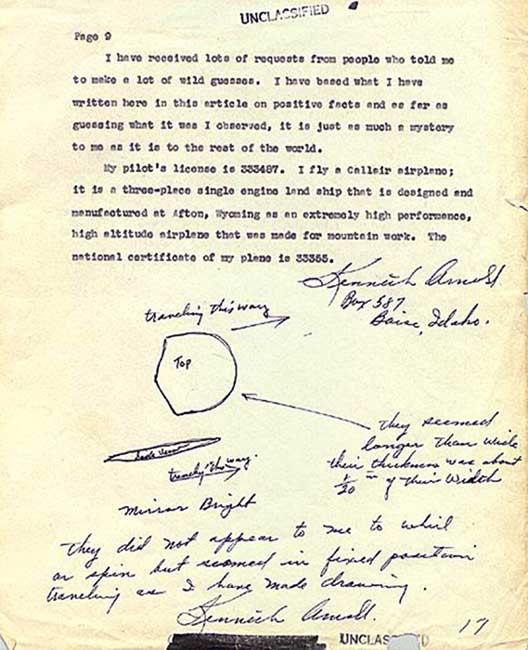
That the nine objects Kenneth Arnold reported near Mount Rainier on 24 June 1947 were real, solid craft of a kind unknown to aviation (often imagined as extraterrestrial vehicles or secret experimental aircraft), that their reported speed and formation could not be produced by any natural phenomenon or ordinary aircraft, and that Arnold's sighting therefore stands as the credible opening evidence of the modern UFO era.
The event is beyond dispute and unusually well documented: on 24 June 1947, private pilot Kenneth Arnold reported nine fast, shiny objects flying in formation near Mount Rainier, told his story to reporters the next day, and touched off the sighting that gave the world the phrase 'flying saucer.' Its cultural weight is enormous; it opened the modern UFO era and preceded Roswell by two weeks. The rated claim is narrower: that Arnold saw genuine unexplained craft rather than a natural or mundane phenomenon misjudged for size, distance, and speed. That claim is unproven. Arnold was a credible, consistent witness, but there is no photograph, radar trace, or physical evidence, and prosaic candidates (a meteor train, a mirage, high-flying birds, or ordinary aircraft misjudged in scale) have been proposed without any of them being confirmed either.
Believed by: A foundational case for UFO researchers, who treat it as the origin point of the modern phenomenon; skeptics variously favor a meteor fireball, an atmospheric mirage, misidentified birds, or a simple misjudgment of distance and scale
The full story
What is documented
Start with what is not in dispute. Early in the afternoon of 24 June 1947, a fire-equipment salesman and private pilot named Kenneth Arnold was flying his small CallAir A-2 over the Cascade Range in Washington State. He had detoured to scan the mountains for a downed Marine transport, for which a reward had been posted. Near Mount Rainier, he reported, a bright flash caught his eye, and he saw a chain of nine shiny objects streaking south toward Mount Adams, flashing, as he put it, "like sunlight on a mirror."
Arnold did something most witnesses never do: he tried to measure it. Using the clock on his instrument panel, he timed the objects as they crossed the roughly 50-mile gap between the two peaks, about a minute and forty-two seconds. When he worked out the arithmetic later, the figure came to more than 1,700 miles per hour. Unsure of the exact distance, he conservatively rounded it down to about 1,200 mph, still far beyond anything then flying, in an era before any aircraft had broken the sound barrier.
The next day, refueling at Pendleton, Oregon, Arnold told his story to reporters at the East Oregonian. The wire services carried it within hours, and the country was suddenly full of saucers. So the question this file turns on is not whether Arnold reported something, or whether his account launched a phenomenon. Both are established. It is whether the larger claim built on top of them, that the objects were genuine unexplained craft, has been proven. It has not.
How the 'flying saucer' was coined by mistake
The single most consequential thing about the Arnold sighting is a misquote. Asked to describe how the objects flew, Arnold reached for a homely image: they moved erratically, he said, "like a saucer if you skipped it across water." The comparison was to the motion, the skipping, fluttering, terrain-hugging path, and not to the shape of the objects at all. In his own sketches he drew forms that were crescent-like or heel-shaped, closer to a boomerang or a flying wing than to a dinner plate.
But a vivid phrase is hard to resist. Reporters and headline writers compressed Arnold's description of movement into a description of form, and within a day the wires were carrying accounts of "flying saucers" and "flying discs." The disc became the default picture of the phenomenon, printed and reprinted until it was fixed in the public mind. Arnold spent years complaining, mildly, about the distortion; interviewed decades later he allowed that he had "suffered some embarrassment here and there by misquotes."
The irony runs deep, because the misnomer arguably shaped what came after it. Once the newspapers taught the country that mysterious sky objects were saucer-shaped, later witnesses in the summer of 1947 and for decades afterward reported seeing exactly that: discs. A description of how nine objects moved on one June afternoon, mangled in transmission, may have handed the entire modern phenomenon its most recognizable symbol. The flying saucer was, in a real sense, born of a printing error.
The strength of the case, stated fairly
This is not a story to dismiss with a wave. What gives the Arnold case its staying power is a rare combination: a capable witness, a quantified observation, and an official record that never closed the matter.
Consider the witness. Arnold was not a nervous motorist glimpsing a light on a lonely road; he was an experienced pilot, practiced at judging aircraft in the air, flying in clear daylight. He reported the sighting at the first opportunity, made no attempt to profit from it, and never altered or dramatized the core of his account across the remaining decades of his life. When a person like that says plainly that he saw something he could not explain, the claim deserves a serious hearing.
Consider the measurement. Most sightings are pure impression, but Arnold timed his against a clock and worked out a speed, and even his deliberately conservative figure of 1,200 mph outran every aircraft then in existence. And consider the aftermath: within days, similar reports were pouring in from across the country, and two weeks later the Army itself announced it had recovered a "flying disc" at Roswell.
An experienced pilot, a clocked speed no plane could match, and a nationwide wave that began the moment he spoke. That is not a campfire tale, and it earned the case its place at the head of the file.
That is the case at full strength: not that alien craft have been proven, but that a credible aviator reported a specific, timed, high-speed formation that no one has ever confidently explained, and that his report opened an era. Anyone who treats it as obviously nothing is not taking the record seriously.
Where the leap to 'unexplained craft' happens
Here is the pivot. Everything above supports a modest conclusion: that Arnold sincerely reported a striking sight he could not identify. The rated claim needs a stronger one: that the objects were real, solid craft beyond the reach of nature or 1947 aviation. The distance between those two is the whole of this case, and the evidence does not obviously cross it.
The famous speed is the place to look, because it is doing more work than it can bear. That 1,200 mph figure is not a measurement; it is a calculation, and it depends on a number Arnold himself said he did not know: how far away the objects were. He assumed they were huge and distant, pacing the 50 miles between two mountains. If instead they were small and close, the very same sweep across his windshield yields an utterly ordinary speed. Change one unmeasured assumption and the impossible number becomes a commonplace one.
The official record, likewise, says less than it seems to. The early Army inquiry that grew into Project Sign and Blue Book did not settle the case, but failing to explain a sighting is not the same as certifying it as a craft. Investigators weighed prosaic candidates, a mirage among them, and never concluded Arnold had seen a manufactured object of unknown origin. To read "we could not identify it" as "it was a real unknown craft" is to finish the sentence the government declined to finish.
And the conclusion is reached by elimination that has not eliminated. A meteor fireball, an atmospheric mirage, high-flying birds, or simple misjudged scale each explain much of the report and stumble on some detail. That none has been nailed down does not hand the result to unexplained craft by default. An unsolved case is unsolved in every direction, and Arnold's is genuinely unsolved, not quietly confirmed.
Believe the pilot, not the conclusion
Keep the two claims apart, because the discipline of this case lives entirely in the gap between them. The event is real: a credible pilot reported nine fast, bright objects in formation, timed them, told reporters within a day, and set off the first great wave of saucer sightings. On that, and on the sighting's vast cultural importance, there is no serious argument. The unexplained-craft conclusion is not established: there is no photograph, no radar return, no physical trace, the crucial speed figure rests on a distance Arnold could not measure, and every mundane candidate remains a live possibility.
Yet the Arnold sighting has resisted confident dismissal for nearly eighty years, no prosaic explanation fits it cleanly, and Arnold himself deserves to be believed about what he experienced, if not automatically about what caused it. There is a real residue of mystery here, and saying the craft claim is unproven takes nothing away from how strange, and how historically enormous, the report was.
What this file withholds is only the final step: from we cannot identify it to it was a genuine unknown craft. That step needs evidence the record has never produced, and it is worth remembering that the very shape everyone pictures, the saucer, came not from Arnold's eyes but from a reporter's pen. Until better data arrives, a meteor, a mirage, a flight of birds, or an honest misjudgment of distance remains as available as anything exotic.
What's still unexplained
- What Arnold actually saw has never been positively identified. No proposed explanation, exotic or mundane, fits every detail he reported: the brightness, the chain formation, the roughly hundred-second duration, and the level, terrain-hugging flight. That residual puzzle is real, and calling the craft claim unproven is not the same as calling the case solved.
- How far away were the objects, and how large? Arnold's entire speed calculation, and with it the claim that no aircraft could match it, hangs on a distance he candidly said he could not measure. Whether the objects were huge and far or small and near was never resolved, and it is the hinge on which the whole case turns.
- Could a meteor fireball fit? A shallow-entry meteor breaking into a bright, fast train is one of the better mundane candidates, but it is hard to square with Arnold's account of objects seen for well over a minute in sustained horizontal flight. Whether a fireball can produce that impression has never been settled.
- Why did the press turn a description of motion into a description of shape, and how much did that reshape everything after? The 'flying saucer' misnomer arguably created the disc archetype that later witnesses then reported, a feedback loop between headline and sighting that is easy to trace and impossible to fully quantify.
Point by point
The claim: Arnold was a sober, experienced pilot with no motive to lie, so his report must describe real, extraordinary craft.
What the record shows: His credibility is genuinely part of why the case endures. Arnold was an experienced private flyer familiar with judging aircraft in the air, he reported the sighting promptly and without seeking profit, and he held to the same account for the rest of his life. That establishes he sincerely described what he believed he saw. It does not establish what the objects were. A truthful, capable observer can still misjudge the size, distance, and speed of unfamiliar shapes against a mountain backdrop, especially objects glimpsed for under two minutes. Sincerity narrows the case to a real event honestly reported; it does not by itself reach 'unexplained craft.'
The claim: The objects' speed, more than 1,200 miles per hour, was impossible for any 1947 aircraft, so they cannot have been ordinary planes.
What the record shows: The speed figure is the case's strongest and shakiest point at once. It is strong because 1,200 mph really did exceed anything then flying. It is shaky because it depends entirely on Arnold's own assumptions: he timed the objects across an estimated 50-mile gap and admitted he did not know their true distance. If the objects were far closer and smaller than he assumed, the same angular motion yields a perfectly ordinary speed. The high number is a calculation resting on an unverifiable distance, not an independent measurement, so it cannot on its own rule out mundane objects.
The claim: Nine objects flying in tight, coordinated formation is the mark of intelligent control, not a natural phenomenon.
What the record shows: A stepped chain of nine bright objects is striking, and it is a fair point that natural phenomena are not usually so orderly. But several proposed explanations do produce chains: a meteor breaking up on a shallow atmospheric entry sheds a train of fragments that travel in a line at enormous speed and shine brightly, and a flight of large birds or a row of terrain-driven mirages can also string out across the sky. Formation is suggestive of design, but it is not unique to craft, and Arnold himself described the motion as irregular and fluttering rather than rigidly held.
The claim: The Air Force investigated and never explained the sighting, which amounts to official confirmation that it was a genuine UFO.
What the record shows: It is true that the early Army Air Forces inquiry did not produce a confident, agreed explanation, and that the Arnold case sits at the head of the files that became Project Sign and Blue Book. But 'not explained' is not the same as 'confirmed unexplained craft.' Investigators floated prosaic candidates, including a mirage, without proving one, and the government never concluded that Arnold saw a manufactured object of unknown origin. Reading official uncertainty as official endorsement adds a conclusion the record does not contain.
The claim: The proposed mundane explanations (meteors, mirages, birds) have each been shown to fail, leaving only the extraordinary answer.
What the record shows: None of the mundane explanations has been proven, but neither has the extraordinary one, and that symmetry is the point. A meteor fireball fits the chain, brightness, and speed but not a sighting that Arnold said lasted well over a minute in level flight. A mirage of the snow-capped Cascade peaks fits the reflectivity and the mountain setting but strains the reported independent motion. High-flying pelicans fit the crescent profiles and undulating flight but not the extreme speed. Each candidate explains part of the report and stumbles on another part. That no single prosaic answer accounts for everything does not convert the case into proof of craft; it leaves it open.
The claim: The famous 'flying saucer' shape confirms Arnold saw disc-shaped craft.
What the record shows: This is the case's central irony. The word 'saucer' entered the language from Arnold's description of how the objects moved, skipping like a saucer flung across water, not their shape. Reporters compressed the motion into a shape, and the disc became the archetype. Arnold's own drawings show crescent or heel-like forms, not classic saucers. The iconic flying-saucer silhouette that seems to corroborate him is partly an artifact of the 1947 headlines, so it cannot be cited as independent confirmation of what he actually reported.
Other readings
Angles that don't fit neatly into the claim or its rebuttal, laid out and weighed, not endorsed.
The meteor-fireball read
Skeptics including Philip J. Klass argued that Arnold may have seen a bright fireball, a meteor breaking up on a shallow atmospheric entry. Such a train travels nearly horizontally, shines brilliantly, strings its fragments into a line, and moves at thousands of miles per hour, which fits the chain, the brightness, and the extreme speed neatly. The difficulty is duration: Arnold described watching the objects for well over a minute in level flight, far longer than a fireball normally lasts. The fit is genuine but incomplete.
The mirage read
Steuart Campbell proposed that the objects were mirages of the snow-capped Cascade peaks, produced by a temperature inversion over the deep valleys in Arnold's line of sight. On this reading the 'objects' were essentially stationary optical images that only appeared to pace his aircraft, which would collapse the terrifying speed to near zero. It accounts for the mirror-bright reflectivity and the mountain setting, but it strains against Arnold's report that the objects moved independently and swung between the peaks.
The birds read
James Easton and others suggested American white pelicans, which are native to the region, very large, pale enough to flash in sunlight, and capable of soaring at altitude in a line with a crescent-shaped profile and an undulating beat, matching some of Arnold's shape and motion details. The obvious objection is speed: no bird approaches even the conservative 1,200 mph figure, so this explanation only works if Arnold badly misjudged the objects' distance and therefore their true velocity.
The misjudged-scale read
The most deflationary reading keeps every honest element of Arnold's account and questions only one hidden assumption: distance. If the objects were much closer and smaller than he supposed, the same angular sweep across the sky yields an ordinary speed and an ordinary size, and they could have been conventional aircraft, geese, or debris. This is not a claim that Arnold lied, only that a sincere observer, with no reference points between two distant mountains, can be wrong about how big and how far something is, and that one such error would explain the entire case.
Timeline
- 1947-06-24Around 3:00 p.m., Kenneth Arnold, a 32-year-old fire-suppression equipment salesman and experienced private pilot, is flying his single-engine CallAir A-2 over the Cascade Range in Washington. He has detoured to look for a Marine Corps C-46 transport that recently crashed in the mountains, for which a reward has been offered.
- 1947-06-24Near Mount Rainier, Arnold reports a bright flash and then nine shiny objects flying in a diagonally stepped-down chain, stretched over some five miles, heading south toward Mount Adams. He says they are highly reflective, flashing 'like sunlight on a mirror,' mostly disc- or heel-shaped, and moving with an erratic, fluttering motion he later likens to a saucer skipped across water.
- 1947-06-24Arnold times the objects against his instrument-panel clock as they pass from Mount Rainier to Mount Adams, a span of roughly 50 miles, in about one minute and forty-two seconds. His later calculation yields more than 1,700 miles per hour; unsure of the exact distance, he conservatively rounds it down to about 1,200 mph, still far faster than any aircraft then flying, before the sound barrier had been broken.
- 1947-06-25On a fuel stop at Pendleton, Oregon, Arnold recounts the sighting to East Oregonian reporters Nolan Skiff and Bill Bequette. Bequette files a short dispatch that the Associated Press carries across the country. Reporters convert Arnold's description of the objects' saucer-like motion into a description of their shape, and the phrase 'flying saucer' (and 'flying disc') enters the language.
- 1947-06-25Within a day the story is national news, and reports of similar objects begin arriving from across the United States. The summer of 1947 becomes the first great wave of 'flying saucer' sightings, and Arnold, to his discomfort, becomes a public figure.
- 1947-07Two weeks after Arnold's report, the Roswell Army Air Field announces it has recovered a 'flying disc' in New Mexico, then retracts it as a weather balloon. Coming amid the wave Arnold had set off, Roswell fuses with the saucer story in the public imagination and helps cement the new phenomenon.
- 1947-07The Army Air Forces begin collecting saucer reports, the effort that leads to Project Sign and, later, Project Blue Book. Investigators consider prosaic explanations for the Arnold case, including a mirage, and never confirm any craft; the case is not resolved to anyone's satisfaction.
- 1952Arnold co-writes 'The Coming of the Saucers' with publisher Ray Palmer, having by now investigated other cases, including the disputed Maury Island affair. He never recants or embellishes his original account and maintains for the rest of his life that he saw something real and unexplained. He dies in 1984.
The event is beyond dispute and unusually well documented: on 24 June 1947, private pilot Kenneth Arnold reported nine fast, shiny objects flying in formation near Mount Rainier, told his story to reporters the next day, and touched off the sighting that gave the world the phrase 'flying saucer.' Its cultural weight is enormous; it opened the modern UFO era and preceded Roswell by two weeks. The rated claim is narrower: that Arnold saw genuine unexplained craft rather than a natural or mundane phenomenon misjudged for size, distance, and speed. That claim is unproven. Arnold was a credible, consistent witness, but there is no photograph, radar trace, or physical evidence, and prosaic candidates (a meteor train, a mirage, high-flying birds, or ordinary aircraft misjudged in scale) have been proposed without any of them being confirmed either.
Reviewed by Colin Peterson · Last reviewed July 18, 2026 · How we rate
Common questions
Is Kenneth Arnold sighting true?
The event is beyond dispute and unusually well documented: on 24 June 1947, private pilot Kenneth Arnold reported nine fast, shiny objects flying in formation near Mount Rainier, told his story to reporters the next day, and touched off the sighting that gave the world the phrase 'flying saucer.' Its cultural weight is enormous; it opened the modern UFO era and preceded Roswell by two weeks. The rated claim is narrower: that Arnold saw genuine unexplained craft rather than a natural or mundane phenomenon misjudged for size, distance, and speed. That claim is unproven. Arnold was a credible, consistent witness, but there is no photograph, radar trace, or physical evidence, and prosaic candidates (a meteor train, a mirage, high-flying birds, or ordinary aircraft misjudged in scale) have been proposed without any of them being confirmed either.
What is Kenneth Arnold sighting?
Early in the afternoon of 24 June 1947, a private pilot named Kenneth Arnold was flying his small plane over the Cascade Range in Washington State, keeping an eye out for a Marine transport that had crashed in the mountains, when he reported seeing nine brilliant, disc-like objects streaking south in formation near Mount Rainier. He time…
What does the evidence show?
His credibility is genuinely part of why the case endures. Arnold was an experienced private flyer familiar with judging aircraft in the air, he reported the sighting promptly and without seeking profit, and he held to the same account for the rest of his life. That establishes he sincerely described what he believed he saw. It does not…
Why do people believe it?
The witness is hard to wave away. Arnold was an experienced pilot used to judging things in the air, not a casual bystander, and he reported the sighting at once, sought no money, and never changed his story across the rest of his life. When a capable, consistent observer describes something extraordinary and stands by it for decades, th…
What is still unresolved?
What Arnold actually saw has never been positively identified. No proposed explanation, exotic or mundane, fits every detail he reported: the brightness, the chain formation, the roughly hundred-second duration, and the level, terrain-hugging flight. That residual puzzle is real, and calling the craft claim unproven is not the same as ca…
Sources
- 1.Kenneth Arnold UFO sighting, Wikipedia
- 2.Kenneth Arnold - UFO, 1947 & Flying Saucer, HISTORY
- 3.1947: Year of the Flying Saucer, Smithsonian National Air and Space Museum
- 4.'Flying saucers' became a thing 70 years ago with sighting near Mount Rainier, The Seattle Times (2017)
- 5.Flying Saucers in the Sky: How the UFO Myth Got Its Shape, TIME (2015)
- 6.Flying saucers, first in world, reported near Mount Rainier on June 24, 1947, HistoryLink.org
- 7.Flying Saucers Turn 64! A Look Back at the Origin of UFOs, Space.com (2011)
- 8.Legendary Flying Saucer: Re-examining the Kenneth Arnold UFO Sighting, Discovery UK
- 9.Project BLUE BOOK - Unidentified Flying Objects, U.S. National Archives
Embed this case file on your site
Paste this snippet to show this case file as a small card, with a link back to the full write-up. Free to use.
<iframe src="https://theconspiratory.com/embed/kenneth-arnold-sighting" title="The Conspiratory verdict" width="520" height="190" style="border:0;max-width:100%" loading="lazy"></iframe>Help us investigate
This is a living case file. If you spot an error or know evidence we missed, tell us, and weigh in on where you land.
Where do you land?
Cast your read on this one.
Comments
Add your take. Comments are read and approved by a human before they appear, so keep it on topic and civil. Please do not accuse named, living people of crimes.