The Newport Tower in Rhode Island is a pre-Columbian Norse or Templar structure, not a colonial windmill
By Colin PetersonJuly 8, 2026
Where the evidence lands →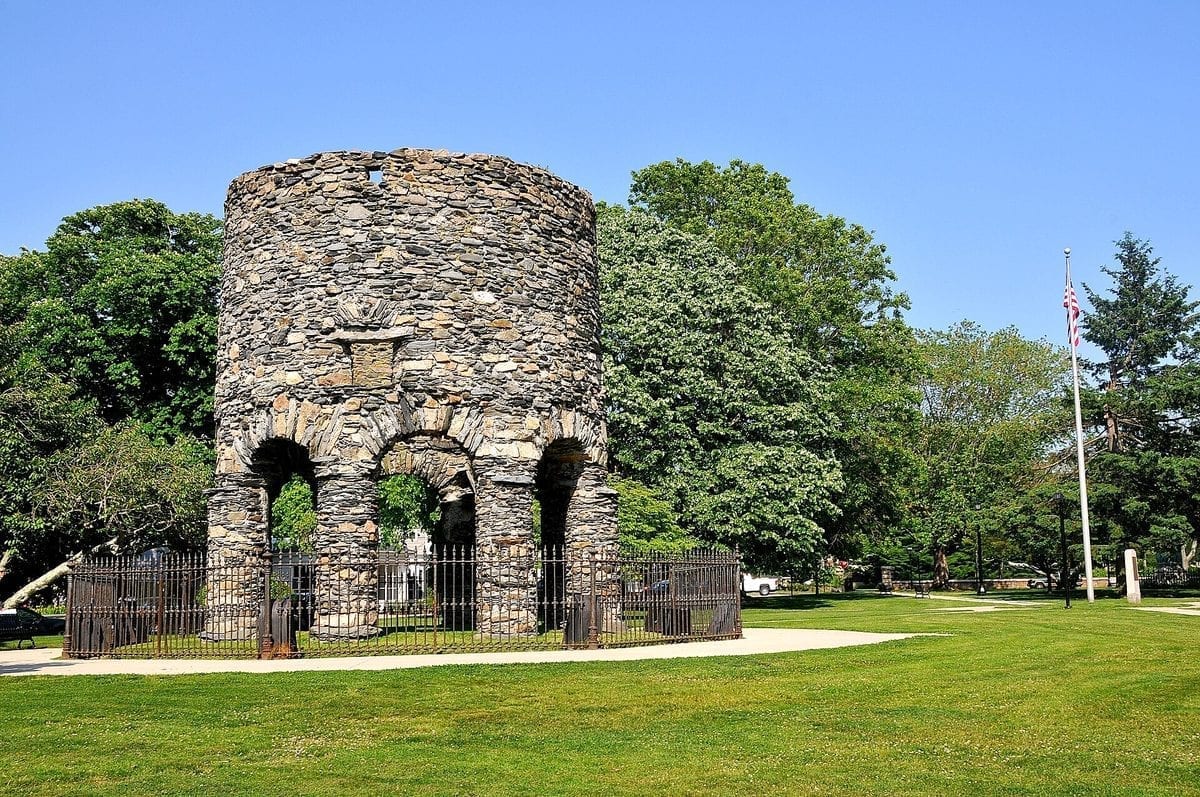
That the Newport Tower was not built as a colonial windmill in the 1600s but was raised centuries earlier by pre-Columbian visitors, most often identified as Norse or Viking explorers or as Knights Templar led by the Scottish earl Henry Sinclair, and that its round form, arcaded base, and solar alignments betray a medieval European rather than an English colonial hand.
The documented structure is a round stone tower in Touro Park, Newport, known for centuries as the Old Stone Mill. A 1677 will refers to a stone-built windmill on the site; a two-year archaeological excavation in 1948 to 1949 recovered only 17th-century colonial material and nothing older; and 1993 radiocarbon dating of the mortar returned a construction window of roughly 1635 to 1698. The rated claim is different: that the tower was raised by Norse voyagers or fugitive Knights Templar a century or more before Columbus. That claim runs against the physical evidence and has been graded from disputed to debunked by mainstream archaeology. A handful of unresolved architectural and astronomical curiosities keep a fringe of the debate alive.
Believed by: A durable niche of amateur diffusionists, Norse-in-America enthusiasts, and Sinclair-Templar theorists, amplified by cable television specials; academic archaeologists and historians overwhelmingly reject the pre-Columbian readings
The full story
What is documented
In Touro Park in the middle of Newport, Rhode Island stands a round stone tower, roughly twenty-eight feet tall, raised on eight columns joined by round arches. It has no roof and no floors, only the shell. For most of its recorded life the townspeople had a plain name for it: the Old Stone Mill.
The documentary trail is short but pointed. In his 1677 will, Governor Benedict Arnold of Rhode Island, an ancestor of the later traitor, referred to his stone-built windmillon the Newport property and set his burying ground between that mill and his house. The land is the land the tower stands on. The tower's design, a stone body carried on an arcade of arches, matches 17th-century English tower windmills, most famously the Chesterton Windmill in Warwickshire, built in 1632 to 1633.
Two later investigations tested the building rather than the paperwork. A two-year archaeological excavation in 1948 to 1949, run under Harvard's Hugh Hencken with William Godfrey directing the fieldwork, trenched the tower inside and out and recovered about 1,600 objects, all consistent with 17th-century English colonial life and none of them older. Colonial material sat in the very trench dug to lay the foundation. Then in 1993, samples of the mortar were drilled out for radiocarbon dating, returning a construction window of roughly 1635 to 1698. The question this file weighs, then, is not whether a stone tower stands in Newport. It is whether the far larger claim attached to it, that Norse voyagers or Knights Templar built it before Columbus, has anything behind it beyond its own romance.
The case people make
The pre-Columbian case is not built on nothing, and it is worth stating in its strongest form. The tower genuinely does not look like an ordinary colonial windmill. New England's 17th-century mills were overwhelmingly wooden, cheap and quick to raise; a costly round tower on a stone arcade, roofless and open, is an unusual thing for a small colonial settlement to have left behind.
Believers point to the round arcaded form itself, which they read as medieval European, reminiscent of round churches and towers of the Norse and Templar worlds. They note that no colonial document describes anyone actually building the structure, only later references to a mill already standing. And they cite a solar effect: around the winter solstice, light passing through the windows is said to strike a particular interior stone, which they take as evidence of a sophisticated builder who aligned the tower to the heavens.
The Norse version descends from serious 19th-century antiquarianism. In 1837 the Danish scholar Carl Christian Rafn marshaled the sagas as records of real voyages and named the tower a Norse relic; Longfellow gave the idea wings in verse. The Templar version, later and more elaborate, ties the tower to Henry Sinclair, Earl of Orkney, and a supposed voyage to New England a century before Columbus.
An odd round tower, no colonist's account of its raising, and a beam of solstice light: the impulse to ask whether it is older than the colony is not, by itself, the error. The error is the specific answer supplied before the evidence was in.
That is the honest core of the case: an unusual building, a thin colonial paper trail, and a few real curiosities that invite a second look.
Where the claim breaks down
A second look is fair. The trouble is that when the tower is actually examined, every physical line of evidence lands in the same century, and it is not a medieval one.
Start with the ground. The 1948 to 1949 excavation was not inconclusive; it was decisive. Around 1,600 artifacts came up, North Devon and other English colonial pottery, clay pipe stems, window glass, iron nails, and colonial material lay in the construction trench cut for the foundation itself. If Norsemen or Templars had raised the tower centuries earlier, their building layer would sit beneath the colonial one. It does not exist. Nothing pre-Columbian was found at all.
Add the mortar. The 1993 radiocarbon program placed construction at roughly 1635 to 1698, centered near 1680. Skeptics are right that mortar dating can be fooled by old limestone carbon or by later repairs, and that caveat is recorded below as a genuine open question. But the dates did not come back medieval and get explained away; they came back colonial, in agreement with the artifacts and the documents.
Then the form. The round arcaded base is not a Norse fingerprint; it is how a tower windmill works. The Chesterton Windmill in Warwickshire, built as a mill in the 1630s, sits on the same ring of stone arches, and Rex Wailes, the foremost English windmill authority, judged both buildings to have been raised as mills. The solstice alignment, finally, is the weakest pillar: a round building pierced by several windows will throw light on something on any given day, and picking out one flattering beam after the fact proves nothing about who built it or when. Motive and mood carry the pre-Columbian story; the physical evidence does not.
The pull of a deeper past
It is worth asking why this building, more than any other colonial ruin, keeps attracting Vikings and Templars. The answer says more about the audience than about the stones.
The tower feeds a durable appetite for a deeper American antiquity. A colonial grain mill is a modest thing; a medieval European monument on New England soil promises a longer, grander lineage, and diffusionist theories that put Old World explorers in America before Columbus have never lacked an eager readership. Rafn and Longfellow handed that appetite a ready-made legend in the 1830s and 1840s, and a myth with literary momentum is far stickier than an archaeological report.
The Templar layer adds the glamour of a global secret. Henry Sinclair, hidden treasure, suppressed knowledge, a voyage before Columbus: it is a familiar and marketable shape, and popular books and television specials have kept it circulating long after scholars set it aside. Once a place is famous for being mysterious, the mystery becomes the attraction, and each debunking is absorbed as one more thing they want you to believe.
A windmill is a fact; a Norse watchtower is a story. When a plain explanation and a thrilling one compete for the same ruin, the thrilling one draws the crowd, whatever the trench says.
The honest loose ends
Rating the pre-Columbian claim as weak does not mean pretending every detail is buttoned down. A few real threads remain, and naming them is what keeps this a fair reading rather than a dismissal.
Mortar radiocarbon dating is genuinely delicate, and at least one published analysis has questioned how the Newport results were interpreted. The tower's proportions differ in places from the closest English mill parallels, and no colonial writer left an account of the actual raising of the structure, only later references to a mill already there. And the solstice light effect has not, as far as the record shows, been rigorously tested against what random window placement alone would produce.
None of these gaps points to Vikings or Templars. They point to the ordinary incompleteness of the record around a 350-year-old building. A modern, multi-laboratory redating of the mortar and a rigorous test of the alignment claims would close most of them, and the honest expectation, given three converging lines of evidence, is that they would confirm the colonial date rather than overturn it.
A colonial mill, not a Norse church
Hold the two claims apart. That an unusual stone tower in Newport invites curiosity is beyond dispute, and a few of its details are genuinely unresolved. But the specific rated claim, that the Newport Tower is a pre-Columbian Norse or Templar structure, is contradicted by the physical record. Excavation found only colonial material, including in the foundation trench; radiocarbon dated the mortar to roughly 1635 to 1698; the design matches 17th-century English tower windmills; and a 1677 will calls the building on that land a stone windmill.
This is not a verdict against wonder or against asking hard questions of a strange old ruin. It is a refusal to let a stirring legend outrank a foundation trench full of colonial pottery. A round stone windmill, raised by English colonists in the 1600s and remembered by them as the Old Stone Mill, is a smaller story than a Viking watchtower or a Templar stronghold. It has the advantage of being the one the ground, the mortar, and the archive all tell.
What's still unexplained
- Mortar radiocarbon dating remains methodologically delicate, and at least one published critique has questioned how the Newport samples were interpreted; a fresh, multi-laboratory redating with modern protocols would put the remaining doubt to rest.
- The tower's exact dimensions and some construction details differ from the closest English mill parallels, and no colonial account describes the actual raising of the structure, leaving a small documentary gap that fringe readings exploit.
- The reported solstice light effect has not been rigorously tested against what random window placement would produce, so whether any alignment is intentional or coincidental is still, strictly speaking, unquantified.
Point by point
The claim: The tower's round shape, arched arcade, and stone construction are medieval European, unlike anything colonial New England built.
What the record shows: The form has a close colonial parallel. English tower windmills of the 17th century, notably the Chesterton Windmill in Warwickshire (built 1632 to 1633), sit on an arcade of stone arches much like Newport's. Rex Wailes, the leading English authority on windmills, judged both structures to have been built as mills. A round arcaded base is what lets a post-supported mill mechanism turn to the wind; it is a functional windmill feature, not a Norse signature.
The claim: No colonial document proves the tower is Arnold's windmill, so its origin is genuinely unknown.
What the record shows: Benedict Arnold's 1677 will refers to his stone-built windmill on the very land where the tower stands, with his burying ground set between the mill and his house. Combined with the colonists' own name for it, the Old Stone Mill, the documentary trail points to a 17th-century mill, not an unrecorded medieval monument that somehow left no colonial mention of its builders.
The claim: If the tower were colonial, excavation would have proven it; instead the digs were inconclusive.
What the record shows: The 1948 to 1949 excavation was decisive in the other direction. It recovered around 1,600 artifacts, including North Devon and other English colonial pottery, clay pipe stems, window glass, and iron nails, and crucially found 17th-century material in the construction trench cut for the foundation itself. Not a single pre-Columbian object turned up. The stratigraphy dates the building to the colonial era, not before it.
The claim: Radiocarbon dating of stone mortar is unreliable, so the colonial dates can be dismissed.
What the record shows: Mortar dating has real pitfalls, chiefly contamination by old carbon from limestone or by later repointing, and skeptics of the colonial date have pressed exactly those points. But the 1993 program used multiple samples and yielded a coherent 17th-century window of about 1635 to 1698, consistent with the archaeology and the documentary record rather than contradicting them. Three independent lines, artifacts, documents, and radiocarbon, converge on the same century.
The claim: The tower's windows align with the sun on the solstices and with stars, proof of a sophisticated pre-Columbian observatory.
What the record shows: A round building with several openings will inevitably produce some light-and-shadow effects, and observers note a beam reaching an interior stone around the winter solstice. But such alignments are easy to find after the fact in any structure with multiple windows, and critics regard the claimed patterns as selection from chance. No astronomical alignment establishes a builder or a date; the physical dating evidence does, and it says 17th century.
Timeline
- 1677Governor Benedict Arnold of Rhode Island, in his will, refers to his stone-built windmill on the Newport property. The reference is generally taken to describe the tower, and colonists thereafter know the structure as the Old Stone Mill.
- 1837Danish antiquarian Carl Christian Rafn, in Antiquitates Americanae, argues that Norse sagas describe real voyages to North America and cites the Newport Tower, sight unseen, as a surviving Norse building. The idea launches the tower's alternate history.
- 1841Henry Wadsworth Longfellow publishes The Skeleton in Armor, a poem tying a Norse warrior to the tower. The romantic Viking association enters popular culture and spreads far beyond scholarship.
- 1848The Rev. Dr. Jackson of Newport collects mortar samples from the tower and from the town's oldest known colonial buildings. He finds them of very similar composition, shell lime, sand, and gravel, an early hint that the tower belongs with the colonial structures.
- 1948-1949A two-year excavation sponsored by the Society for American Archaeology, overseen by Hugh Hencken of Harvard and directed in the field by William S. Godfrey, trenches the tower inside and out. It recovers roughly 1,600 items, all consistent with 17th-century English colonial occupation, and nothing pre-Columbian. Colonial-era artifacts are found in the builder's trench beneath the foundation.
- 1951Godfrey's Harvard doctoral dissertation concludes the tower was built by Benedict Arnold in the mid-17th century and finds no archaeological support for a Norse origin. The windmill interpretation becomes the scholarly consensus.
- 1992Former British intelligence officer and writer Andrew Sinclair, in The Sword and the Grail, advances the claim that the tower was built by medieval Scottish Templars connected to Henry Sinclair, Earl of Orkney. The Templar version, later boosted by other popular authors, competes with the older Norse story.
- 1993A team drills mortar from the tower's columns for radiocarbon dating. The results, published in the mid-1990s, place the mortar's carbonation, and thus construction, at roughly 1635 to 1698 at 95 percent confidence, centered near 1680, squarely in the colonial period.
The documented structure is a round stone tower in Touro Park, Newport, known for centuries as the Old Stone Mill. A 1677 will refers to a stone-built windmill on the site; a two-year archaeological excavation in 1948 to 1949 recovered only 17th-century colonial material and nothing older; and 1993 radiocarbon dating of the mortar returned a construction window of roughly 1635 to 1698. The rated claim is different: that the tower was raised by Norse voyagers or fugitive Knights Templar a century or more before Columbus. That claim runs against the physical evidence and has been graded from disputed to debunked by mainstream archaeology. A handful of unresolved architectural and astronomical curiosities keep a fringe of the debate alive.
Reviewed by Colin Peterson · Last reviewed July 8, 2026 · How we rate
Common questions
Is Newport Tower true?
The documented structure is a round stone tower in Touro Park, Newport, known for centuries as the Old Stone Mill. A 1677 will refers to a stone-built windmill on the site; a two-year archaeological excavation in 1948 to 1949 recovered only 17th-century colonial material and nothing older; and 1993 radiocarbon dating of the mortar returned a construction window of roughly 1635 to 1698. The rated claim is different: that the tower was raised by Norse voyagers or fugitive Knights Templar a century or more before Columbus. That claim runs against the physical evidence and has been graded from disputed to debunked by mainstream archaeology. A handful of unresolved architectural and astronomical curiosities keep a fringe of the debate alive.
What is Newport Tower?
In a small park in Newport, Rhode Island stands a round stone tower on eight arched columns, roofless and floorless, its purpose obvious enough to the colonists who called it the Old Stone Mill and puzzling enough to everyone since. Governor Benedict Arnold, an ancestor of the traitor of the same name, referred to a stone-built windmill…
What does the evidence show?
The form has a close colonial parallel. English tower windmills of the 17th century, notably the Chesterton Windmill in Warwickshire (built 1632 to 1633), sit on an arcade of stone arches much like Newport's. Rex Wailes, the leading English authority on windmills, judged both structures to have been built as mills. A round arcaded base i…
Why do people believe it?
The tower genuinely is odd. It is roofless, floorless, and unlike the ordinary frame windmills of colonial New England, so the instinct that it demands a special explanation is understandable even though the special explanation does not survive the evidence.
What is still unresolved?
Mortar radiocarbon dating remains methodologically delicate, and at least one published critique has questioned how the Newport samples were interpreted; a fresh, multi-laboratory redating with modern protocols would put the remaining doubt to rest.
Sources
- 1.Newport Tower (Rhode Island), Wikipedia (2026)
- 2.Dating Ancient Mortar, American Scientist (2003)
- 3.On the Carbon-14 Analyses of Mortar from the Newport Tower: Theoretical Considerations, Newport History (Salve Regina University Digital Commons) (2000)
- 4.The Newport Tower: Not a 12th-Century Baptistery, Archaeology Review (Carl Feagans) (2025)
- 5.A Closer Look at the Mysterious Newport Tower, Rhode Island Monthly (2019)
- 6.Newport Tower, Atlas Obscura (2020)
- 7.The Newport Tower, New England (Yankee Magazine) (2016)
- 8.Mysterious Newport Tower shines bright on Winter Solstice, WPRI 12 News (2021)
Embed this case file on your site
Paste this snippet to show this case file as a small card, with a link back to the full write-up. Free to use.
<iframe src="https://theconspiratory.com/embed/newport-tower" title="The Conspiratory verdict" width="520" height="190" style="border:0;max-width:100%" loading="lazy"></iframe>Help us investigate
This is a living case file. If you spot an error or know evidence we missed, tell us, and weigh in on where you land.
Where do you land?
Cast your read on this one.
Comments
Add your take. Comments are read and approved by a human before they appear, so keep it on topic and civil. Please do not accuse named, living people of crimes.