The 2022 Nord Stream pipeline blasts were a covert state sabotage operation whose real perpetrator is being concealed
By Colin PetersonJuly 12, 2026
Where the evidence lands →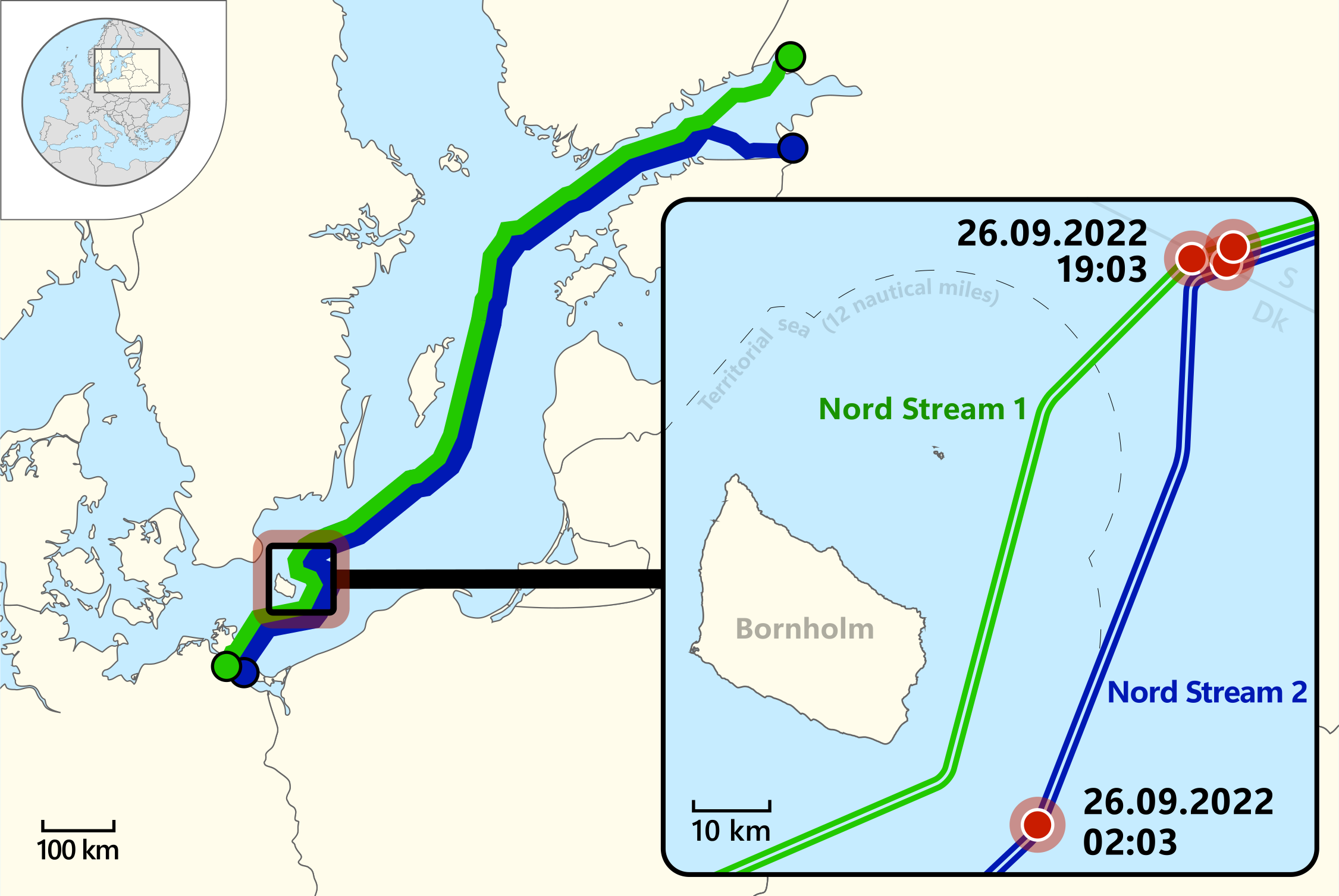
That the destruction of the Nord Stream pipelines was a covert operation carried out or directed by a state actor, and that the identity of the true perpetrator is being deliberately concealed or misdirected by governments and investigators. Competing versions name a pro-Ukrainian group or the Ukrainian state, the Russian state acting against its own infrastructure as a false flag, or the United States (with Norwegian help), each presented by its adherents as the hidden hand behind the blasts.
That the pipelines were deliberately sabotaged is not in dispute: Swedish, Danish and German investigators all found traces of explosives and concluded the blasts were an intentional attack, not an accident. What remains genuinely open is who did it, and whether the truth is being managed. Rival state-actor theories point at Ukraine, Russia and the United States, and each rests more on motive and circumstance than on proof. German prosecutors have pursued a pro-Ukrainian line and charged a Ukrainian national, but a charge is an allegation, not a conviction, and no one has been found guilty.
Believed by: A broad international audience; the “blame the US” version is promoted heavily by Russian officials and state media and by parts of the Western anti-interventionist left, while mainstream European coverage has increasingly centred on a Ukrainian operation
The full story
What is not in doubt
Begin with the part of this story that is settled, because it is unusually solid and it frames everything that follows. In the small hours of 26 September 2022, underwater explosions ruptured the Nord Stream 1 and Nord Stream 2 gas pipelines on the floor of the Baltic Sea, near the Danish island of Bornholm. Seismographs across the region registered two distinct events with the sharp signature of detonations rather than earthquakes. For days afterward, methane churned to the surface in wide boiling patches visible from the air. Three of the four pipeline strings were destroyed.
Within days, Denmark and Sweden jointly told the UN Security Council that the leaks had been caused by detonations equivalent to several hundred kilograms of explosives. In November 2022, Swedish prosecutors confirmed that analysis of material recovered from the seabed had turned up traces of explosives. When Denmark closed its own investigation more than a year later, it repeated the same conclusion in plain language: this was deliberate sabotage. No serious investigator has argued otherwise.
So the question this file weighs is not whether the pipelines were attacked. They were. The question is who did it, and whether the answer is being concealed. That is a genuinely open problem, and it is worth being honest that more than three years on, no person has been convicted and no state has been proven responsible. The most consequential act of infrastructure sabotage in recent European history is, formally, unsolved.
Three suspects, three motives
The reason a conspiracy took hold here so fast is that every plausible culprit had a plausible reason, and the vacuum where an answer should have been filled with rival stories almost immediately. Steelmanning them honestly means noticing that none is absurd.
The United States. In February 2023 the veteran investigative journalist Seymour Hershpublished a detailed account claiming that US Navy divers, working with Norway, had planted the charges under cover of a NATO exercise months earlier and detonated them remotely. The story landed on fertile ground: Washington had openly favoured ending Europe's reliance on Russian gas, and a US president had said, before the war, that if Russia invaded, “there will no longer be a Nord Stream 2.” For audiences already suspicious of American power, means and motive seemed to line up.
Russia. Others proposed a false flag: that Moscow destroyed its own pipelines to rattle European energy markets, sow division, and let the blame fall on the West. Russia had the naval and diving capability, and it had already weaponised the gas flow by throttling and then halting Nord Stream 1. Whether wrecking a dormant but potentially valuable asset served Russian interests is exactly the objection critics raise, but as a hypothesis it was never unthinkable.
Ukraine, or a pro-Ukrainian group. In March 2023, reporting in the United States and Germany pointed a third way: new intelligence suggested a pro-Ukrainian team, operating from a chartered sailing yacht, the Andromeda, rented through a Poland-based company by people carrying forged passports. Ukraine had the clearest motive of all, severing the pipelines would lock Europe out of buying Russian gas and starve Moscow of future revenue, and over the following years this became the trail investigators actually followed.
Someone blew up critical infrastructure in the middle of a war, and years later no state has answered for it. The suspicion that a powerful actor is getting away with something is not, by itself, paranoid.
That is the honest case for treating this as more than idle rumour. The act was real, the perpetrator was a capable actor who has not been named with certainty, and each candidate had a motive a reasonable person could credit. The conspiracy claim goes further, that the truth is known and hidden, and that is where the evidence has to be examined rather than assumed.
Where the evidence actually points
Sorting the theories by evidence rather than by motive changes the picture. Motive is cheap; everyone in this story had one. Proof is what is scarce, and it is distributed very unevenly across the three suspects.
The US-did-itversion, for all its reach, rests on a single anonymous source. Hersh's report has not been corroborated by documents, by a second on-the-record source, or by any official finding in the years since. The White House called it “complete fiction,” the CIA called it “completely and utterly false,” and Norway denied involvement. Denials from accused parties prove nothing on their own, but the absence of any corroborating evidence, after years of intense scrutiny, is telling. A strong motive and a plausible mechanism are not a case; they are the beginning of one, and this one never advanced past its first source.
The Russian false flag theory is in a similar position: aired, arguable, and unproven. No official investigation has produced evidence tying the blasts to Russia, and the strategic logic is genuinely contested, since Russia already controlled whether the gas flowed and gained little concrete from destroying the hardware.
The Ukrainian trail is the outlier, because it is the one that accumulated actual investigative material. German prosecutors traced the Andromeda charter, examined forged documents, reported explosive residue aboard, issued a European arrest warrant for a Ukrainian diving instructor in 2024, secured the arrest of a second Ukrainian, a former army officer, in Italy in 2025, and in July 2026 brought formal charges alleging a Ukrainian team carried out the operation. That is a real evidentiary trail, and it is why this file treats the Ukrainian hypothesis as the best-supported of the three.
But best-supported is not the same as proven, and the presumption of innocence matters here more than anywhere. A charge is an allegation a court has yet to test. The accused, identified in German filings only by initials, denies involvement and has raised a claim of state immunity; Kyiv denies having ordered any attack; and prosecutors have not publicly established who authorised the operation, if anyone in a position of state authority did. No individual named in this case has been convicted of anything, and this file names none as guilty. The careful reading is that attribution points toward a Ukrainian operation without yet resting on a proven one.
The cover-up question
The conspiracy claim is not only about who did it. Its sharper edge is the assertion that the truth is known and hidden, that investigators found the answer and governments chose to bury it. This is where the theory is most seductive and least supported.
What actually happened looks less like a coordinated hush than a jurisdictional tangle. The blasts occurred in international waters near the overlapping economic zones of several states, so three separate national investigations ran in parallel, sharing material unevenly. Sweden closed its case in February 2024, citing a lack of jurisdiction and finding no Swedish involvement, and passed its evidence to Germany. Denmark closed weeks later, affirming that the attack was deliberate but concluding there were insufficient grounds to bring a Danish criminal case. Germany did not close; it kept going, and it is the German process that produced the arrest warrants and charges.
That is not the shape a cover-up usually takes. A country genuinely suppressing the answer does not keep a live prosecution running, issue international arrest warrants, and let the suspect trail be reported around the world. The Ukrainian lead, supposedly the one being buried to protect an ally, was in fact the one investigators publicly pursued hardest.
The failed UN vote is read the same suspicious way, and it too has a duller explanation. In March 2023 Russia put forward a resolution for an independent international commission. It did not fail because the West vetoed it; it fell short of the nine votes needed, drawing three in favour and twelve abstentions. Western states argued the national investigations should be allowed to finish before a parallel UN body was created. One can find that convenient, but a procedural failure to reach a threshold is not the same as a great power smothering the truth.
Closed files and official silence are hard to tell apart from concealment. But a jurisdictional mess between distrustful governments explains the record at least as well as a hidden hand.
Why it persists
A theory this durable usually survives on more than error, and this one does. It persists because its foundation is true and its central grievance is legitimate: a spectacular crime was committed and no one has answered for it. When the real state of affairs is “unsolved and unpunished,” the distance to “solved and covered up” feels short, even though they are very different claims.
It persists, too, because it is a mirror. A story with three credible suspects lets each audience select the villain that flatters its worldview. Anti-American readers keep the Hersh version; hawks toward Moscow keep the false flag; and because every candidate really did have a motive, each camp can wave at a genuine strategic interest and call it a smoking gun. A theory that can be all things to all people rarely dies.
State information operations poured fuel on this. Russian officials and state media promoted the US-blame narrative with the full resources of a government, which is why one particular attribution, the least evidenced of the three, achieved a visibility wildly out of proportion to its support. When a nation-state amplifies a theory, that theory travels regardless of what the evidence says.
And the official process gave suspicion real material to work with. Closed investigations, sealed files, a probe conducted in deliberate secrecy, a rejected international inquiry: to an outsider these are hard to distinguish from concealment, because concealment would look exactly like this. The theory feeds on the gap between what governments know and what they have been willing to say, and that gap is real even if the sinister interpretation of it is not established.
Sabotage certain, culprit unknown
Two things are true at once, and the discipline of this case is refusing to collapse them. The sabotage is a fact: the Nord Stream pipelines were deliberately destroyed by explosives, a finding shared by Swedish, Danish and German investigators alike. The attribution is not settled: no state has been shown responsible, and no individual has been convicted.
The possibilities can still be ordered by evidence rather than by motive. The German investigation has assembled a real trail pointing toward a Ukrainian operation, and that is the best-supported hypothesis on the table, but a charge is an allegation a court has still to weigh, and the question of who, if anyone, gave a state order is exactly what remains unanswered. The claim that the United States did it rests on a single anonymous source and has never been corroborated. The Russian false flag remains a live possibility without evidence behind it.
The cover-up framing, finally, asks more of the record than the record supports. What the theory reads as suppression, closed cases, secret files, a failed UN vote, is at least as well explained by three distrustful governments investigating an attack in shared waters and reaching the limits of their jurisdiction. The proper stance is to hold the open question open: to insist that a serious crime deserves a named and proven answer, and to refuse to supply that answer ahead of the evidence, whichever government it might implicate.
What's still unexplained
- Who actually ordered the operation remains unresolved. German prosecutors have charged individuals and pointed to a Ukrainian team, but the question of state authorization, whether anyone in a government directed it, is precisely what a trial would have to test and what remains unproven.
- The physical execution is still debated. Whether a small crew on a leisure yacht could realistically have placed and detonated hundreds of kilograms of explosives at depth, without state-level logistics, is contested by naval and diving experts, and the yacht trail's authenticity has itself been questioned as a possible plant.
- The intelligence picture is opaque. Reports that Western services had advance warning of an attack plan, and that Germany's probe was slowed by diplomatic sensitivities, have never been fully explained on the record, leaving room for reasonable suspicion about how much was known and when.
- Why three national investigations produced such uneven public accounts, with Sweden and Denmark closing without charges while Germany pressed on, is only partly explained by jurisdiction, and the gaps keep the concealment question alive for those inclined to distrust the official story.
Point by point
The claim: The explosions were sabotage, not an accident or a technical failure.
What the record shows: This part is established, and it is the one thing all sides agree on. Seismic stations recorded discrete blast events; Denmark and Sweden told the UN the damage came from detonations of several hundred kilograms of explosives; and Swedish, Danish and German investigators independently found traces of explosives at the scene. The Danish police, on closing their probe, stated plainly that it was deliberate sabotage. The open question is attribution, not whether a bomb went off.
The claim: The United States destroyed the pipelines, using Navy divers and Norwegian help, and is covering it up.
What the record shows: This is the version associated with Seymour Hersh's February 2023 report, and it remains unproven. Hersh's account rests on a single unnamed source and has not been corroborated by any documentary evidence or second sourcing that has entered the public record. The White House, the CIA and Norway all denied it. The United States plainly had a stated strategic interest in ending European dependence on Russian gas, which is why the theory resonates, but motive and opportunity are not the same as proof, and none has surfaced.
The claim: A Ukrainian operation did it, and Western governments quietly buried that fact to protect an ally.
What the record shows: German investigators genuinely pursued this line, and by 2024-2026 it was the most evidence-backed of the theories: a chartered yacht, forged passports, explosive residue, arrest warrants and, in July 2026, formal charges against a Ukrainian national. But charges are allegations tested in court, not convictions. The accused denies involvement and has raised a claim of state immunity; Kyiv denies ordering any attack; and prosecutors have not established who, if anyone, gave the order. Far from being buried, this trail was reported worldwide, which cuts against the “concealment” framing.
The claim: Russia blew up its own pipelines as a false flag, to spook European energy markets and pin the blame on the West.
What the record shows: A real hypothesis that was aired early, and also unproven. Skeptics note that Russia controlled the flow anyway (it had already throttled and then halted Nord Stream 1) and gained little concrete from destroying an asset it might later have switched back on, while a state with divers and naval reach could plausibly stage such an attack. No official investigation has produced evidence tying the blasts to Russia, and Russia denies responsibility. It sits alongside the others as a live but unsubstantiated possibility.
The claim: The refusal to run a single, open international investigation proves a cover-up.
What the record shows: It proves jurisdictional mess and geopolitical distrust more than concealment. The blasts happened in international waters near several states' zones, so three national probes ran in parallel and shared material unevenly. Russia's push for a UN-led inquiry failed at the Security Council, but it fell short on abstentions rather than being vetoed, and Western states argued the national investigations should be allowed to finish. That is a weaker and more mundane explanation than a coordinated hush, and it fits the facts at least as well.
Timeline
- 2022-09-26A series of underwater explosions ruptures three of the four Nord Stream pipeline strings in the Baltic Sea near Bornholm, inside the exclusive economic zones of Denmark and Sweden but in international waters. Danish seismographs register two events, at roughly 02:03 and 19:03 local time, with signatures typical of detonations rather than earthquakes. Gas leaks bubble to the surface for days.
- 2022-09-30Denmark and Sweden jointly inform the UN Security Council that the leaks were caused by at least two detonations involving explosives equivalent to several hundred kilograms of TNT. The incident is treated from the outset as sabotage.
- 2022-11-18Swedish prosecutors announce that analysis of material recovered from the seabed found traces of explosives, formally confirming that the pipelines were the target of gross sabotage.
- 2023-02-08Investigative journalist Seymour Hersh publishes a self-authored report alleging that US Navy divers, aided by Norway, planted the explosives under cover of the June 2022 BALTOPS naval exercise and detonated them months later. He relies on a single anonymous source. The White House calls it “complete fiction”; the CIA calls it “completely and utterly false”; Norway denies any role.
- 2023-03-07The New York Times reports that new intelligence reviewed by US officials suggests a pro-Ukrainian group carried out the attack. German outlets describe a chartered sailing yacht, the Andromeda, rented via a Poland-based company by people using forged passports, with explosive residue reportedly found aboard. Officials caution the yacht trail could itself be a false flag.
- 2023-03-27The UN Security Council rejects a Russian-drafted resolution that would have set up an independent international investigation. The vote is 3 in favour (Brazil, China, Russia) to none against, with 12 abstentions, short of the nine needed to pass. Russia says it doubts the transparency of the national probes.
- 2024-02Sweden closes its investigation on 7 February, citing a lack of jurisdiction and finding no Swedish involvement, and hands its material to Germany. Denmark closes its investigation on 26 February, concluding the blasts were deliberate sabotage but that there were insufficient grounds for a criminal case. Germany's investigation continues.
- 2024-2026Germany's Federal Public Prosecutor pursues a pro-Ukrainian trail. A European arrest warrant is issued in 2024 for a Ukrainian diving instructor; a second Ukrainian, a former army officer, is arrested in Italy in August 2025 and extradited to Germany. In July 2026 German prosecutors bring charges, alleging the operation was mounted by a Ukrainian team. The accused denies involvement, and Kyiv denies ordering any attack.
From the case file
The actual records: declassified, released, or leaked. We link straight to each document in its official archive, so you never have to take our word for it. Read the originals yourself.
The prosecutor closes the Swedish investigation concerning gross sabotage against Nord Stream
The official statement in which Sweden closed its criminal investigation into the Nord Stream blasts. It confirms the incident was gross sabotage, explains that Swedish jurisdiction did not apply because the attack occurred in international waters with no established Swedish involvement, and notes that the collected material was handed to German investigators.
Read the document: Swedish Prosecution Authority →Security Council Rejects Draft Resolution Establishing Commission to Investigate Sabotage of Nord Stream Pipeline (SC/15243)
The official UN meetings-coverage record of the 27 March 2023 vote on a Russian-drafted resolution to create an independent international investigation. The Council rejected it, 3 in favour to none against with 12 abstentions, short of the nine votes required. The record captures the competing arguments about the transparency of the national probes.
Read the document: United Nations →That the pipelines were deliberately sabotaged is not in dispute: Swedish, Danish and German investigators all found traces of explosives and concluded the blasts were an intentional attack, not an accident. What remains genuinely open is who did it, and whether the truth is being managed. Rival state-actor theories point at Ukraine, Russia and the United States, and each rests more on motive and circumstance than on proof. German prosecutors have pursued a pro-Ukrainian line and charged a Ukrainian national, but a charge is an allegation, not a conviction, and no one has been found guilty.
Reviewed by Colin Peterson · Last reviewed July 12, 2026 · How we rate
Common questions
Is Nord Stream sabotage true?
That the pipelines were deliberately sabotaged is not in dispute: Swedish, Danish and German investigators all found traces of explosives and concluded the blasts were an intentional attack, not an accident. What remains genuinely open is who did it, and whether the truth is being managed. Rival state-actor theories point at Ukraine, Russia and the United States, and each rests more on motive and circumstance than on proof. German prosecutors have pursued a pro-Ukrainian line and charged a Ukrainian national, but a charge is an allegation, not a conviction, and no one has been found guilty.
What is Nord Stream sabotage?
In the early hours of 26 September 2022, underwater explosions tore open the Nord Stream 1 and Nord Stream 2 gas pipelines beneath the Baltic Sea near the Danish island of Bornholm. Seismographs recorded the blasts, gas boiled to the surface for days, and investigators from three countries found residue of explosives. That it was deliber…
What does the evidence show?
This part is established, and it is the one thing all sides agree on. Seismic stations recorded discrete blast events; Denmark and Sweden told the UN the damage came from detonations of several hundred kilograms of explosives; and Swedish, Danish and German investigators independently found traces of explosives at the scene. The Danish p…
Why do people believe it?
The founding fact is real and dramatic. Someone really did blow up critical transnational infrastructure in the middle of a war, and no government has been held to account for it, so the sense that a powerful actor is getting away with something is not paranoid, it is close to accurate.
What is still unresolved?
Who actually ordered the operation remains unresolved. German prosecutors have charged individuals and pointed to a Ukrainian team, but the question of state authorization, whether anyone in a government directed it, is precisely what a trial would have to test and what remains unproven.
Sources
- 1.The prosecutor closes the Swedish investigation concerning gross sabotage against Nord Stream, Swedish Prosecution Authority (Åklagarmyndigheten) (2024)
- 2.Security Council Rejects Draft Resolution Establishing Commission to Investigate Sabotage of Nord Stream Pipeline (SC/15243), United Nations (Meetings Coverage and Press Releases) (2023)
- 3.Denmark's Nord Stream probe finds sabotage, not enough grounds for case, Al Jazeera (2024)
- 4.White House rejects report that US was behind Nord Stream sabotage, France 24 (Agence France-Presse) (2023)
- 5.Claim That US Blew up Nord Stream Pipelines Relies on Anonymous Source, Snopes (2023)
- 6.German prosecutors charge Ukrainian suspect over Nord Stream explosions, Al Jazeera (2026)
- 7.Ukrainian diver with alleged links to Nord Stream attack detained in Poland, Al Jazeera (2025)
- 8.Who sabotaged Nord Stream? 3 years on, investigations offer more questions than answers, The Kyiv Independent (2025)
- 9.Nord Stream pipelines sabotage, Wikipedia (2026)
Embed this case file on your site
Paste this snippet to show this case file as a small card, with a link back to the full write-up. Free to use.
<iframe src="https://theconspiratory.com/embed/nord-stream-sabotage" title="The Conspiratory verdict" width="520" height="190" style="border:0;max-width:100%" loading="lazy"></iframe>Help us investigate
This is a living case file. If you spot an error or know evidence we missed, tell us, and weigh in on where you land.
Where do you land?
Cast your read on this one.
Comments
Add your take. Comments are read and approved by a human before they appear, so keep it on topic and civil. Please do not accuse named, living people of crimes.