Piltdown Man was a genuine 'missing link' in human evolution, the earliest Englishman
By Colin PetersonJuly 18, 2026
Where the evidence lands: Contradicted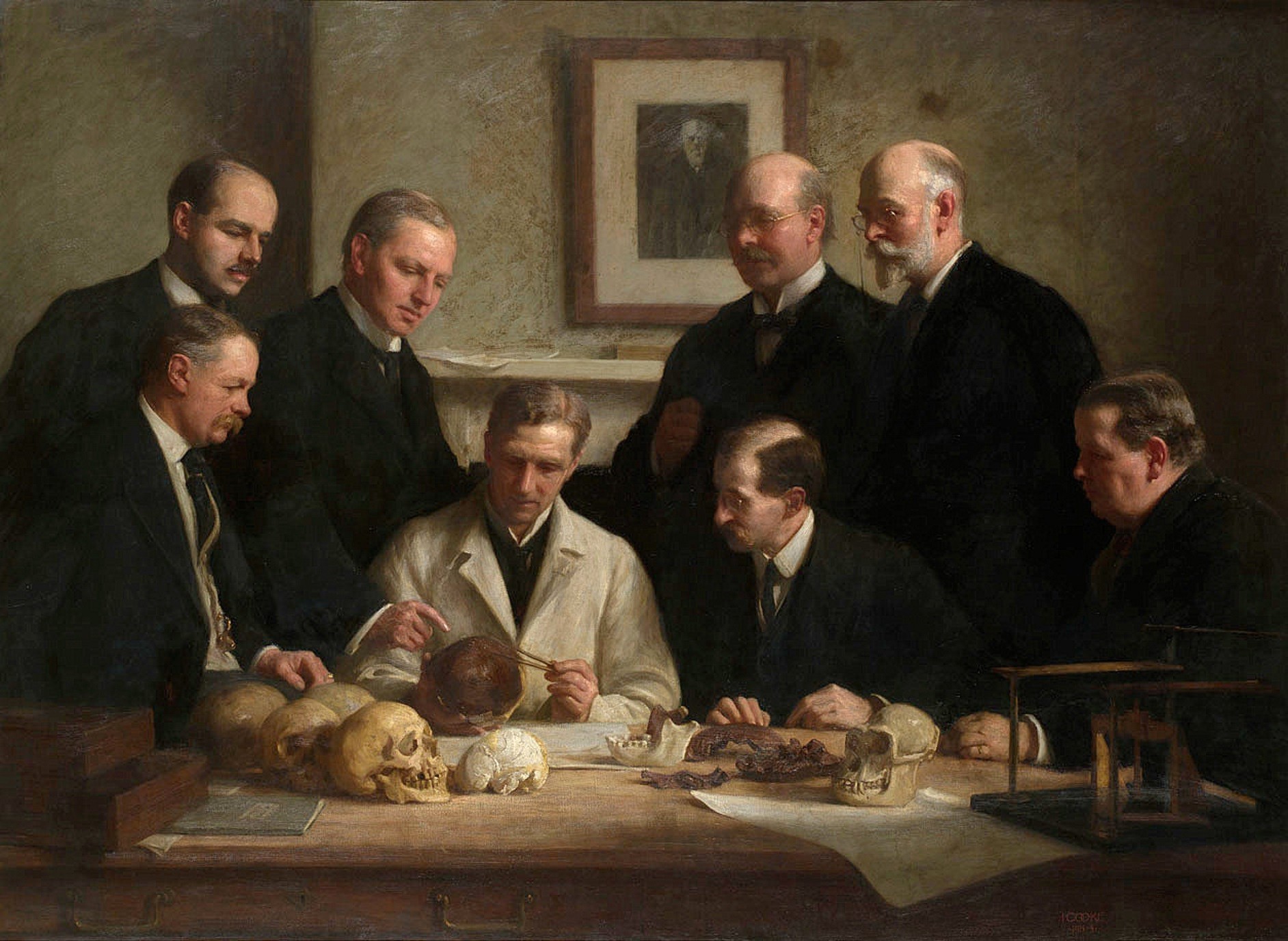
That fossil fragments recovered from a gravel pit at Piltdown, in Sussex, England, between 1912 and 1915 represented a genuine early human ancestor, named Eoanthropus dawsoni ('Dawson's dawn man'): a creature with a large, essentially human brain but a primitive, ape-like jaw, and therefore the long-sought 'missing link' proving that the human brain evolved before the rest of the human body.
Contradicted. Piltdown Man was a deliberate forgery, and it is the definitive case of one. In 1953 Joseph Weiner, Kenneth Oakley, and Wilfrid Le Gros Clark showed that the skull and jaw came from two different creatures: a few-centuries-old human braincase paired with the jaw and teeth of an orang-utan, chemically stained to look ancient, with the teeth filed down to fake human wear. A 2016 Royal Society Open Science study by Isabelle De Groote and colleagues used DNA and CT scanning to tie the ape material to a single orang-utan and a single, consistent forging method, pointing to the finds' discoverer, Charles Dawson, as the likely sole hoaxer. The fossil was never real. Rated debunked.
Believed by: Much of the British scientific establishment for four decades, including leading anatomists Arthur Smith Woodward, Grafton Elliot Smith, and Arthur Keith; taught as a real human ancestor into the 1950s
The full story
The first Englishman
In February 1912, an amateur collector named Charles Dawson wrote to his friend Arthur Smith Woodward, the Keeper of Geology at what was then the British Museum (Natural History) and is now the Natural History Museum in London. Dawson, a Sussex solicitor with a sideline in fossils and antiquities, said that workmen digging gravel at Barkham Manor, near the village of Piltdown in East Sussex, had turned up a piece of a strikingly thick, human-looking skull. Over that summer the two men, later joined by the young Jesuit palaeontologist Pierre Teilhard de Chardin, worked the pit and recovered more of the skull, a broken lower jaw, some worn teeth, crude stone tools, and the fossilised remains of extinct animals.
On 18 December 1912, before a crowded meeting of the Geological Society of London, Woodward unveiled the find and gave it a scientific name: Eoanthropus dawsoni, “Dawson's dawn man.” The reconstruction he presented was electrifying. Here was a creature with a large, essentially modern braincase joined to a primitive, ape-like jaw: apparently hard proof that the human line had grown its big brain first, long before it lost its animal face. For a British audience it was more than a scientific triumph. Continental Europe had its Neanderthals and Cro-Magnons; now England had its own ancient ancestor, older and, in the flattering reading, brainier than the rest.
The claim did not go unchallenged. A few anatomists said the obvious thing: that a human skull and an ape's jaw had simply been found near each other and did not belong to one animal. But the doubts were blunted, first by a canine tooth recovered in 1913 whose flat wear seemed to bridge the two, and then decisively by Piltdown II, a second set of fragments Dawson reported in 1915 from a site a couple of miles away. That a similar skull-and-jaw combination should turn up twice, at two separate places, seemed to settle the matter. When Dawson died in 1916, the fossils that had made his name stopped appearing, and Eoanthropus took its place in the textbooks as a genuine human ancestor.
Why careful people believed
It is tempting to treat forty years of belief as a mass failure of intelligence. That is too easy, and it misses the more unsettling lesson. Piltdown fooled serious, skilled scientists because it was engineered, precisely, to fit what the best minds of the day already expected to find.
The reigning idea in human origins before the First World War was what later writers called the “brain first”model: the assumption that the defining human feature, the large brain, evolved early, and that an upright body and human-like teeth came afterward. A fossil showing a big skull on an ape's jaw was the theory made flesh. When evidence arrives already agreeing with the consensus, it draws admiration rather than suspicion, and the people most invested in the theory are the least motivated to attack it.
The forgery was not crude. It was aimed, with real anatomical knowledge, at exactly the fossil British science was hoping to find.
National feeling reinforced the science. Britain, unlike France or Germany, had produced no great human fossil of its own, and an ancient “first Englishman” answered a genuine wish. Leading figures put their authority behind it: Woodward himself, the anatomist Grafton Elliot Smith, and Sir Arthur Keith, one of the most eminent anatomists alive, all defended Eoanthropus in print. Their names became part of the evidence, because a claim endorsed by such experts felt costly to doubt.
The physical construction was clever too. The braincase was real human bone and the jaw was real ape bone; the forger simply removed the connecting regions (the parts that would have made the mismatch obvious), filed the teeth to fake a human chewing pattern, and stained everything a matching antique brown. Investigators were, in effect, handed only the pieces that fit and denied the pieces that did not. And the tests that could have settled it chemically did not yet exist. In 1912 there was no fluorine dating, no radiocarbon, no DNA. For a generation, no one had a simple physical way to prove the bones were young. Belief, in that vacuum, was not stupidity. It was the wrong answer to a question the era could not yet properly test.
How a fake warped the science
The real damage of Piltdown was not that people admired a fake. It was that a fake sat at the centre of a whole field and bent the interpretation of everything found around it. Because Eoanthropus was accepted as a true ancestor, it became a benchmark, and genuine fossils that disagreed with it were treated as the ones that must be wrong.
The clearest casualty was the Taung Child. In 1924 the anatomist Raymond Dart described a small-brained, human-jawed fossil skull from South Africa, naming it Australopithecus africanus. It was, we now know, a real early human relative and a landmark discovery, and it pointed to exactly the opposite conclusion from Piltdown: that upright walking and human-like teeth came firstand the big brain came later, and that the human story began in Africa, not England. The British establishment, with Piltdown as its yardstick and Arthur Keith among the loudest voices, largely dismissed Dart's find for years. The same fate met the small-brained Peking Man fossils emerging from China. Piltdown had made the correct pattern look like the mistaken one.
So the forgery did not merely waste time; it actively steered the field down a blind alley, delaying acceptance of the African, body-first account of human evolution that the real fossils were trying to tell. A generation of students learned a family tree with a fabrication near its root and genuine ancestors pushed to the margins. That is why Piltdown is so often called the most consequential scientific fraud of the 20th century: not for how long it lasted, but for how much true science it held back while it lasted.
Ironically, the fake's own success eventually helped undo it. As more and more real fossils piled up showing small brains and human jaws, Piltdown looked less like a link and more like an outlier that fit nothing. By the early 1950s it was an embarrassment in search of an explanation, and scientists finally had the tools to go looking for one.
How it was finally caught
The unravelling began with chemistry. In 1949 Kenneth Oakley applied a fluorine-absorption test to the Piltdown bones. Bones buried for long ages soak up fluorine from groundwater, so a truly ancient fossil should be rich in it. The Piltdown bones were not; they were far too young to be the near-human antiquity claimed. Oakley did not immediately cry fraud, but the anomaly invited a closer look.
That look came in 1953, when the anatomist Joseph Weiner, together with Oakley and the Oxford anatomist Wilfrid Le Gros Clark, examined the specimen with fresh, sceptical eyes. The conclusion was devastating and unambiguous. The skull was human and geologically recent, only a few centuries old. The jaw and teeth were those of an orang-utan. The teeth had been deliberately filed down to fake human-style flat wear, leaving straight abrasion marks visible under a microscope, and the whole assemblage had been chemically stained with iron and chromium to imitate great age and the colour of the Piltdown gravel. The associated tools and animal fossils had been salted in the same way. Eoanthropus dawsoni was not a missing link. It was a fraud, and a deliberate one.
For decades after, the field debated who did it. The list of suspects grew long and colourful: Dawson himself, Woodward, Teilhard de Chardin, the zoologist Martin Hinton, even Sir Arthur Conan Doyle, who lived nearby. The strongest modern answer came in 2016, when Isabelle De Groote and colleagues published a study in Royal Society Open Sciencethat reexamined the material with DNA analysis and CT scanning. They found that the ape teeth and jaw most likely came from a single orang-utan (probably from Borneo), and that a single, consistent method (the same staining, the same use of gravel packed into cavities) ran through every piece, at both Piltdown sites. The uniformity pointed to one hand. Combined with the fact that Dawson was present at every discovery, was the source of the finds that conveniently stopped when he died, and had by then been shown to have faked dozens of other “antiquities” over his career, the study concluded he was the likely sole forger.
On the central claim (that Piltdown Man was a real human ancestor) the verdict is debunked, and it is one of the most thoroughly settled verdicts in all of science. What remains genuinely open is narrower and more human: whether Dawson had any help, and what exactly drove a country solicitor to build a monster out of a medieval skull and an ape's jaw and set it loose in the record of our own origins for forty years. The fossil was never in doubt after 1953. Only the man behind it still is.
What's still unexplained
- Whether Charles Dawson acted entirely alone is not fully settled. The 2016 study argues that the single, consistent forging method across all the pieces points to one hoaxer, and Dawson (the only person present at every find, and a man since shown to have faked dozens of other 'antiquities') is the overwhelming favourite. But over the decades suspicion has also fallen on collaborators and visitors to the dig, including Arthur Smith Woodward's circle, Pierre Teilhard de Chardin, the museum zoologist Martin Hinton, and others, and no confession or documentary smoking gun has ever surfaced. The forger's identity is highly likely, not certain.
- The forger's precise motive remains a matter of inference rather than record. Ambition and a hunger for scientific recognition are the usual explanation for Dawson, who craved election to the Royal Society; some historians have floated a grudge, a prank that escaped control, or a scheme to embarrass a rival that was never meant to last forty years. What the evidence establishes is that the fossil was fabricated, not the state of mind behind it.
Point by point
The claim: The skull and jaw were found together, in the same gravel, so they must belong to one creature: a real ancestor with a human brain and an ape's jaw.
What the record shows: They belonged to two different animals that lived thousands of years and a hemisphere apart. The 1953 analysis showed the braincase was human and only a few centuries old, while the jaw and teeth were those of an orang-utan. The 2016 Royal Society Open Science study went further, using DNA and CT scans to conclude the ape material most likely came from a single orang-utan specimen, probably from Borneo. Nothing about the pairing was natural; it was assembled.
The claim: The teeth showed a flat, human-style wear pattern that a mere ape jaw could never have.
What the record shows: That 'human' wear was filed on by hand. Under a microscope the molar and canine surfaces carry straight, artificial scratches from an abrasive tool, cutting across the teeth at angles no chewing motion produces. The forger had ground down the ape teeth to imitate the flat wear of a human diet, then stained them to match. The very feature offered as proof was the clearest fingerprint of fabrication.
The claim: The bones were deep brown and mineral-heavy, exactly as a genuinely ancient fossil buried in iron-rich gravel should be.
What the record shows: The colour was painted on. Chemical testing found the bones had been stained with iron and chromium compounds to fake the look of great age and of the Piltdown gravel, and in places packed with grains to add fossil-like weight. Oakley's 1949 fluorine test had already shown the bones absorbed far too little fluorine to be as old as claimed; the staining was cosmetic, not the record of a real burial.
The claim: A second, independent find (Piltdown II) at a separate site confirmed the first, which no single planted specimen could fake.
What the record shows: Piltdown II confirmed nothing except that the same hand was still at work. Dawson reported the second-site fragments in 1915 but never let anyone else document the location, and the finds stopped the moment he died in 1916. The 2016 DNA and morphological work linked the teeth from both 'sites' to the same orang-utan, showing the supposedly independent confirmation was cut from the same forged cloth as the original.
The claim: The tools and extinct-animal fossils found alongside the skull dated the site and vouched for the discovery.
What the record shows: Those associated finds were salted in too. The stone and bone implements (including a much-mocked carved 'cricket bat' bone) and the exotic animal teeth showed the same artificial staining and did not belong in that gravel; several of the mammal fossils came from elsewhere entirely. The whole assemblage was a curated stage set, built to make a modern human skull and an ape's jaw read as one ancient Englishman.
The claim: So many eminent scientists could not all have been fooled by a crude fake.
What the record shows: They were, and the forgery was not crude; it was targeted. The pieces were chosen and doctored to fit what leading British anatomists already expected an early human to look like, and the diagnostic joints (the parts that would have exposed the mismatch) were conveniently broken or missing. Confirmation bias, national pride, and limited dating technology did the rest. Expert consensus is powerful, but it is not the same as physical proof, and here it was pointed at a decoy for forty years.
Timeline
- 1912 (early)Charles Dawson, a Sussex solicitor and amateur antiquarian, writes to Arthur Smith Woodward, Keeper of Geology at the British Museum (Natural History), saying he has recovered part of a thick, human-like skull from workmen digging gravel at Barkham Manor near Piltdown, East Sussex.
- 1912 (summer)Dawson and Woodward, later joined by the French Jesuit and palaeontologist Pierre Teilhard de Chardin, dig at the site and recover more skull fragments, a broken lower jaw, primitive stone tools, and animal fossils, all of which they treat as belonging to a single ancient individual.
- 18 Dec 1912At a packed meeting of the Geological Society of London, Woodward announces the find and names it Eoanthropus dawsoni. He presents a reconstruction with a large braincase, arguing this proves early humans developed a modern-sized brain long before losing their ape-like faces.
- 1913A canine tooth is recovered at the site, worn flat in a way that seems to fit the human reconstruction. Critics who suspect the human skull and the ape-like jaw simply do not belong together are answered: here, apparently, is a tooth intermediate between the two.
- 1915Dawson reports a second set of finds, 'Piltdown II', from a site about two miles away: skull fragments and a molar that seem to independently confirm the original creature. A second specimen, from a separate location, turns many remaining doubters into believers.
- 1916Dawson dies. No further Piltdown fossils are ever found, at either site; the flow of discoveries stops entirely with the man who made them.
- 1920s–1930sGenuine fossils that contradict Piltdown accumulate abroad: Raymond Dart's 1924 Taung Child in South Africa and the Peking Man finds in China both show small-brained, human-jawed ancestors, the exact reverse of Eoanthropus. Piltdown's prestige helps the British establishment sideline them.
- 1949Kenneth Oakley applies a new fluorine-dating test to the Piltdown bones and finds they are far younger than claimed, though he does not yet call the assemblage a fraud.
- 1953Joseph Weiner, Oakley, and Wilfrid Le Gros Clark publish a combined chemical and anatomical analysis proving the specimen is a deliberate forgery: a recent human skull joined to a stained, filed orang-utan jaw. Eoanthropus dawsoni is struck from the human family tree.
Contradicted. Piltdown Man was a deliberate forgery, and it is the definitive case of one. In 1953 Joseph Weiner, Kenneth Oakley, and Wilfrid Le Gros Clark showed that the skull and jaw came from two different creatures: a few-centuries-old human braincase paired with the jaw and teeth of an orang-utan, chemically stained to look ancient, with the teeth filed down to fake human wear. A 2016 Royal Society Open Science study by Isabelle De Groote and colleagues used DNA and CT scanning to tie the ape material to a single orang-utan and a single, consistent forging method, pointing to the finds' discoverer, Charles Dawson, as the likely sole hoaxer. The fossil was never real. Rated debunked.
Reviewed by Colin Peterson · Last reviewed July 18, 2026 · How we rate
Common questions
Is Piltdown Man true?
Contradicted. Piltdown Man was a deliberate forgery, and it is the definitive case of one. In 1953 Joseph Weiner, Kenneth Oakley, and Wilfrid Le Gros Clark showed that the skull and jaw came from two different creatures: a few-centuries-old human braincase paired with the jaw and teeth of an orang-utan, chemically stained to look ancient, with the teeth filed down to fake human wear. A 2016 Royal Society Open Science study by Isabelle De Groote and colleagues used DNA and CT scanning to tie the ape material to a single orang-utan and a single, consistent forging method, pointing to the finds' discoverer, Charles Dawson, as the likely sole hoaxer. The fossil was never real. Rated debunked.
What is Piltdown Man?
Piltdown Man is the most consequential scientific fraud of the 20th century: a skull assembled from a medieval human braincase and an ape's jaw, planted in a Sussex gravel pit and presented in 1912 as the fossil 'missing link' between apes and humans. It was accepted by much of British science for roughly forty years, and while it reigne…
What does the evidence show?
They belonged to two different animals that lived thousands of years and a hemisphere apart. The 1953 analysis showed the braincase was human and only a few centuries old, while the jaw and teeth were those of an orang-utan. The 2016 Royal Society Open Science study went further, using DNA and CT scans to conclude the ape material most l…
Why do people believe it?
It confirmed what leading scientists already wanted to be true. Early-20th-century thinking favoured a 'brain first' model in which humans evolved their large brains before anything else, and Piltdown (big skull, ape jaw) was the perfect fossil embodiment of that theory. A find that flatters the reigning hypothesis meets far less scrutin…
What is still unresolved?
Whether Charles Dawson acted entirely alone is not fully settled. The 2016 study argues that the single, consistent forging method across all the pieces points to one hoaxer, and Dawson (the only person present at every find, and a man since shown to have faked dozens of other 'antiquities') is the overwhelming favourite. But over the de…
Sources
- 1.Piltdown Man hoax findings: Charles Dawson the likely fraudster, Natural History Museum, London (2016)
- 2.New genetic and morphological evidence suggests a single hoaxer created 'Piltdown man', De Groote I. et al., Royal Society Open Science 3:160328 (2016)
- 3.New genetic and morphological evidence suggests a single hoaxer created 'Piltdown man' (full text), De Groote I. et al. (via PubMed Central, PMC5108962) (2016)
- 4.Piltdown Man, Natural History Museum, London (Library and Archives)
- 5.Study reveals culprit behind Piltdown Man, one of science's most famous hoaxes, Michael Price, Science (AAAS) (2016)
- 6.How to Solve Human Evolution's Greatest Hoax, Smithsonian Magazine
- 7.Piltdown man, Encyclopaedia Britannica
- 8.Whatever Happened To Piltdown Man?, JSTOR Daily
- 9.The Problem of Piltdown Man, Science History Institute
- 10.Piltdown Man, Wikipedia
Embed this verdict on your site
Paste this snippet to show our sourced verdict as a small card, with a link back to the full case file. Free to use.
<iframe src="https://theconspiratory.com/embed/piltdown-man" title="The Conspiratory verdict" width="520" height="190" style="border:0;max-width:100%" loading="lazy"></iframe>Help us investigate
This is a living case file. If you spot an error or know evidence we missed, tell us, and weigh in on where you land.
Where do you land?
Cast your read on this one.
Comments
Add your take. Comments are read and approved by a human before they appear, so keep it on topic and civil. Please do not accuse named, living people of crimes.