The Plain of Jars: thousands of giant stone jars scattered across Laos whose true purpose has never been explained
By Colin PetersonJuly 8, 2026
Where the evidence lands →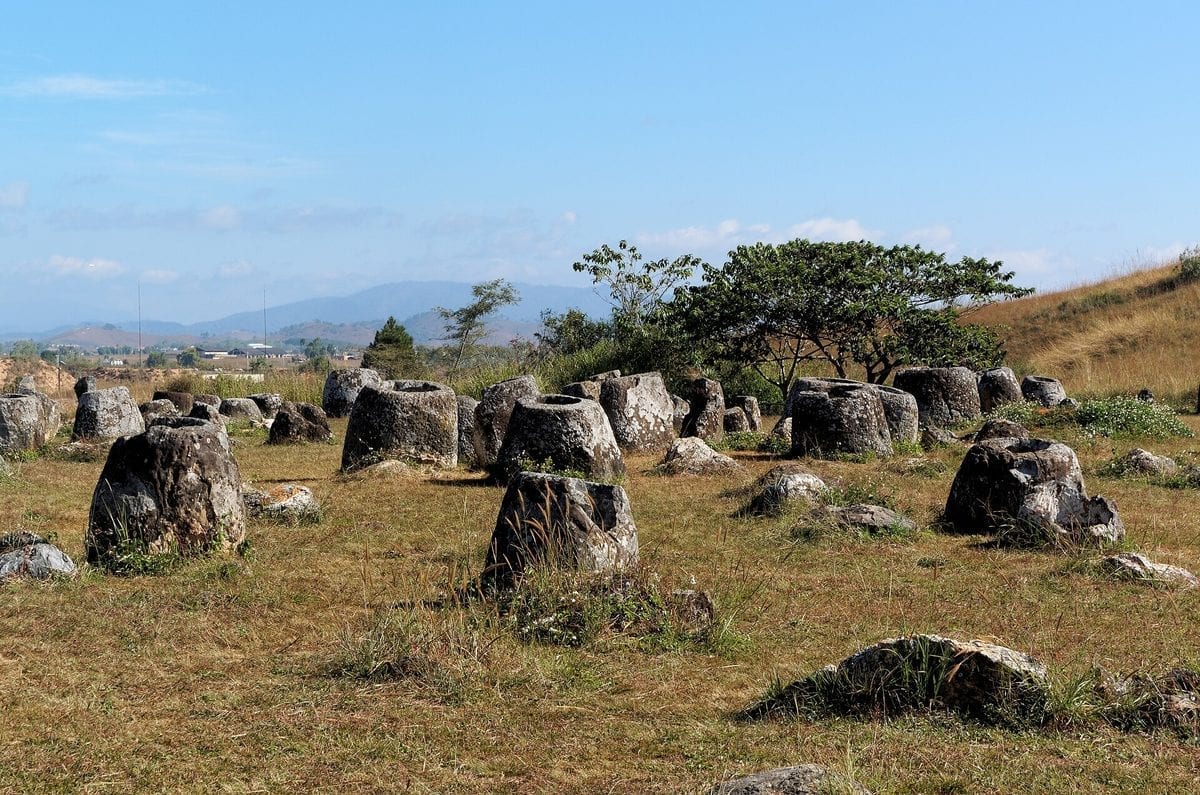
That the true purpose of the Plain of Jars has never been conclusively determined: explanations range from the local tradition that giants carved the jars to ferment and store rice wine, to the practical idea that they were storage or catchment vessels, to the archaeological interpretation that they were funerary containers, with some fringe writers invoking a lost advanced or non-human civilization; and that no single account has been proven.
The Plain of Jars is real, and its outline is well established: across the Xieng Khouang plateau of north-central Laos sit more than 2,100 carved stone jars at some ninety sites, dated to the Iron Age, and inscribed by UNESCO as a World Heritage Site in 2019. What is genuinely open is what the jars were for. The strong and growing scholarly consensus, from Madeleine Colani in the 1930s to the Australian-Lao teams excavating today, is that they are funerary: burnt and buried human remains, secondary burials, and grave goods have been found in and around them. The claim we rate is narrower: that the exact original purpose of the jars themselves has been conclusively determined. It has not. The funerary interpretation is well supported but not closed, the local tradition that a race of giants carved the jars to brew rice wine is folklore rather than history, and no evidence points to a lost super-civilization or non-human builders. On the question of purpose: likely funerary, still under study, and not the work of giants.
Believed by: In local folklore around Xieng Khouang, the jars are traditionally credited to giants who used them for rice wine. More broadly, the Plain of Jars is a fixture of popular mystery and lost-civilization literature, frequently cited as an unexplained ancient enigma, while professional archaeologists treat it as a datable Iron Age funerary landscape still yielding new findings.
The full story
What is documented
Start with what is solid, because a good deal here is. Spread across the Xieng Khouang plateau of north-central Laos are more than 2,100 carved stone jars, grouped at some ninety sites. They range from about a metre to over three metres tall, some weighing several tonnes, and were cut from local sandstone, granite, and conglomerate, then moved from quarries kilometres away. They carry no inscriptions and no maker's mark, and no written source records who raised them.
They are not, however, undated. Radiocarbon dating of associated burials and optically stimulated luminescence dating of the sediment beneath jars place the site firmly in the Iron Age, with some jars set in position as early as roughly 1240 to 660 BCE and mortuary activity continuing for centuries after. In 2019, UNESCO inscribed the megalithic jar sites as a World Heritage Site, a serial property of fifteen components including jars, stone discs, quarries, and funerary objects.
So the question this file weighs is not whether the jars are real, or ancient, or remarkable. They are all three. It is narrower: has the exact original purpose of the jars actually been established, or does the fair answer remain that we have a strong leading interpretation and a set of open details?
The mystery people feel
The pull of the place is easy to understand and worth stating fairly, because the sense of enigma is not invented. Picture a wide upland dotted with thousands of weathered stone vessels, standing in silence for two or three thousand years, with no inscription, no chronicle, and no living memory of the hands that carved them. Few archaeological landscapes present so blank a face.
Local tradition fills that blank with a story as old as the jars are weathered. In it, a race of giants once lived on the plateau, and their king, Khun Cheung, won a great war and had the enormous jars made to brew and store rice wine for the victory feast, the grandest jar kept for himself. It is a vivid, rooted explanation, and it belongs to the people of Xieng Khouang as heritage.
And there is a real question underneath the legend, one that professional archaeologists share. The precise function of the jars, the exact mechanism by which they served whatever rite raised them, is still under active study. The site was also sealed off for decades by the danger of unexploded bombs, which slowed research and let the aura of the unknown settle over it.
Thousands of silent stone jars, no writing, no record of the builders, and a landscape long closed by war. The wonder is genuine; the mistake is only in what people rush to fill it with.
That is the case at its most reasonable: not that giants were real or that the jars are unknowable, but that a strange, undocumented, long-inaccessible site invites the question, and that the question has not been fully answered.
What the digging actually shows
Wonder is fair. The leap from we do not fully understand this to giants, or a lost civilization, or the unknowable is where the evidence stops and the storytelling starts, and the evidence points somewhere more specific.
When archaeologists dig in and around the jars, what they find, again and again, is the dead. In the 1930s the French archaeologist Madeleine Colani excavated a limestone cave beside one site and recovered ash, charcoal, and burnt bone and teeth, and read it as a crematorium tied to the jars. She interpreted the jars as funerary and published two volumes on the work in 1935. Nearly a century later, the Australian-Lao teams excavating since 2016 have found the same signature: secondary burials, human remains, ceramics, and grave goods clustered with the jars. At one jar, researchers recovered the commingled remains of at least 37 individuals alongside iron tools, a copper-based bell, and imported glass beads.
Set that against the alternatives. The giants of the legend leave no trace, because there were none; the story is folklore, not history. The idea of everyday storage vessels does not match a context dominated by burials rather than by granaries or residues. And the notion of a lost advanced or non-human civilization founders on the plain fact that carving and hauling stone is well within the reach of Iron Age societies, as megalith-builders on every continent attest. Nothing at the site requires unknown technology.
The dating undercuts the enigma too. Far from being unknowable, the jars sit in a measurable Iron Age chronology, and the beads found inside them tie the plateau into a long-distance trade network reaching to South Asia and the Middle East. This was not an isolated island of mystery but a connected society with a mortuary tradition.
Not solved, only narrowed
It would be just as much of an overreach to swing the other way and declare the jars fully explained. They are not: what stands is a leading interpretation, strong and well evidenced, that has not yet closed the question of purpose.
The funerary reading is the best-supported by a wide margin, but the exact role of the jars themselves is still argued. Did a body decompose inside a jar before the bones were removed for secondary burial nearby, a practice with parallels elsewhere in Southeast Asia? Were the jars holding vessels, or markers, or something that changed across the many centuries the sites were used? Researchers are testing these possibilities, not reciting a settled answer.
The gaps are real. The people who made the jars remain unnamed, with no writing to identify them. Most of the roughly ninety sites have never been excavated, in part because unexploded ordnance still restricts access, so the evidence base is a partial sample. New digging keeps adding complications rather than a tidy conclusion.
The dead are in the record, and the giants are not. But knowing the jars are funerary is not the same as knowing exactly how they were used, and that honest gap is the whole of the verdict.
So the two errors sit on either side of the truth. To say giants built them, or that the answer is unknowable, or that it took a lost super-civilization, is to ignore what the digging plainly shows. To say the case is entirely closed is to overstate a genuinely unfinished inquiry. The evidence supports a funerary purpose and leaves the mechanism open.
Why the legend endures
The Plain of Jars keeps its reputation as an unexplained enigma for reasons that are partly about the site and partly about how people meet a mystery.
It endures because the scene is genuinely strange. A blank, silent field of stone vessels with no inscription is the perfect canvas, and a colourful legend of giants and rice wine is simply more memorable than a careful account of secondary burial. The vivid story travels; the technical one does not.
It endures because real uncertainty remains. Because archaeologists honestly say the precise function is still being studied, and because most of the sites are unexcavated, there is a true gap for the imagination to occupy. Legitimate open questions get stretched into total mystery, and total mystery invites the extraordinary answer.
And it endures because it fits a familiar pattern. Megalithic sites the world over get gathered into one story of forgotten super-builders and visitors from elsewhere, and the Plain of Jars slides easily into that template. War sealed it off for decades, mainstream research arrived late, and by the time excavation filled in the picture, the aura of the inexplicable had already set.
Likely funerary, still open
Hold the two claims apart, because the discipline of this case lives in the gap between them. The site is real and datable: more than two thousand Iron Age stone jars, a UNESCO World Heritage landscape, repeatedly found in association with human burials and grave goods. On that, there is no serious dispute. The exact purpose of the jars is not conclusively proven: the funerary interpretation is strong and well supported, but the precise mechanism is still under study, the makers are unnamed, and most sites are undug.
None of that dismisses the wonder of the place. The Plain of Jars is a spectacular and genuinely unfinished piece of the human record, and the impulse to stand among the jars and ask what they were is exactly right. What the evidence declines to support is the specific extraordinary answers: that giants carved them for a feast, that they are unknowable, or that they demand a lost civilization. Those fill the gap with spectacle where the record offers something quieter.
The strong leading interpretation and the real open questions stand together: a funerary landscape, built by an Iron Age people we cannot yet name, whose exact use of these enormous jars is still being recovered one careful excavation at a time. The mystery is real. The answer, so far as we have it, is human.
What's still unexplained
- The precise function of the large jars is not settled. That human remains and burials cluster with them is well documented, but whether each jar served to hold a decomposing body before secondary burial, to store remains, or to mark a grave, and how that varied across sites, is still being worked out.
- The identity of the people who made the jars remains undocumented. Dating and trade goods place them in the Iron Age and connect them to wide exchange networks, but no written record names the culture, and much of the plateau's archaeology is still unexcavated.
- Most of the roughly ninety sites have never been fully studied. Unexploded ordnance still limits access to large areas, so the sample that underpins current interpretations is partial, and future clearance and excavation could complicate or refine the funerary picture.
- How the practice began, spread, and ended is unclear. The jars appear to span many centuries of use and reuse, and the relationship between the earliest placement and later burials is one of the more open threads in the current research.
Point by point
The claim: A race of giants carved the jars to brew and store rice wine, as local legend holds.
What the record shows: This is a cherished folk tradition, not a historical finding, and there is no evidence for giants or for large-scale brewing. What excavation actually recovers in and around the jars is funerary: burnt and buried human bone, secondary burials, ceramics, and grave goods. Colani documented cremated remains and a probable crematory cave in the 1930s, and modern teams have found human remains and burial objects at multiple sites. The rice-wine story survives as living heritage and a memorable explanation, but the material record points to the dead, not to a giants' feast.
The claim: No one knows who built the jars or when, so their age and origin are a total blank.
What the record shows: The makers are undocumented, but the site is far from undatable. Radiocarbon dating of associated burials and optically stimulated luminescence dating of sediments beneath jars place the megaliths in the Iron Age, with some jars set in position as early as roughly 1240 to 660 BCE and burial activity continuing for centuries. Trade goods such as imported glass beads further tie the communities into datable long-distance networks. The identity of the culture is a real gap; the chronology is not a mystery in the way the claim implies.
The claim: The purpose of the jars is completely unknown and may be unknowable.
What the record shows: The strongest interpretation is well supported rather than absent. From Colani onward, the funerary reading has accumulated evidence: cremation deposits, secondary burials, and grave goods clustered with the jars. What remains genuinely uncertain is the precise role the massive jars themselves played, whether as vessels for decomposition or distillation of the body before secondary burial, as holding containers, or as markers, and whether the practice varied across sites and centuries. That residual uncertainty about mechanism is real, and it is an argument about how the jars were used, not a sign that the site is an unsolvable enigma.
The claim: The jars were practical storage vessels, for water, grain, or rice wine, rather than anything to do with the dead.
What the record shows: This is a reasonable-sounding alternative that the excavated context does not favour. Where jars have been dug around and beneath, the recurring associations are human remains, burials, and mortuary objects, not the residues, granaries, or settlement features one would expect from everyday storage. Nothing rules out incidental later reuse, but the primary pattern that archaeologists actually find is funerary, which is why storage has not displaced the burial interpretation.
The claim: The scale and mystery of the jars point to a lost advanced civilization or non-human builders.
What the record shows: The engineering is impressive but within the reach of Iron Age societies. The jars were carved from local sandstone, granite, and conglomerate and moved from quarries up to several kilometres away, work comparable to megalithic projects built by pre-industrial peoples worldwide using labour, tools, sledges, and time. No artefact, technique, or measurement at the site requires unknown technology or outside builders. The appeal to a lost super-civilization or ancient aliens fills a gap in the historical record with spectacle rather than with evidence.
Timeline
- c. 1240–660 BCEThe stone jars are quarried, carved, and set in place across the Xieng Khouang plateau during the Iron Age. Optically stimulated luminescence dating of sediments beneath jars at one site places them in their final positions as early as roughly 1240 to 660 BCE, older than many earlier estimates. The people who made them left no writing, and their identity is not documented.
- Pre-modern eraLocal oral tradition explains the jars as the work of giants. In the best-known version, a king named Khun Cheung (also rendered Khun Jeuang) wins a great battle and has the enormous vessels made to brew and store rice wine, known locally as lau hai, for a victory celebration. The largest jar is said to have been reserved for the king himself.
- 1930sThe French geologist and archaeologist Madeleine Colani surveys and excavates a dozen jar sites. Digging in a limestone cave at Site 1, she finds ash, charcoal, and burnt bone and teeth, and interprets the cave as a crematorium and the jars as vessels tied to funerary rites. She publishes her findings in two volumes in 1935.
- 1964–1973During the wider Indochina conflict, the United States conducts a massive, largely covert bombing campaign over Laos. The Xieng Khouang plateau, including the jar fields, is among the most heavily bombed areas on earth, and unexploded ordnance is left scattered across the landscape.
- Late 20th centuryAccess to the sites is constrained for decades by the danger of unexploded bombs. Clearance organisations such as the Mines Advisory Group surface-clear and mark safe walkways at a handful of sites, and only about three of the roughly ninety jar sites are opened for regular visits.
- 2016An Australian-Lao research team, co-led by Louise Shewan of the University of Melbourne, Dougald O'Reilly of the Australian National University, and Thonglith Luangkhoth of the Lao Department of Heritage, begins a sustained program of excavation, drone survey, radiocarbon and luminescence dating, and isotopic analysis across the jar sites.
- 2019-07At its 43rd session, the UNESCO World Heritage Committee inscribes the Megalithic Jar Sites in Xiengkhuang, the Plain of Jars, as a World Heritage Site: a serial property of fifteen components containing carved jars, stone discs, secondary burials, tombstones, quarries, and funerary objects. It becomes the third World Heritage listing in Laos.
- 2020sContinuing excavation deepens the funerary picture. At one jar investigated in the 2020s, researchers recover the commingled remains of at least 37 people alongside iron tools, earthenware, a copper-based bell, and glass beads chemically traced to sources as distant as southern India and Mesopotamia, evidence of long-distance trade. The exact function of the large jars themselves remains a subject of active study.
The Plain of Jars is real, and its outline is well established: across the Xieng Khouang plateau of north-central Laos sit more than 2,100 carved stone jars at some ninety sites, dated to the Iron Age, and inscribed by UNESCO as a World Heritage Site in 2019. What is genuinely open is what the jars were for. The strong and growing scholarly consensus, from Madeleine Colani in the 1930s to the Australian-Lao teams excavating today, is that they are funerary: burnt and buried human remains, secondary burials, and grave goods have been found in and around them. The claim we rate is narrower: that the exact original purpose of the jars themselves has been conclusively determined. It has not. The funerary interpretation is well supported but not closed, the local tradition that a race of giants carved the jars to brew rice wine is folklore rather than history, and no evidence points to a lost super-civilization or non-human builders. On the question of purpose: likely funerary, still under study, and not the work of giants.
Reviewed by Colin Peterson · Last reviewed July 8, 2026 · How we rate
Common questions
Is The Plain of Jars true?
The Plain of Jars is real, and its outline is well established: across the Xieng Khouang plateau of north-central Laos sit more than 2,100 carved stone jars at some ninety sites, dated to the Iron Age, and inscribed by UNESCO as a World Heritage Site in 2019. What is genuinely open is what the jars were for. The strong and growing scholarly consensus, from Madeleine Colani in the 1930s to the Australian-Lao teams excavating today, is that they are funerary: burnt and buried human remains, secondary burials, and grave goods have been found in and around them. The claim we rate is narrower: that the exact original purpose of the jars themselves has been conclusively determined. It has not. The funerary interpretation is well supported but not closed, the local tradition that a race of giants carved the jars to brew rice wine is folklore rather than history, and no evidence points to a lost super-civilization or non-human builders. On the question of purpose: likely funerary, still under study, and not the work of giants.
What is The Plain of Jars?
On the rolling uplands of the Xieng Khouang plateau in north-central Laos lie more than 2,100 tubular stone jars, some taller than a person and weighing several tonnes, clustered across roughly ninety sites. Carved from sandstone, granite, and conglomerate and hauled from quarries kilometres away, they have stood for two to three thousan…
What does the evidence show?
This is a cherished folk tradition, not a historical finding, and there is no evidence for giants or for large-scale brewing. What excavation actually recovers in and around the jars is funerary: burnt and buried human bone, secondary burials, ceramics, and grave goods. Colani documented cremated remains and a probable crematory cave in…
Why do people believe it?
The setting is genuinely eerie. Thousands of weathered stone jars standing silent across an upland plateau, with no inscriptions and no written history, is exactly the kind of scene that invites a dramatic story, and the human mind resists leaving so strange a landscape unexplained.
What is still unresolved?
The precise function of the large jars is not settled. That human remains and burials cluster with them is well documented, but whether each jar served to hold a decomposing body before secondary burial, to store remains, or to mark a grave, and how that varied across sites, is still being worked out.
Sources
- 1.Megalithic Jar Sites in Xiengkhuang – Plain of Jars, UNESCO World Heritage Centre (2019)
- 2.Giant jars, ancient bells, buried bones and a mystery that endures, Pursuit, University of Melbourne (2026)
- 3.'Plain of Jars', one of the most mysterious archaeological sites, reveals its true age, Live Science (2021)
- 4.Giant jars, ancient bells, buried bones and a mystery that endures, Phys.org (2026)
- 5.The death jar: a new mortuary tradition at the Plain of Jars, Lao PDR, Antiquity (Cambridge University Press) (2026)
- 6.Plain of Jars, Archaeology Magazine (Archaeological Institute of America) (2019)
- 7.Plain of Jars Archaeological Project, University of Melbourne and Australian National University
- 8.Plain of Jars, Wikipedia
Embed this case file on your site
Paste this snippet to show this case file as a small card, with a link back to the full write-up. Free to use.
<iframe src="https://theconspiratory.com/embed/plain-of-jars" title="The Conspiratory verdict" width="520" height="190" style="border:0;max-width:100%" loading="lazy"></iframe>Help us investigate
This is a living case file. If you spot an error or know evidence we missed, tell us, and weigh in on where you land.
Where do you land?
Cast your read on this one.
Comments
Add your take. Comments are read and approved by a human before they appear, so keep it on topic and civil. Please do not accuse named, living people of crimes.