The Rohonc Codex is a genuine encoded manuscript whose lost script and language can be deciphered, not an early-modern hoax
By Colin PetersonJuly 8, 2026
Where the evidence lands →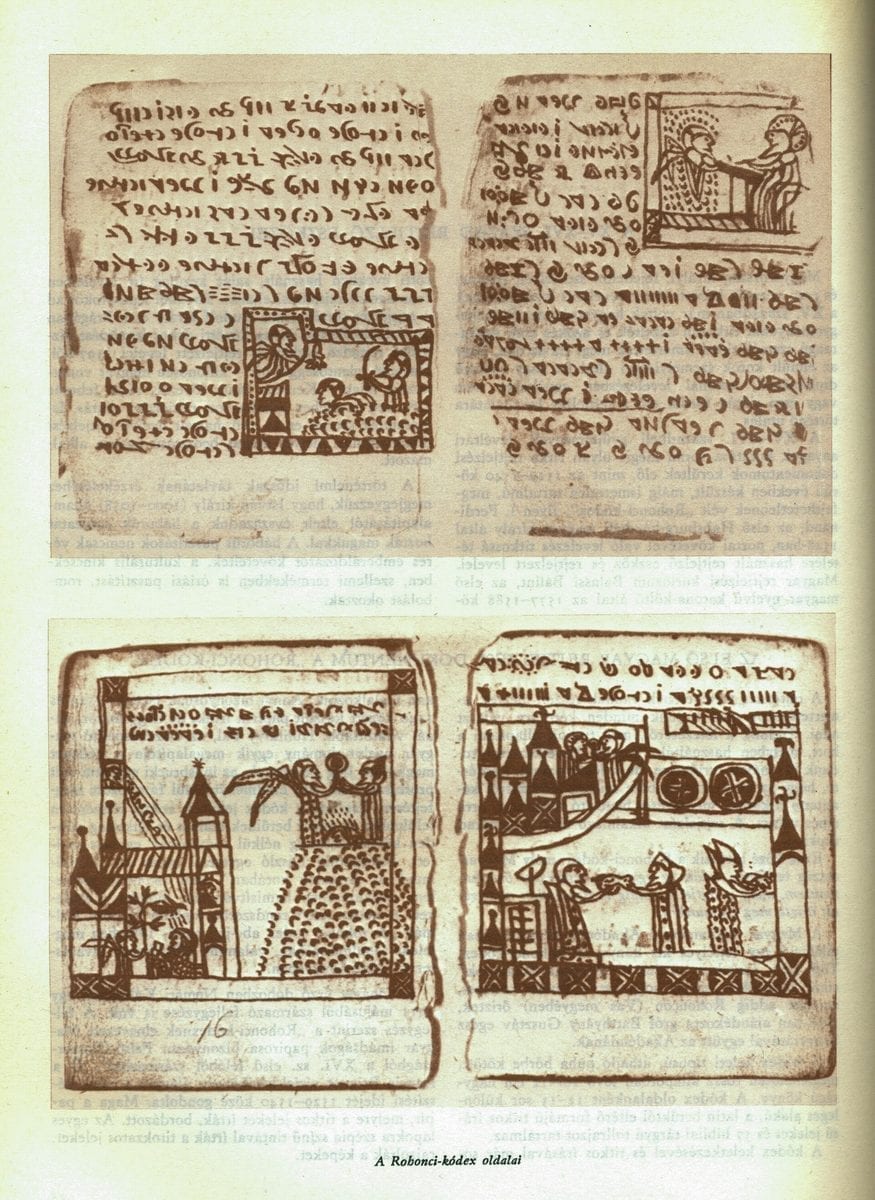
That the Rohonc Codex is an authentic written document encoding a genuine message in a real (if lost) language or cipher, and that its content has been, or can be, reliably deciphered, as opposed to being a meaningless hoax or forgery produced in the 18th or early 19th century to deceive collectors and scholars.
The Rohonc Codex is a real object: a small illustrated manuscript of roughly 448 paper pages, written in an unknown script of about 200 recurring symbols and dotted with 87 crude drawings, held since 1838 in the Library of the Hungarian Academy of Sciences. That much is documented. The rated claim is narrower: that the codex is a genuine, meaningful text carrying a real message, and that its writing has been (or can be) reliably deciphered, rather than a meaningless forgery manufactured to fool collectors. On the evidence that claim is unproven. Nobody has produced a decipherment the scholarly community accepts, and a long-standing hypothesis holds that the book is an early-modern hoax, most often pinned on the Transylvanian antiquarian and known forger Sámuel Literáti Nemes. The hoax charge is itself unproven: no forger has been tied to the manuscript, and its 16th-century paper and internally consistent symbol system are harder to fake than a random scribble.
Believed by: Amateur cryptographers, manuscript enthusiasts, and a scattering of nationalist decipherers who read it as ancient Hungarian, Dacian, Sumerian, or Vlach; a small number of academic specialists take seriously the more sober reading that it is a genuine 16th-century religious text
The full story
What is documented
Start with the object itself, because it is real and catalogued even though its contents are not understood. The Rohonc Codex is a small manuscript of roughly 448 paper pages, each about 12 by 10 centimetres, filled with a dense script of around 200 recurring symbols that matches no known writing system. Interspersed through the text are 87 illustrations: religious scenes, secular and military ones, crude in execution but coherent in subject.
Its modern history is documented. In 1838 Count Gusztáv Batthyány donated the library of his estate at Rohonc, in western Hungary (today Rechnitz, just over the border in Austria), to the Hungarian Academy of Sciences, and the codex came with it. It has lived in the Academy's library ever since, where scholars can and do examine it. Codicologists have dated its paper by the watermark, an anchor within a circle in the Venetian style, to roughly the 1530s.
So the question this file weighs is not whether the codex exists, or whether it is old. It is the narrower and harder one: whether the symbols mean anything, whether anyone has actually read them, and whether the book is a genuine document or an elaborate fabrication designed to look like one.
The case for a genuine, readable text
The strongest version of the believers' case is not the wild decipherments; it is the quieter observation that the codex behaves like a real writing system. It is worth stating fairly.
First, the paper is genuinely old. The watermark places the sheets in the 1530s, in the Venetian paper trade, which is hard to reconcile with a lazy modern fake scrawled on convenient stock. Second, the internal structure is disciplined. Statistical study, including the work of Levente Zoltán Király and Gábor Tokai, finds recurring symbol groups and regularities that look more like language or code than like the random noise a hoaxer would dash off. Third, the illustrations cohere: they form recognisable religious and battle scenes, not doodles, and some appear to key to specific biblical episodes.
A forger out to fool collectors has no reason to build a consistent 200-symbol grammar and match his pictures to scripture. That much structure is the thing the hoax story has to explain away.
On this reading the 2018 Cryptologia study is the payoff: Király and Tokai argue the writing is a purpose-built code system and the book a coded Catholic devotional text, an interpretation respected specialists such as Benedek Láng have treated seriously. The honest form of the claim is not “it has been solved” but “it is real, and we are beginning to read it.”
Where the decipherments break down
The trouble is that the confident, complete decipherments, the ones that generate headlines, do not survive contact with method. And they cannot all be right, because they flatly contradict one another.
One researcher reads the codex as Sumerian, reached by turning pages upside down and matching symbols to Latin letters by eye. Another reads it as an 11th to 12th century Vlach chroniclein Vulgar Latin, running bottom to top and right to left. Others have proposed old Hungarian, Dacian, Brahmi, or early Romanian. A single book cannot be all of these at once, and the fact that so many mutually exclusive “solutions” exist is itself the tell.
The shared flaw is method. These readings assign one symbol several different sound values, and several symbols the same value, then reorder the results until words appear. A procedure that flexible can extract a message from wallpaper, which is precisely why none of the readings can be independently reproduced. When another scholar applies the same key to a fresh page, coherent text does not come out. A genuine decipherment, like the cracking of Linear B, lets others repeat the result. None of the Rohonc readings does.
The careful work of Király and Tokai stands apart precisely because it is modest: a proposed code system and partial matches, offered provisionally, not a finished translation. That it has not been completed and confirmed is exactly why the case is not closed.
The hoax hypothesis, and its limits
If no one can read it, perhaps there is nothing to read. That is the oldest rival to the genuine-text view, and it has a respectable pedigree: in 1866 the historian Károly Szabó named a culprit, the Transylvanian antiquarian Sámuel Literáti Nemes, a man with a documented history of forging manuscripts and antiquities for wealthy patrons.
The attraction is obvious. Nemes was real, he was a genuine forger, and he was active in the right place and period to have manufactured a mysterious “ancient” book. Many Hungarian scholars have long assumed some version of this story, that the codex is an 18th or 19th century fabrication built to impress collectors or fuel national-origin fantasies.
But the hoax case has a hole of its own: no evidence actually ties Nemes to this manuscript. There is no sale, no confession, no matching hand, no paper trail. The attribution rests on reputation and plausibility, not proof, and attempts to link him to the codex have not succeeded. It also has to explain the two features that cut against a casual fake: the genuine 16th-century paper and the disciplined internal structure. A forger could have used old paper, and a patient one could have built a fake system, but “could have” is not the same as “did.” The hoax verdict is a strong suspicion, not an established fact.
Why the mystery endures
Undeciphered books exert a peculiar gravity, and the Rohonc Codex has pulled at amateurs and scholars alike for the same reasons its cousin, the Voynich Manuscript, does.
An unreadable script reads as a locked door with a key presumed to exist. The mind resists the idea that the symbols might encode nothing, or nothing recoverable, and reaches instead for a hidden message equal to the effort of guarding it. Every failed decipherment, rather than deflating the mystery, reopens it: the answer simply has not been found yet.
Heritage sharpens the pull. Readings that make the codex an ancient record of Hungarians, Dacians, or Vlachs offer a flattering origin story, which is part of why such interpretations keep surfacing and why their authors defend them well past the point the evidence allows. The wish shapes the reading.
And crucially, serious scholarship has kept the door open. Because researchers like Benedek Láng, Király, and Tokai treat the codex as a real problem rather than a settled fraud, the belief that it can one day be read carries a legitimacy that pure fringe speculation never earns. The mystery endures because, unusually, it might actually be a mystery.
A real riddle, still unsolved
Keep the two questions apart. The object is documented: a real, old, illustrated manuscript in the Hungarian Academy of Sciences, written on 16th-century paper in a script of some 200 symbols. There is no dispute about that. The rated claim is narrower: that the codex is a genuine, meaningful text that has been or can be reliably deciphered rather than a fabricated hoax. On that claim the record supports no confident answer in either direction.
The sensational decipherments fail, contradict each other, and cannot be reproduced, so “it has been read” is not established. The hoax attribution to Sámuel Literáti Nemes rests on reputation rather than evidence, so “it is a proven forgery” is not established either. The most rigorous modern work, the Király and Tokai code-system reading, is promising and incomplete. That is a genuine standoff, not a solved case dressed up as a puzzle.
This is one of the rarer entries in which no one yet knows. The Rohonc Codex is a real, physical riddle that has resisted two centuries of clever people, and the disciplined path is to keep the paper, the statistics, and the partial readings on the table, to demand that any claimed solution be reproducible, and to be comfortable saying, for now, that the book keeps its secret.
What's still unexplained
- What is the codex actually written in? No decipherment has been independently reproduced, so the language, cipher, or code behind the roughly 200 symbols remains genuinely unknown.
- Is it authentic or a hoax? The forgery attribution to Sámuel Literáti Nemes is unproven and the genuine-text reading is incomplete, so whether the book was made to communicate or to deceive is still open.
- How do the 16th-century paper and the writing relate in time? The watermark dates the sheets to the 1530s, but nothing yet fixes when the symbols were inked, leaving room for both a genuine Renaissance-era origin and a later fabrication on old paper.
- Do the Király and Tokai results scale to a full reading? Their code-system model and scriptural matches are promising, but whether they can yield a complete, verifiable translation the field will accept is not yet settled.
Point by point
The claim: The codex has been deciphered: it is a genuine ancient text in Sumerian, Dacian, Vlach, or old Hungarian, as various researchers have shown.
What the record shows: None of these decipherments holds up. They contradict one another (the same book cannot be Sumerian and medieval Vlach and old Hungarian at once), and they rely on methods scholars regard as arbitrary: reordering symbols, reading pages upside down, assigning one symbol several sound values and one sound to several symbols until something readable emerges. That procedure can extract a message from almost any pattern, which is exactly why it convinces no one outside its author. No proposed reading has been independently reproduced.
The claim: The whole thing is a proven hoax by the forger Sámuel Literáti Nemes, so there is nothing to decipher.
What the record shows: The hoax hypothesis is plausible but unproven. Nemes was a genuine and prolific forger, which is why suspicion fell on him in 1866, but no document, sale record, or physical link actually ties him to this manuscript. The attribution rests on his reputation and opportunity, not on evidence that he made it. Calling the codex a confirmed Nemes forgery overstates what anyone has shown.
The claim: The 16th-century paper proves the text is an authentic Renaissance-era document.
What the record shows: It proves the paper is old, not the writing. The watermark dates the sheets to roughly the 1530s, but a later forger could in principle have obtained genuine old blank paper, and old stock was available to antiquarians. The paper narrows the field and makes a crude 19th-century fake less likely, yet on its own it cannot establish when, or by whom, the symbols were actually inked.
The claim: The symbols are just random scribbles, the kind of meaningless filler a hoaxer would produce.
What the record shows: Statistical work cuts against pure randomness. Modern analyses, including the Király and Tokai studies, find recurring symbol groups, consistent patterns, and structure that behave more like a real writing or code system than like noise. The illustrations, too, form coherent religious and battle scenes rather than doodles. Whatever the codex is, its internal regularity is a genuine feature a good explanation has to account for, and it is harder to fake than gibberish.
The claim: The 2018 Király and Tokai study cracked it: the codex is a coded Catholic religious text.
What the record shows: Their work is the most rigorous to date and is respected by specialists such as Benedek Láng, but it is a partial and provisional reading, not a finished, verified decipherment. They propose a code system and match some illustrations to scripture; they do not deliver a full, checkable transliteration that others can independently confirm line by line. It strengthens the case that the book is meaningful without closing the question of exactly what it says.
Timeline
- 1530sCodicologists date the codex's paper by its watermark, an anchor inside a circle typical of Venetian paper of the period, to roughly 1529 to 1540. This dates the paper, not necessarily the writing on it, a distinction that sits at the heart of the whole dispute.
- 1838Count Gusztáv Batthyány donates his library from the Rohonc estate in western Hungary (Rohonc is now Rechnitz, Austria) to the Hungarian Academy of Sciences. The unreadable codex arrives with the rest of the collection and enters the Academy's holdings, where it still resides.
- 1840s–1850sEarly scholars examine the manuscript and cannot place its script. The 200 or so recurring symbols resist matching to any known alphabet, and the direction of reading (right to left, and possibly bottom to top) is itself contested. The book acquires its reputation as an enigma.
- 1866The historian Károly Szabó proposes that the codex is a modern forgery, attributing it to Sámuel Literáti Nemes (1796–1842), a Transylvanian-Hungarian antiquarian notorious for fabricating documents and antiquities for noble patrons. This launches the hoax hypothesis that shadows the codex to this day.
- 1990sA wave of amateur decipherments appears. The Hungarian Attila Nyíri claims a Sumerian-based reading after turning pages upside down and matching symbols to Latin letters by resemblance, a method critics note is inconsistent and self-serving, transliterating the same symbol several ways to force out words.
- early 2000sThe Romanian scholar Viorica Enăchiuc publishes a full translation reading the codex as an 11th to 12th century Vulgar Latin chronicle of the Vlachs' wars, written bottom to top and right to left. Linguists reject it as arbitrary and unrepeatable, like the other national-origin readings.
- 2010The historian of science Benedek Láng publishes a sober survey in the journal Cryptologia, treating the codex as a real cryptographic problem rather than a curiosity and weighing the hoax hypothesis against a genuine-cipher reading without declaring the case closed.
- 2018Levente Zoltán Király and Gábor Tokai publish in Cryptologia the most systematic attack yet, arguing the writing is a purpose-built code system rather than a simple alphabet, that the illustrations key to specific Bible passages, and that the book is a coded Catholic devotional text. The work is taken seriously but not accepted as a full solution.
- 2021Benedek Láng's book The Rohonc Code: Tracing a Historical Riddle appears from Penn State University Press, laying out the manuscript's history, the failed and partial decipherments, and the still-open question of whether it is genuine or a fabrication.
The Rohonc Codex is a real object: a small illustrated manuscript of roughly 448 paper pages, written in an unknown script of about 200 recurring symbols and dotted with 87 crude drawings, held since 1838 in the Library of the Hungarian Academy of Sciences. That much is documented. The rated claim is narrower: that the codex is a genuine, meaningful text carrying a real message, and that its writing has been (or can be) reliably deciphered, rather than a meaningless forgery manufactured to fool collectors. On the evidence that claim is unproven. Nobody has produced a decipherment the scholarly community accepts, and a long-standing hypothesis holds that the book is an early-modern hoax, most often pinned on the Transylvanian antiquarian and known forger Sámuel Literáti Nemes. The hoax charge is itself unproven: no forger has been tied to the manuscript, and its 16th-century paper and internally consistent symbol system are harder to fake than a random scribble.
Reviewed by Colin Peterson · Last reviewed July 8, 2026 · How we rate
Common questions
Is The Rohonc Codex true?
The Rohonc Codex is a real object: a small illustrated manuscript of roughly 448 paper pages, written in an unknown script of about 200 recurring symbols and dotted with 87 crude drawings, held since 1838 in the Library of the Hungarian Academy of Sciences. That much is documented. The rated claim is narrower: that the codex is a genuine, meaningful text carrying a real message, and that its writing has been (or can be) reliably deciphered, rather than a meaningless forgery manufactured to fool collectors. On the evidence that claim is unproven. Nobody has produced a decipherment the scholarly community accepts, and a long-standing hypothesis holds that the book is an early-modern hoax, most often pinned on the Transylvanian antiquarian and known forger Sámuel Literáti Nemes. The hoax charge is itself unproven: no forger has been tied to the manuscript, and its 16th-century paper and internally consistent symbol system are harder to fake than a random scribble.
What is The Rohonc Codex?
The Rohonc Codex is one of the world's most stubbornly unreadable books. Roughly 448 small paper pages, packed with about 200 distinct symbols in a script that matches no known writing system, and illustrated with 87 rough drawings of religious, secular, and military scenes, it surfaced in western Hungary and was given to the Hungarian A…
What does the evidence show?
None of these decipherments holds up. They contradict one another (the same book cannot be Sumerian and medieval Vlach and old Hungarian at once), and they rely on methods scholars regard as arbitrary: reordering symbols, reading pages upside down, assigning one symbol several sound values and one sound to several symbols until something…
Why do people believe it?
An unreadable book is an irresistible puzzle. A physical object covered in a script no expert can place, sitting in a national academy for nearly two centuries, invites the sense that a hidden message is waiting for the right key, much as the Voynich Manuscript does.
What is still unresolved?
What is the codex actually written in? No decipherment has been independently reproduced, so the language, cipher, or code behind the roughly 200 symbols remains genuinely unknown.
Sources
- 1.Rohonc Codex, Wikipedia (2026)
- 2.Cracking the code of the Rohonc Codex, Cryptologia (Taylor & Francis) (2018)
- 3.Why Don't We Decipher an Outdated Cipher System? The Codex of Rohonc, Cryptologia (Taylor & Francis) (2010)
- 4.The Rohonc Code: Tracing a Historical Riddle, Penn State University Press (2021)
- 5.The indecipherable Rohonc Codex: an ancient text that has baffled researchers for more than 200 years, Ancient Origins (2014)
- 6.Rohonc Codex: Genuine or Hoax?, Historic Mysteries (2019)
- 7.Kiraly and Tokai's Rohonc Codex decryption, Cipher Mysteries (2018)
Embed this case file on your site
Paste this snippet to show this case file as a small card, with a link back to the full write-up. Free to use.
<iframe src="https://theconspiratory.com/embed/rohonc-codex" title="The Conspiratory verdict" width="520" height="190" style="border:0;max-width:100%" loading="lazy"></iframe>Help us investigate
This is a living case file. If you spot an error or know evidence we missed, tell us, and weigh in on where you land.
Where do you land?
Cast your read on this one.
Comments
Add your take. Comments are read and approved by a human before they appear, so keep it on topic and civil. Please do not accuse named, living people of crimes.