A leaping, fire-breathing entity called Spring-heeled Jack stalked Victorian Britain as a real supernatural creature
By Colin PetersonJuly 8, 2026
Where the evidence lands →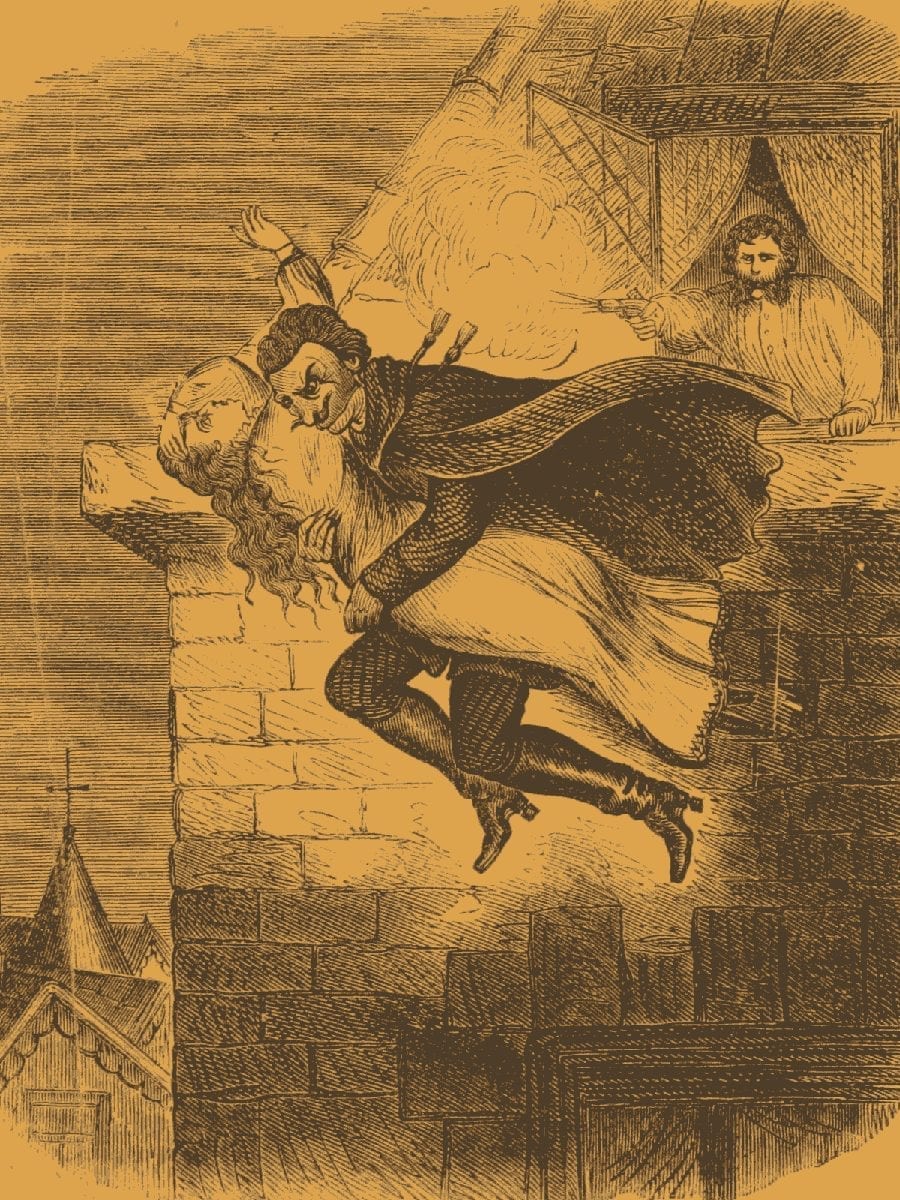
That the Spring-heeled Jack reports describe a single, literal being with genuinely non-human abilities, chiefly enormous spring-loaded leaps and the ability to breathe fire, who was either supernatural (a demon or ghost) or otherwise outside ordinary human explanation, and who physically stalked Victorian Britain for roughly seventy years.
The wave of reports is real and well documented: from 1837 onward, newspapers, magistrates, and the Lord Mayor of London recorded frightened accounts of a cloaked figure who leapt over walls, breathed blue and white flame, and clawed at witnesses. The record is not in dispute. The claim we rate is narrower and different: that these reports were caused by a single literal creature, a supernatural or non-human being with genuine spring-loaded leaping and fire-breath. That claim is unproven. No physical remains, capture, or verified evidence was ever produced, and the pattern fits hoaxes, pranks, copycats, misidentification, and mass panic amplified by the penny-dreadful press. A creature has not been shown to exist; it also cannot be formally disproven for every scattered sighting across seventy years.
Believed by: Frightened residents of Victorian London and, later, the Midlands, Scotland, and Liverpool; the figure became a household bogeyman used to scare children, and was kept alive by penny dreadfuls and stage plays. Today it is mainly of interest to folklorists, historians, and cryptozoology enthusiasts.
The full story
What is documented
Start with what is genuinely on the record, because a good deal is. In the autumn of 1837 and through the winter that followed, people in and around London reported being ambushed by a cloaked figure who sprang at them from the dark, leapt away with startling agility, and, in the most alarming accounts, breathed coloured flame and clawed at his victims. Within weeks the figure had a name that would outlast the century: Spring-heeled Jack.
This was not merely a rumour whispered in taverns. On 9 January 1838the Lord Mayor of London, Sir John Cowan, read out at a public Mansion House session an anonymous letter from a self-described “resident of Peckham”, alleging that a band of pranksters had wagered to terrify the villages around London in the guise of a ghost, a bear, and a devil. The Times printed it, other papers followed, and the Lord Mayor was soon shown a stack of further complaints. Two named witnesses, Jane Alsop in Bow and Lucy Scales in Limehouse, gave detailed statements in February 1838 describing a figure who spat blue and white flame. Over the following decades scattered reports surfaced across Britain, including soldiers at Aldershot in 1877 and a commotion in Everton, Liverpool, as late as 1904.
So the wave of reports, the public alarm, and the durable folklore are all real and well attested. The question this file weighs is not whether people reported Spring-heeled Jack. They plainly did. It is whether those reports were caused by a single literal creature with genuinely non-human powers, or by something far more ordinary wearing an extraordinary costume.
The case for a real creature
The believer's case is stronger than a modern reader might expect, and it deserves to be put fairly. Unlike many monster tales, Spring-heeled Jack begins with documented, contemporary testimony, not just later legend. The Lord Mayor of London took it seriously enough to raise it in public. Respectable newspapers carried the witness statements. Jane Alsop and Lucy Scales were named, ordinary young women with no obvious motive to invent an identical, specific horror within days of each other.
And the described abilities are consistent in their strangeness. Across many accounts the figure leaps impossibly high, clearing walls and hedges, and breathes coloured fire from his mouth while his eyes glow. That two of the most physically unusual details, the leaping and the flame, recur again and again, the argument runs, is hard to square with pure imagination. Something, the believer says, was frightening real people badly enough to leave torn clothing and lasting shock.
Then there is the span. The reports do not stop with the 1838 sensation. They recur for decades, in different towns, long after the initial panic and even long after the aristocrat most often blamed had died. To a believer, a phenomenon that keeps reappearing across a lifetime, in places with no obvious connection, looks less like a single hoax that ran its course and more like a persistent presence.
The strongest version of the claim is not that a demon roamed London. It is narrower: that real, frightened, named witnesses described abilities no ordinary prankster could produce, and that no one ever fully explained them.
Where the creature claim breaks down
The reports are real; the leap to a literal creature is where the evidence runs out. The decisive problem is a simple one: after roughly seventy years of sightings, nothing physical was ever produced. No body, no capture, no verified impossible footprint, no artifact of the fire-breath. A creature that assaulted people in the middle of a crowded metropolis for decades left behind exactly what a legend leaves behind, which is stories.
The signature abilities dissolve under ordinary explanation. The flamecould be produced with simple Victorian chemistry or a practised fire-breather's trick, and a lantern with a coloured lens throws an unnatural glare in a dark alley, especially to a terrified witness who is briefly blinded. The leaps were never measured or tested; the most gravity-defying versions come from later retellings and from the penny dreadfuls, not from the sober statements taken at the time. Fear and darkness reliably turn a running, climbing man into a bounding phantom.
The variation in the accounts is itself telling. The figure is described as a devil, a bear, a ghost, a gentleman with a lantern, a helmeted man in white oilskin. That is not the profile of one consistent creature; it is the profile of many different frights, some of them real assaults by ordinary criminals, all being sorted after the fact into a single famous name. Once the press had christened Spring-heeled Jack, every ambiguous scare in a dark street had a label waiting for it.
Even the leading human suspect points away from the supernatural. The Marquess of Waterford, the “Mad Marquis” widely blamed for the early scares, was a wealthy man with a documented appetite for cruel practical jokes and reckless bets. That is a mundane explanation, not a monstrous one. It fails only as a complete account, because sightings continued after his death in 1859, which is precisely what a spreading legend does.
How a panic becomes a monster
To explain the whole seventy-year arc, no creature is required, only a well-understood social machine. It runs in stages, and Spring-heeled Jack passed through each of them.
First, a real seed: an initial cluster of genuine frights in 1837 and 1838, some likely pranks, some likely ordinary assaults, frightening enough to be reported to magistrates and the Lord Mayor. Second, amplification: the press, hungry for a sensation, gave the frights a single name, a vivid face, and national reach, which both alarmed the public and told them exactly what to be afraid of. Third, contagion: with the template established, new and unrelated scares, copycats, and misperceptions were read through it, so that a lantern in an alley or a leaping figure on a rooftop became another Spring-heeled Jack sighting.
Fourth, and crucially, fiction fed back into fact. From the 1860s the penny dreadfuls and stage melodramas turned Jack into a caped, superhuman character, and their exaggerated leaps and flames became the picture the public carried in its head. By the time later witnesses reported him, they were often describing the fictional version. The Everton scare of 1904 fits this pattern: a local commotion, crowds gathering nightly to see the famous bogeyman, and, by one later account, a distressed local man on the rooftops at the bottom of it.
A legend that spreads for seventy years is not evidence of a creature that lived for seventy years. It is evidence that the story worked.
Why the legend endures
Spring-heeled Jack has outlived every witness by more than a century, and the reasons say as much about people as about any phantom. He is, first, an unusually good story. A cloaked figure with burning eyes and fiery breath who springs over walls is almost engineered to be remembered and retold, and a specific, dramatic villain is far easier to hold in the mind than a diffuse tangle of pranks, crimes, and misperceptions.
He also had a social job. For generations he was the bogeyman at the window, invoked to frighten children into good behaviour. A monster woven into ordinary domestic life does not fade when the original incidents do; it is renewed with every telling.
And he sits in a real gap of the unexplained. Because the earliest cases were never conclusively solved and no culprit was ever convicted, the file was never formally closed. Where a story ends in a question mark rather than a confession, an extraordinary answer can always be kept alive alongside the ordinary ones. That open space, more than any evidence, is what has carried Spring-heeled Jack from the gaslit streets of 1838 into cryptozoology and popular culture today.
A panic, not a monster
Hold the two claims apart. The record, a genuine wave of frightened reports in 1837 and 1838, official notice from the Lord Mayor of London, named witnesses, a media sensation, and a folklore that spread across Britain for decades, is not in doubt. Any fair account grants all of it.
The rated claim is different and narrower: that a single literal creature, supernatural or otherwise non-human, with real spring-loaded leaps and genuine fire-breath, was the cause. Nothing was ever caught, no remains were found, the signature abilities all have ordinary explanations, and the seventy-year span fits a self-sustaining legend far better than a living monster. The pattern points to hoaxes, pranks, copycats, real but ordinary assaults, misidentification, and mass panic magnified by the press and the penny dreadfuls.
Even so, a scatter of individual sightings across many towns and many years cannot each be run to ground and formally closed, so a blanket dismissal would overstate what can be shown. What can be said is this: there is a real historical phenomenon here, and there is no good evidence that a real creature caused it.
What's still unexplained
- Who was behind the earliest, best-documented 1837–1838 attacks? A single prankster, a small group on a wager, and outright criminal assaults have all been proposed, but no culprit was ever conclusively identified or convicted.
- How much of the vivid detail, the wall-clearing leaps and the theatrical flame, belongs to the original witness statements, and how much was added by later retellings and the penny dreadfuls? Untangling report from fiction across the record is genuinely difficult.
- Why did the reports cluster where and when they did, and what role did press coverage play in seeding new sightings? The phenomenon is a useful case study in how a media sensation can manufacture and spread a wave of frights.
- What lay behind the latest sightings, such as Everton in 1904, so long after the original scare? Copycats, ordinary local incidents recast under a famous name, and simple rumour are all plausible, but the specific causes are not settled.
Point by point
The claim: Multiple respectable witnesses independently described the same creature, so something real was out there.
What the record shows: The reports are real, but describing something is not the same as a single creature causing it. The accounts vary widely: some describe a devil, some a bear or ghost, some a gentlemanly figure with a lantern, some a helmeted man in white oilskin. Once the story and its name were in every newspaper, later witnesses had a ready template to fit ambiguous frights into. Shared expectation, not a shared creature, best explains the convergence.
The claim: Spring-heeled Jack leapt over high walls and cleared hedges, feats no ordinary person could perform.
What the record shows: The leaping is the least reliable part of the accounts. The most dramatic wall-clearing details come from stories retold and embellished long after the fact, and from the penny dreadfuls, not from the sober magistrate statements. Fear, darkness, and a fleeing figure easily produce impressions of impossible agility. No leap was ever measured, tested, or witnessed under conditions that rule out ordinary running and climbing.
The claim: He breathed blue and white flame, which no human could do, proving a supernatural nature.
What the record shows: Blue and white flame from the mouth is theatrical, not necessarily supernatural. A person could produce a startling flash with readily available Victorian chemistry or simple fire-breathing technique, and a lantern with a coloured lens could throw an unnatural glare in a dark alley. Witnesses were terrified and briefly blinded, exactly the conditions under which a trick reads as a miracle. A staged effect fits the reports as well as a monster does.
The claim: The attacks continued for decades across Britain, too long and too widespread to be one hoaxer or a passing panic.
What the record shows: The long span actually argues against a single creature, not for one. It points instead to a self-sustaining legend: an initial cluster of real pranks and assaults created a name and an image, which the press amplified, which the penny dreadfuls fixed in popular memory, which then let unrelated frights, copycats, and ordinary crimes across the country all be filed under one label. A durable story spreading is not the same as a durable creature living.
The claim: The Marquess of Waterford, a known prankster, was widely blamed, showing there was a real culprit behind it.
What the record shows: The Waterford rumour, if anything, supports the mundane reading. It attributes the early scares to a wealthy man with a documented taste for cruel practical jokes and bets, which is a human explanation, not a supernatural one. It also fails as a total account, because sightings continued after his 1859 death, which is exactly what one expects if the phenomenon was a spreading legend rather than the work of any one person.
The claim: If it was all imagination, there would be no physical evidence at all, yet witnesses had torn clothing and real fright.
What the record shows: Torn clothing and genuine terror are consistent with real assaults by ordinary people, which certainly happened, and with panic. What is missing is the evidence that would distinguish a creature from a human: no capture, no body, no verified footprint of an impossible leap, no artifact of the fire-breath. Real harm proves an attacker; it does not prove a non-human one. After seventy years the creature left nothing testable behind.
Timeline
- 1837According to accounts published later, a servant named Mary Stevens is said to have been accosted near Clapham Common by a figure who sprang from a dark spot, seized her, and fled; other early reports describe a leaping figure clearing high walls. These southwest London stories seed the legend.
- 1838-01-09The Lord Mayor of London, Sir John Cowan, reads out at a public Mansion House session an anonymous letter signed by a 'resident of Peckham', alleging that a group of pranksters had wagered to terrify villages disguised as a ghost, a bear, and a devil. The Times reports it, and the story goes national.
- 1838-01The Lord Mayor is soon shown a pile of letters from around London complaining of similar frights. Public alarm, and public appetite for the story, both climb sharply. A name, Spring-heeled Jack, attaches to the figure.
- 1838-02-19Jane Alsop reports that a cloaked man called at her father's house in Bow claiming to be a policeman who had caught Spring-heeled Jack; when she brought a candle he threw off the cloak, vomited blue and white flame, showed eyes like 'red balls of fire', and tore at her dress with claws she believed were metallic. The account becomes the defining description.
- 1838-02-28Lucy Scales, 18, reports that a tall, cloaked figure in Green Dragon Alley, Limehouse, spat blue flame in her face, blinding and terrifying her; she collapsed in fits. The assailant carried a lantern like those used by police and walked off without a word.
- 1840s–1850sRumour names the Marquess of Waterford, a notorious aristocratic prankster known as the 'Mad Marquis', as the culprit behind the early scares. He marries in 1842 and dies in 1859, yet reports of Spring-heeled Jack continue, undermining any single-hoaxer explanation.
- 1877-08Soldiers at Aldershot Garrison report a leaping figure that approached a sentry, slapped his face, and was fired at without visible effect (accounts differ on whether the shots were blanks, warning shots, or misses). Similar reports circulate in the Midlands.
- 1863 onwardSpring-heeled Jack becomes a commercial fiction. Penny dreadfuls, most famously 'Spring-Heel'd Jack: The Terror of London', and stage melodramas recast him as a caped anti-hero, cementing the leaping, fire-breathing image and blurring the line between report and story.
- 1904-09The Liverpool Echo reports a 'spring-heel Jack' causing commotion in William Henry Street, Everton, with crowds gathering nightly. It is often cited as the last significant sighting; a later recollection attributed the scare to a local man in mental distress climbing on rooftops.
The wave of reports is real and well documented: from 1837 onward, newspapers, magistrates, and the Lord Mayor of London recorded frightened accounts of a cloaked figure who leapt over walls, breathed blue and white flame, and clawed at witnesses. The record is not in dispute. The claim we rate is narrower and different: that these reports were caused by a single literal creature, a supernatural or non-human being with genuine spring-loaded leaping and fire-breath. That claim is unproven. No physical remains, capture, or verified evidence was ever produced, and the pattern fits hoaxes, pranks, copycats, misidentification, and mass panic amplified by the penny-dreadful press. A creature has not been shown to exist; it also cannot be formally disproven for every scattered sighting across seventy years.
Reviewed by Colin Peterson · Last reviewed July 18, 2026 · How we rate
Common questions
Is Spring-heeled Jack true?
The wave of reports is real and well documented: from 1837 onward, newspapers, magistrates, and the Lord Mayor of London recorded frightened accounts of a cloaked figure who leapt over walls, breathed blue and white flame, and clawed at witnesses. The record is not in dispute. The claim we rate is narrower and different: that these reports were caused by a single literal creature, a supernatural or non-human being with genuine spring-loaded leaping and fire-breath. That claim is unproven. No physical remains, capture, or verified evidence was ever produced, and the pattern fits hoaxes, pranks, copycats, misidentification, and mass panic amplified by the penny-dreadful press. A creature has not been shown to exist; it also cannot be formally disproven for every scattered sighting across seventy years.
What is Spring-heeled Jack?
Beginning in the autumn of 1837, alarmed Londoners reported a tall, cloaked figure who sprang at them out of the dark, leapt over walls and hedges with unnatural ease, spat blue or white flame, and tore at their clothes with claws that felt metallic. Within months the story had a name, Spring-heeled Jack, and a life of its own. The Lord…
What does the evidence show?
The reports are real, but describing something is not the same as a single creature causing it. The accounts vary widely: some describe a devil, some a bear or ghost, some a gentlemanly figure with a lantern, some a helmeted man in white oilskin. Once the story and its name were in every newspaper, later witnesses had a ready template to…
Why do people believe it?
The reports were genuinely frightening and, in the early cluster, genuinely documented by authorities and serious newspapers. That real evidentiary weight gives the legend a credibility that a purely invented monster would lack, and makes the leap to a literal creature feel small.
What is still unresolved?
Who was behind the earliest, best-documented 1837–1838 attacks? A single prankster, a small group on a wager, and outright criminal assaults have all been proposed, but no culprit was ever conclusively identified or convicted.
Sources
- 1.Spring-heeled Jack, Wikipedia (2025)
- 2.Meet Spring-Heeled Jack, the Leaping Devil That Terrorized Victorian England, Atlas Obscura (2016)
- 3.England's most notorious urban legend: The mystery of Spring-Heeled Jack, Sky HISTORY
- 4.Spring Heeled Jack, Historic UK
- 5.The Legend Of Spring-Heeled Jack, The Victorian Demon Who Terrorized London, All That's Interesting
- 6.Spring-Heeled Jack: The Leaping Boogeyman who terrorized Victorian England, The Vintage News (2017)
- 7.Spring-Heeled Jack: Fiction Based on Fact, Casebook: Jack the Ripper
- 8.Spring-Heel'd Jack, The Terror Of London (Newsagents' Publishing Company, 1867), Internet Archive (1867)
Embed this case file on your site
Paste this snippet to show this case file as a small card, with a link back to the full write-up. Free to use.
<iframe src="https://theconspiratory.com/embed/spring-heeled-jack" title="The Conspiratory verdict" width="520" height="190" style="border:0;max-width:100%" loading="lazy"></iframe>Help us investigate
This is a living case file. If you spot an error or know evidence we missed, tell us, and weigh in on where you land.
Where do you land?
Cast your read on this one.
Comments
Add your take. Comments are read and approved by a human before they appear, so keep it on topic and civil. Please do not accuse named, living people of crimes.