The 1958 Trindade Island photographs show a genuine flying saucer witnessed by the crew of a Brazilian Navy ship
By Colin PetersonJuly 8, 2026
Where the evidence lands →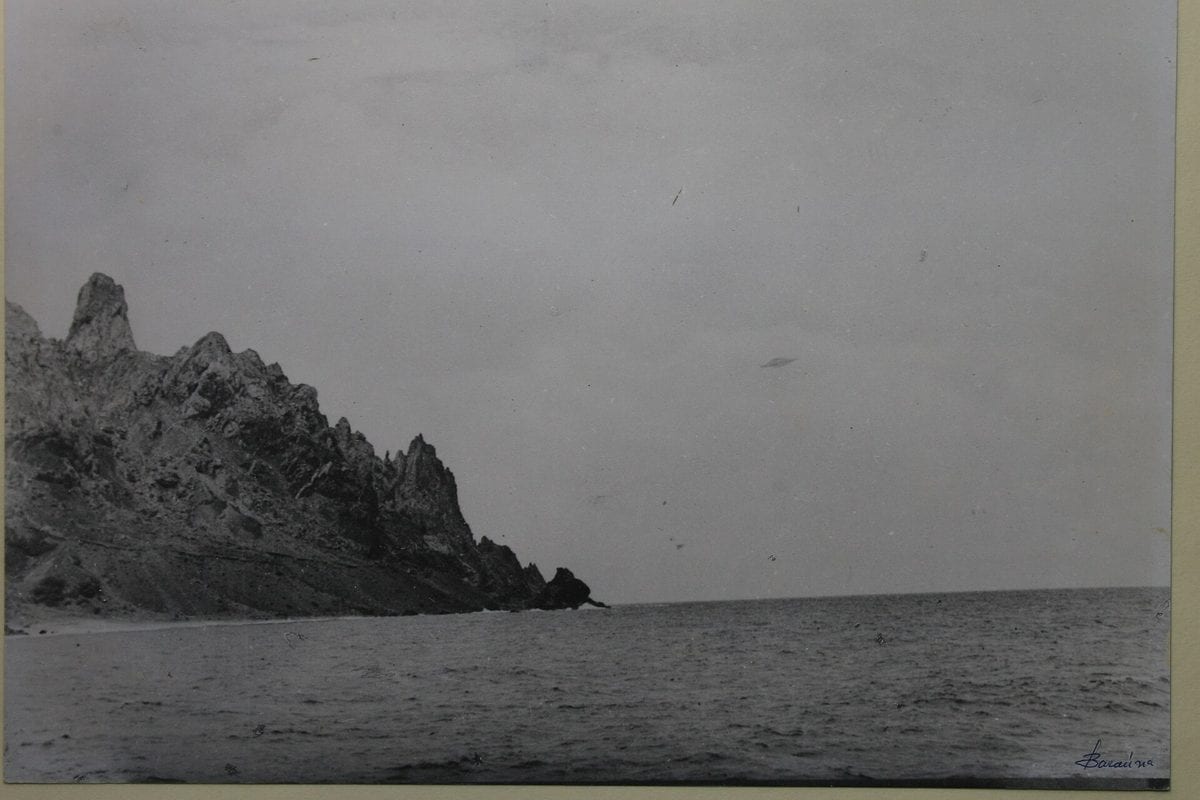
That the four photographs taken by Almiro Barauna off Trindade Island on 16 January 1958 are authentic, unmanipulated images of a real, structured flying object of unknown (and possibly extraterrestrial) origin, corroborated by dozens of naval witnesses and validated by the Brazilian Navy's own analysis, and that skeptical explanations and later hoax claims do not account for the evidence.
On 16 January 1958, civilian photographer Almiro Barauna took four photographs of a dark, Saturn-shaped object from the deck of the Brazilian Navy vessel Almirante Saldanha, anchored off Trindade Island in the South Atlantic. The Navy Ministry examined his negatives, declared them authentic, and President Juscelino Kubitschek released them to the press, an unusually strong official endorsement. That is what is on the record. The claim we rate is narrower: that the photographs prove a real, unexplained (and to many believers, extraterrestrial) craft. That claim is still argued over, and it has never been proven. The U.S. Air Force Project Blue Book judged the images a hoax; skeptics note Barauna had faked photographs before; and in 2010 a Brazilian television program aired a secondhand account that he had confessed to staging the shots. None of these rebuttals is conclusive either, and the alleged confession is contested. The genuine anomalies are noted below.
Believed by: UFO researchers who rank Trindade among the strongest photographic cases (it was cited by NICAP and later by civilian investigators such as Dr. Olavo Fontes), alongside a broad Brazilian public that took the Navy's endorsement as official confirmation
The full story
What is documented
Start with what is not in serious dispute. On 16 January 1958, the Brazilian Navy vessel Almirante Saldanha was anchored off Trindade Island, a remote volcanic outcrop in the South Atlantic roughly 1,100 kilometers from the mainland, tied to research conducted during the International Geophysical Year. Aboard was Almiro Barauna, a civilian photographer brought along to document the expedition.
Near midday, people on deck reported a dark, fast-moving object over the island. Barauna raised his camera and, by his account amid some jostling, exposed several frames. Four of them showed a discernible shape: a dark grey, roughly Saturn-shaped object with a raised central band, seen passing a peak, reversing, and leaving at speed. He developed the film aboard ship, and the negatives soon passed to the Navy.
What followed is the reason Trindade is remembered. The Navy Ministry examined the negatives, reported no evidence of tampering, and President Juscelino Kubitschek released the images to the press. An official statement confirmed that Barauna had taken them aboard the ship in the presence of the crew. Governments almost never put their name to a UFO photograph; here one did.
So the question this file weighs is not whether the photographs exist, nor whether officials endorsed them. Both are true. It is whether they show what the claim says they show: a real, structured, unexplained craft.
The case for authenticity
The strongest version of the believers' case rests on provenance, not on the pixels. This was not a lone witness on a dark road. It was a government ship, a disciplined crew, and a photographer working in daylight, followed by an official examination that found nothing wrong.
Consider the chain. Dozens of people on deck, commonly numbered around 47 to 48, reported seeing something. The negatives went to the Navy's own analysts, who reported no manipulation. The President handed the pictures to reporters. Two decades later, an independent 1978 re-analysis reportedly found none of the double-exposure or montage artifacts that a fake would leave. No examination has ever produced the trick or reproduced the images.
The photographs themselves are unusually good for the genre: four frames of a distinct, ringed object in clear light, not a smudge of glare. For believers, the combination of credible witnesses, official validation, and clean imagery is close to the best a photographic UFO case can offer.
A navy examined the film, a president released it, and no one in more than sixty years has demonstrated the forgery. That is not proof of a spacecraft, but it is a great deal more than most UFO photographs can claim.
The honest form of the case is not that extraterrestrials have been proven. It is that the standard debunkings are incomplete, and that a case with this much official backing deserves to be treated as genuinely open rather than quietly dismissed.
Where the claim runs into trouble
The provenance is impressive, but it does less work than it seems. The Navy certified that Barauna took the pictures aboard the ship and that the negatives showed no tampering it could detect with 1958 methods. That is a finding about the film, not an identification of the object. No manipulation found is not the same as real unexplained craft.
Then there is the photographer. Barauna had faked photographs before, including a magazine piece demonstrating how a UFO image could be staged, and he held the negatives briefly before handing them to the Navy. That history does not prove this case was faked, but it is exactly the background that makes a skeptic cautious, and it is why Project Blue Book leaned toward a hoax verdict.
Skeptical analysts have gone further and shown a plausible mechanism. Tim Printy and others have argued that an in-camera masking or double-exposure technique could produce a convincing fake on location, one that would survive development and casual inspection aboard ship. A demonstrated possibility is not a demonstrated fact, but it removes the sense that the photographs are inexplicable.
The witness count is also softer than the headline number. Figures near 48 are repeated, yet the surviving first-hand testimony is thinner and less uniform than that, and a genuine but ordinary object in the distance could have seeded real sightings while the dramatic shape came from the camera. None of this proves a hoax. It shows that the case for a real craft has never actually been closed.
The 2010 confession that was not quite one
In August 2010, the Brazilian program Fantasticoaired what was widely reported as Barauna's confession. The photographer had died in 2000, so the account came from a family acquaintance, Emilia Bittencourt, who said she had heard him admit that the images were a montage: he had, she said, joined two kitchen spoons into a makeshift saucer and photographed it against his refrigerator.
For a case this contested, a confession would be decisive. This one is not. It is secondhand, offered a decade after Barauna's death, with no negatives, no apparatus, and no corroborating witness. And the detail undercuts itself: the surviving photographs show an object against sky and island seen from a ship's deck, not a saucer against a kitchen appliance. A story about a refrigerator does not obviously explain a picture taken at sea.
The result is that the 2010 account belongs in the same bin as the evidence it was meant to overturn: suggestive, uncorroborated, and unable to close the case. It nudges the balance toward a hoax without proving one, which is precisely the state the whole affair has been stuck in for decades.
A confession relayed by a neighbor, after the man is dead, describing a scene that does not match the photograph, is a lead, not a verdict.
Why the case endures
Trindade holds its place in UFO history for a reason that has little to do with the object and much to do with the authority attached to it. When a national navy and a head of state stand behind a photograph, ordinary skepticism feels almost impertinent. Official endorsement is the rarest thing in this field, and Trindade has it.
It also benefits from a clean image. Most UFO photographs are ambiguous by nature, which lets both sides read what they wish into them. Trindade offers four frames of a definite, structured shape, and a clear picture invites the mind to treat it as a clear fact, even when its origin is anything but settled.
And it sits inside a national story. Brazil had a busy 1950s UFO era and a later record of official interest, so the case reads to many as one data point in a pattern rather than a curiosity. A pattern feels more real than an anomaly, and Trindade gets to borrow that sense of weight.
Finally, the case survives because its critics never finished the job. Every debunking, from Blue Book to the 2010 broadcast, arrived short of proof, and an unfinished rebuttal is fertile ground. Belief here is not sustained only by wishful thinking; it is sustained by a genuine gap the skeptics have never fully filled.
Endorsed, but unresolved
Hold the two claims apart. What is on the record is solid: the sighting happened, the photographs are real, and the Brazilian Navy genuinely endorsed them. The claim we rate is narrower and shakier: that the images depict a real, unexplained craft. The case has never been cleanly debunked, and it has never been confirmed.
The official endorsement, impressive as it is, certifies the circumstances of the photograph, not the identity of the object. Against it stand a photographer with a hoaxing history, a plausible (if unproven) faking technique, and a secondhand confession that does not quite fit. In the other direction stand a 1978 re-analysis that found no tampering and the plain fact that no one has ever reproduced the images or produced the trick. Neither side has closed the argument.
That is an honest place to leave it. Trindade is not a proven spacecraft and not a proven fraud. It is a strong case with a real official pedigree and real unresolved doubts, and the responsible reading is to say so rather than to force it into a certainty the evidence does not support.
What's still unexplained
- No one has ever reproduced Barauna's photographs by demonstrating the specific fake alleged, and the physical negatives and any apparatus are long gone, so the hoax hypotheses remain unproven mechanisms rather than shown facts.
- The witness record is central to the case yet unevenly documented; a rigorous accounting of who saw what, and how consistent the independent accounts actually were, has never been fully assembled from the 1958 sources.
- The 2010 confession is uncorroborated and internally awkward (the kitchen-and-refrigerator description does not match a shipboard photograph), leaving it unclear whether it reflects a real admission, a misremembered story, or an embellishment.
- The Brazilian Navy's original technical analysis has never been published in full, so the exact basis for the official finding of authenticity, and its limits given 1958 technology, cannot be independently assessed.
Point by point
The claim: The Brazilian Navy analyzed the negatives and declared them authentic, so the photographs must be genuine.
What the record shows: The Navy's endorsement is real and unusually strong, but it establishes that officials found no manipulation with the methods and technology of 1958, not that the object was an unexplained craft. A finding of no detectable tampering is not the same as a positive identification. The Navy vouched that Barauna took the pictures aboard the ship in front of witnesses; it did not, and could not, certify what the object was.
The claim: Dozens of naval witnesses saw the object, which rules out a lone photographer's trick.
What the record shows: Witness numbers in the range of 47 to 48 are widely repeated, yet the surviving testimony is thinner and less consistent than the headline figure suggests. Some accounts describe a clear structured craft; others are vaguer or secondhand. A genuine, if ordinary, aerial object seen at a distance could have prompted real sightings while the striking shape in the photographs came from photographic technique. Multiple witnesses to something do not confirm the photographs are faithful to it.
The claim: Project Blue Book proved the photographs were a hoax.
What the record shows: Blue Book leaned toward a hoax verdict, largely on Barauna's background and his custody of the negatives, but it did not demonstrate a method or produce the fake. Its reasoning was circumstantial: Barauna had staged photographs before, including a magazine piece showing how a UFO image could be faked, and he had the film for a short time before handing it over. That is grounds for suspicion, not a proof of forgery.
The claim: The 2010 television confession settles it: Barauna admitted the whole thing was a montage.
What the record shows: The 2010 Fantastico account is secondhand, relayed by an acquaintance years after Barauna's death, with no negatives, apparatus, or corroborating witness produced. The specific description offered, that he improvised a saucer from two kitchen spoons photographed against a refrigerator, does not fit a picture taken on a ship's deck against sky and island, which weakens rather than strengthens the account. It is an allegation, not documentation.
The claim: Skeptics have shown exactly how the picture was faked with an in-camera masking trick.
What the record shows: Analysts such as Tim Printy have argued that an internal-mask or double-exposure method could have produced a convincing fake on location, one that would survive on-the-spot development and casual inspection. This shows a plausible mechanism, which matters, but a demonstrated possibility is not the same as evidence that this mechanism was used here. Other examinations, including the 1978 re-analysis, reported no such artifacts.
Timeline
- 1957-1958The Almirante Saldanha, a Brazilian Navy training and hydrographic vessel, takes part in operations tied to the International Geophysical Year, ferrying personnel and supplies to a research post on Trindade Island, roughly 1,100 kilometers off the Brazilian coast.
- 1958-01-16Around midday, as the ship prepares to leave the anchorage, people on deck report a bright, fast-moving object approaching the island. Almiro Barauna, a civilian photographer aboard to document the expedition, grabs his camera and, in the confusion, manages to take several frames.
- 1958-01-16The object is described as dark grey, disc- or Saturn-shaped with a raised central band, passing behind a peak on the island, reversing course, and departing at high speed. Estimates of the number of witnesses vary, with figures of roughly 47 to 48 people commonly cited.
- 1958-01Barauna develops the film in a makeshift darkroom aboard ship, reportedly under the eyes of officers, and four of the frames show a discernible object. He retains the negatives briefly before the Navy takes them for examination.
- 1958-02The Navy Ministry sends the negatives for photogrammetric and technical analysis, which reports no sign of tampering. The images reach the Rio de Janeiro press, and the story becomes a national sensation.
- 1958-02President Juscelino Kubitschek, reportedly convinced by the account, allows the photographs to be released, and the Navy Ministry issues a statement confirming that Barauna took them aboard the Almirante Saldanha in the presence of the crew. Few UFO cases anywhere receive so direct an official endorsement.
- 1960sThe case enters the international UFO literature. Brazilian physician and investigator Dr. Olavo Fontes promotes it, and the U.S. group NICAP cites it as a strong photographic case. Meanwhile the U.S. Air Force Project Blue Book files record it and lean toward a hoax explanation, questioning Barauna's history and access to the negatives.
- 1978An independent laboratory re-examination using photographic analysis reportedly finds no evidence of the double-exposure or montage techniques skeptics had proposed, keeping the authenticity question open rather than settling it.
- 2010-08The Brazilian television program Fantastico airs an account attributed to a family acquaintance, Emilia Bittencourt, claiming Barauna (who died in 2000) had privately admitted staging the images. Skeptics and believers alike note the account is secondhand, unsupported by physical evidence, and inconsistent with the shipboard setting.
From the case file
The actual records: declassified, released, or leaked. We link straight to each document in its official archive, so you never have to take our word for it. Read the originals yourself.
On 16 January 1958, civilian photographer Almiro Barauna took four photographs of a dark, Saturn-shaped object from the deck of the Brazilian Navy vessel Almirante Saldanha, anchored off Trindade Island in the South Atlantic. The Navy Ministry examined his negatives, declared them authentic, and President Juscelino Kubitschek released them to the press, an unusually strong official endorsement. That is what is on the record. The claim we rate is narrower: that the photographs prove a real, unexplained (and to many believers, extraterrestrial) craft. That claim is still argued over, and it has never been proven. The U.S. Air Force Project Blue Book judged the images a hoax; skeptics note Barauna had faked photographs before; and in 2010 a Brazilian television program aired a secondhand account that he had confessed to staging the shots. None of these rebuttals is conclusive either, and the alleged confession is contested. The genuine anomalies are noted below.
Reviewed by Colin Peterson · Last reviewed July 8, 2026 · How we rate
Common questions
Is Trindade Island UFO photos true?
On 16 January 1958, civilian photographer Almiro Barauna took four photographs of a dark, Saturn-shaped object from the deck of the Brazilian Navy vessel Almirante Saldanha, anchored off Trindade Island in the South Atlantic. The Navy Ministry examined his negatives, declared them authentic, and President Juscelino Kubitschek released them to the press, an unusually strong official endorsement. That is what is on the record. The claim we rate is narrower: that the photographs prove a real, unexplained (and to many believers, extraterrestrial) craft. That claim is still argued over, and it has never been proven. The U.S. Air Force Project Blue Book judged the images a hoax; skeptics note Barauna had faked photographs before; and in 2010 a Brazilian television program aired a secondhand account that he had confessed to staging the shots. None of these rebuttals is conclusive either, and the alleged confession is contested. The genuine anomalies are noted below.
What is Trindade Island UFO photos?
In January 1958, a Brazilian Navy ship on its way to resupply a research station at Trindade Island, a remote volcanic outcrop in the South Atlantic, became the setting for one of the most cited photographic UFO cases in history. A civilian photographer aboard, Almiro Barauna, produced four images of a dark, ringed object over the island…
What does the evidence show?
The Navy's endorsement is real and unusually strong, but it establishes that officials found no manipulation with the methods and technology of 1958, not that the object was an unexplained craft. A finding of no detectable tampering is not the same as a positive identification. The Navy vouched that Barauna took the pictures aboard the s…
Why do people believe it?
The state itself endorsed it. A national navy examined the negatives and a sitting president released them, and for most observers official validation of that weight is close to conclusive. Few UFO cases carry a comparable stamp, which is exactly why Trindade became a flagship case.
What is still unresolved?
No one has ever reproduced Barauna's photographs by demonstrating the specific fake alleged, and the physical negatives and any apparatus are long gone, so the hoax hypotheses remain unproven mechanisms rather than shown facts.
Sources
- 1.The Trindade island visual and photographic case of 1958, Patrick Gross, UFOs at Close Sight (2010)
- 2.Trindade photographic case, Brazil 1958 (Pocantico presentation), Patrick Gross, UFOs at Close Sight (1997)
- 3.Trindade Island UFO Revisited, Kevin Randle, A Different Perspective (2010)
- 4.UFO over Trindade Island, Tim Printy, astronomyufo.com (2010)
- 5.Trindade Island UFO: Most Revered Photograph A Hoax, Ghost Theory (2010)
- 6.Trindade Island Photographs, Trindade Island, Brazil, January 16, 1958, UFO Evidence
- 7.Unsolved: The Trindade Island's UFO, HandWiki
- 8.Project Blue Book file: Trindade Island, 16 January 1958, The Black Vault (1958)
Embed this case file on your site
Paste this snippet to show this case file as a small card, with a link back to the full write-up. Free to use.
<iframe src="https://theconspiratory.com/embed/trindade-island-ufo" title="The Conspiratory verdict" width="520" height="190" style="border:0;max-width:100%" loading="lazy"></iframe>Help us investigate
This is a living case file. If you spot an error or know evidence we missed, tell us, and weigh in on where you land.
Where do you land?
Cast your read on this one.
Comments
Add your take. Comments are read and approved by a human before they appear, so keep it on topic and civil. Please do not accuse named, living people of crimes.