The Unfinished Obelisk of Aswan is too large and too precisely worked to be the product of hand tools, and proves a lost or non-human technology
By Colin PetersonJuly 8, 2026
Where the evidence lands: Contradicted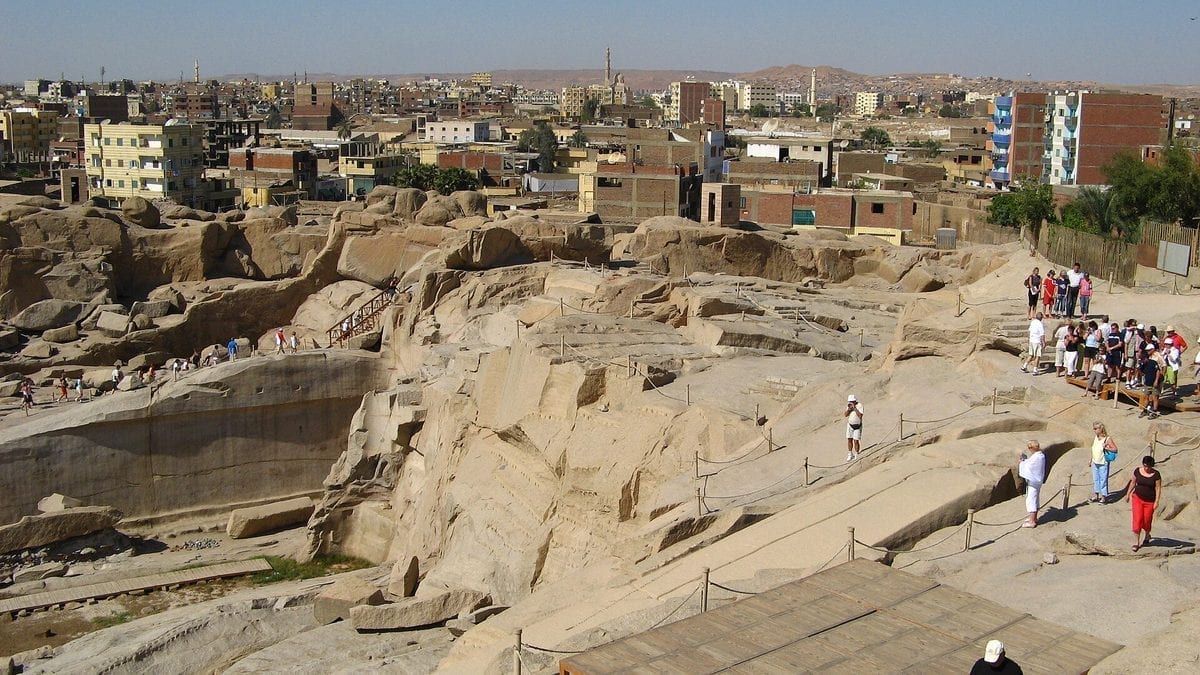
That the Unfinished Obelisk at Aswan is so large, and its worked surfaces so regular, that ordinary Bronze Age hand tools could not have produced it, and that it is therefore evidence of a lost advanced technology (power machinery, sonic or ultrasonic cutting, or some forgotten method) or of non-human intervention, which mainstream Egyptology conceals or ignores.
Contradicted. The Unfinished Obelisk is real and well studied: a colossal granite shaft, roughly 42 metres long and close to 1,090 tonnes if it had been finished, still lying in its quarry at Aswan where masons abandoned it after the stone cracked, most likely a commission of the pharaoh Hatshepsut for Karnak. The claim we rate is different and larger: that its scale and finish are beyond hand tools and therefore prove a forgotten high technology or a non-human hand. That claim is debunked. The quarry preserves the actual method in plain sight (rounded bruising from dolerite pounders, ochre guide-lines, unfinished trenches, and the crack that ended the work), experimental archaeology has reproduced the technique, and no machined surface, tool, or artifact of any advanced technology has ever been found. A hard, slow, ordinary explanation is documented; an extraordinary one is asserted.
Believed by: A broad popular audience reached through ancient-mysteries television, YouTube, and books, ranging from ancient-astronaut proponents to lost-civilisation writers and readers who find the sheer scale of the stone hard to reconcile with copper-age tools
The full story
What is documented
The starting point is unusually solid, because the object in question is not a legend but a worksite you can walk around. In the granite quarries at Aswan, on the east bank of the Nile, lies a single colossal obelisk that was never finished. Along its underside it is still joined to the living bedrock, exactly as its makers left it. Had it been completed it would have risen roughly 42 metres and weighed close to 1,090 tonnes, nearly a third larger than any obelisk the Egyptians actually raised.
The work is generally dated to the reign of Hatshepsut, around 1479 to 1458 BC, and the shaft was most likely intended for the temple of Amun at Karnak. It was abandoned for a plain reason that is still visible in the stone: fissures opened through the granite, and a flawed shaft could not be used. The crews left it where it lay and moved on, and in doing so they preserved something a finished monument never could: the tools, the guide-marks, and the half-cut trenches of the job itself.
So the question this file weighs is not whether the obelisk is real, or whether it is huge. Both are settled. It is whether the far larger claim built on its size, that it is beyond hand tools and therefore proves a lost or non-human technology, has anything behind it. It does not.
The case people make
The suspicion deserves to be stated at full strength, because it does not come from nowhere. Stand at the quarry and the scale alone does the arguing: a single stone the length of a twelve-storey building, cut from one piece, meant to be stood upright and balanced. The instinct that copper chisels and hand-held rocks could not have produced it is immediate and, on its face, reasonable.
The surfaces feed the same intuition. The quarry is covered in scoop-shaped depressions, smooth rounded channels and hollows that, to a modern eye trained on machined metal, look far more like the work of a tool that spins or grinds than of a man swinging a stone. Engineer Christopher Dunn and others have pressed exactly this point: that the obelisk offers evidence less by showing what methods were used than by the overpowering indications, as they see it, of what methods could not have been.
A stone the size of a building, scooped surfaces that look milled, and a monument abandoned mid-work. The impulse to ask how on earth this was done is not the error. The error is the specific answer supplied in place of the evidence.
That is the case at its most honest: not a proof of machines or visitors, but a sincere argument from incredulity, rooted in a genuine astonishment that a Bronze Age society could set itself a task this enormous. Anyone who has stood beside the stone can feel the pull of it.
The method is written in the stone
Here the claim runs into the object itself. The quarry does not hide how the obelisk was worked; it records it. The rounded hollows that look machined are the signature of dolerite pounding. Crews used hand-held balls of dolerite, an igneous rock tougher than granite, to bruise and pulverise the surface, blow by blow, reducing the rock to powder rather than cutting it. The marks left behind are overlapping, rounded bruises, not the straight striations of a saw or the concentric grooves of a drill.
The site is littered with the corroborating detail. Discarded dolerite hammerstones lie about the quarry. Ochre guide-lines mark where masons meant to work. The separation trenches cut around the shaft, just wide enough for a worker to stand and swing, are still unfinished. And the crack that ended the project runs through the granite in plain view. This is not the residue of a machine that vanished; it is the toolkit and the layout of a copper-age crew, frozen at the moment they walked away.
The conventional account also handles the size without strain. Granite surrenders to abrasion given enough workers and enough time, and a pharaonic state had command of both. Softer stone was cut with copper saws fed with sand, whose quartz grains, as hard as the granite, did the actual cutting. Scale, on this reading, is a measure of ambition and organisation, of how many hands a ruler could marshal, not evidence of a secret method.
The technique put to the test
A method preserved in a quarry is persuasive; a method reproduced by hand is decisive. The conventional explanation has been put to the test, repeatedly, and it works.
Experimental archaeologists including Egyptologist Mark Lehner, stonemason Roger Hopkins, and researcher Denys Stocks have quarried and shaped granite using nothing but dolerite pounders and copper-and-sand abrasion, work carried out at Aswan and elsewhere and filmed for the PBS series NOVA. A 2023 study went further still, using photogrammetry to measure how quickly a dolerite pounder removes granite, translating the ancient technique into numbers. The technique is confirmed, not conjectured.
What these experiments also confirm is that the work is slow and gruelling, which is not an embarrassment for the conventional case but the heart of it. A monument that took a large crew a long time to rough out, and that was then abandoned when the stone failed, is exactly what a punishingly slow method predicts. The lost-technology reading, by contrast, has to explain not only an imagined machine but its total absence: no tool, no cut surface, no debris, no depiction, nothing anywhere in the archaeological record.
The scoop-marks that are offered as proof of a machine are the exact marks a stone pounder leaves. The evidence held up as the mystery is, on inspection, the solution.
Why the claim persists
The lost-technology reading endures for reasons that have more to do with how the story is told than with the stone itself.
It rides a true and overwhelming impression. The scale is real, and the astonishment it produces is genuine; the mind reaches for a cause equal to the object, and a forgotten super-science or an alien hand feels more proportionate to a 1,090-tonne stone than a crew of workers with rocks. The correct answer is the counterintuitive one, and disbelief in the slow, low-tech method does the rest.
It is amplified by a medium that edits out the answer. Ancient-mysteries television and viral video linger on the size and the scoop-marks while leaving the pounders, the ochre lines, and the reproduction experiments on the cutting-room floor. Presented as a problem with its solution removed, the obelisk looks like an anomaly. Shown whole, it looks like a worksite.
And it serves a larger narrative. Slotting the stone into a tale of a vanished golden age, or of visitors who gave the ancients a leg up, converts a hard engineering job into a cosmic clue. That story is more thrilling than the documented one, in which the marvel is not a machine but the sheer organised will of a society that set thousands of people to bruise a mountain into shape.
Dolerite pounders, not machines
Hold the two claims apart, because the whole discipline of the case lives in the gap between them. The monument is real and remarkable: a colossal, partly quarried obelisk, abandoned when the granite cracked, that uniquely preserves the tools and technique of its own making. On that there is no argument. The claim we rate is different: that its scale and finish are beyond hand tools and therefore prove a lost or non-human technology. That claim is contradicted by the object itself, which carries the pounding marks, the hammerstones, the guide-lines, and the crack that together document an ordinary, if heroic, ancient method. On that claim the rating is Contradicted.
This is not a diminishment of the achievement. Quarrying a stone this size by bruising granite with harder stone, over months of relentless labour, is an extraordinary human feat, and the awe the obelisk inspires is earned. The lost-technology reading does not add to that achievement; it takes it away, handing the credit to a machine no one has found or a visitor no one can produce.
The honest posture is the simplest one. Look at what the quarry actually shows, follow the marks to the tools that made them, and let the reproduced technique settle the question. What remains is not a mystery of forgotten technology but a monument to organisation, patience, and ambition, left half-finished by a crack in the rock and preserved, for exactly that reason, as the clearest window we have into how the Egyptians shaped their giants.
What's still unexplained
- Exactly how long the full job would have taken, and how many workers were deployed, remains estimated rather than certain; recent rate measurements narrow the range, but the precise labour budget for a monument this size is still debated within conventional bounds.
- How the Egyptians intended to detach the finished shaft cleanly from the bedrock along its underside, and then transport and raise close to 1,090 tonnes, is understood in outline from later successful obelisks but not documented step by step for this specific, never-completed piece.
- How much the ochre guide-lines and layout marks can tell us about the crews' planning and quality control is an active research question, one that concerns the sophistication of the organisation rather than any exotic technology.
Point by point
The claim: An object this large, close to 1,090 tonnes, simply cannot be produced with copper-age hand tools, so a lost or advanced technology is required.
What the record shows: Scale is a labour problem, not a technology problem. Granite yields to patient abrasion: crews bruised away the rock with hand-held dolerite pounders (a stone tougher than granite), cut the perimeter trenches wide enough to stand in, and dressed surfaces with sand as an abrasive. The method is slow and brutally labour-intensive, but it is documented in the quarry itself and it scales with manpower and time, both of which a pharaonic state commanded. Size shows ambition and organisation; it does not show a hidden machine.
The claim: The regular, scooped surfaces and precise trenches look machined, beyond what hammering could achieve.
What the record shows: The surfaces record exactly the tool that made them. The quarry floor and the obelisk are covered in the rounded, overlapping bruise-marks that dolerite pounding leaves, not the linear striations of a saw or the helical grooves of a drill. Rows of these scoop-shaped depressions, ochre guide-lines marking where to work, and unfinished separation trenches are visible in situ. Far from hiding a method, the site preserves the method, and the marks match pounding, not machining.
The claim: No one has ever reproduced this kind of granite work by hand, so the conventional explanation is untested.
What the record shows: It has been reproduced. Experimental archaeologists have quarried and shaped granite using dolerite pounders and copper-and-sand abrasion, work carried out at Aswan and elsewhere and filmed for programmes such as NOVA. A 2023 photogrammetric study went further and measured how fast a dolerite pounder removes granite, putting numbers to the process. The technique is confirmed to work; the honest finding is that it is punishingly slow, which fits an abandoned monument that a large workforce laboured over for a long time.
The claim: The obelisk was abandoned because the ancient technology failed or was lost, a sign something extraordinary was going on.
What the record shows: The abandonment has a mundane, visible cause: the granite cracked. Fissures run through the shaft, and flawed stone cannot bear an obelisk's stresses once raised, so the crews cut their losses and started elsewhere. This is ordinary quarrying misfortune, and it is the reason the site is so valuable: a finished obelisk tells you nothing about how it was made, while a monument abandoned mid-work freezes the technique in place.
The claim: Mainstream Egyptology suppresses or ignores the anomaly because it cannot explain the obelisk.
What the record shows: The opposite is true. The Unfinished Obelisk is one of the most discussed objects in Egyptology precisely because it is so revealing, studied in detail since Engelbach's 1923 monograph and central to research on ancient stoneworking. There is no suppression: the tools, marks, guide-lines, and crack are published, photographed, and open to visitors at an officially managed site. A field that built its account of obelisk-making largely on this object is not hiding it.
Timeline
- c. 1479–1458 BCDuring the reign of Hatshepsut, masons begin cutting a single enormous obelisk directly from the granite bedrock of the Aswan quarry, most likely intended for the temple of Amun at Karnak. Planned at roughly 42 metres and nearly 1,090 tonnes, it would have been the largest obelisk ever raised.
- c. 15th century BCAs the perimeter trenches are cut and the shaft is nearly ready to be detached, cracks open through the granite. The flawed stone cannot be used, and the work is abandoned. The obelisk is left half-freed, still joined to the bedrock along its base, together with the tools and guide-marks of the crews.
- Antiquity to modern eraOver the following millennia the site is partly buried by sand and quarry debris. The obelisk survives largely because it was never moved, preserving an unfinished worksite rather than a finished monument.
- 1921–1923The engineer and Egyptologist Reginald Engelbach clears and studies the obelisk and publishes The Problem of the Obelisks (1923), calculating its dimensions and weight, estimating the workforce, and documenting the dolerite-pounding method from the marks left in the quarry. His study becomes the foundational analysis of how such monuments were made.
- 1970sAs the ancient-astronaut genre popularised by writers such as Erich von Daniken spreads, Egypt's largest stoneworks, including the Aswan quarry, are recast in popular media as feats supposedly beyond ancient capability, seeding the idea that a lost or alien technology was involved.
- 1990sExperimental archaeology puts the conventional method to the test. Teams including Egyptologist Mark Lehner, stonemason Roger Hopkins, and researcher Denys Stocks quarry and shape granite with dolerite pounders and copper-and-sand abrasion, work filmed at Aswan and in the United States for the PBS series NOVA.
- 1998Engineer Christopher Dunn argues in The Giza Power Plant and related writing that the obelisk's scale and surfaces indicate machining, pressing the case that the object shows what methods could not have been used rather than what could. The claim becomes a staple of lost-technology commentary.
- 2010s–2020sCable television and online video carry the lost-technology and ancient-alien readings to a mass audience, focusing on the quarry's scoop-shaped marks and the obelisk's size. In parallel, a 2023 photogrammetric study measures the actual rate at which dolerite pounders remove granite, refining the quantitative picture of the ancient method.
From the case file
The actual records: declassified, released, or leaked. We link straight to each document in its official archive, so you never have to take our word for it. Read the originals yourself.
The Problem of the Obelisks, from a Study of the Unfinished Obelisk at Aswan
The foundational scientific study of the Unfinished Obelisk, based on Engelbach's clearance and survey of the site in 1921 and 1922. It calculates the obelisk's planned dimensions and weight, estimates the workforce, and documents the dolerite-pounding quarrying method from the marks in the granite. It is the primary reason the object is understood as evidence of how obelisks were made, not evidence of anything lost.
Read the document: Internet Archive →The Unfinished Obelisk (official monument record)
The official record for the Unfinished Obelisk from the antiquities authority that manages the site. It confirms the attribution to Hatshepsut, the intended destination at Karnak, and the abandonment of the work because of flaws and fissures in the stone, with the tool marks and ochre guide-lines still visible in situ.
Read the document: Egyptian Ministry of Tourism and Antiquities →Contradicted. The Unfinished Obelisk is real and well studied: a colossal granite shaft, roughly 42 metres long and close to 1,090 tonnes if it had been finished, still lying in its quarry at Aswan where masons abandoned it after the stone cracked, most likely a commission of the pharaoh Hatshepsut for Karnak. The claim we rate is different and larger: that its scale and finish are beyond hand tools and therefore prove a forgotten high technology or a non-human hand. That claim is debunked. The quarry preserves the actual method in plain sight (rounded bruising from dolerite pounders, ochre guide-lines, unfinished trenches, and the crack that ended the work), experimental archaeology has reproduced the technique, and no machined surface, tool, or artifact of any advanced technology has ever been found. A hard, slow, ordinary explanation is documented; an extraordinary one is asserted.
Reviewed by Colin Peterson · Last reviewed July 8, 2026 · How we rate
Common questions
Is The Unfinished Obelisk true?
Contradicted. The Unfinished Obelisk is real and well studied: a colossal granite shaft, roughly 42 metres long and close to 1,090 tonnes if it had been finished, still lying in its quarry at Aswan where masons abandoned it after the stone cracked, most likely a commission of the pharaoh Hatshepsut for Karnak. The claim we rate is different and larger: that its scale and finish are beyond hand tools and therefore prove a forgotten high technology or a non-human hand. That claim is debunked. The quarry preserves the actual method in plain sight (rounded bruising from dolerite pounders, ochre guide-lines, unfinished trenches, and the crack that ended the work), experimental archaeology has reproduced the technique, and no machined surface, tool, or artifact of any advanced technology has ever been found. A hard, slow, ordinary explanation is documented; an extraordinary one is asserted.
What is The Unfinished Obelisk?
In the granite quarries on the east bank of the Nile at Aswan lies one of the most instructive objects in Egyptology: a single obelisk, still attached to the bedrock along its underside, that its makers never freed. Had it been finished it would have stood roughly 42 metres tall and weighed close to 1,090 tonnes, nearly a third larger th…
What does the evidence show?
Scale is a labour problem, not a technology problem. Granite yields to patient abrasion: crews bruised away the rock with hand-held dolerite pounders (a stone tougher than granite), cut the perimeter trenches wide enough to stand in, and dressed surfaces with sand as an abrasive. The method is slow and brutally labour-intensive, but it i…
Why do people believe it?
The raw scale is genuinely staggering. Standing beside a single stone the length of a twelve-storey building, the intuition that hands and stones could not have shaped it is immediate and forceful, and that gut reaction does most of the persuading before any argument is made.
What is still unresolved?
Exactly how long the full job would have taken, and how many workers were deployed, remains estimated rather than certain; recent rate measurements narrow the range, but the precise labour budget for a monument this size is still debated within conventional bounds.
Sources
- 1.Unfinished obelisk, Wikipedia
- 2.The Unfinished Obelisk, Egyptian Ministry of Tourism and Antiquities
- 3.The problems of the obelisk revisited: Photogrammetric measurement of the speed of quarrying granite using dolerite pounders, Journal of Archaeological Science: Reports (ScienceDirect) (2023)
- 4.Claim: Ancient Egyptians Could Not Work Granite Without High-Tech Diamond Tools, Metabunk (2021)
- 5.A NOVA Crew Strains, and Chants, to Solve the Obelisk Mystery, Smithsonian Magazine (1999)
- 6.Secrets of Lost Empires: Pharaoh's Obelisk, PBS NOVA (1997)
- 7.Unfinished Obelisk in Aswan is More Than 3,500 Years Old, My Modern Met (2021)
- 8.The problem of the obelisks, from a study of the unfinished obelisk at Aswan, Reginald Engelbach (Internet Archive) (1923)
- 9.The Evidence is Cut in Stone: A Compelling Argument for Lost High Technology in Ancient Egypt, Ancient Origins (2018)
Embed this verdict on your site
Paste this snippet to show our sourced verdict as a small card, with a link back to the full case file. Free to use.
<iframe src="https://theconspiratory.com/embed/unfinished-obelisk" title="The Conspiratory verdict" width="520" height="190" style="border:0;max-width:100%" loading="lazy"></iframe>Help us investigate
This is a living case file. If you spot an error or know evidence we missed, tell us, and weigh in on where you land.
Where do you land?
Cast your read on this one.
Comments
Add your take. Comments are read and approved by a human before they appear, so keep it on topic and civil. Please do not accuse named, living people of crimes.