The Whaley House in San Diego is genuinely haunted, the most haunted house in America, occupied by the spirits of a hanged man and the Whaley family
By Colin PetersonJuly 8, 2026
Where the evidence lands →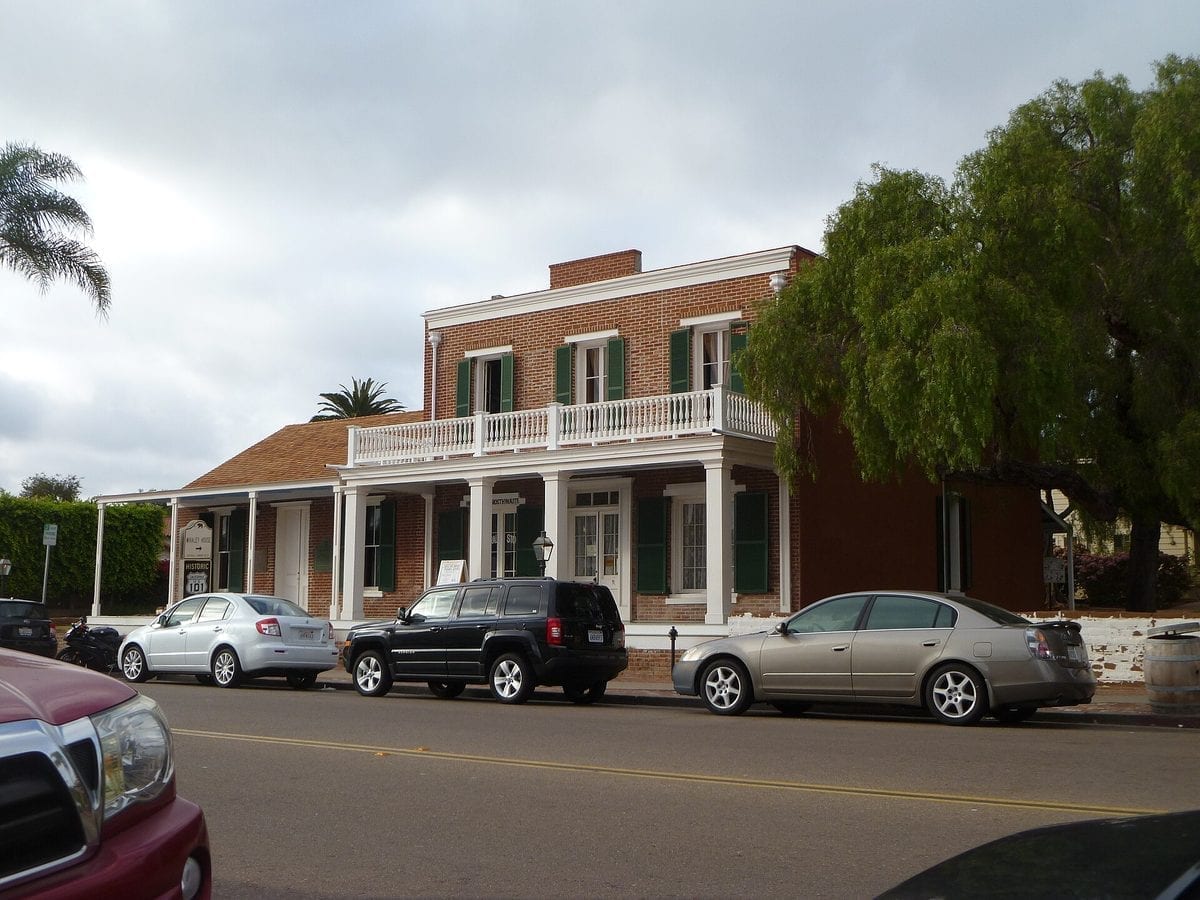
That the Whaley House is literally haunted, permanently inhabited by the ghosts of Yankee Jim Robinson, Thomas and Anna Whaley, their children, and others, that the activity is objectively real rather than imagined, and that the house is the most haunted in America, a status various accounts say was even certified by the federal government.
The Whaley House is a real and well-documented place: an 1857 brick home in Old Town San Diego, built by Thomas Whaley on ground that had served as a public gallows, later a store, courthouse, and theater, and a museum since 1960. Real tragedies happened there. The claim we rate is narrower: that the house is literally inhabited by the ghosts of Yankee Jim Robinson, Thomas and Anna Whaley, and others, and that it is objectively the most haunted house in America. That claim rests on anecdotes, low-light perception, media labels, and a heavily marketed tourist reputation, not on any controlled or repeatable evidence. No paranormal presence has ever been demonstrated, and the mundane explanations are strong, so the haunting is unproven. The underlying reports, including one written by Thomas Whaley himself, have mostly been retold rather than rigorously tested.
Believed by: Paranormal enthusiasts, ghost-tour operators and their customers, and a large share of the more than 100,000 people who visit the museum each year; the house is a fixture of American haunted-place lists and television specials
The full story
The house and its dead
Start with what is solid, because a good deal here is. The Whaley House is a real two-story Greek Revival brick home in Old Town San Diego, completed in 1857 by the merchant Thomas Whaleyfrom bricks fired in his own yard. Over the years the same building served as a store, the county courthouse, and San Diego's first commercial theater. It has been a museum since 1960 and draws well over a hundred thousand visitors a year.
The sorrows are documented too. Whaley built on a lot where a man known as Yankee Jim Robinson had been hanged in 1852, in an execution so poorly arranged that he reportedly strangled for a long time rather than dying at once. A Whaley infant died of scarlet fever in the house in 1858. In 1885 one of the daughters, Violet, died by suicide there, a real loss this file treats with the seriousness it deserves. The family lived on the property until the last surviving child died in 1953.
So the question is not whether the house is old, or whether painful things happened in it. Both are true. The question is the larger one layered on top: whether the building is literally inhabited by the spirits of those dead, and whether it is, as advertised, objectively the most haunted house in America.
Why people are convinced
The believers' case is not empty, and it is worth stating at its strongest. Unlike many haunted-house legends, this one has a firsthand account from the original owner. Thomas Whaley wrote of hearing heavy, unexplained footsteps moving through the house, and he wondered aloud whether they belonged to the hanged man on whose gallows ground he had chosen to build. That is a named, historical witness, writing near the time, not a modern tour guide.
The stories also cluster in ways that feel coherent. Reports place activity on the staircase and the rooms above the old gallows site, exactly where the darkest history sits. Anna Whaley's gentle presence is described on the main floor and in the garden she tended. Even a professional skeptic, the young broadcaster Regis Philbin, came away rattled after seeing a filmy white shape on a wall in 1964.
A slow hanging, a child lost to fever, a daughter's suicide, and the builder's own note about footsteps he could not explain. The raw material of the legend is not invented. That is what makes it persuasive.
Add the endorsements, a Life magazine cover feature and years of television billing the place as America's most haunted, and the believer's conclusion follows naturally: too many people, over too long a time, in a house with this much death behind it, cannot all be imagining the same thing.
The certificate that never was
One of the most quoted proofs is also the easiest to check, and it collapses on contact. Across tourism copy, blog posts, and even some reference pages, you will read that the U.S. Department of Commerce officially certified the Whaley House as one of the only genuinely haunted houses in the country.
There is no such thing. The Department of Commerce does not designate haunted houses, keeps no such list, and by all available evidence never did. No agency issues a “haunted” credential, and no one repeating the claim has ever produced the document, the file number, or the date behind it. It is a piece of official-sounding folklore, a badge with nothing behind the badge, passed from one write-up to the next because it sounds authoritative.
The same discount applies to the media labels. Being named the most haunted house by Life magazine or the Travel Channelmeasures fame, not physics; these are entertainment features, not investigations that verified a spirit. The museum's operators went so far as to trademark the phrase “America's Most Haunted House,” which tells you exactly what kind of claim it is: a brand, not a finding.
What a dark old house does on its own
Strip away the credentials and you are left with the reports themselves: footsteps, cold spots, orbs in photos, fleeting shapes, a tightening in the chest under the archway. Each has an ordinary candidate that has to be ruled out before a ghost is needed, and none has been.
A large 19th-century brick houseis a noise machine. It expands and contracts with San Diego's heat, its floors and timbers settle, and footfalls carry through old wood, which is enough to explain the sounds Whaley heard. Cold spots are what drafts and convection produce in a building with leaky windows. The glowing orbsin visitors' photographs are a thoroughly studied artifact, dust or insects close to the lens lit by an on-camera flash, not spirits.
The bodily sensations have equally mundane roots. Low-frequency sound and simple suggestioncan generate unease, pressure, and glimpses of movement at the edge of vision, and a visitor who already knows about a slow hanging under that very archway is primed to feel a tightening throat. Even Philbin's apparition, by his own account, resolved into a portrait the moment he turned on the light, which is what perception in a dark room does. None of this proves nothing paranormal happened. It shows that nothing paranormal is required, and that no test has removed the ordinary explanations.
The setting does the work
Why does this particular house, out of countless old buildings with sad histories, become the most haunted in America? The answer has more to do with story and setting than with anything measured in its rooms.
The Whaley House offers a perfect stage. It is a genuinely atmospheric Victorian interior, dim and creaking, entered by visitors who have already read the tragedies before they cross the threshold. Expectation is a powerful lens: once you are told a daughter died in a certain room and a man strangled on the ground beneath your feet, a cold draft and a groaning stair stop being architecture and become evidence.
There is also a self-reinforcing economy. Ghost tours, night investigations, television specials, and a trademarked slogan all depend on the house being haunted, and each retelling adds detail and confidence to stories that were anecdotes to begin with. A firsthand note from Thomas Whaley grows, over generations, into a catalog of named spirits with personalities and perfumes.
The house does not need to be haunted to feel haunted. A dark stage, a tragic script, and an audience that already knows the ending will do the rest.
A sad history, no proven ghost
Hold the two things apart. The Whaley House is real, historically important, and the site of documented human tragedy, and none of that is in dispute. The claim we rate is the other one: that the building is objectively inhabited by surviving spirits and is, as a matter of fact, the most haunted house in America. On that claim, the evidence is anecdote, atmosphere, media branding, and a government certification that does not exist. The everyday explanations for the reports are strong and have never been excluded under controlled conditions.
The single most interesting thread, Thomas Whaley's own written account of footsteps he could not explain, is a real primary source, and much of the wider record has been retold rather than rigorously tested. A settling brick house remains the likeliest answer to what Whaley heard, but the claim has not been put to a test that could have failed.
The house deserves its fame as a landmark and its respect as a place where people genuinely suffered. What it has not earned is the supernatural certainty stamped on its marquee. Enjoy the tour, feel the chill on the stairs, and keep the difference in view: a place can be haunting without being haunted, and this one has become a national legend on exactly that ambiguity.
What's still unexplained
- Thomas Whaley's own contemporaneous notes about unexplained footsteps remain a genuine primary-source puzzle. A settling brick house is the likely answer, but what he actually heard cannot now be re-examined.
- The long catalog of reports has mostly been retold, not tested. No sustained, controlled investigation has isolated a paranormal signal, but neither has the full body of claims been systematically studied, which leaves them untested rather than tested and failed.
- The origin of the “U.S. Department of Commerce certification” story is itself unexplained. No one has traced the phrase to a real document, and it is unclear when or how it entered the house's promotional lore.
- How much of the reported activity is intrinsic to the building and how much is produced by expectation, atmosphere, and the tourism economy that depends on the ghosts is a question the popularity of the site makes hard to disentangle.
Point by point
The claim: The U.S. Department of Commerce officially certified the Whaley House as one of the only genuinely haunted houses in America.
What the record shows: No such certification exists. The Department of Commerce does not, and by all available evidence never did, maintain any list or official designation of haunted houses. The claim is repeated across tourism copy and blog posts but has never been traced to a real government record, and no agency issues such a credential. It functions as an official-sounding badge with nothing official behind it.
The claim: Life magazine and the Travel Channel call it the most haunted house in America, so the haunting must be real.
What the record shows: A media label measures fame, not physics. The 2005 Life feature and the many television specials are entertainment and tourism coverage, not investigations that verified a ghost. The museum's operators trademarked the “America's Most Haunted House” phrase, which is a marketing asset. Popularity and a catchy title are not evidence that anything supernatural is present.
The claim: Thomas Whaley himself documented the haunting when he wrote of hearing Yankee Jim's footsteps.
What the record shows: Whaley's note is a genuine primary source, and it is the strongest single thread in the case, but it documents an unexplained sound, not a ghost. A large brick house expands and contracts with San Diego's heat, timbers settle, and footsteps carry through floors; a grieving, imaginative resident living on the site of a notorious hanging attributing those noises to Robinson is interpretation layered onto an ordinary creak.
The claim: Visitors report cold spots, glowing orbs, apparitions, and a tightening in the chest under the old archway, which shows spirits are present.
What the record shows: Each has a mundane candidate. Drafts and convection in a poorly sealed 19th-century house create cold pockets; orbs in photographs are dust or insects lit by an on-camera flash, a well-studied artifact; low-frequency sound and simple suggestion can produce unease and fleeting peripheral shapes; and knowing the tragic backstory primes the mind to read meaning into normal sensations. None of this has been isolated under controls.
The claim: Even skeptics like Regis Philbin saw the ghost of Anna Whaley with their own eyes.
What the record shows: By Philbin's own telling, when he turned on the light “nothing was there but a portrait of Anna Whaley.” A filmy shape in a dark historic room that resolves into a painting on illumination is a textbook example of perception in low light, not a demonstration that a figure was ever physically present.
The claim: The site's violent past, a slow hanging and multiple deaths in the family, explains why so many spirits linger here.
What the record shows: The tragedies are real and give the stories their emotional force, which is precisely why the house is such fertile ground for legend. But a grim history is a narrative hook, not physical evidence. Countless sites of death produce no reported hauntings; the correlation people feel between suffering and ghosts is a storytelling instinct, not a measured phenomenon.
Timeline
- 1852-09James “Yankee Jim” Robinson is publicly hanged on the lot in Old Town after a conviction connected to a stolen rowboat. The gallows are poorly suited to his height, and by many accounts he strangles slowly rather than dying quickly. Thomas Whaley is among the spectators.
- 1857Whaley completes a two-story Greek Revival brick house on that same lot, built from bricks fired in his own yard, and the family moves in during August. It is one of the first brick structures in San Diego and later serves as a store, county courthouse, and the town's first commercial theater.
- 1858The Whaleys' young son, Thomas Jr., dies in the house of scarlet fever before his second birthday, one of several family tragedies later woven into the haunted narrative.
- 1860Thomas Whaley records in his own writings that he and others hear heavy, unexplained footsteps moving on the stairs and floors, sounds he speculates belong to the spirit of Yankee Jim Robinson. This is the earliest firsthand account of strange activity in the house.
- 1871During a dispute over moving the county records out of Old Town, men enter the house and, by later accounts, confront Anna Whaley on the staircase while Thomas is away. The courthouse era ends, and the episode becomes part of the building's lore.
- 1885-08-19Violet Whaley, one of the couple's daughters, dies by suicide in the house following a brief and unhappy marriage. Her death, treated here with the gravity a real loss deserves, becomes another anchor for the ghost stories.
- 1953Lillian Whaley, the last surviving Whaley child, dies, ending the family's long occupancy. The neglected house is threatened with demolition before preservationists intervene.
- 1960Restored and designated a historic landmark, the Whaley House opens to the public as a museum. Ghost stories, already local lore, become a central part of its public identity.
- 1964Television personality Regis Philbin, filming at the house, reports seeing a filmy white apparition on a wall, which he says vanished into a portrait of Anna Whaley when he switched on a light. The account is retold for decades.
- 2005Life magazine features the Whaley House as the most haunted house in America, a designation echoed by the Travel Channel and a long run of paranormal television. The museum embraces and trademarks the “America's Most Haunted House” label.
The Whaley House is a real and well-documented place: an 1857 brick home in Old Town San Diego, built by Thomas Whaley on ground that had served as a public gallows, later a store, courthouse, and theater, and a museum since 1960. Real tragedies happened there. The claim we rate is narrower: that the house is literally inhabited by the ghosts of Yankee Jim Robinson, Thomas and Anna Whaley, and others, and that it is objectively the most haunted house in America. That claim rests on anecdotes, low-light perception, media labels, and a heavily marketed tourist reputation, not on any controlled or repeatable evidence. No paranormal presence has ever been demonstrated, and the mundane explanations are strong, so the haunting is unproven. The underlying reports, including one written by Thomas Whaley himself, have mostly been retold rather than rigorously tested.
Reviewed by Colin Peterson · Last reviewed July 8, 2026 · How we rate
Common questions
Is Whaley House haunting true?
The Whaley House is a real and well-documented place: an 1857 brick home in Old Town San Diego, built by Thomas Whaley on ground that had served as a public gallows, later a store, courthouse, and theater, and a museum since 1960. Real tragedies happened there. The claim we rate is narrower: that the house is literally inhabited by the ghosts of Yankee Jim Robinson, Thomas and Anna Whaley, and others, and that it is objectively the most haunted house in America. That claim rests on anecdotes, low-light perception, media labels, and a heavily marketed tourist reputation, not on any controlled or repeatable evidence. No paranormal presence has ever been demonstrated, and the mundane explanations are strong, so the haunting is unproven. The underlying reports, including one written by Thomas Whaley himself, have mostly been retold rather than rigorously tested.
What is Whaley House haunting?
The Whaley House, an 1857 Greek Revival brick home in Old Town San Diego, is routinely called the most haunted house in America. The label has real history behind it. Thomas Whaley built the house on a lot where a man known as Yankee Jim Robinson had been hanged in 1852, in a botched execution that left him strangling for many minutes. W…
What does the evidence show?
No such certification exists. The Department of Commerce does not, and by all available evidence never did, maintain any list or official designation of haunted houses. The claim is repeated across tourism copy and blog posts but has never been traced to a real government record, and no agency issues such a credential. It functions as an…
Why do people believe it?
The tragedies actually happened. A botched public hanging on the lot, an infant's death, a daughter's suicide, and a family that lived and died in the house give the ghost stories a foundation of real, documented sorrow, which makes the supernatural version feel plausible.
What is still unresolved?
Thomas Whaley's own contemporaneous notes about unexplained footsteps remain a genuine primary-source puzzle. A settling brick house is the likely answer, but what he actually heard cannot now be re-examined.
Sources
- 1.Whaley House (San Diego, California), Wikipedia
- 2.The Whaley House, The Journal of San Diego History, San Diego History Center (1960)
- 3.After 151 years, court is back in session at San Diego's historic Whaley House, KPBS Public Media (2022)
- 4.Inside the Icon: Whaley House, San Diego Magazine
- 5.The Whaley House, TIME (Top 10 Haunted Places) (2009)
- 6.Haunted Houses: 10 Houses With Real Ghosts, CBS News
- 7.Halloween at the Whaley House, NBC 7 San Diego
- 8.Whaley House in Old Town San Diego, America's Most Haunted House, Whaley House Museum (Save Our Heritage Organisation)
Embed this case file on your site
Paste this snippet to show this case file as a small card, with a link back to the full write-up. Free to use.
<iframe src="https://theconspiratory.com/embed/whaley-house" title="The Conspiratory verdict" width="520" height="190" style="border:0;max-width:100%" loading="lazy"></iframe>Help us investigate
This is a living case file. If you spot an error or know evidence we missed, tell us, and weigh in on where you land.
Where do you land?
Cast your read on this one.
Comments
Add your take. Comments are read and approved by a human before they appear, so keep it on topic and civil. Please do not accuse named, living people of crimes.