Christ would return on October 22, 1844, as calculated by the Baptist preacher William Miller and his followers from the prophecy of Daniel 8:14
By Colin PetersonJuly 18, 2026
Where the evidence lands: Contradicted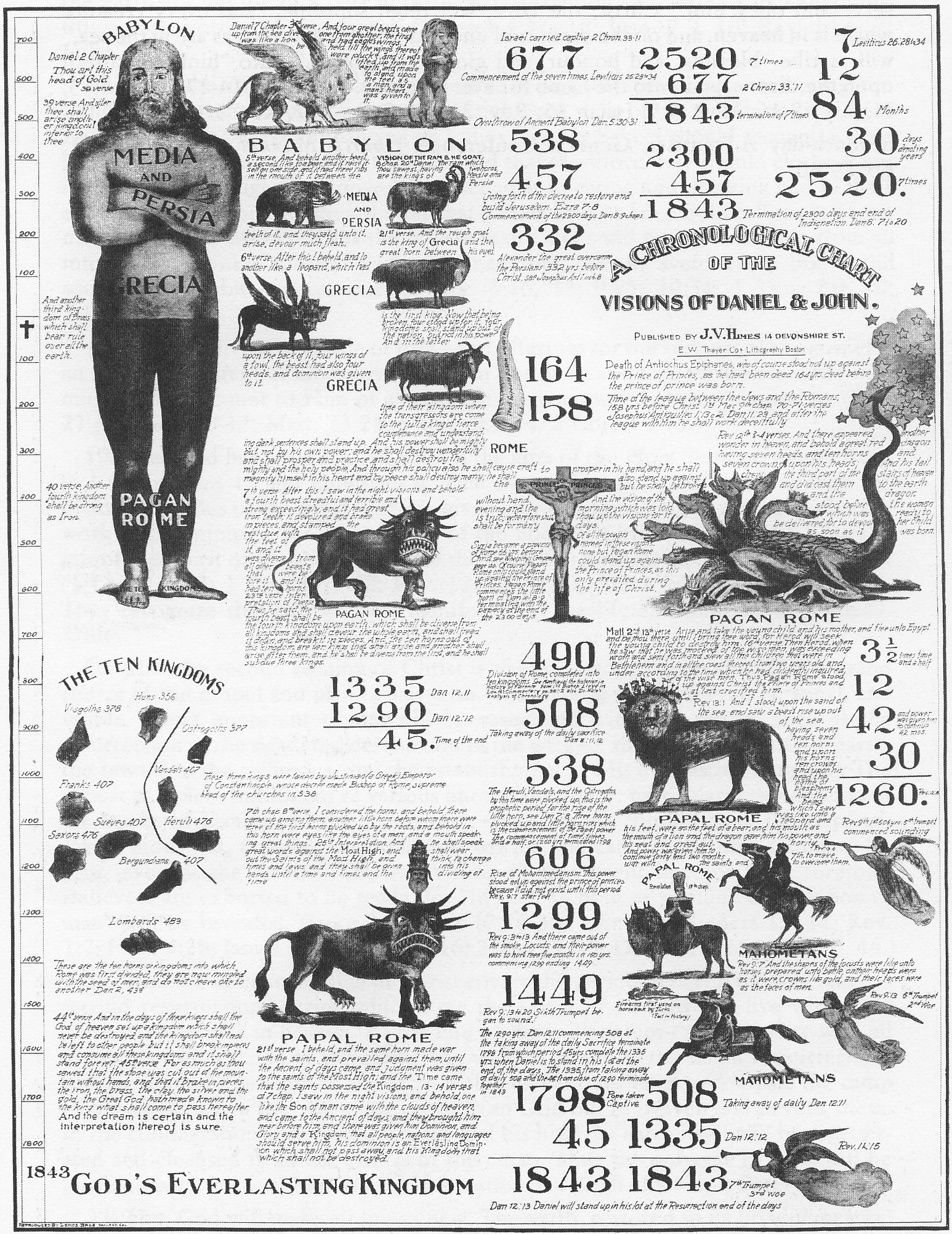
That the Second Coming of Christ would take place on a fixed, knowable calendar date: October 22, 1844, as calculated by William Miller's followers from the 2,300-day prophecy of Daniel 8:14, and, in the modern echo, on May 21, 2011 (later revised to October 21, 2011), as calculated by Harold Camping. In its strongest form the claim held that the ordinary world would end, or be decisively interrupted, on those specific days.
Contradicted. The prediction was specific, dated, and testable: tens of thousands of Millerites expected Christ to return on October 22, 1844, a date reckoned from the 2,300 evenings of Daniel 8:14. The day came and went with no return, an outcome the movement itself named the Great Disappointment. This is not a verdict on Christian belief in a Second Coming, which is historic doctrine held sincerely by millions; it is a verdict on one dated forecast, which mainstream churches had already declined to endorse and which the calendar answered. The same test settled Harold Camping's May 21, 2011 date in exactly the same way. On the narrow claim, the verdict is debunked.
Believed by: Tens of thousands of Millerites across the United States by 1844 (contemporary and later estimates range from roughly 50,000 committed believers to as many as 100,000 sympathizers), drawn from Baptist, Methodist, Congregationalist and other Protestant congregations
The full story
What happened
The documented part of this story is not in dispute. In the early 1830s, a self-taught farmer and lay Baptist preacher named William Miller, of Low Hampton, New York, began lecturing that the Second Coming of Christ would occur “about the year 1843.” His central text was Daniel 8:14, whose “2,300 evenings and mornings” he read as 2,300 years, counted from 457 BC to the “cleansing of the sanctuary,” which he understood as the return of Christ. From 1840 the publisher Joshua V. Himes gave the message national reach through papers with names like Signs of the Times and The Midnight Cry, and a regional idea became a mass movement of tens of thousands.
Miller's first window, running to March 21, 1844, passed quietly and produced an early letdown. Then, at a camp meeting that summer, the preacher Samuel S. Snow advanced the “seventh-month message,” fixing the date by a Karaite Jewish reckoning of the Day of Atonement to a precise day: October 22, 1844. In the final weeks the date swept the movement. Believers settled their affairs and gathered to wait.
The day came, and nothing came with it. The movement named the outcome the Great Disappointment. One participant, Hiram Edson, later recalled that the believers “wept, and wept, till the day dawn.” That is the settled record, and it frames the distinction this file keeps throughout: the prediction and its enormous following are documented fact; the claim that Christ actually returned on October 22, 1844 is the rated question, and it is the one the calendar answered.
Taking the belief seriously
It would be easy, and unfair, to treat the Millerites as simply gullible. The honest starting point is that the belief beneath the date was neither foolish nor fringe. Faith in a Second Coming is historic Christian doctrine, held then and now by millions across the theological spectrum. What Miller added was not the hope of a return but a timetable for it, and he arrived at that timetable through exactly the kind of close scriptural work his era prized.
The method had the shape of rigor. Miller reasoned from named chapters and verses, from chronological tables, and from a definite arithmetic that he had checked and rechecked over years of private study before he would preach it publicly. To a sincere nineteenth- century reader steeped in the Bible, a date derived from prophecy and fixed to the day did not look like a guess. It looked like a discovery, and the labor behind it read as diligence rather than as error.
The moment mattered too. The 1840s were years of fervent religious revival and rapid social change in the United States, a setting in which a message that the present order was about to end could feel less like fantasy than like an articulation of something many people already sensed. And the waiting was communal. Tens of thousands prepared together, published together, and gathered together, so that the belief carried not just conviction but belonging.
The hope of Christ's return is historic and sincerely held. The people who waited on that hillside in 1844 deserve to be met with respect, not ridicule.
None of this makes the date true. But it explains why a dated forecast could draw sincere devotion from thoughtful, serious people, and it sets the terms for the rest of this file: the aim is not to mock a faith, but to test one specific, checkable claim that faith was attached to.
The date came and went
What makes this case a classic, and unusually easy to adjudicate, is that the claim was falsifiable in the plainest sense. Most contested beliefs are hard to test because they turn on hidden events or disputed evidence. This one named a public, world-altering occurrence at a fixed time: the return of Christ, on October 22, 1844. There was no ambiguity to interpret and no private version to fall back on.
The test ran itself. The date arrived and the predicted event did not. The movement did not need skeptics to marshal counter-evidence; it supplied the verdict itself in the very name it gave the day. The same was true of the calculation's instability along the way. A method that produced first an 1843 window, then a spring 1844 date, then October 22 through a separate reckoning, was not pinpointing a fixed fact of prophecy. It was being adjusted until a date could be defended, which is a different thing.
The wider Christian response is worth stating plainly, because it corrects a common misreading. Setting a calendar date for the Second Coming was not mainstream Christian teaching in 1844 and is not now. Most churches and clergy rejected the Millerite dates at the time, many pointing to the Gospel line that of “that day and hour knoweth no man” (Matthew 24:36). The failure of October 22 was therefore not a failure of Christian faith. It was the failure of one particular dated prediction that most of the faith had already declined to endorse.
What believers do after a date fails
The most revealing part of the Great Disappointment is not the failure itself but what happened next, because it turns out to be a pattern rather than an accident. In the days after October 22, the Millerites split. Some left the faith. Others concluded that the arithmetic had been right but the event had been misread. Hiram Edsonand others advanced the idea that October 22 marked not Christ's return to earth but the start of a final “investigative judgment” in a heavenly sanctuary, an event no observer on earth could see or check.
That move preserved the calculation by relocating its result beyond the reach of disconfirmation, and from that reinterpreting strand, shaped heavily by the visions and writings of Ellen G. White, came the Seventh-day Adventist Church, formally organized in 1863. A failed date had not ended the movement; it had reorganized it. More than a century later the social psychologist Leon Festinger and his colleagues, in When Prophecy Fails (1956), used the Millerites among their historical cases to describe exactly this dynamic: cognitive dissonance. When a deep commitment collides with a disconfirming fact, a committed believer often does not abandon the belief; the mind reaches instead for a reading that keeps the framework intact, and sometimes redoubles its zeal.
This is why a dated prophecy so rarely dies on schedule. The disappointment is real and painful, but the arc that follows, prediction, failure, reinterpretation, new commitment, is well documented across traditions and centuries. Understanding it is not a way to mock believers. It is a way to see clearly what is actually being tested when a date is set, and what tends to happen to the people who set their lives by it.
The modern echo: Harold Camping and 2011
The pattern did not stay in the nineteenth century. Its clearest modern re-run belonged to Harold Camping, the California engineer-turned-broadcaster who built the Family Radio network. Camping had already predicted the end for September 1994 and revised when it passed. In his 2005 book Time Has an End he named a new day, deriving May 21, 2011 from a chronology that counted roughly 7,000 years from a dated Genesis flood. This time the message went everywhere: Family Radio reportedly spent on the order of a hundred million dollars on billboards and caravans announcing Judgment Day, and followers quit jobs and drained savings to spread the warning.
May 21 arrived, and the world continued. Camping first said the judgment had been “spiritual” rather than visible, then rescheduled the physical end to October 21, 2011. That date passed as well. The reschedule did not rescue the original claim any more than the heavenly-sanctuary reading had rescued 1844; a forecast that must be moved because its date has already failed is, by definition, a forecast that was wrong.
What set Camping apart was the ending. After a stroke, in a statement issued in March 2012, he did what almost no date-setter does: he recanted. He called his attempt to name the day “incorrect and sinful,”wrote that his critics who cited “of that day and hour knoweth no man” had been right, and announced that Family Radio had “no interest in even considering another date.” Camping died the following year. The distance between 1844 and 2011, hillsides and billboards, camp meetings and radio, changed the scale and the speed of the thing but not its logic. A date was named, the date was tested, and the date failed, exactly as every dated end-times forecast before it had failed.
Across nearly two centuries the machinery is remarkably consistent: a date is set, the day arrives, ordinary life continues, and the failure is reinterpreted rather than simply admitted.
The date came, and passed
Two things are true, and this file holds them apart. The movements were real: William Miller and Harold Camping made specific, dated predictions that drew large, sincere followings and reshaped real lives. The predictions were false: Christ did not return on October 22, 1844, nor on May 21 or October 21, 2011. On the rated claim, that the predicted return would occur on those dates, the verdict is debunked, established by the simplest possible test. The date came and nothing happened.
That verdict is narrow by design. It says nothing about whether a Second Coming is real as a matter of Christian faith; that is a theological question outside the reach of a calendar, and it is held sincerely and reasonably by millions. It rules only on the dated forecasts, which mainstream theology itself had already declined to endorse, and which failed exactly as centuries of earlier and later date-setting has failed.
The lasting value of the Great Disappointment is as a case study, the one that later observers keep returning to. It shows, more cleanly than almost any other episode, both halves of the phenomenon: how a careful, sincere calculation can persuade tens of thousands that they know the day, and what those believers tend to do when the day passes and disproves them. The date is checkable in a way almost nothing else in this territory is. When the next one appears, and one always does, the honest response is neither to mock the faith nor to brace for the end, but to note the day, let it arrive, and read the result. So far, across every tradition and every century, the result has been the same.
What's still unexplained
- The size of the Millerite movement is genuinely uncertain. Contemporary and later estimates range widely, from roughly 50,000 committed believers to as many as 100,000 sympathizers, and the sources that produced these figures had their own reasons to inflate or minimize them. The precise scale of belief on October 22, 1844 cannot now be recovered.
- How many people took materially costly, life-altering steps, in 1844 or in 2011, is not well established. Familiar stories of Millerites selling farms and leaving crops unharvested, and of Camping followers quitting jobs and draining savings, were widely repeated, but the true proportion of sincere, ruinous decisions against a much larger crowd of the merely curious or skeptical was never rigorously measured.
- The long human aftermath is thinly documented. What became of ordinary believers who waited and were disappointed, whether they left their faith, deepened it, joined the emerging Adventist bodies, or simply moved on, is the kind of question that neither 19th-century record-keeping nor a modern news cycle tends to follow.
Point by point
The claim: Serious, sincere religious leaders made specific, dated predictions that drew large followings.
What the record shows: This part is documented and not in dispute. William Miller lectured for over a decade, was licensed by the Baptists, and with the publisher Joshua V. Himes built a national movement of tens of thousands who genuinely expected Christ on October 22, 1844. Harold Camping, president of the Family Radio network, spent an estimated hundred million dollars publicizing May 21, 2011. The existence and reach of these predictions is the settled historical record; whether the predicted event occurred is the separate, rated question.
The claim: The Second Coming actually occurred, or began, on October 22, 1844 (or on May 21, 2011).
What the record shows: It did not. This is the claim we rate, and like most dated end-times forecasts it is cleanly falsifiable: a public, world-altering event was predicted at a fixed time. The times arrived and the events did not. The believers of 1844 named the result themselves, the Great Disappointment, and in 2011 ordinary life continued through May 21 and again through October 21. There is no hidden version of a bodily Second Coming that leaves the world unchanged; the claim was tested by the simplest possible means, and it failed.
The claim: The 2,300-day calculation in Daniel 8:14 pinpoints the date of Christ's return.
What the record shows: The calculation rests on a stack of interpretive choices that the text does not compel: reading prophetic 'days' as years, fixing 457 BC as the start, and equating the 'cleansing of the sanctuary' with the Second Coming. Even within the movement the arithmetic proved unstable, producing first an 1843 window, then a spring 1844 date, then October 22, 1844 through Samuel Snow's separate Karaite reckoning. A method that yields several different 'certain' dates in succession is not pinpointing anything; it is being adjusted until a date can be defended, and then adjusted again when it fails.
The claim: The failure was explained away rather than accepted, so the belief was never really tested.
What the record shows: The reinterpretations are themselves part of the record and confirm the failure rather than rescuing it. After October 22, Hiram Edson and others kept the date but relocated the event to a heavenly 'investigative judgment' no observer could check, a move that preserved the calculation by making it unfalsifiable. Camping first declared May 21 a 'spiritual' judgment, then rescheduled to October 21. In both cases the original, dated, this-world forecast had already been answered by the calendar; shifting the goalposts after the fact does not un-answer it.
The claim: Mainstream Christianity endorsed these dates.
What the record shows: It did not. Most churches and clergy rejected Millerite date-setting in the 1840s, and Camping was widely repudiated by evangelical leaders in 2011, many citing the Gospel warning that of 'that day and hour knoweth no man' (Matthew 24:36). Belief in a Second Coming is historic, widespread Christian doctrine; assigning it an exact calendar date is a minority practice that mainstream theology has repeatedly disowned. Camping himself ended by conceding the point, calling his attempt to name a date 'sinful.'
The claim: The Great Disappointment was a one-off episode peculiar to the 19th century.
What the record shows: It was closer to a template. In When Prophecy Fails (1956), the social psychologist Leon Festinger and colleagues used the Millerites among their historical cases to describe a recurring arc: a group commits to a dated prophecy, the date fails, and rather than dissolve, many members reinterpret the failure and sometimes redouble their commitment. Camping's 2011 campaign followed the arc almost exactly, and dated end-times predictions have kept recurring since, from viral internet forecasts to the annual clustering of Rapture dates around the autumn Hebrew feasts. The specific dates change; the structure does not.
Timeline
- 1831After years of private Bible study, William Miller, a farmer and lay Baptist preacher in Low Hampton, New York, begins lecturing publicly that the Second Coming of Christ will occur 'about the year 1843.' He reasons chiefly from Daniel 8:14, reading its '2,300 evenings and mornings' as 2,300 years running from a 457 BC starting point to the cleansing of the sanctuary, which he takes to mean the return of Christ.
- 1832–1840Miller publishes a series of articles in the Baptist paper the Vermont Telegraph, then a pamphlet and a book. He is licensed to preach and delivers hundreds of lectures. From 1840, the publisher Joshua V. Himes gives the movement national reach through papers such as Signs of the Times and The Midnight Cry, turning a regional message into a mass campaign.
- 1843–March 1844Miller settles on a window: sometime between March 21, 1843 and March 21, 1844, on the Jewish year. Comets and revival meetings heighten expectation. When March 21, 1844 passes without event, the movement experiences a first, quieter letdown sometimes called the 'spring disappointment,' and some believers briefly look to a revised date in April.
- Summer–Autumn 1844At a camp meeting, the Millerite preacher Samuel S. Snow advances the 'seventh-month message': using a Karaite Jewish reckoning of the Day of Atonement, he fixes the date as the tenth day of the seventh month, which he calculates as October 22, 1844. The message spreads rapidly through the movement in the final weeks.
- October 22, 1844Believers gather in homes, meeting houses and open fields to await the return. The day passes like any other. The movement names the outcome the Great Disappointment. Contemporary accounts describe weeping and stunned believers; the diarist Hiram Edson wrote that they 'wept, and wept, till the day dawn.'
- 1844–1845The movement fractures. Miller acknowledges the error and never sets another date before his death in 1849. Some abandon the faith; others conclude the calculation was right but the event was misread. Hiram Edson and others argue that October 22 marked not Christ's return to earth but the start of a final 'investigative judgment' in a heavenly sanctuary.
- 1863One strand of the reinterpreting Millerites, shaped heavily by the visions and writings of Ellen G. White, organizes formally as the Seventh-day Adventist Church. Other bodies, including the Advent Christian Church, trace their roots to the same disappointment. A failed date, rather than ending the movement, had reorganized it.
- 1992–2005The modern echo takes shape. The California radio broadcaster Harold Camping, founder of the Family Radio network, predicts the end for September 1994, then revises when it passes. In the 2005 book Time Has an End he names a new date, deriving May 21, 2011 from a chronology counting roughly 7,000 years from a dated Genesis flood.
- May 21 – October 21, 2011Family Radio blankets the country with billboards and caravans announcing May 21 as Judgment Day, reportedly spending on the order of a hundred million dollars. The day passes. Camping first says the judgment was 'spiritual,' then reschedules the physical end to October 21, 2011. It too passes. In March 2012, after a stroke, Camping issues a statement calling his date-setting 'incorrect and sinful' and renounces the practice.
Contradicted. The prediction was specific, dated, and testable: tens of thousands of Millerites expected Christ to return on October 22, 1844, a date reckoned from the 2,300 evenings of Daniel 8:14. The day came and went with no return, an outcome the movement itself named the Great Disappointment. This is not a verdict on Christian belief in a Second Coming, which is historic doctrine held sincerely by millions; it is a verdict on one dated forecast, which mainstream churches had already declined to endorse and which the calendar answered. The same test settled Harold Camping's May 21, 2011 date in exactly the same way. On the narrow claim, the verdict is debunked.
Reviewed by Colin Peterson · Last reviewed July 18, 2026 · How we rate
Common questions
Is The Great Disappointment true?
Contradicted. The prediction was specific, dated, and testable: tens of thousands of Millerites expected Christ to return on October 22, 1844, a date reckoned from the 2,300 evenings of Daniel 8:14. The day came and went with no return, an outcome the movement itself named the Great Disappointment. This is not a verdict on Christian belief in a Second Coming, which is historic doctrine held sincerely by millions; it is a verdict on one dated forecast, which mainstream churches had already declined to endorse and which the calendar answered. The same test settled Harold Camping's May 21, 2011 date in exactly the same way. On the narrow claim, the verdict is debunked.
What is The Great Disappointment?
In the 1830s and 1840s a self-taught Baptist lay preacher named William Miller convinced tens of thousands of Americans that Christ would return around 1843, and then, after Miller's own window passed, on a precise date: October 22, 1844. The calculation ran through the 2,300 'days' of Daniel 8:14, read as 2,300 years and mapped onto a K…
What does the evidence show?
This part is documented and not in dispute. William Miller lectured for over a decade, was licensed by the Baptists, and with the publisher Joshua V. Himes built a national movement of tens of thousands who genuinely expected Christ on October 22, 1844. Harold Camping, president of the Family Radio network, spent an estimated hundred mil…
Why do people believe it?
Belief in the Second Coming is historic, mainstream Christian doctrine, not a fringe idea. What Miller and Camping added was only a date. A dated prediction can therefore borrow the credibility of a deeply held, respectable expectation while attaching it to a specific claim most theologians reject, which makes the date feel like the natu…
What is still unresolved?
The size of the Millerite movement is genuinely uncertain. Contemporary and later estimates range widely, from roughly 50,000 committed believers to as many as 100,000 sympathizers, and the sources that produced these figures had their own reasons to inflate or minimize them. The precise scale of belief on October 22, 1844 cannot now be…
Sources
- 1.Millerism, Encyclopaedia Britannica (2024)
- 2.William Miller | Millerite, Adventist, Preacher, Encyclopaedia Britannica (2024)
- 3.Great Disappointment, Wikipedia (2025)
- 4.American Adventism: The Great Disappointment, Christian History Institute / Christian History Magazine (1999)
- 5.When Prophecy Fails: A Social and Psychological Study of a Modern Group that Predicted the Destruction of the World, Leon Festinger, Henry W. Riecken & Stanley Schachter (via Wikipedia) (1956)
- 6.Doomsday Prophet Camping Says Predictions Were 'Incorrect And Sinful', NPR (The Two-Way) (2012)
- 7.2011 end times prediction, Wikipedia (2025)
- 8.The Legacy of Harold Camping, Who Falsely Predicted the World's End, Lives On, Religion Unplugged (2021)
- 9.Harold Camping repents for 'sinful' prediction, Baptist Press (2012)
Embed this verdict on your site
Paste this snippet to show our sourced verdict as a small card, with a link back to the full case file. Free to use.
<iframe src="https://theconspiratory.com/embed/great-disappointment-1844" title="The Conspiratory verdict" width="520" height="190" style="border:0;max-width:100%" loading="lazy"></iframe>Help us investigate
This is a living case file. If you spot an error or know evidence we missed, tell us, and weigh in on where you land.
Where do you land?
Cast your read on this one.
Comments
Add your take. Comments are read and approved by a human before they appear, so keep it on topic and civil. Please do not accuse named, living people of crimes.