The Rosicrucians are a real, unbroken secret brotherhood that has guided science, religion, and politics from the shadows for centuries
By Colin PetersonJuly 8, 2026
Where the evidence lands →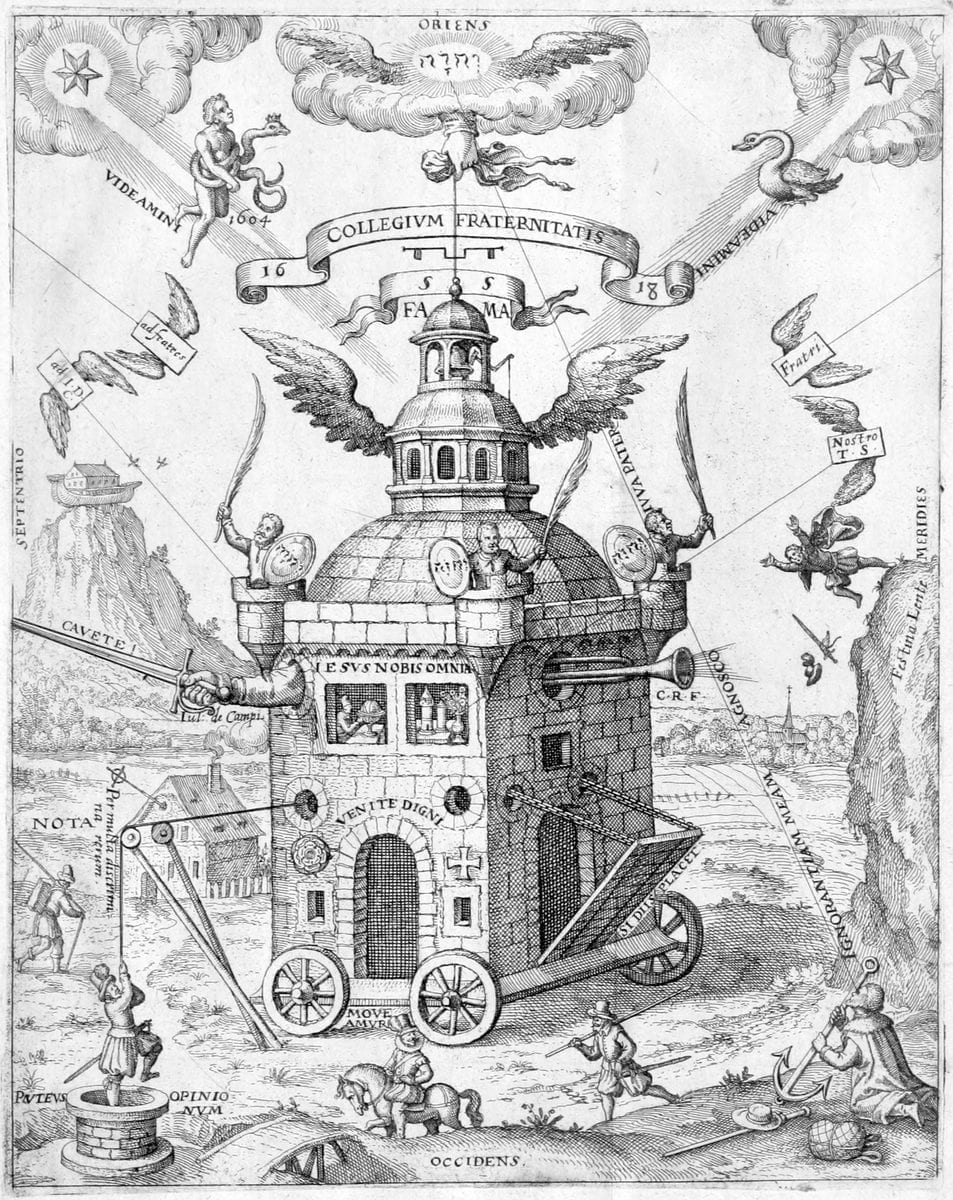
That the Rosicrucian Brotherhood described in the 17th-century manifestos was a genuine, organized secret order of enlightened adepts, that it has survived unbroken through the centuries in concealment, and that from behind the scenes it has directed the course of science, religion, and politics, often braided together with the Freemasons and Illuminati into a single hidden power.
The record is not in dispute: between roughly 1610 and 1616 three anonymous manifestos appeared in Germany announcing a hidden brotherhood, the Order of the Rose Cross, founded by a sage named Christian Rosenkreuz. They set off a Europe-wide furore and helped shape early modern science, alchemy, and later esoteric and Masonic movements. Modern Rosicrucian orders are real, openly operating fraternal and study societies. The claim we rate is narrower and larger: that a single, continuous, hidden order of adepts genuinely existed behind the manifestos and has secretly steered world events ever since. That claim is unproven. Historians find no trace of an actual organized brotherhood behind the texts, the founder is generally treated as a symbolic invention, and at least one likely author called the project a ludibrium, a playful fiction. The real influence of the Rosicrucian idea is well documented; the existence of the world-controlling order is not.
Believed by: In its softer form, an audience of esotericists, occult historians, and members of modern Rosicrucian bodies who see themselves as heirs to a genuine tradition; in its harder, secret-rulers form, a strand of conspiracy culture that folds the Rose Cross into a single Illuminati-Masonic-Rosicrucian hidden hand.
The full story
What is documented
Start with what is solid, because in this case the record is genuinely remarkable on its own. Between roughly 1610 and 1616, three anonymous works appeared in the German-speaking lands. The Fama Fraternitatis, circulated in manuscript and printed at Kassel in 1614, announced a secret Brotherhood of the Rose Cross founded by a sage called Christian Rosenkreuz, who had gathered hidden wisdom on his travels and bound a few chosen men to work in secret for the healing of the sick and the reform of the world. The Confessio Fraternitatis (1615) affirmed the order and sharpened its attack on the church and the universities. The Chymical Wedding of Christian Rosenkreutz (1616), an elaborate alchemical romance in seven days, completed the trio.
The reaction was extraordinary and is not in doubt. The manifestos set off what has been called the Rosicrucian furore: hundreds of pamphlets, letters, and treatises across Europe within a decade, many written by hopeful seekers begging to be admitted to a brotherhood that never wrote back. Nobody credibly stepped forward as a member. No meeting place was ever found. The order announced itself loudly and then, so far as the record shows, was never actually located.
So the question this file weighs is not whether the manifestos are real. They plainly are, and their influence on alchemy, early science, and later esoteric and fraternal movements is a serious subject of study. The question is whether a single, organized, continuous secret order genuinely stood behind them, and has quietly steered history ever since.
The case for a real order
The believer's case deserves its strongest form, because it is not built on nothing. The manifestos were real documents, and they did not merely entertain: they announced a program of universal reform of religion, learning, and society at a moment when Europe was hungry for exactly that. Something in them struck a nerve deep enough to generate a continent-wide search.
And the afterlife of the idea is documented. The historian Frances Yates argued that the Rosicrucian moment sat at a real crossroads of magic, religion, and emerging science, and that its themes helped shape the intellectual world that produced the scientific revolution. The language of an invisible college of natural philosophers, echoing the manifestos, circulated among figures such as Robert Boyle in the decades before the Royal Society was chartered. Later, Rosicrucian symbolism ran visibly into speculative Freemasonry and a whole family of esoteric orders.
From there the argument is simple. If the Rose Cross left such deep marks on science and on secret fraternities, does that not suggest a real hidden network doing the work, rather than a mere story? And if respectable modern Rosicrucian orders still exist and teach today, is that not a living thread reaching back to the source?
Real manifestos, a real furore, and real influence on real movements. The mystery is authentic. The leap is in deciding that a single hidden organization, rather than a powerful idea, is what connects the dots.
That is the honest version of the case: not that anyone has produced the brotherhood, but that the Rosicrucian current is real enough, and its traces wide enough, that the existence of some enduring order behind them can feel like the natural explanation.
Where the claim breaks down
The trouble begins where the influence of an idea is quietly swapped for the existence of an organization. Those are not the same thing, and almost the entire record supports the first while offering nothing for the second.
The central fact is an absence with teeth. Reference works note that no reliable evidence dates any Rosicrucian order earlier than the 17th-century texts themselves. The founder, Christian Rosenkreuz, is generally treated as a symbolic figure, not a historical person. Of a society that held meetings or kept officers, historians find no trace. The manifestos are documented; the brotherhood they describe is not.
There is also a pointed piece of testimony from inside the story. Johann Valentin Andreae, a Lutheran theologian closely linked to the manifestos and the acknowledged author of the Chymical Wedding, called that work a ludibrium: a jest, a playful fiction he had composed as a young man. Whether that label covers only the Chymical Wedding or the earlier manifestos too is debated, but it points hard toward a literary and allegorical project, a hopeful summons or a spiritual game, rather than a bulletin from a real secret society.
Even the modern orders do not close the gap. Bodies such as AMORC are genuine, active organizations, but AMORC was founded in 1915, and other Rosicrucian societies arose in the 18th and 19th centuries. They inherit the symbolism and the ideals of the Rose Cross, which is a real and traceable inheritance. They do not supply a documented, unbroken chain of adepts running back to a founder who was probably invented.
The unfalsifiable turn
The hardest version of the theory, that a continuous Rose Cross order has secretly governed the world, has a structural problem worth naming, because it recurs in every hidden-rulers story.
The claim is built to survive any absence of evidence. No members can be identified, so the secrecy must be perfect. No records exist, so they must have been hidden or destroyed. The order never acts openly, so its power must be exercised through others. Each missing piece, which for an ordinary hypothesis would count against it, is here recast as further proof of a brotherhood too skilled to be caught. A theory that treats the total lack of an organization as confirmation of the organization has quietly made itself impossible to test.
This is also where the Rose Cross gets merged with theFreemasons and the Illuminatiinto a single all-purpose hidden hand. The merger feels tidy, but it is a rhetorical move, not a finding. It works by collapsing several distinct histories, most of them far more open than the legend allows, into one silhouette that can be blamed for anything and confirmed by nothing.
An order you cannot find, cannot name, and cannot catch is not thereby proven to be hiding. It may simply be a story, and the missing brotherhood may be missing because it was never there.
Why the legend endures
The Rosicrucian legend has lasted four centuries for reasons that say a great deal about how mysteries take hold, and rather less about whether the order was ever real.
It began in authentic strangeness. Unlike many conspiracy stories, this one starts from genuine anonymous documents and a genuine historical frenzy. When the opening facts are real and unexplained, the mind reaches naturally for a hidden reality that would make sense of them, and a secret brotherhood is a deeply satisfying answer.
It is fed by real influence. Because Rosicrucian themes truly did shape alchemy, early science, and later fraternal orders, a believer never lacks footprints to point at. The difficulty is that footprints of an idea and footprints of an organization look alike from a distance, and the legend thrives in that blur.
And it is sustained by symbol and secrecy. The manifestos speak in emblem and allegory and boast of concealment, which gives the imagination limitless room. Living orders keep the name and the imagery in circulation, and a wider culture that suspects the world is secretly run supplies a ready frame. “Of course you cannot find them” is a prior that turns every gap in the record into another room in the hidden house.
A fiction that moved history
Hold the two claims apart, and the case resolves cleanly. The documented Rosicrucian movement is real and important: three genuine manifestos, a genuine furore, a genuine influence on science, alchemy, Freemasonry, and later esoteric orders, and genuine modern societies that carry the name. None of that is in dispute, and none of it needs a hidden hand to be true.
The claim we rate is the larger one: that a single, organized, continuous secret order actually stood behind the manifestos and has covertly steered history ever since. That claim is unproven. No trace of the original brotherhood as an organization has ever been found; the founder is generally read as a symbol; a likely author called the project a playful fiction; and the modern orders inherit the ideals rather than a documented ancient lineage. The story may have begun as allegory, as reformist hope, or as a jest that got taken literally.
This is not a verdict against wonder, and not a claim that the mystery is fake. It is a refusal to let the real influence of a powerful idea be quietly upgraded into the secret rule of a body no one can locate. The manifestos are one of the great puzzles of early modern Europe. The world-controlling order is a separate assertion, and on the evidence available it remains exactly that: an assertion, unproven, resting on an absence it insists on reading as a hiding place.
What's still unexplained
- Who actually wrote the manifestos, and how many hands were involved. The Tübingen circle around Andreae, Hess, and Besold is the leading candidate, and scholars such as Carlos Gilly and Roland Edighoffer argue for collaborative authorship, but the precise attribution of the Fama and Confessio remains debated.
- How far the manifestos were meant as a literal call to form a brotherhood versus a purely allegorical or satirical exercise. Andreae's ludibrium remark clearly covers the Chymical Wedding, but whether it extends to the earlier texts is genuinely unsettled.
- How deeply Rosicrucian rhetoric shaped the invisible college language around Robert Boyle and the currents that produced the Royal Society and speculative Freemasonry. This is a live question of intellectual history, distinct from any claim of a governing secret order.
- What relationship, if any, the many later Rosicrucian bodies bear to the original texts beyond shared symbolism. Continuity of ideas and imagery is clear; continuity of an actual organization is not established.
Point by point
The claim: The manifestos were a report of a real, organized secret brotherhood that already existed.
What the record shows: No independent trace of such an organization has been found. Reference works note that no reliable evidence dates a Rosicrucian order earlier than the 17th-century texts themselves, that the founder Christian Rosenkreuz is generally regarded as a symbolic rather than a historical figure, and that there is no sign of a society holding meetings or keeping officers. What is documented is a set of anonymous publications and the storm of responses they provoked, not the brotherhood they described.
The claim: The stories inside the manifestos, the tomb, the healing adepts, the eastern wisdom, are literal history.
What the record shows: They read as allegory, and at least one probable author treated them that way. Johann Valentin Andreae, linked to the manifestos and the acknowledged author of the Chymical Wedding, called that work a ludibrium, a playful fiction or spiritual game he had written as a young man. Many historians read the Fama and Confessio as a utopian and reformist literary project, a hopeful summons rather than a factual account of an existing order.
The claim: The order proves its reality by its hidden influence over science, religion, and politics.
What the record shows: The influence of the Rosicrucian idea is real and studied, but influence of an idea is not the hidden hand of an organization. Frances Yates and later scholars trace how Rosicrucian themes of universal reform and an invisible college of savants fed into early modern science and esoteric currents. That is a story of texts, symbols, and inspired individuals shaping later movements, not the sign of a single continuous body pulling strings behind them.
The claim: Modern Rosicrucian orders are the surviving, unbroken continuation of the original 17th-century brotherhood.
What the record shows: Modern orders such as AMORC are genuine, active organizations, but their claims of ancient descent are traditional and devotional rather than documented lineage. AMORC was founded in 1915 by Harvey Spencer Lewis; other bodies arose in the 18th and 19th centuries. They draw on the Rosicrucian symbolism and ideals, which is very different from an unbroken chain of secret adepts reaching back to a founder who is himself likely fictional.
The claim: The silence and anonymity around the order prove it is real and simply very good at hiding.
What the record shows: Absence of evidence is being read here as evidence of concealment, which makes the claim unfalsifiable. The very features offered as proof, no verifiable members, no records, no confirmed acts, are just what a purely literary invention would also leave behind. A story that can absorb the total lack of a brotherhood as further proof of the brotherhood explains nothing, because nothing could ever count against it.
Timeline
- 1610A manuscript later printed as the Fama Fraternitatis begins to circulate among German occultists and reformers. It tells of a brotherhood of the Rose Cross founded by a Father C.R. and calls on the learned of Europe to join a coming general reformation.
- 1614The Fama Fraternitatis is published at Kassel. It appeals to rulers, clergy, and scholars to embrace a regenerated knowledge and describes the discovery of the hidden, undecayed tomb of the order's founder, Christian Rosenkreuz.
- 1615The second manifesto, the Confessio Fraternitatis, appears, affirming the brotherhood's existence and expanding its themes of secret wisdom, spiritual renewal, and sharp criticism of the established church and universities.
- 1616The Chymical Wedding of Christian Rosenkreutz is printed at Strasbourg. An elaborate alchemical allegory in seven days, it is later claimed by the Lutheran theologian Johann Valentin Andreae, who calls it a ludibrium, a jest or playful fiction.
- 1614-1620sThe manifestos ignite the Rosicrucian furore: hundreds of pamphlets, letters, and treatises across Europe, many from would-be members trying to make contact with a brotherhood that never answers and whose members never step forward.
- 17th centuryScholars connect the manifestos to a circle of Lutheran intellectuals around the University of Tübingen, including the physician Tobias Hess and the jurist Christoph Besold, sharing interests in Paracelsian medicine, Hermetic philosophy, and church reform.
- 1640s-1660sThe language of an invisible college of natural philosophers, echoing the Rosicrucian ideal, circulates among figures such as Robert Boyle. Historians later debate how far this rhetoric fed into the networks that produced the Royal Society and speculative Freemasonry.
- 1915Harvey Spencer Lewis founds AMORC, the Ancient and Mystical Order of the Rosae Crucis, in the United States, presenting it as a revival of an ancient tradition. It grows into the largest modern Rosicrucian body, headquartered in San Jose, California.
- 20th-21st centuriesIn conspiracy literature the Rose Cross is increasingly merged with the Freemasons and Illuminati into a single hidden order said to rule the world, a claim that goes far beyond both the documented manifestos and the openly operating modern societies.
The record is not in dispute: between roughly 1610 and 1616 three anonymous manifestos appeared in Germany announcing a hidden brotherhood, the Order of the Rose Cross, founded by a sage named Christian Rosenkreuz. They set off a Europe-wide furore and helped shape early modern science, alchemy, and later esoteric and Masonic movements. Modern Rosicrucian orders are real, openly operating fraternal and study societies. The claim we rate is narrower and larger: that a single, continuous, hidden order of adepts genuinely existed behind the manifestos and has secretly steered world events ever since. That claim is unproven. Historians find no trace of an actual organized brotherhood behind the texts, the founder is generally treated as a symbolic invention, and at least one likely author called the project a ludibrium, a playful fiction. The real influence of the Rosicrucian idea is well documented; the existence of the world-controlling order is not.
Reviewed by Colin Peterson · Last reviewed July 8, 2026 · How we rate
Common questions
Is The Rosicrucians true?
The record is not in dispute: between roughly 1610 and 1616 three anonymous manifestos appeared in Germany announcing a hidden brotherhood, the Order of the Rose Cross, founded by a sage named Christian Rosenkreuz. They set off a Europe-wide furore and helped shape early modern science, alchemy, and later esoteric and Masonic movements. Modern Rosicrucian orders are real, openly operating fraternal and study societies. The claim we rate is narrower and larger: that a single, continuous, hidden order of adepts genuinely existed behind the manifestos and has secretly steered world events ever since. That claim is unproven. Historians find no trace of an actual organized brotherhood behind the texts, the founder is generally treated as a symbolic invention, and at least one likely author called the project a ludibrium, a playful fiction. The real influence of the Rosicrucian idea is well documented; the existence of the world-controlling order is not.
What is The Rosicrucians?
In the second decade of the 17th century, three anonymous texts appeared in the German-speaking lands and announced the existence of a secret brotherhood dedicated to a universal reform of religion, learning, and society. They told of Christian Rosenkreuz, a traveler who had gathered hidden wisdom in the East and founded an invisible fra…
What does the evidence show?
No independent trace of such an organization has been found. Reference works note that no reliable evidence dates a Rosicrucian order earlier than the 17th-century texts themselves, that the founder Christian Rosenkreuz is generally regarded as a symbolic rather than a historical figure, and that there is no sign of a society holding mee…
Why do people believe it?
The documented history is genuinely strange and compelling. Real anonymous manifestos really did appear, really did name a hidden order, and really did trigger a continent-wide search. A story that begins in verifiable mystery invites the leap to a hidden reality behind it.
What is still unresolved?
Who actually wrote the manifestos, and how many hands were involved. The Tübingen circle around Andreae, Hess, and Besold is the leading candidate, and scholars such as Carlos Gilly and Roland Edighoffer argue for collaborative authorship, but the precise attribution of the Fama and Confessio remains debated.
Sources
- 1.Rosicrucianism, Wikipedia (2026)
- 2.Rosicrucian | Definition, History, & Facts, Encyclopaedia Britannica (2026)
- 3.Fama Fraternitatis, Wikipedia (2026)
- 4.Confessio Fraternitatis, Wikipedia (2026)
- 5.Chymical Wedding of Christian Rosenkreutz, Wikipedia (2026)
- 6.The Rosicrucian Enlightenment (2nd Edition), by Frances A. Yates, Routledge (2001)
- 7.Ancient and Mystical Order Rosae Crucis (AMORC), Wikipedia (2026)
- 8.Ancient and Mystical Order of the Rosae Crucis (AMORC), Encyclopedia.com (2001)
- 9.1911 Encyclopaedia Britannica: Rosicrucianism, Wikisource (1911)
Embed this case file on your site
Paste this snippet to show this case file as a small card, with a link back to the full write-up. Free to use.
<iframe src="https://theconspiratory.com/embed/rosicrucians" title="The Conspiratory verdict" width="520" height="190" style="border:0;max-width:100%" loading="lazy"></iframe>Help us investigate
This is a living case file. If you spot an error or know evidence we missed, tell us, and weigh in on where you land.
Where do you land?
Cast your read on this one.
Comments
Add your take. Comments are read and approved by a human before they appear, so keep it on topic and civil. Please do not accuse named, living people of crimes.