The government knows a Yellowstone supervolcano eruption is imminent and is covering it up
By Colin PetersonJuly 12, 2026
Where the evidence lands: Contradicted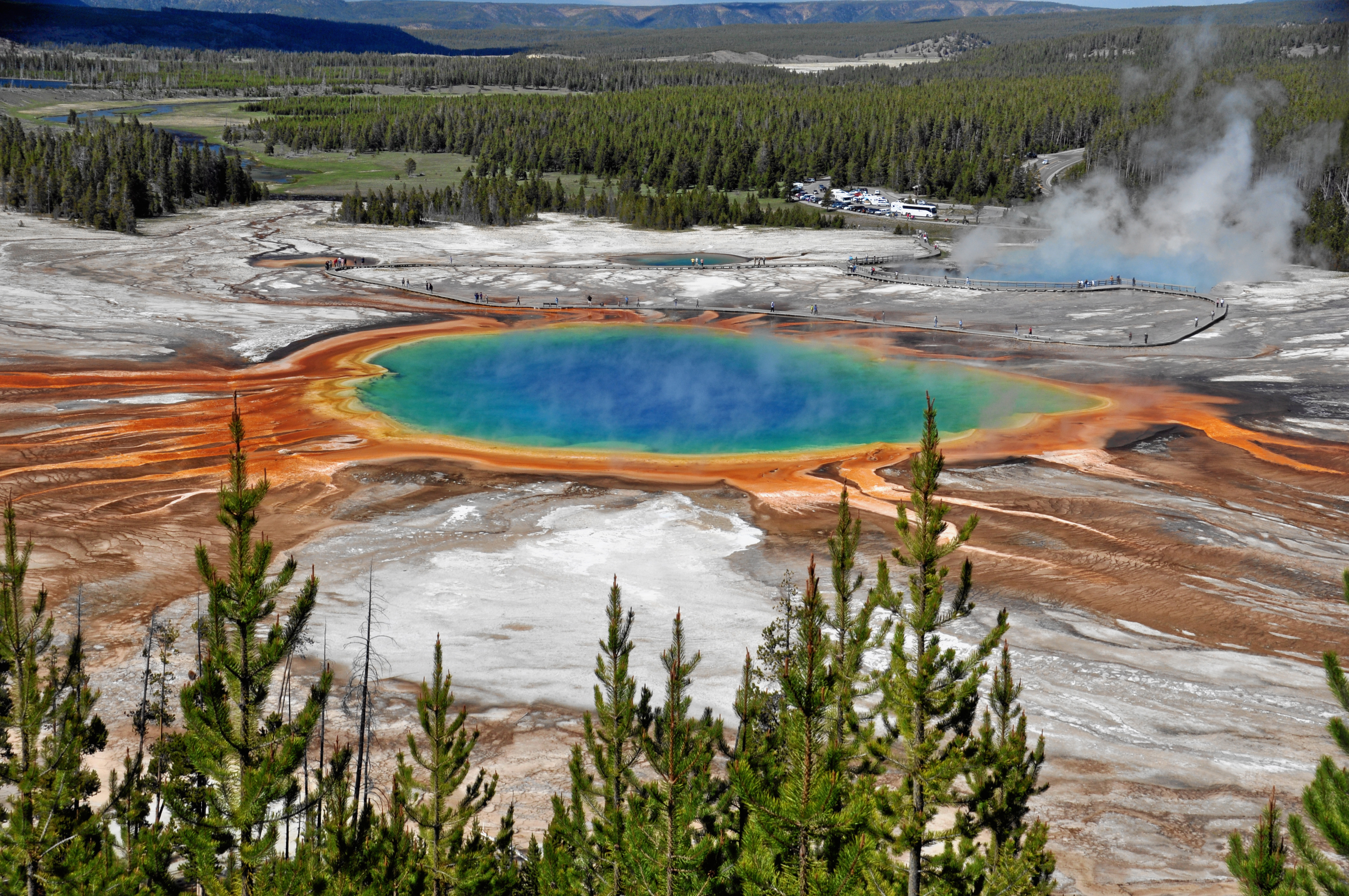
That a civilization-ending eruption of the Yellowstone supervolcano is imminent or 'overdue', that earthquake swarms, ground uplift, animals fleeing the park, and closed roads and boardwalks are suppressed warning signs, and that the U.S. Geological Survey and other agencies know an eruption is coming and are deliberately concealing it to avoid mass panic.
Contradicted. The geology is real: Yellowstone sits over a genuine volcanic hotspot and caldera that produced three enormous super-eruptions roughly 2.1 million, 1.3 million, and 640,000 years ago. The claim we rate is the part that fails: that an eruption is imminent or overdue, that earthquake swarms, ground uplift, or fleeing bison prove it, and that the U.S. Geological Survey knows and is hiding it. The USGS Yellowstone Volcano Observatory monitors the caldera continuously and publishes its data and status openly; the alert level has sat at normal, the annual odds of a super-eruption are on the order of 1 in 730,000, and super-eruptions do not run on a schedule. A distant future eruption is geologically possible. An imminent, concealed one is not what the evidence shows.
Believed by: A broad online doomsday audience, spread through short-form video, YouTube channels, and tabloid science headlines, and periodically revived by any earthquake swarm, road closure, or uplift report
The full story
The real volcano under the geysers
Start with what is not in dispute, because it is genuinely dramatic and it is the ground the whole theory grows from. Yellowstone National Park sits on top of one of the largest active volcanic systems on the planet, a hotspot fed by a plume of hot rock deep in the mantle. The geysers, hot springs, and steaming ground that draw the crowds are the surface expression of a shallow magma reservoir a few miles down. This is a real, living volcano, not a metaphor.
It has erupted on a colossal scale before. Over the past few million years the system produced three caldera-forming super-eruptions: Huckleberry Ridge about 2.1 million years ago, Mesa Falls about 1.3 million years ago, and Lava Creek about 640,000 years ago. The first ejected roughly 2,450 cubic kilometers of material, dwarfing anything in recorded human history. The most recent carved out the present Yellowstone caldera, a depression tens of miles across that you can drive through without ever realizing you are inside a volcano's collapsed crater.
None of that is a conspiracy theory. It is textbook geology, and it is exactly why the U.S. Geological Survey watches the place so intently. The claim we rate takes this real foundation and builds something the evidence does not support on top of it: that another super-eruption is imminent or “overdue,” that everyday signs prove it, and that the government knows and is hiding it. Those are the parts to weigh.
The case for worry
Steelman it fairly, because the fear is not baseless. Yellowstone truly is capable of an eruption that would darken skies, bury the interior of a continent in ash, and disrupt the global climate and food supply for years. A hazard that severe, even at low odds, is worth taking seriously, and dismissing it with a shrug would be its own kind of dishonesty.
The system is also visibly restless, which gives the worry something to point at. The caldera shudders with hundreds to thousands of small earthquakes a year and occasionally with energetic swarms. The ground itself breathes: parts of the caldera floor have risen and fallen by inches over recent decades as fluids and magma move beneath. Geysers change their rhythms, new thermal features appear, and in 2024 a sudden hydrothermal explosion at Biscuit Basin hurled rock and boiling water across a boardwalk. To an anxious observer, each of these looks like a warning.
Then there is the pattern that sounds damning at first hearing: three giant eruptions, the most recent about 640,000 years ago, and a supposed 600,000-year interval between them. Stated that way, the conclusion writes itself, we are past due. And when a story surfaced in 2017 that NASA had sketched a plan to drill into Yellowstone and cool it down, it was easy to read as proof that people who know better are quietly frightened.
The danger is real and the ground is genuinely restless. That is what makes the imminence claim feel like a short step rather than a leap.
So the raw materials are all true: a real supervolcano, real seismicity, real ground movement, real hazards. The question is whether they add up to “imminent eruption being covered up,” and that is where the case has to be tested against what the monitoring actually shows.
What the monitoring actually shows
Take the “overdue” argument first, because it collapses on simple arithmetic that the USGS lays out in public. Three eruptions give only two intervals: roughly 0.8 million and 0.66 million years, which average about 0.73 million years, not 0.6. Run the math the theory's own way and the average would put the next window something like 90,000 years in the future, not the present. And two data points cannot define a cycle at all. Volcanoes do not erupt on a timer; “overdue” imports a regularity that the geology simply does not have.
The everyday signs are normal background behavior, and, crucially, they are published rather than buried. Yellowstone's hundreds to thousands of small quakes a year and its inches of rise and fall are exactly what an active caldera does; the ground has repeatedly swelled and then subsided again without anything happening. The Yellowstone Volcano Observatory posts monthly updates, live seismograph feeds, and GPS deformation data for anyone to read. The alert level has sat at normal (aviation color code green). A super-eruption would be preceded not by a quiet 4.8 quake but by sustained, escalating, unmistakable unrest over a long period, and that is not what the instruments record.
The viral scares fall apart on inspection one by one. The famous 2014 bison video was shot weeks before that spring's largest earthquake, and the animals were running intothe park; the videographer said nothing was chasing them. Seasonal migration of bison and elk to lower ground in winter is ordinary, and the USGS notes there is little established link between animal behavior and eruptions. Road and boardwalk closures are routine maintenance and seasonal safety measures, not evidence smuggled offstage. The “NASA plan” was a theoretical, unfunded concept an engineer mentioned in a BBC interview, not a mission and not a signal of hidden panic.
A cover-up run through freely downloadable, real-time data is close to a contradiction in terms.
The cover-up premise is the weakest link of all. The observatory's whole method is open publication, and it spends real effort actively debunking the scares by name. Secrecy would require hiding data that the agency streams to the public in real time and mirrors across universities and independent seismic networks worldwide. And the feared outcome is not even the likely next event: the USGS assesses that a lava flow or a hydrothermal explosion is far more probable than a caldera-forming super-eruption, whose annual odds it puts on the order of 1 in 730,000, with no sign of one in the coming centuries.
Why the dread persists
The scare endures because it is built on a true and frightening fact, which is what makes it so durable. Yellowstone really can produce a civilization-scale eruption. Take a genuine low-probability danger and quietly swap the probability for imminence, and you have a story that feels grounded in science while pointing somewhere science does not go.
A hidden apocalypse is also one of the most psychologically sticky shapes a rumor can take. The idea that catastrophe is bearing down in secret, while officials smile and say everything is fine, taps a primal dread and flatters the believer at the same time: you are one of the few clear-eyed enough to see past the reassurance. That framing is self-sealing. When the USGS says the risk is remote, a distrustful audience hears precisely what a cover-up would be expected to say, so the debunking is absorbed as more proof of the plot.
Yellowstone feeds the machine with an endless supply of raw material. It is a live volcanic system, so there is always a fresh earthquake swarm, a plume of steam, an uplift report, a closed boardwalk, or a startled herd to film. Each is easy to shoot and easy to misread, and short-form platforms reward the alarming cut over the careful correction. “Yellowstone is about to erupt” will always travel faster than “the annual odds are about one in 730,000,” because fear outperforms arithmetic in a feed.
The honest response is not to mock the fear but to keep the true part and drop the false one. Respect the volcano, fund the monitoring, and take seriously the real, smaller hazards like hydrothermal explosions. Just do not mistake a restless, well-watched caldera, whose data anyone can pull up, for a doomsday clock being hidden by the people whose entire job is to publish it.
Possible someday, not imminent
On the claim we rate, that a Yellowstone super-eruption is imminent or overdue and that the government knows and is covering it up, the rating is debunked. The “overdue” math is wrong, the warning signs are ordinary and openly published, the viral scares are misread events that the USGS itself takes apart, and a cover-up conducted through real-time public data is not a coherent idea. The alert level has stayed normal, and the most likely future activity is a lava flow or a steam explosion, not the civilization-ending blast at the center of the fear.
The honest position holds two things at once, without letting either swallow the other. Yellowstone is a real supervolcano over a real hotspot, it has erupted catastrophically before, and it will erupt again on some distant geologic timescale; that long-term possibility is not in doubt and is exactly why it is monitored so closely. And there is no evidence that such an eruption is near, no schedule that makes it “due,” and no secret being kept. Respect the geology, keep watching the caldera, and treat the doomsday version for what it is: a true danger stretched, by fear and by algorithm, into a certainty and a conspiracy the evidence cannot carry.
Watch
What's still unexplained
- A super-eruption at Yellowstone is genuinely possible on geologic timescales; the system is active and will erupt again someday. What is debunked is the claim of imminence and cover-up, not the existence of long-term volcanic hazard.
- How much warning a future caldera-forming eruption would actually give is uncertain. Scientists expect weeks to years of escalating, unmistakable signals, but no one has monitored a super-eruption's run-up with modern instruments, so the lead time is an honest unknown.
- Hydrothermal explosions, like the 2024 Biscuit Basin event, are the hazard most likely to hurt people in the park, and they can happen with little or no warning. That is a real, localized danger that is separate from, and much smaller than, the super-eruption people fear.
- Episodes of caldera uplift, subsidence, and earthquake swarms are still being studied to refine what is normal background behavior versus what would signal a meaningful change. This is ordinary science on an active system, not a suppressed alarm.
Point by point
The claim: Yellowstone erupts roughly every 600,000 years, and the last one was about 640,000 years ago, so a super-eruption is overdue.
What the record shows: This is the core arithmetic error, and the USGS addresses it directly. There have been three caldera-forming eruptions, which is only two intervals: about 0.8 and about 0.66 million years, averaging roughly 0.73 million years, not 0.6 million. With the last eruption about 640,000 years ago, the average would put the next window closer to 90,000 years from now, not the present. More fundamentally, two intervals are far too few to define a 'cycle', and volcanoes do not erupt on a schedule. 'Overdue' assumes a clockwork that does not exist.
The claim: Earthquake swarms and ground uplift at Yellowstone are suppressed warning signs of an eruption about to happen.
What the record shows: Earthquakes and ground movement are normal, constant features of Yellowstone, and they are published, not suppressed. The caldera records anywhere from roughly 700 to 3,000 earthquakes a year, mostly tiny, and the ground routinely rises and falls by inches as hydrothermal fluids and magma shift, then reverses. YVO posts monthly updates, earthquake lists, and deformation data openly. None of this activity has approached the sustained, escalating pattern that would precede an eruption, and the alert level has remained at normal.
The claim: Animals fleeing the park, like the viral bison video, show that wildlife senses the coming eruption before humans do.
What the record shows: The famous 2014 video was filmed weeks before the magnitude 4.8 quake, and the bison were running into the park, not out of it; the person who shot it said they were simply running, with nothing chasing them. Bison and elk migrating to lower elevations in winter and back in spring is ordinary seasonal behavior. The USGS notes there is little to no established link between animal behavior and impending seismic or volcanic events, and it debunked the 'fleeing animals' claim by name.
The claim: The USGS knows an eruption is coming and hides it to prevent panic; even NASA has a secret plan.
What the record shows: The observatory's entire model is open publication: real-time seismographs, GPS and deformation data, monthly status updates, and public FAQs that actively knock down the scares. A secret cover-up run through freely downloadable data streams is close to a contradiction. The 'NASA plan' was a theoretical, unfunded concept an engineer described in a 2017 BBC interview, not a government mission or a sign of hidden alarm. If anything, agencies spend considerable effort telling the public the risk is remote.
The claim: When it goes, Yellowstone will end civilization, and that scale of threat is being downplayed.
What the record shows: A future super-eruption would be genuinely catastrophic, which is why scientists study the system so closely. But that specific outcome is not the most likely next event. The USGS assesses that the more probable future activity is a lava flow or a hydrothermal (steam) explosion, hazards that are serious but local, not a caldera-forming super-eruption. The annual probability of a super-eruption is estimated at roughly 1 in 730,000, and there is no evidence one is imminent in the coming centuries.
Timeline
- 2.1 million years agoThe Huckleberry Ridge eruption, the largest of Yellowstone's three known super-eruptions, ejects on the order of 2,450 cubic kilometers of material and forms a vast caldera. It is one of the biggest volcanic events in the geologic record and anchors Yellowstone's reputation.
- 1.3 million years agoThe Mesa Falls eruption, the smallest of the three, forms the Island Park caldera in the western part of the system. The gaps between the eruptions are roughly 0.8 and 0.66 million years, which later gets misused to argue for a fixed 600,000-year 'cycle'.
- c. 640,000 years agoThe Lava Creek eruption forms the present Yellowstone caldera, the roughly 30-by-45-mile depression at the heart of the park. Since then the system has produced dozens of far smaller lava flows, the most recent about 70,000 years ago, but no caldera-forming event.
- 2001The Yellowstone Volcano Observatory (YVO) is established as a partnership of the USGS, the National Park Service, and the University of Utah, later a consortium of nine agencies. It monitors earthquakes, ground deformation, and hydrothermal activity around the clock and posts the data publicly.
- 2014-03-30A magnitude 4.8 earthquake, the strongest at Yellowstone since 1980, strikes near Norris Geyser Basin. A video of bison running along a park road goes viral as supposed proof that animals sense an imminent eruption and are fleeing. The park issues a 'rumor control' response; the bison were filmed weeks earlier and were running into the park, not away.
- 2017-08A BBC story reports that NASA scientists had sketched a theoretical, multi-billion-dollar concept to cool the Yellowstone magma system by drilling and circulating water. The idea, never an official mission, is widely rewritten online as evidence that NASA and the government secretly fear an imminent eruption.
- 2018–2024Recurring earthquake swarms, episodes of caldera uplift and subsidence, the 2024 Biscuit Basin hydrothermal explosion, and routine seasonal road and boardwalk closures each spawn fresh 'Yellowstone about to blow' headlines and videos, which YVO and fact-checkers repeatedly debunk.
From the case file
The actual records: declassified, released, or leaked. We link straight to each document in its official archive, so you never have to take our word for it. Read the originals yourself.
Is Yellowstone overdue for an eruption? When will Yellowstone erupt?
The USGS FAQ that directly rebuts the 'overdue' claim. It walks through the interval arithmetic, notes there have been only two gaps between three eruptions (averaging about 0.73 million years), and explains that volcanoes do not erupt on a schedule, so Yellowstone is not overdue.
Read the document: USGS →Questions About Future Volcanic Activity at Yellowstone
The observatory's public assessment of what could actually happen next. It puts the annual probability of a super-eruption on the order of 1 in 730,000, states there is no evidence one is imminent, and notes that a lava flow or a hydrothermal explosion is far more likely than a caldera-forming eruption.
Read the document: USGS / YVO →No, animals are not leaving Yellowstone National Park
YVO's own public debunking of the recurring 'fleeing animals' scare. It explains that seasonal wildlife migration is normal, that viral videos are routinely mislabeled or misdated, and that there is little established link between animal behavior and impending eruptions.
Read the document: USGS / YVO →Yellowstone Volcano Updates
The observatory's regularly published status updates and current alert level for Yellowstone. It is the open, real-time record of earthquakes, ground deformation, and hydrothermal activity, and is direct evidence that the monitoring data is published rather than concealed.
Read the document: USGS / YVO →Contradicted. The geology is real: Yellowstone sits over a genuine volcanic hotspot and caldera that produced three enormous super-eruptions roughly 2.1 million, 1.3 million, and 640,000 years ago. The claim we rate is the part that fails: that an eruption is imminent or overdue, that earthquake swarms, ground uplift, or fleeing bison prove it, and that the U.S. Geological Survey knows and is hiding it. The USGS Yellowstone Volcano Observatory monitors the caldera continuously and publishes its data and status openly; the alert level has sat at normal, the annual odds of a super-eruption are on the order of 1 in 730,000, and super-eruptions do not run on a schedule. A distant future eruption is geologically possible. An imminent, concealed one is not what the evidence shows.
Reviewed by Colin Peterson · Last reviewed July 15, 2026 · How we rate
Common questions
Is Yellowstone supervolcano true?
Contradicted. The geology is real: Yellowstone sits over a genuine volcanic hotspot and caldera that produced three enormous super-eruptions roughly 2.1 million, 1.3 million, and 640,000 years ago. The claim we rate is the part that fails: that an eruption is imminent or overdue, that earthquake swarms, ground uplift, or fleeing bison prove it, and that the U.S. Geological Survey knows and is hiding it. The USGS Yellowstone Volcano Observatory monitors the caldera continuously and publishes its data and status openly; the alert level has sat at normal, the annual odds of a super-eruption are on the order of 1 in 730,000, and super-eruptions do not run on a schedule. A distant future eruption is geologically possible. An imminent, concealed one is not what the evidence shows.
What is Yellowstone supervolcano?
Yellowstone National Park sits on top of one of the largest volcanic systems on Earth, a hotspot that has produced three colossal super-eruptions over the past few million years. That much is settled science. A popular doomsday claim takes the real geology and adds a twist: that a catastrophic eruption is imminent or overdue, that recent…
What does the evidence show?
This is the core arithmetic error, and the USGS addresses it directly. There have been three caldera-forming eruptions, which is only two intervals: about 0.8 and about 0.66 million years, averaging roughly 0.73 million years, not 0.6 million. With the last eruption about 640,000 years ago, the average would put the next window closer to…
Why do people believe it?
The underlying threat is real and awe-inspiring. Yellowstone genuinely is a supervolcano capable of a civilization-scale eruption, so the dread is not invented out of nothing; it is a true, low-probability danger stretched into an imminent certainty.
What is still unresolved?
A super-eruption at Yellowstone is genuinely possible on geologic timescales; the system is active and will erupt again someday. What is debunked is the claim of imminence and cover-up, not the existence of long-term volcanic hazard.
Sources
- 1.Is Yellowstone overdue for an eruption? When will Yellowstone erupt?, U.S. Geological Survey
- 2.Questions About Future Volcanic Activity at Yellowstone, U.S. Geological Survey
- 3.Summary of Yellowstone Eruption History, U.S. Geological Survey
- 4.No, animals are not leaving Yellowstone National Park, U.S. Geological Survey, Yellowstone Volcano Observatory
- 5.Yellowstone Animals Fleeing Park, Supervolcano Eruption Imminent?, Snopes (2014)
- 6.Animals aren't fleeing Yellowstone National Park in droves; the claims are baseless, PolitiFact (2025)
- 7.Is NASA Planning to Geoengineer Yellowstone's Supervolcano Threat Away?, Snopes (2017)
- 8.Scientists hatch bold plan to save planet from supervolcano eruption, NBC News (Mach) (2017)
- 9.Yellowstone Caldera, Wikipedia
Embed this verdict on your site
Paste this snippet to show our sourced verdict as a small card, with a link back to the full case file. Free to use.
<iframe src="https://theconspiratory.com/embed/yellowstone-supervolcano" title="The Conspiratory verdict" width="520" height="190" style="border:0;max-width:100%" loading="lazy"></iframe>Help us investigate
This is a living case file. If you spot an error or know evidence we missed, tell us, and weigh in on where you land.
Where do you land?
Cast your read on this one.
Comments
Add your take. Comments are read and approved by a human before they appear, so keep it on topic and civil. Please do not accuse named, living people of crimes.