World Trade Center Building 7 was brought down by a controlled demolition, not by fire
By Colin PetersonJuly 20, 2026
Where the evidence lands: Contradicted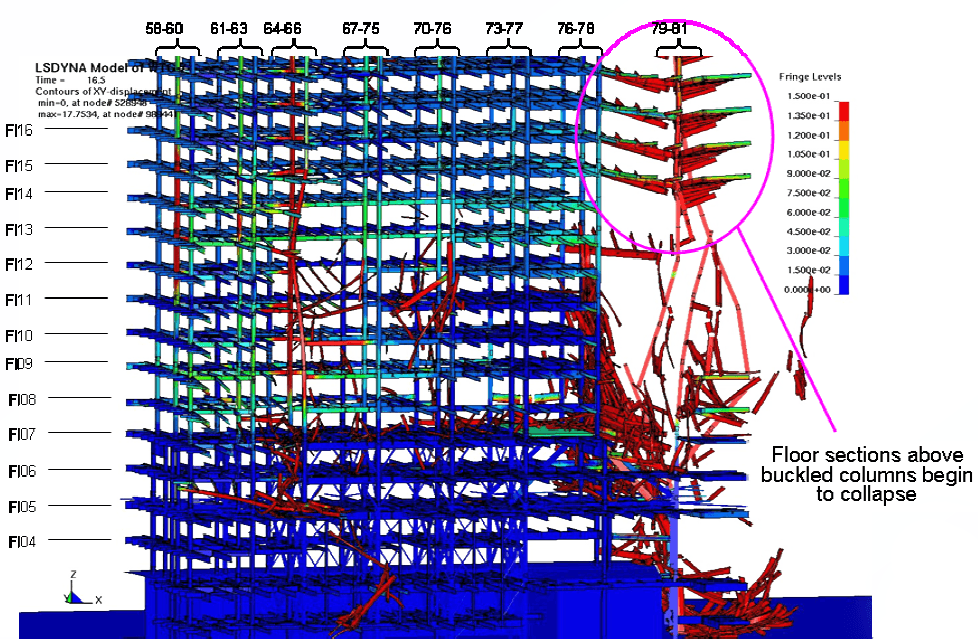
That World Trade Center 7, a 47-story tower not struck by any aircraft, could not have collapsed from fire alone and was instead brought down by a controlled demolition using pre-planted explosives or incendiaries. Proponents point to the collapse's speed and symmetry, a measured period of free-fall acceleration, a BBC broadcast that reported the collapse before it happened, and leaseholder Larry Silverstein's remark that the decision was made to 'pull it,' arguing that together these show the building was deliberately destroyed and the truth concealed.
Contradicted. The claim that WTC 7 was demolished with pre-planted explosives is contradicted by the physical and engineering record. The building was struck by debris from the North Tower and burned uncontrolled for about seven hours with no water to fight the fires; NIST's three-year investigation traced the collapse to fire-driven thermal expansion that failed a critical column, and found no blast sounds, no explosive residue, and no acoustic signature of demolition. The specific talking points (the seconds of free fall, the BBC's premature report, Larry Silverstein's 'pull it' remark) each have documented, non-conspiratorial explanations. Rated debunked.
Believed by: The WTC 7 collapse is the single most-cited pillar of the 9/11 'inside job' movement, popularized in the slogan 'WTC 7 never fell for that.' Belief in the specific demolition claim is a minority position but a durable one, sustained by activist groups such as Architects & Engineers for 9/11 Truth and by the counterintuitive video of the collapse, which many people encounter for the first time online years after the attacks.
The full story
The third building that fell
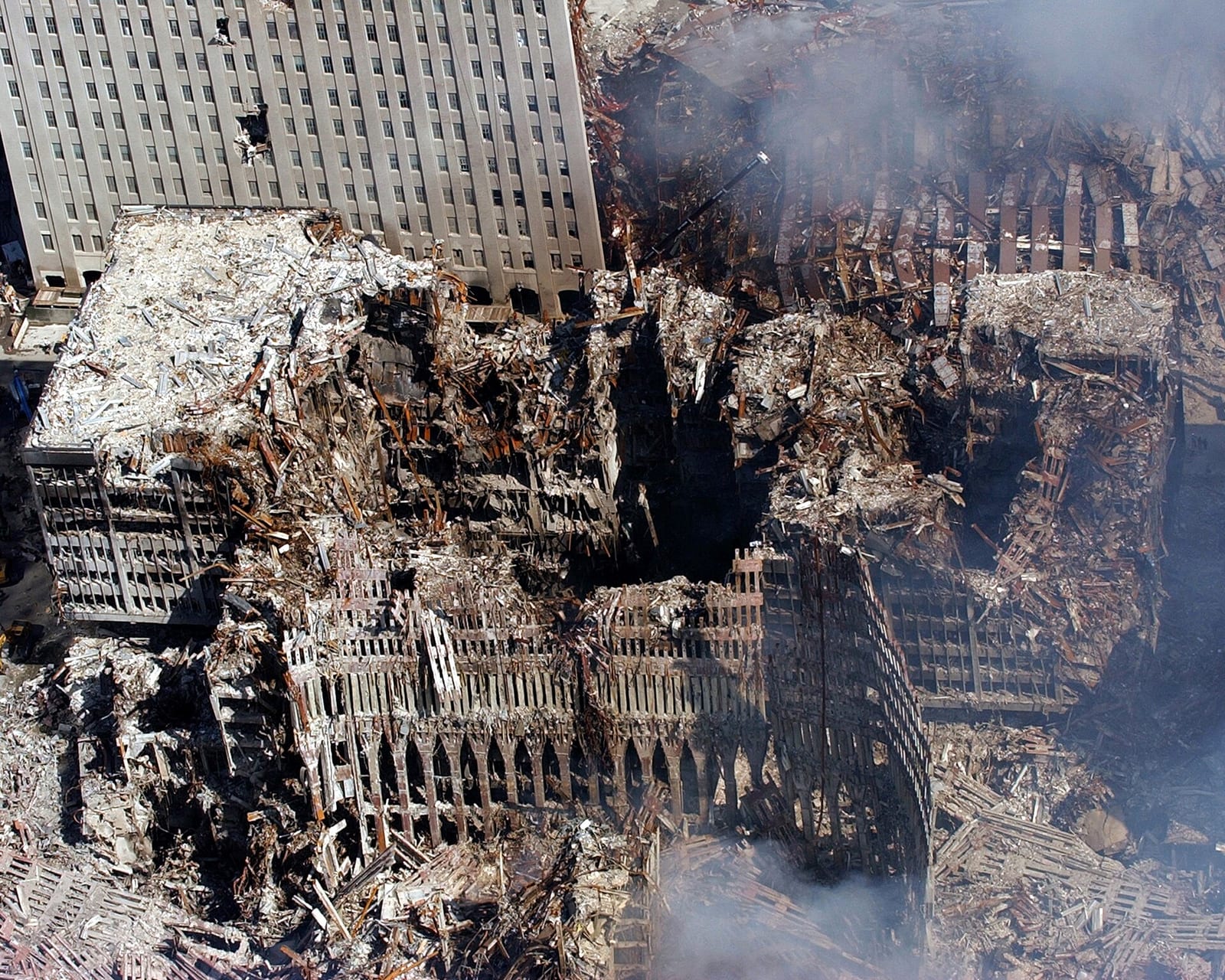
At 5:20 p.m. on 11 September 2001, about seven hours after the Twin Towers had come down, a third World Trade Center skyscraper collapsed. It was Building 7, a 47-story tower across a street from the North Tower's footprint. No aircraft had struck it. It had been evacuated, so no one was killed when it fell, and in the overwhelming grief and chaos of that afternoon its collapse passed almost unnoticed in the public memory of the day.
That obscurity is exactly what would later make WTC 7 the single most powerful exhibit in the argument that 9/11 was an inside job. The claim examined in this file is specific: not that the whole day was staged (our umbrella file on the 9/11 inside-job theory takes on the broader thesis), but that this one building, untouched by any plane, was brought down by a controlled demolitionrather than by fire. In movement shorthand, “WTC 7 never fell for that.” If a skyscraper no plane hit came down in a demolition, the reasoning goes, then someone rigged it in advance, and the official story is a lie.
The discipline this file tries to keep is to separate what is documented from what is claimed. It is documented that WTC 7 was gouged by debris from the collapsing North Tower, that it burned uncontrolled for hours with no water to fight the fires, and that federal engineers spent years reconstructing exactly how it failed. What is claimed, and what is rated here, is that explosives did the work instead. On the physical and engineering record, that claim is not merely unproven; it is contradicted.
What the demolition claim asserts
Stated at its strongest, the case for demolition is not frivolous, and dismissing it without engagement explains nothing about why it endures. It rests on a small set of observations, each of which genuinely gives a thoughtful person pause the first time they meet it.
The centerpiece is the video. WTC 7's collapse is smooth, symmetrical, and vertical: the roofline drops almost as a single object, straight down into the building's footprint. To an eye trained on controlled-demolition footage, it looks like a controlled demolition. And proponents can point to something NIST itself conceded: for roughly 2.25 seconds, the building's north face fell at literal free-fall acceleration, as though nothing at all were beneath it to slow it down. A building crushing its own structure on the way down should decelerate; free fall, however briefly, seems to mean there was nothing left to resist.
To an eye trained on demolition footage, the fall of Building 7 looks like a demolition. That resemblance is the engine of the entire claim.
Then come the quotes and the coincidences. In a 2002 PBS documentary, leaseholder Larry Silversteinrecalled that, after the day's terrible losses, he told the fire department “maybe the smartest thing to do is pull it,” and that “they made that decision to pull, and we watched the building collapse.” To many ears, “pull it” sounded like demolition jargon and like an admission. Separately, the BBCreported WTC 7's collapse more than twenty minutes before it happened, the still-standing tower visible in the shot behind the reporter, which looked to proponents like proof the outcome was known in advance. Add the fact that this was, by NIST's own account, the first tall building ever to collapse primarily from fire, and the demolition case assembles itself into something that feels, to many, like a pattern.
What the engineering actually found
WTC 7's collapse was not only a suspicious video; it was an engineering catastrophe the profession needed to understand, because a tall building had never before fallen this way. The National Institute of Standards and Technology spent about three years on it, drawing on recovered steel, thousands of photographs and videos, eyewitness accounts, and detailed structural-fire computer models. Its conclusion is specific, and it does not support demolition.
The conditions were extraordinary. When the North Tower collapsed, its debris tore a gash into WTC 7 and started fires on multiple floors. The building's automatic sprinklers depended on city water mains that had been severed in the wider destruction, so the fires burned essentially unfought for about seven hours. NIST found that this prolonged, uncontrolled heating caused ordinary thermal expansion: steel floor beams lengthened as they heated and pushed a girder off its seat at a critical interior support, column 79. The floors around that column collapsed, leaving it laterally unbraced over many stories; it buckled, the failure propagated across the interior, and only then did the exterior shell, by now an emptied box, come down as the near-uniform object the videos show. This is why “fire can't collapse a skyscraper” misses: nobody claimed the fire melted or vaporized the steel. Heated steel expands and weakens, and expansion at a single vulnerable connection was enough to begin the cascade.
The free fall follows from this account rather than against it. By the time the facade began to drop as a unit, the interior had already failed progressively, out of view; for those two-odd seconds there was almost nothing intact beneath the shell to slow it, so it fell freely until it met resistance below. NIST also addressed demolition head on. It found no blast soundson any audio recording of the collapse and none reported by the many witnesses nearby; by its calculation, the smallest charge capable of failing column 79 would have produced a sound of roughly 130 to 140 decibels half a mile away, impossible to miss and absent from every recording. No explosive residue was found, no charges or wiring were recovered, and the observed collapse does not match a demolition's signature, which begins with a rhythmic sequence of detonations at the base.
The smallest blast capable of failing the critical column would have been heard for half a mile. No recording of the day contains it.
Structural engineers overwhelmingly accept this account. A later reanalysis funded by a 9/11-truth group argued that fire could not explain the collapse, but engineers criticized its modeling choices and it has not displaced the NIST findings. NIST's own shortcomings, its refusal to release the full model files and its choice not to test for residue, are fair criticisms of the investigation's transparency. They are not evidence that explosives were used. A criticism of what investigators declined to do is not a substitute for the physical evidence a demolition would have left behind, and that evidence has never appeared.
The signature talking points, one by one
The demolition case survives less as a single argument than as a bundle of memorable anomalies. Taken individually, each has a documented explanation.
Silverstein's “pull it.”The quote is real, but “pull it” is not standard demolition terminology, and the context points the other way. Silverstein's spokesperson and the fire department have said he was describing the decision to pull the firefighting operation, to withdraw the crews, which matches the documented fact that firefighters had already been pulled back for hours because they had no water and judged the building lost. A high-rise explosive demolition is engineered over weeks; it cannot be arranged over an afternoon while the building burns. We report the remark and its explanation; we do not treat it as a confession, and this file makes no accusation of a crime against any living person.
The BBC's early report. The BBC did announce the collapse before it occurred, with the tower still standing behind the reporter. The cause was a newsroom error on a chaotic day: American networks and wire services had been reporting for over an hour that WTC 7 had collapsed or was about to, the building had been declared in imminent danger and cordoned off, and the BBC relayed a mistaken wire report that Reuters later corrected. A premature report of a collapse that everyone on the scene expected, and that then happened, is an error, not foreknowledge. A plot that leaked the outcome to a newsroom and got the timing wrong would be a strange plot indeed.
The “free-fall seconds.” NIST acknowledged the roughly 2.25-second interval of near free fall and explained it, as above, by the interior structure having already collapsed before the visible shell dropped. Free fall over a couple of seconds is what one expects once the supports beneath a section have been removed by prior internal failure. It is not a fingerprint of cutting charges, which would still have to announce themselves audibly and leave residue, and did neither.
“It had never happened before.” True, and NIST said so: WTC 7 was the first known collapse of a tall building driven primarily by fire. But the conditions were also without precedent, a high-rise raked by debris from a 110-story tower and left to burn for seven hours with no working sprinklers or hoses. An unprecedented outcome from unprecedented conditions is not a paradox requiring explosives to resolve.
Why the belief took hold and endures
If the engineering is this settled, the interesting question is psychological: why does WTC 7 remain the movement's crown exhibit two decades on? The answer is not stupidity. It is a set of features almost tailor-made to seed and sustain doubt.
Start with counterintuitiveness and obscurity. Most people carry no memory of WTC 7 at all, so when they first see the footage it arrives with the force of a secret: a skyscraper no plane touched, folding straight down, that “they never told you about.” The surprise is real, and the failure of the official account to lodge in popular memory the way the towers did leaves a vacuum. The video's surface resemblance to a demolition then does the persuading instantly, before anyone explains why the resemblance is misleading.
Then there is the hesitant early record. FEMA's 2002 study could not fully account for the collapse and candidly rated its best explanation as low-probability; the confident NIST answer did not arrive until 2008. For seven years the government had no settled public explanation for a dramatic event, and doubt is efficient at colonizing a vacuum. By the time the firm answer came, the demolition narrative had a long head start, and later corrections rarely catch the original suspicion.
The theory also keeps hard-looking anchorsthat most conspiracy claims lack: a real Silverstein quote, a real premature BBC broadcast, a real NIST admission of a free-fall interval. Each has a mundane, documented explanation, but each sounds, in isolation, like a smoking gun, and a handful of smoking-gun-shaped facts feels more damning than any one of them is. Finally, WTC 7 rides the credibility of the larger doubt around 9/11. Set against the Iraq War's false pretext and the documented pre-attack intelligence failures, the idea that officials could rig and hide a demolition stopped feeling unthinkable. WTC 7 became the technical exhibit for a suspicion that began as a political one.
Fire, not demolition
The verdict is unhedged on this one. The controlled-demolition claim is not simply unproven; on the physical and engineering evidence it is contradicted. A three-year federal investigation, the recovered steel, the total absence of blast sounds on any recording, the absence of explosive residue, and a worked-out fire-driven mechanism for the collapse all point the same way: WTC 7 came down because debris from the North Tower set it ablaze and it burned unfought for hours until a critical column failed. The building's counterintuitive appearance on video is not evidence that overrides all of that; it is the very thing the evidence explains.
None of this requires pretending the investigation was flawless or the questions frivolous. NIST's refusal to release its full model and its choice not to test for residue are legitimate transparency criticisms, and they are named as open questions here rather than waved away. But a complaint about what investigators declined to do is not a demolition. The affirmative case for explosives, recorded detonations, recovered charges, physical residue, a matching collapse signature, has no support at all, and its signature talking points each dissolve on contact with their documented context.
It is worth holding the two 9/11 verdicts side by side. Our umbrella file rates the broad “inside job” thesis unproven, because its political core rests on intelligence failures that are entirely real even though a plot was never shown. The WTC 7 demolition claim is narrower and harder-edged, and it earns the harder word: debunked. The building fell because it burned. That answer is less dramatic than a hidden hand, and it is the one the evidence carries.
Watch
In pictures
What's still unexplained
- Why did NIST decline to release the full input and output files of its WTC 7 collapse model? NIST cited public-safety concerns about the data, which independent engineers who wanted to check the work found unsatisfying. The refusal is a legitimate transparency criticism of the investigation; it is not, on its own, evidence that the model would have shown anything other than what NIST reported.
- Why did NIST not test the WTC 7 steel or dust for explosive or thermite residue? NIST's position was that its fire-driven collapse mechanism accounted for the observations and that a residue test was not warranted. Critics regard skipping the test as a methodological gap even if the underlying model holds. The decision not to look is a fair complaint; it is not evidence that residue was present.
- How much did the specific structural details of WTC 7 (its long floor spans and the transfer structure over the Con Edison substation beneath it) predispose it to progressive collapse? NIST identified these features as contributing factors, and engineers continue to study how atypical they were. This is a live engineering question about why this building in particular failed, entirely within the fire hypothesis and distinct from any demolition claim.
Point by point
The claim: A steel skyscraper had never collapsed from fire before, and none has since in the same way. WTC 7 coming down from office fires alone is physically impossible; only explosives can explain it.
What the record shows: It is true that WTC 7 was the first known collapse of a tall building driven principally by fire, and NIST said so plainly. But 'unprecedented' is not the same as 'impossible,' and the circumstances were themselves unprecedented. WTC 7 was not an ordinary office fire: it had been gouged by debris from the 110-story North Tower falling next to it, its automatic sprinklers were starved because the city water mains feeding them were broken, and the fires burned unfought for roughly seven hours because firefighters had no water and had withdrawn. NIST's three-year investigation, using recovered evidence, photographs, and detailed structural-fire modeling, found that this prolonged heating caused thermal expansion of floor beams that pushed a girder off its seat at a critical interior column (column 79); the surrounding floors collapsed, leaving that column unbraced over many stories, and it buckled, triggering a progressive collapse. The novelty of the outcome reflects the novelty of the conditions, not a hidden demolition.
The claim: WTC 7 fell at free-fall acceleration, straight down into its own footprint. A building resisting its own collapse cannot fall at the speed of a dropped object; only synchronized cutting charges produce free fall.
What the record shows: This is the movement's strongest single point, and NIST conceded the underlying fact: measuring the north face, NIST acknowledged a stage of descent lasting about 2.25 seconds (some eight stories) during which the exterior fell at essentially gravitational acceleration. That admission came after independent analyst David Chandler pressed NIST on its draft. But NIST's explanation is structural, not evasive. By the time the visible facade began to drop as a unit, the interior columns and floors had already failed progressively, out of camera view; for that brief interval there was little intact structure left beneath the shell to resist it, so it fell freely until it met resistance again below. Free fall over roughly two seconds is consistent with that internal-collapse-first sequence. It is not, by itself, evidence of cutting charges, and the loud, distinctive, rhythmic detonations a demolition of that scale would produce were neither recorded nor reported.
The claim: The BBC reported that WTC 7 had collapsed more than twenty minutes before it actually fell, with the still-standing building visible behind the reporter. They could only have known in advance if the collapse was scripted.
What the record shows: The BBC did report the collapse prematurely, and the building is indeed visible behind the reporter, still standing. The explanation, documented by the BBC and by fact-checkers, is a newsroom error in a chaotic day. From roughly 4:15 p.m., American networks and wire services were reporting that WTC 7 had collapsed or was about to; the building had been declared in imminent danger of collapse for hours, and emergency services had set up a collapse zone around it. The BBC, relaying a mistaken wire report (Reuters later issued a correction), aired the news early. A premature report of a collapse that everyone on the scene expected and that did occur is a mistake, not foreknowledge; if it were evidence of a plot, one would have to explain why the plotters leaked to the BBC and got the timing wrong.
The claim: Leaseholder Larry Silverstein admitted it. In a PBS documentary he said the decision was made to 'pull it,' and 'pull it' is demolition jargon for bringing a building down with explosives.
What the record shows: Silverstein's remark is real, but the demolition reading does not survive context. He recalled telling the fire department commander, after the day's terrible loss of life, that 'maybe the smartest thing to do is pull it,' and 'then they made that decision to pull, and we watched the building collapse.' Silverstein's spokesperson and the fire department have stated he was referring to pulling the firefighting operation, withdrawing the crews, not demolishing the structure, which fits the documented fact that firefighters had already been pulled back for hours because they had no water and judged the building lost. 'Pull it' is not standard terminology for an explosive demolition (controlled demolition of a high-rise is planned over weeks and cannot be arranged in an afternoon), and no one has produced the wiring, charges, or preparation such a demolition would require. This is reported here as a quote with a documented explanation, not as an admission of a crime.
The claim: NIST refused to release its computer model and never tested the debris for explosive or thermite residue. That is what a cover-up looks like.
What the record shows: These are real criticisms of the investigation, and they deserve a straight answer rather than dismissal. NIST declined to release the full input and output files of its structural-fire model, citing 'public safety' concerns about the data, a decision that critics reasonably find unsatisfying and that fuels suspicion. And NIST did not chemically test the steel or dust for explosive residue, its position being that its collapse hypothesis accounted for the observations and that a residue test was therefore not warranted. One can regard both choices as poor methodology or poor public relations. Neither is evidence that residue existed or that a model would have shown demolition. The affirmative case for explosives, physical residue, recorded detonations, recovered charges, still has no support; the complaint is about what the investigators declined to do, not about anything that was found.
Timeline
- 2001-09-11At 5:20 p.m., about seven hours after the North Tower fell, World Trade Center 7 collapses. No aircraft struck it; it had been damaged by falling debris and had burned uncontrolled for hours after firefighters, with no water pressure and other priorities, pulled back and let it go. The building had been evacuated, and no one is killed in its collapse.
- 2002-05FEMA's World Trade Center Building Performance Study (FEMA 403) offers an early, self-described preliminary assessment of WTC 7. Unable to fully explain the collapse with the data then available, it calls fire the probable cause but says the sequence has 'only a low probability of occurrence.' That cautious language becomes an early seed for demolition suspicion.
- 2002-09The PBS documentary America Rebuilds airs, containing leaseholder Larry Silverstein's now-infamous recollection that he and the fire department discussed the situation and that 'maybe the smartest thing to do is pull it.' Demolition proponents later read 'pull it' as an order to demolish the building.
- 2005-2006The viral documentary Loose Change and physicist Steven E. Jones's demolition writings spread online, and Richard Gage founds Architects & Engineers for 9/11 Truth in 2006. WTC 7 becomes the movement's centerpiece, its collapse footage circulated as self-evident proof of demolition.
- 2008-08-21NIST releases its draft report on WTC 7, announcing that uncontrolled fires, not explosives, caused the collapse, the first known instance of a tall building brought down primarily by fire. NIST states it found no evidence of a blast or controlled demolition.
- 2008-11-20NIST publishes the final report (NCSTAR 1A). Responding to public comment, it explicitly acknowledges a roughly 2.25-second stage of near free-fall descent and explains it as a consequence of the interior structure having already failed progressively, out of view, before the exterior shell came down.
- 2011NIST issues an updated 'Questions and Answers' page addressing the recurring talking points directly: why no blast was heard, why the free-fall interval is consistent with fire-induced failure, and why controlled demolition was ruled out.
- 2019-2020A University of Alaska Fairbanks team led by engineer J. Leroy Hulsey publishes a report, funded by Architects & Engineers for 9/11 Truth, arguing that fire could not have produced the collapse. Structural engineers criticize its modeling and assumptions; it does not overturn the NIST findings but keeps the demolition claim in circulation.
From the case file
The actual records: declassified, released, or leaked. We link straight to each document in its official archive, so you never have to take our word for it. Read the originals yourself.
Final Report on the Collapse of World Trade Center Building 7 (NIST NCSTAR 1A)
NIST's final report on WTC 7, the first known collapse of a tall building driven principally by fire. It traces the failure to thermal expansion dislodging a girder at column 79 and the progressive internal collapse that followed, explicitly addresses the roughly 2.25-second near free-fall interval, and finds no evidence of a blast or controlled demolition.
Read the document: NIST Publications →World Trade Center Building Performance Study (FEMA 403)
The early, self-described preliminary engineering assessment issued before the NIST investigation. Unable to fully explain WTC 7 with the data then available, it called fire the probable cause while rating that sequence low-probability; its tentative language became an early seed for demolition suspicion, and the later NIST report superseded it.
Read the document: FEMA (Internet Archive copy) →Other case files that cite the same sources
Contradicted. The claim that WTC 7 was demolished with pre-planted explosives is contradicted by the physical and engineering record. The building was struck by debris from the North Tower and burned uncontrolled for about seven hours with no water to fight the fires; NIST's three-year investigation traced the collapse to fire-driven thermal expansion that failed a critical column, and found no blast sounds, no explosive residue, and no acoustic signature of demolition. The specific talking points (the seconds of free fall, the BBC's premature report, Larry Silverstein's 'pull it' remark) each have documented, non-conspiratorial explanations. Rated debunked.
Reviewed by Colin Peterson · Last reviewed September 3, 2026 · How we rate
Common questions
Is WTC 7 controlled demolition true?
Contradicted. The claim that WTC 7 was demolished with pre-planted explosives is contradicted by the physical and engineering record. The building was struck by debris from the North Tower and burned uncontrolled for about seven hours with no water to fight the fires; NIST's three-year investigation traced the collapse to fire-driven thermal expansion that failed a critical column, and found no blast sounds, no explosive residue, and no acoustic signature of demolition. The specific talking points (the seconds of free fall, the BBC's premature report, Larry Silverstein's 'pull it' remark) each have documented, non-conspiratorial explanations. Rated debunked.
What is WTC 7 controlled demolition?
At 5:20 p.m. on 11 September 2001, some seven hours after the Twin Towers fell, a third World Trade Center skyscraper collapsed: the 47-story Building 7, which no plane had hit. Its smooth, vertical descent, captured on video, became the cornerstone of the argument that 9/11 was an inside job, the claim being that WTC 7 was brought down…
What does the evidence show?
It is true that WTC 7 was the first known collapse of a tall building driven principally by fire, and NIST said so plainly. But 'unprecedented' is not the same as 'impossible,' and the circumstances were themselves unprecedented. WTC 7 was not an ordinary office fire: it had been gouged by debris from the 110-story North Tower falling ne…
Why do people believe it?
A third building fell that most people never knew about. WTC 7 was not hit by a plane, and its collapse, the first of a tall building driven mainly by fire, looks jarringly like a demolition on video: smooth, symmetrical, straight down. For many, seeing it for the first time is the moment doubt sets in, precisely because it is so counter…
What is still unresolved?
Why did NIST decline to release the full input and output files of its WTC 7 collapse model? NIST cited public-safety concerns about the data, which independent engineers who wanted to check the work found unsatisfying. The refusal is a legitimate transparency criticism of the investigation; it is not, on its own, evidence that the model…
Sources
- 1.Questions and Answers about the NIST WTC 7 Investigation, National Institute of Standards and Technology (2011)
- 2.NIST WTC 7 Investigation Finds Building Fires Caused Collapse, National Institute of Standards and Technology (2008)
- 3.Final Report on the Collapse of World Trade Center Building 7 (NIST NCSTAR 1A), National Institute of Standards and Technology (2008)
- 4.Twenty-Four Years Later, 9/11 Conspiracies Persist. The Real Science Ends the Debate., Popular Mechanics (Hearst) (2025)
- 5.No, the Owner of WTC Building 7 Didn't 'Admit' It Was Demolished After 9/11, Snopes (2020)
- 6.Error in BBC reporting doesn't mean 9/11 was scripted, Full Fact (2018)
- 7.A BBC reporting error is not proof the network was part of an 'inside job' on 9/11, Poynter Institute (2021)
- 8.World Trade Center controlled demolition conspiracy theories, Wikipedia (2026)
- 9.The 9/11 Commission Report: Final Report of the National Commission on Terrorist Attacks Upon the United States, U.S. Government Publishing Office (GovInfo) (2004)
Embed this verdict on your site
Paste this snippet to show our sourced verdict as a small card, with a link back to the full case file. Free to use.
<iframe src="https://theconspiratory.com/embed/wtc-building-7" title="The Conspiratory verdict" width="520" height="190" style="border:0;max-width:100%" loading="lazy"></iframe>Help us investigate
This is a living case file. If you spot an error or know evidence we missed, tell us, and weigh in on where you land.
Where do you land?
Cast your read on this one.
Comments
Add your take. Comments are read and approved by a human before they appear, so keep it on topic and civil. Please do not accuse named, living people of crimes.