American Airlines Flight 77 did not hit the Pentagon on 9/11: the damage was caused by a missile, a drone, or a smaller aircraft
By Colin PetersonJuly 20, 2026
Where the evidence lands: Contradicted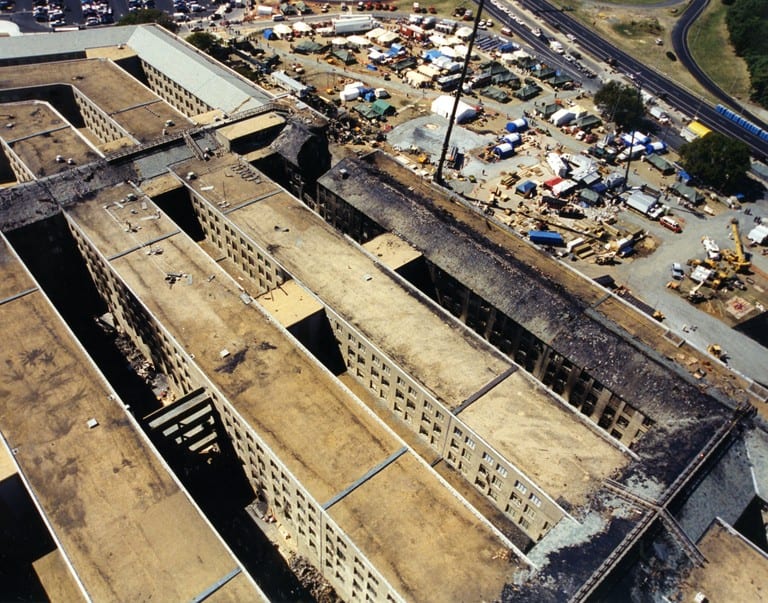
That American Airlines Flight 77 did not crash into the Pentagon on 11 September 2001, and that the damage and fire were produced instead by something else: a guided missile, a military drone, an A-3 Skywarrior or other small aircraft, or a pre-planted charge. In this telling the entry hole was too small for a Boeing 757, there was too little recognizable aircraft wreckage on the lawn, and the government suppressed the surveillance footage that would have shown the truth, all pointing to a staged event rather than a hijacked airliner.
Contradicted. An unusually large and varied evidentiary record runs against this one. American Airlines Flight 77, a Boeing 757, struck the Pentagon at 9:37 a.m. on 11 September 2001. More than a hundred eyewitnesses saw a large jetliner hit the building; the remains of nearly everyone aboard and inside were identified by DNA; recovered debris matched a 757; five approach light poles were sheared off along the flight path; the flight-data recorder was retrieved; and the American Society of Civil Engineers reconstructed the impact in detail. The 'missile' thesis rests on misread photographs and a wrong intuition about how a thin-skinned airliner damages a reinforced building.
Believed by: The 'no plane at the Pentagon' idea is a durable sub-strand of 9/11 doubt rather than a majority view. It was seeded internationally in 2002 by French author Thierry Meyssan and pushed into the English-speaking mainstream by the 2005 internet film Loose Change and the 'Hunt the Boeing' website. Surveys have repeatedly found sizeable minorities doubting the official 9/11 account overall; the specific Pentagon-missile claim commands a smaller but persistent following within that audience.
The full story
What is documented, and what is claimed
Begin with the part that is settled, because 189 people died in it. At 9:37 a.m. on 11 September 2001, American Airlines Flight 77, a Boeing 757 hijacked shortly after leaving Washington Dulles, was flown into the western face of the Pentagon. All 64 people aboard (53 passengers, 6 crew, and 5 hijackers) were killed, along with 125 people working inside the building. About twenty minutes after impact, a section of the outer rings collapsed. This case file is the specific companion to our broader file on the 9/11 “inside job” theory; where that one surveys the whole family of claims, this one takes up a single technical assertion about the Pentagon and tests it.
The claim is that none of that happened as described: that no large airliner hit the Pentagon at all, and that the damage was caused instead by a cruise missile, a military drone, a small jet such as an A-3 Skywarrior, or a planted charge, with Flight 77 spirited away and the scene dressed to look like a crash. It was seeded internationally in 2002 by the French writer Thierry Meyssan, packaged for the web by the “Hunt the Boeing!” quiz, and carried to a mass audience by the film Loose Change. Three talking points do almost all the work: the entry hole was “too small,” there was “no plane debris,” and the government “hid the video.” Each is examined below.
The discipline this file keeps is the one the whole site keeps: separate the documented record from the rated claim. That Flight 77 struck the Pentagon is documented from many independent directions at once. That a missile did it is a claim, and on the evidence it is false.
Why the early photos looked confusing
The claim did not come from nowhere, and it is worth stating its strongest form honestly. In the first hours, the images that circulated were a low-resolution security frame and a scatter of ground-level shots taken beforethe upper floors collapsed. They show a facade that looks oddly intact, a punched impact zone that does not trace a neat airplane outline, and a lawn without a fuselage lying on it. If those few frames are all you see, the reaction “that cannot be a 155-foot jetliner” is not stupid. It is the honest response of someone applying a cartoon intuition, that a plane leaves a plane-shaped hole and a plane-shaped wreck, to a scene that does not match the cartoon.
If the only images you ever see are the cropped ones, the missing airliner feels like a discovery. The trick is in the cropping.
The “Hunt the Boeing!” presentation sharpened that instinct into a method: here are the photos, it said, now you find the 757. Framed that way, the absence of an obvious airliner in a handful of selected pictures reads as an empirical finding the viewer makes for themselves. That is genuinely persuasive, and pretending it is not explains nothing about why the claim spread. The answer to it is not ridicule. It is the rest of the evidence, and an accurate picture of what actually happens when an aluminum tube meets a hardened building.
The 'small hole' and the 'missing' debris
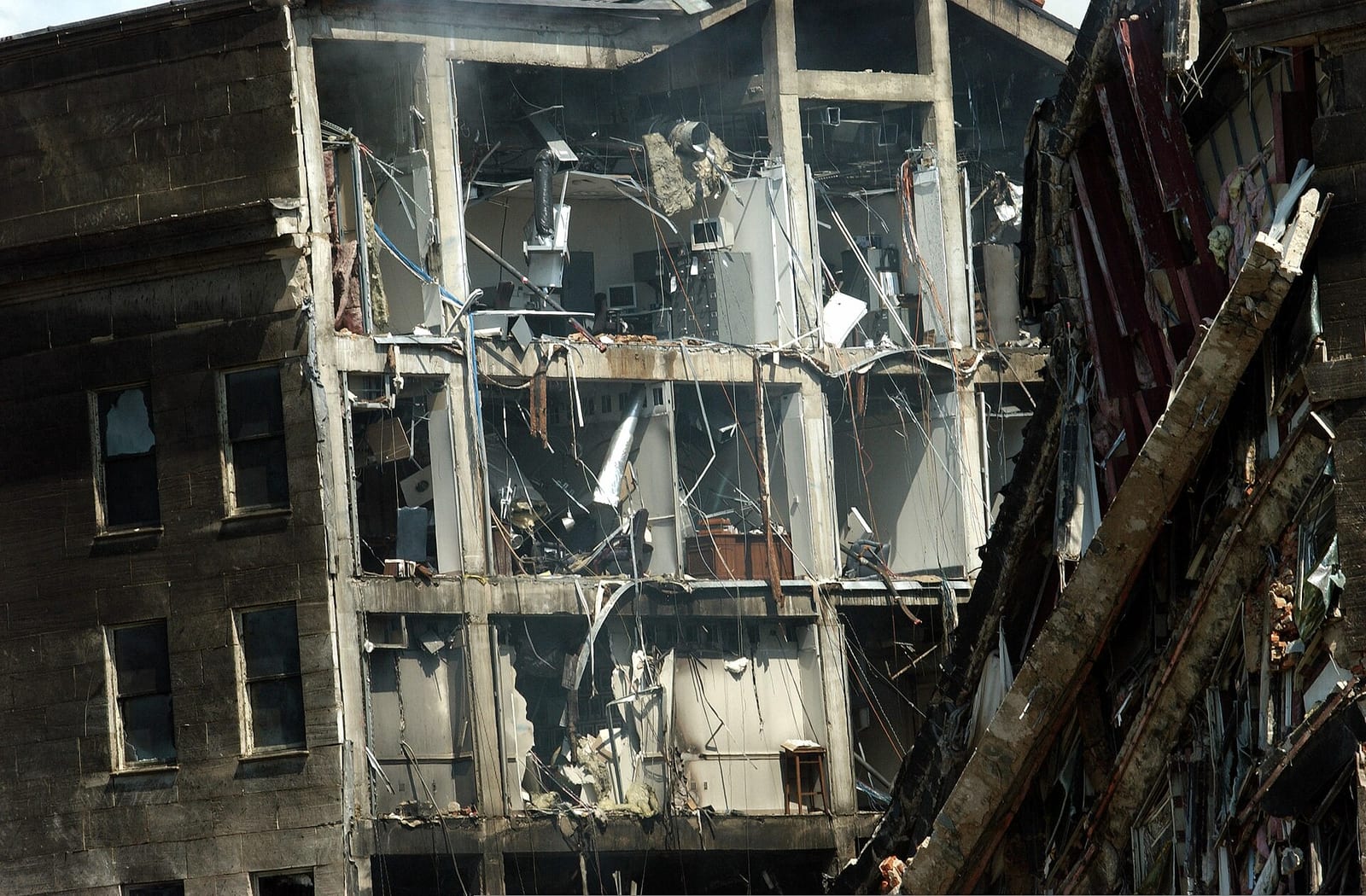
Start with the hole, because the whole claim leans on it. The frequently reproduced “16-foot” opening is a punch-through in an inner ring, photographed later, not the damage to the outer facade. The American Society of Civil Engineers, whose Pentagon Building Performance Report is the detailed structural study of the crash, found that the aircraft destroyed or impaired roughly 50 columns along a swath about 75 feet wideon the first floor, far larger than the tidy circle skeptics point to. A thin-skinned airliner does not stamp its own silhouette into reinforced concrete. The wings and tail carry little dense mass and shattered and burned against the wall; the fuselage, engines, and landing gear, the dense parts, drove inward. Because a 757's wings sweep back toward the tail, they meet the wall close to the fuselage line, so the concentrated damage is narrower than the full 125-foot span. A clean, wing-shaped gash would have been the thing requiring explanation.
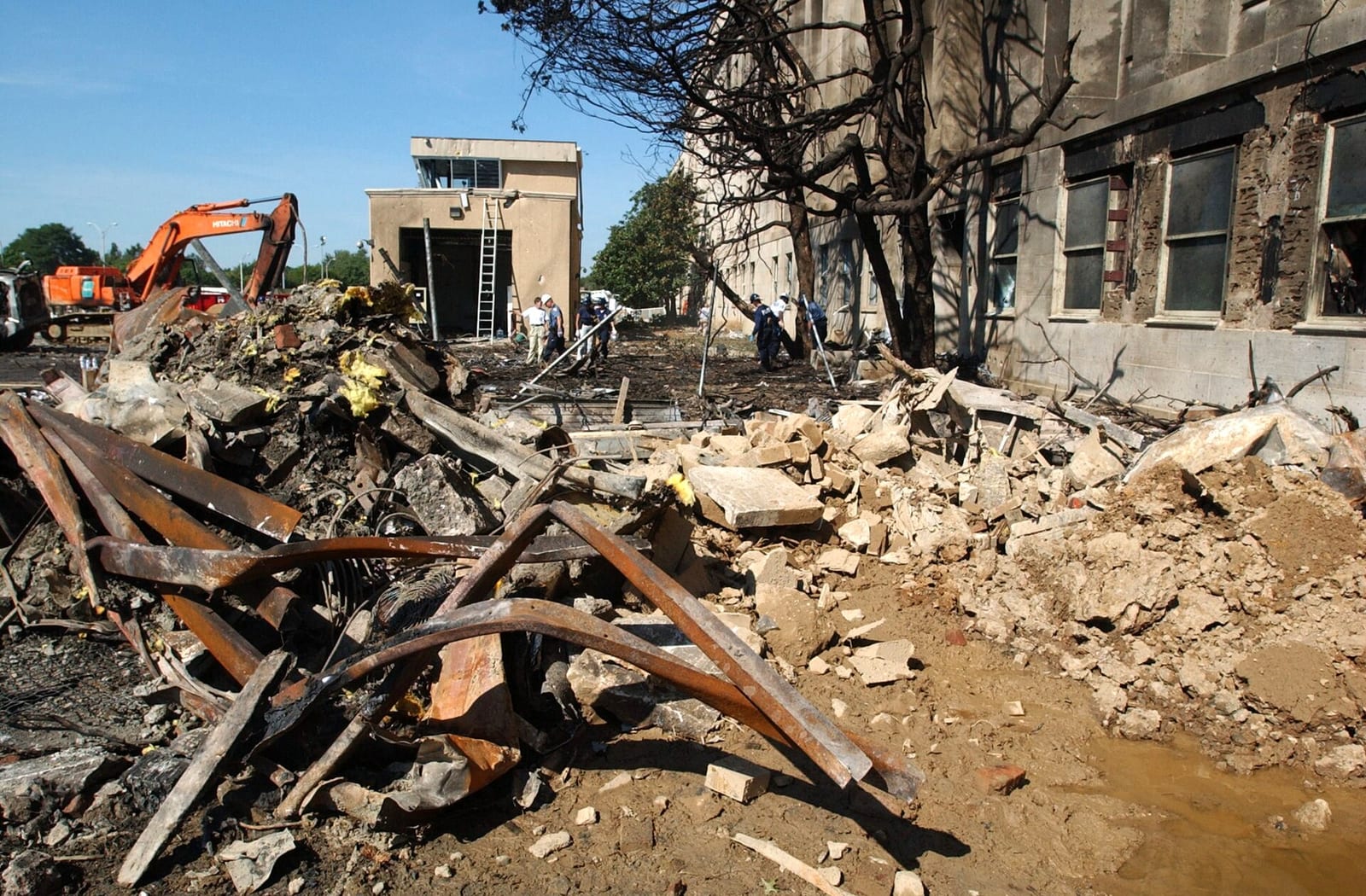
Now the debris. The premise that there was none is simply false; it survives only through cropping. First responders and a structural engineer at the scene described handling aircraft parts bearing airline markings, including a section of tail. The site yielded fuselage skin, wheels and landing-gear parts, and engine components consistent with a Boeing 757. Much of the airframe was consumed by the impact and the intense jet-fuel fire, and much of what survived went intothe building rather than onto the lawn, which is exactly why the exterior looks deceptively clean in photographs taken before the upper floors came down. The “where is the plane” question has an answer: largely inside the Pentagon, in fragments, mixed with the wreckage of three collapsed floors.
A 757 does not bounce off a building and leave a whole airplane on the grass. It goes in, and it comes apart.
Then there is the evidence that has nothing to do with interpreting a photograph. Five light poles on the highway approach were sheared off along the precise line a descending jet would follow, one of them driven through the windshield of a taxi. A large body of eyewitnesses, more than a hundred, many of them commuters stopped in traffic beside the building, saw a twin-engine airliner in American Airlines colors hit the Pentagon. The flight-data recorder was recovered from the wreckage, and its data lines up with air-traffic radar and with phone calls placed from the plane by flight attendant Renee May and passenger Barbara Olson. None of that depends on how a low-resolution frame is read.
The people aboard, and the video
The most decisive evidence is also the most human, and it deserves to be stated plainly and with care. The Office of the Armed Forces Medical Examiner identified the remains of 184 of the 189 peoplewho died at the Pentagon, using DNA analysis, fingerprints, and dental records. Those identified include the passengers and crew of Flight 77 and, separately catalogued, the five hijackers. Families of the passengers gave DNA reference samples from combs and toothbrushes so their relatives could be matched. Five people could not be identified given the severity of the fire, a real and painful limit, but the people said by the theory to have been “never accounted for” were, in the great majority, positively identified from remains recovered inside the building they were flown into. That fact alone places the airliner at the Pentagon.
The video complaint is the softest of the three, though it is the one that most fuels suspicion. The cameras positioned to see the impact were mostly parking-lot and perimeter-security units recording at a few frames per second, nowhere near fast enough to freeze a jet moving over 500 miles per hour into a recognizable shape. Some footage was held as evidence during the prosecution of Zacarias Moussaoui. The Department of Defense released its own low-rate frames in 2006 after a Freedom of Information Act lawsuit, and predictably they are blurry, because the camera was bad, not because there was nothing to film. A withheld tape and a bad tape look identical to someone determined to see a cover-up; the difference is whether the rest of the record has an airliner in it, and it does.
Set against all of this, the missile thesis has to carry a burden it never shoulders. It must explain away, in a single coordinated fabrication, the radar track, the physical flight recorder, the sheared light poles, the recovered 757 parts, the more-than-a-hundred witnesses, and the DNA identification of 184 people, each consistent with the others and with Flight 77. No such fabrication has ever been shown, and the simplest account that fits every strand is the one the record already tells: a hijacked Boeing 757 hit the Pentagon.
Flight 77 was there
The verdict here is not hedged. On the physical, forensic, and eyewitness evidence, the claim that a missile, drone, or small aircraft rather than American Airlines Flight 77 struck the Pentagon is debunked. The “too small” hole is a misread photograph of an inner wall; the “missing” debris was recovered, catalogued, and matched to a 757; the “hidden” video is a slow security camera; and the people said to be unaccounted for were identified by DNA. Every independent line of evidence, the airframe parts, the light poles, the flight recorder, the radar, the calls from the plane, the remains, converges on one aircraft.
It is worth being precise about what this file does and does not settle, because the broader 9/11 debate contains claims of very different strength. Our companion file rates the wider “inside job” theory as unproven, because its orchestration sub-claim, whatever one makes of it, sits atop real and documented pre-attack intelligence failures. The Pentagon-missile claim is a different animal. It is a specific, testable, physical assertion, and it fails the test. There is no honest “unproven” to retreat to when the wreckage was recovered and the dead were named.
Sixty-four people were aboard that plane, and 125 more were at their desks. They are not served by a story that turns them into props in a staged event, nor by cropped photographs that make a real airliner vanish. The most careful thing that can be said about the Pentagon on 9/11 is also the plainest: Flight 77 was there, and the evidence for it is overwhelming.
Watch
In pictures
What's still unexplained
- Why did the government not release clearer footage sooner? The best answer is mundane, that the well-placed cameras were low-frame-rate security devices never meant to capture a jet, and that some footage was held as evidence during the Moussaoui prosecution, but the years-long delay and the FOIA fight to pry the tapes loose did real damage to public trust and handed the theory a talking point it did not need to earn.
- How reliable are eyewitness accounts of a two-second event? A handful of witnesses gave descriptions that varied in detail, and a small number were later cited by proponents as supporting a different flight path. The large majority independently described a large American Airlines jet striking the building; the ordinary variation among traumatized witnesses to a split-second event is not evidence of a different aircraft, but it is a genuine limit on eyewitness precision.
- Why were five of the 189 Pentagon dead never identified? Five people could not be matched from the recovered remains given the severity of the fire and impact. This is a real and painful limit of the forensic effort, not a sign the plane was elsewhere; 184 identifications, including the Flight 77 passengers and crew, place the airliner at the scene beyond serious doubt.
Point by point
The claim: The entry hole was far too small for a Boeing 757. Photos show a punctured area only about 16 feet across, which fits a missile, not a 155-foot airliner with a 125-foot wingspan.
What the record shows: This misreads both the photographs and the physics. The frequently cited 'small' hole is the punch-through in an inner ring photographed after the fact, not the initial impact damage to the outer facade. The American Society of Civil Engineers found that the aircraft destroyed or impaired roughly 50 columns across a swath about 75 feet wide on the first floor, and that the impact area on the outer wall was far larger than the tidy circle skeptics point to. A thin-skinned airliner does not stamp an airplane-shaped silhouette into a reinforced masonry-and-concrete building. The wings and tail, which hold little that is dense, largely shredded and burned against the facade, while the denser fuselage, engines, and landing gear drove inward. The swept-back wings meet the wall close to the fuselage line, so the concentrated damage is narrower than a full wingspan. A clean, wing-shaped gash would actually have been the anomaly.
The claim: There was almost no plane debris. If a 757 crashed there, the lawn would have been covered in recognizable wreckage; instead the photos show a nearly intact facade and little airplane.
What the record shows: Debris was recovered and identified. First responders and a structural engineer who reached the scene described picking up aircraft parts with airline markings and holding a section of the tail; photographs from the site show fuselage skin, wheel and landing-gear components, and engine parts consistent with a Boeing 757. Much of the airframe, aluminum and composites, was destroyed by the impact and the intense fuel fire, and a great deal of it went inside the building rather than scattering on the lawn, which is why the exterior looks deceptively intact in early frames taken before the upper floors collapsed. The 'no debris' claim leans almost entirely on selectively cropped photographs; the fuller photographic record, and the physical parts recovered and catalogued, show the opposite.
The claim: The 64 people supposedly aboard Flight 77 were never accounted for at the Pentagon, which shows the plane was elsewhere.
What the record shows: The forensic record is decisive and, for the families, personal. The Office of the Armed Forces Medical Examiner identified the remains of 184 of the 189 people who died at the Pentagon, using DNA analysis, fingerprints, and dental records, including the passengers and crew of Flight 77 and, separately, the five hijackers. Families of those aboard provided DNA reference samples from household items to enable the matches. Passengers made phone calls from the hijacked aircraft before it hit, among them flight attendant Renee May and passenger Barbara Olson. The people aboard Flight 77 were not disappeared; the majority were positively identified from remains recovered inside the Pentagon.
The claim: No credible footage shows a plane, and the government seized and hid the surveillance videos, which it would only do to conceal that there was no airliner.
What the record shows: The premise is weaker than it sounds. More than a hundred eyewitnesses, many of them stuck in traffic on the adjacent highways, saw a large twin-engine jetliner in American Airlines livery descend and strike the building, and several watched it clip and snap the highway light poles on its approach path. Five poles were knocked down along the exact line a descending 757 would follow, one of them spearing a taxi. Cameras positioned to record the impact were mostly not aimed at the sky; the parking-security and hotel cameras that captured anything did so at a few frames per second, too slow to freeze a jet moving over 500 miles per hour into a clean image. The Department of Defense released its own low-rate footage in 2006 after a FOIA suit. Blurry frames from a parking camera are the signature of a bad camera angle, not proof of a missile.
The claim: The Pentagon's flight recorders and radar prove nothing, and could have been faked to plant Flight 77 at the scene.
What the record shows: Flight 77's flight-data recorder was recovered from the wreckage inside the Pentagon, and its data, together with air-traffic-control radar and the recorded final phone calls, traced a continuous path for the aircraft from its hijacking over Ohio to its final turn and descent into the building's west face. The National Transportation Safety Board produced a flight-path study from the recorder. To sustain the missile thesis one must posit not a single fabrication but a seamlessly coordinated one spanning radar archives, a physical recorder, dozens of independent eyewitnesses, the light-pole damage, the recovered airframe parts, and the DNA identifications of 184 people, all consistent with one another and with a 757. No such fabrication has ever been evidenced.
Other readings
Angles that don't fit neatly into the claim or its rebuttal, laid out and weighed, not endorsed.
The reinforced-section coincidence
Proponents note that Flight 77 struck a wedge of the Pentagon that had just been renovated and structurally reinforced, and read the timing as suspicious, as if the impact point were chosen to limit casualties and betray inside knowledge. The reinforcement is real and did reduce the death toll, but the hijackers had no way to steer to a specific first-floor wedge on a shallow, high-speed approach, and treating a lucky consequence of an ongoing renovation program as evidence of design inverts cause and effect. It is a coincidence with a documented, mundane origin, not a clue.
Timeline
- 2001-09-11American Airlines Flight 77, a Boeing 757 hijacked after departing Washington Dulles for Los Angeles, is flown into the western face of the Pentagon at 9:37 a.m. All 64 aboard (53 passengers, 6 crew, and 5 hijackers) and 125 people inside the building are killed. A section of the outer rings collapses about 20 minutes after impact.
- 2001-09In the first hours, low-resolution frames from a Pentagon security camera and a handful of ground-level photos circulate. Because the wings and tail had largely disintegrated against the facade and the upper floors had not yet collapsed, the early images show a relatively contained impact area and little intact fuselage on the lawn. To untrained eyes this looks incongruous for a 155-foot airliner, and the confusion becomes raw material for later claims.
- 2002-03French author Thierry Meyssan publishes L'Effroyable Imposture (The Big Lie / The Frightening Fraud), arguing no airliner hit the Pentagon and that a missile or truck bomb caused the damage. It becomes a bestseller in France and exports the 'no plane' thesis worldwide.
- 2002The 'Hunt the Boeing!' web quiz appears, presenting cropped photographs and daring readers to 'find' 757-sized wreckage. Its framing, that the absence of an intact plane in selected images proves no plane was there, sets the template for the entire claim.
- 2003-01The American Society of Civil Engineers publishes The Pentagon Building Performance Report, a detailed structural study of the crash. It documents the aircraft impact, estimates that the airframe destroyed or impaired roughly 50 first-floor columns along a path about 75 feet wide, and credits the building's reinforced design with limiting the collapse and loss of life.
- 2004-07The 9/11 Commission Report lays out Flight 77's hijacking and course in detail, drawing on air-traffic data, phone calls from the plane, and the recovered flight-data recorder, and identifies the five hijackers aboard.
- 2005-2006The internet documentary Loose Change spreads virally and repackages the Pentagon claims, the 'small hole,' the missing debris, the withheld tapes, for a mass online audience, cementing them in popular conspiracy culture.
- 2006-05After a Freedom of Information Act lawsuit, the Department of Defense releases Pentagon security-camera footage of the impact. The low frame rate does not resolve the fast-moving airliner clearly, which proponents treat as confirmation of a cover-up rather than as the limitation of a parking-lot camera.
From the case file
The actual records: declassified, released, or leaked. We link straight to each document in its official archive, so you never have to take our word for it. Read the originals yourself.
The Pentagon Building Performance Report
The detailed structural-engineering study of the Pentagon crash. It documents the aircraft impact, estimates that the airframe destroyed or impaired roughly 50 first-floor columns along a path about 75 feet wide, and attributes the limited collapse to impact damage plus fire, crediting the building's continuity and redundancy with saving lives. Its findings directly contradict the 'too small a hole' and 'no plane' claims.
Read the document: NIST catalogue record →The 9/11 Commission Report: Final Report of the National Commission on Terrorist Attacks Upon the United States
The authoritative public account of the al-Qaeda plot, including Flight 77's hijacking, its course reconstructed from radar and the recovered flight-data recorder, the phone calls placed from the aircraft, and the identification of the five hijackers aboard.
Read the document: U.S. Government Publishing Office (GovInfo) →Other case files that cite the same sources
Contradicted. An unusually large and varied evidentiary record runs against this one. American Airlines Flight 77, a Boeing 757, struck the Pentagon at 9:37 a.m. on 11 September 2001. More than a hundred eyewitnesses saw a large jetliner hit the building; the remains of nearly everyone aboard and inside were identified by DNA; recovered debris matched a 757; five approach light poles were sheared off along the flight path; the flight-data recorder was retrieved; and the American Society of Civil Engineers reconstructed the impact in detail. The 'missile' thesis rests on misread photographs and a wrong intuition about how a thin-skinned airliner damages a reinforced building.
Reviewed by Colin Peterson · Last reviewed September 3, 2026 · How we rate
Common questions
Is Pentagon 'missile', not Flight 77 true?
Contradicted. An unusually large and varied evidentiary record runs against this one. American Airlines Flight 77, a Boeing 757, struck the Pentagon at 9:37 a.m. on 11 September 2001. More than a hundred eyewitnesses saw a large jetliner hit the building; the remains of nearly everyone aboard and inside were identified by DNA; recovered debris matched a 757; five approach light poles were sheared off along the flight path; the flight-data recorder was retrieved; and the American Society of Civil Engineers reconstructed the impact in detail. The 'missile' thesis rests on misread photographs and a wrong intuition about how a thin-skinned airliner damages a reinforced building.
What is Pentagon 'missile', not Flight 77?
At 9:37 a.m. on 11 September 2001, American Airlines Flight 77 was flown into the western face of the Pentagon, killing all 64 people aboard the Boeing 757 and 125 people inside the building, 189 deaths in all. Within months a counter-narrative spread: that no large plane hit the Pentagon at all, and that the damage was really caused by…
What does the evidence show?
This misreads both the photographs and the physics. The frequently cited 'small' hole is the punch-through in an inner ring photographed after the fact, not the initial impact damage to the outer facade. The American Society of Civil Engineers found that the aircraft destroyed or impaired roughly 50 columns across a swath about 75 feet w…
Why do people believe it?
The earliest images genuinely were confusing. Taken before the upper floors collapsed and framed to exclude the debris field, they show a strangely contained impact for so large a plane. A person encountering only those photos, with no sense of how an aluminum airframe behaves against reinforced concrete, can reach the 'that can't be a 7…
What is still unresolved?
Why did the government not release clearer footage sooner? The best answer is mundane, that the well-placed cameras were low-frame-rate security devices never meant to capture a jet, and that some footage was held as evidence during the Moussaoui prosecution, but the years-long delay and the FOIA fight to pry the tapes loose did real dam…
Sources
- 1.A Boeing 757 Really Did Hit the Pentagon. The Evidence Shatters Every Myth., Popular Mechanics (Hearst) (2025)
- 2.The Pentagon Building Performance Report, American Society of Civil Engineers (NIST catalogue record) (2003)
- 3.The investigations: The Pentagon, Civil Engineering / American Society of Civil Engineers (2021)
- 4.Was the 9/11 Pentagon Attack Faked?, Snopes (2016)
- 5.Yes, a plane crashed into the Pentagon on Sept. 11, 2001, PolitiFact (Poynter Institute) (2022)
- 6.The 9/11 Commission Report: Final Report of the National Commission on Terrorist Attacks Upon the United States, U.S. Government Publishing Office (GovInfo) (2004)
- 7.Attack on The Pentagon: 9/11 conspiracy theories debunked, Sky HISTORY (2021)
- 8.Remains Unidentified For 5 Pentagon Victims, The Washington Post (2001)
- 9.Seven Resources Debunking 9/11 Conspiracy Theories, Council on Foreign Relations (2021)
Embed this verdict on your site
Paste this snippet to show our sourced verdict as a small card, with a link back to the full case file. Free to use.
<iframe src="https://theconspiratory.com/embed/pentagon-9-11-missile" title="The Conspiratory verdict" width="520" height="190" style="border:0;max-width:100%" loading="lazy"></iframe>Help us investigate
This is a living case file. If you spot an error or know evidence we missed, tell us, and weigh in on where you land.
Where do you land?
Cast your read on this one.
Comments
Add your take. Comments are read and approved by a human before they appear, so keep it on topic and civil. Please do not accuse named, living people of crimes.